Why do the paintings and poetry of the Italian Renaissance—a celebration of classical antiquity—also depict the Florentine countryside populated with figures dressed in contemporary silk robes and fleur-de-lys crowns? Upending conventional interpretations of this well-studied period, Charles Dempsey argues that a fusion of classical form with contemporary content, once seen as the paradox of the Renaissance, can be better understood as its defining characteristic.
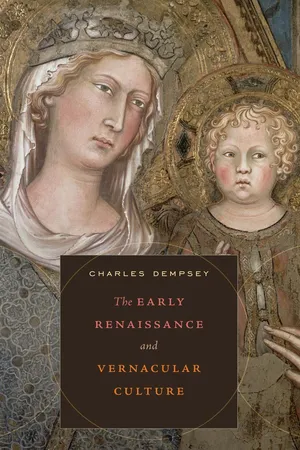
Dempsey describes how Renaissance artists deftly incorporated secular and popular culture into their creations, just as they interwove classical and religious influences. Inspired by the love lyrics of Parisian troubadours, Simone Martini altered his fresco Maestà in 1321 to reflect a court culture that prized terrestrial beauty. As a result the Maestà scandalously revealed, for the first time in Italian painting, a glimpse of the Madonna's golden locks. Modeled on an ancient statue, Botticelli's Birth of Venus went much further, featuring fashionable beauty ideals of long flowing blonde hair, ivory skin, rosy cheeks, and perfectly arched eyebrows. In the only complete reconstruction of Feo Belcari's twelve Sybilline Octaves, Dempsey shows how this poet, patronized by the Medici family, was also indebted to contemporary dramatic modes. Popularizing biblical scenes by mixing the familiar with the exotic, players took the stage outfitted in taffeta tunics and fanciful hats, and one staging even featured a papier maché replica of Jonah's Whale. As Dempsey's thorough study illuminates, Renaissance poets and artists did not simply reproduce classical aesthetics but reimagined them in vernacular idioms.
- 399 pages
- English
- PDF
- Available on iOS & Android
eBook - PDF
The Early Renaissance and Vernacular Culture
About this book
Information
Table of contents
- Contents
- List of Illustrations
- Acknowledgments
- Introduction
- 1. Courtly Lyric I: Simone Martini, French Courtly Lyric, and the Vernacular
- 2. Courtly Lyric II: Sandro Botticelli and Poliziano: Humanist Learning and the Vernacular
- 3. Civic Ritual I: Cardinal Orsini’s Paintings and Baccio Baldini’s Engravings of the Sibyls: Humanist Learning and Vernacular Drama
- 4. Civic Ritual II: Reconstructing the Vernacular Octaves with the Prophecies of the Twelve Sibyls
- Appendix
- Notes
- Index
Trusted by 375,005 students
Access to over 1.5 million titles for a fair monthly price.
Study more efficiently using our study tools.
Frequently asked questions
Yes, you can cancel anytime from the Subscription tab in your account settings on the Perlego website. Your subscription will stay active until the end of your current billing period. Learn how to cancel your subscription
No, books cannot be downloaded as external files, such as PDFs, for use outside of Perlego. However, you can download books within the Perlego app for offline reading on mobile or tablet. Learn how to download books offline
We are an online textbook subscription service, where you can get access to an entire online library for less than the price of a single book per month. With over 1.5 million books across 990+ topics, we’ve got you covered! Learn about our mission
Look out for the read-aloud symbol on your next book to see if you can listen to it. The read-aloud tool reads text aloud for you, highlighting the text as it is being read. You can pause it, speed it up and slow it down. Learn more about Read Aloud
Yes! You can use the Perlego app on both iOS and Android devices to read anytime, anywhere — even offline. Perfect for commutes or when you’re on the go.
Please note we cannot support devices running on iOS 13 and Android 7 or earlier. Learn more about using the app
Please note we cannot support devices running on iOS 13 and Android 7 or earlier. Learn more about using the app
Yes, you can access The Early Renaissance and Vernacular Culture by Charles Dempsey in PDF and/or ePUB format, as well as other popular books in History & History of Renaissance Art. We have over 1.5 million books available in our catalogue for you to explore.