Holism grows out of the philosophical position that an object or phenomenon is more than the sum of its parts. And yet analysis--a mental process crucial to human comprehension--involves breaking something down into its components, dismantling the whole in order to grasp it piecemeal and relationally. Wading through such quandaries with grace and precision, The Institutions of Meaning guides readers to a deepened appreciation of the entity that ultimately enables human understanding: the mind itself.
This major work from one of France's most innovative philosophers goes against the grain of analytic philosophy in arguing for the view known as anthropological holism. Meaning is not fundamentally a property of mental representations, Vincent Descombes says. Rather, it arises out of thought that is holistic, embedded in social existence, and bound up with the common practices that shape the way we act and talk.
To understand what an individual "believes" or "wants"--to apply psychological words to a person--we must take into account the full historical and institutional context of a person's life. But how can two people share the same thought if they do not share the same system of belief? Descombes solves this problem by developing a logic of relations that explains the ability of humans to analyze structures based on their parts. Integrating insights from anthropology, linguistics, and social theory, The Institutions of Meaning pushes philosophy forward in bold new directions.
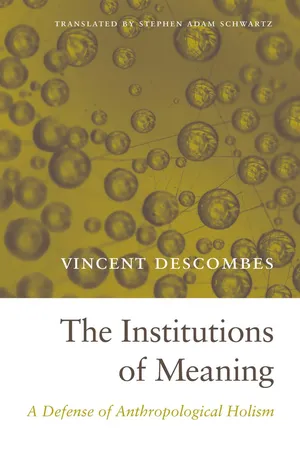
eBook - ePub
The Institutions of Meaning
A Defense of Anthropological Holism
- 360 pages
- English
- ePUB (mobile friendly)
- Available on iOS & Android
eBook - ePub
The Institutions of Meaning
A Defense of Anthropological Holism
About this book
Information
Topic
PhilosophySubtopic
Analytic PhilosophyPART I
INTENTIONALIST CONCEPTIONS OF MIND
1
The Intentionality of the Mental
This book aims to present and defend a holistic conception of mind. As the words “intentionality” and “intentionalist” are specialized philosophical terms, they will require a more thorough explanation than a mere definition might provide. In this chapter, I hope to provide the necessary technical vocabulary. But before doing that, I should provide some justification for the effort that will be required to come to a sufficiently clear notion of intentionality.
1.1. Intentional Terms
Why should our approach to contentious questions about the mind proceed by way of considerations of intentionality? There are two reasons, both of which derive from the state of such questions in contemporary philosophy.
First reason: it is generally accepted that the description of everything that entails mental life—of opinions, attitudes, and behavior (insofar as an intelligible order can be discerned in it) and even of mores and institutions—must be carried out in what are called “intentional terms.” What, then, is a description in intentional terms? To begin to address this question, we should first note that intentional terms are opposed to natural terms. Intentional terms allow us to state how things present themselves to someone. This “someone” need not be a particular someone; it could be a general function or an anonymous entity such as “the public” or “our ancestors” or “the tradition.” Natural terms, on the other hand, allow us to state how things are in themselves. Thus, a description of what is happening when what is happening is that it is raining will require a descriptive discourse that makes use of natural terms. But a description of what is happening when what is happening is that it is said to be raining (or that it is believed to be raining or affirmed to be raining or that rain is hoped for or feared or needed or announced, etc.) will require a descriptive discourse in intentional terms. In this example, the intentional term is the semantic verb “to say that.”
That it is raining is a meteorological fact. That it is said to be raining is a fact that falls within the purview of the sciences of the mind—linguistics, for example. There is also a formal criterion by which intentional descriptions of the sort given in the sciences of the mind can be recognized: they use what is called indirect discourse, a grammatical form used after declarative verbs and verbs of opinion, perception, or attitude. The construction that allows one to report the content of someone’s words or thoughts (without necessarily reproducing the words verbatim or the exact form of expression, if any, that the thoughts were given) is, in Latin, called oratio obliqua. This construction allowed logicians claim that what is distinctive about intentional verbs such as “to judge that,” “to say that,” “to believe that,” and “to wish that” is that they create an oblique context within discourse. Everything that appears within such a context (everything in the sentence that appears in the object clause governed by the intentional verb) tells us not of the world but of what someone thinks or says or believes or wishes about it.
I have set in opposition two types of events: natural events and intentional events. This opposition can be easily transposed into other ontological categories: natural abilities and intentional abilities, natural relations and intentional relations. Are intentional events also mental events? Yes, they are, but only if we hold mental events to be those that are meaningful. Thus, to say that it is raining is an intentional event (and therefore mental in this sense), not because it comprises an interior part (thought) added to the exterior part (language), but because I have done something other than describe the event of the speech act as a speech act if I have failed to mention that the words uttered meant something. What serves here as the criterion of the mental is not interiority but rather signification. In other words, mind is not found first in our heads and then, derivatively or as an effect, in signs. To make this claim is not to deny that there are interior mental acts or unexpressed mental episodes. It is only to point out that, from the perspective of meaning or intentionality, the interior is not to be privileged—there is a complete equivalence between the interior and the exterior. For example, it will not do to contrast the crudeness of (exterior, material) language with the subtlety of ideas. Books are “mental goods” (Mallarmé) but not because they are exterior signs that refer back to interior ideas in the way that smoke refers to the fire that produces it or, more generally, in the way the work refers back to the worker.1 The ideas of a thinker are to be sought in the thinker’s book, for the only way we have of identifying and analyzing an idea is to identify and analyze the expression it may be given.
That is the first reason: without using the language of intentions, as philosophers know, it is impossible to talk about the meaning of a sentence, the aims of an undertaking, the motives for an action, or the rules observed in social life. Here is the second reason: the language of intentions is as such irreducible to naturalistic language. The recognition of this point, if it were correctly understood, would have important consequences, since it would entail the abandonment of the great positivist project of a unified science of all phenomena, which was, of course, meant to include psychology. But if the intentional mode of description can never be eliminated in favor of the naturalistic mode, the sciences of the mind will never form part of the unified science of all phenomena. There would therefore be no such unified science of all phenomena, unless, that is, we decreed that the only phenomena worthy of the name are those that can be described in natural terms and that, therefore, only natural terms allow one to formulate genuine descriptions. The human sciences [Geisteswissenschaften] would then be something other than the sort of inquiries subject to factual proof that we call “sciences.” They would instead be mere personal constructions or free interpretations.
Today, philosophers generally concede that intentional language is untranslatable as such into a language that would use only natural terms. Those philosophers who remain committed to the positivist project will then have to find a way to evade this obstacle to a naturalistic psychology. Many have sought to do this using theories of automatic calculating machines (theories of artificial intelligence).2 For it is true that such machines can be described in two different ways, both as the machines that they are and as if they were the human calculators that they stand in for. Why not reverse the procedure in order to provide two descriptions of an intelligent being? One, in intentional terms, would apply to such a being insofar as it speaks, has goals and ideas, etc. The other, in natural terms, would apply to the mechanical functioning of a machine capable of replacing him. The coordination of these two levels of description would allow us not to reduce the intentional to the natural—for the gap between them cannot be bridged—but to locate the former in the latter. Yet such a program would appear to presuppose an atomistic conception of the mental. Otherwise, it would be impossible to coordinate the two levels systematically. It is for this reason that one might well maintain that those in favor of this “research program” are involved in a rearguard action.
I have claimed that naturalist or positivist philosophers could accept the irreducibility of intentionality without having to concede that their program has failed. All they need to do is refuse to acknowledge that intentional utterances are authentically descriptive. To say that it is raining might then be the beginning of a scientific inquiry, but to say that it is said (by someone) to be raining would be, at best, the beginning of an interpretation. Why would it be an interpretation of natural facts rather than a fact of a different order, an intentional fact? The rationale for this arises out of what is called “mental holism.” It is a relatively simple matter to state what one has rejected in claiming that the phenomena of mind are “holistic” and thereby have the character of totalities or complex systems. In doing so, one is rejecting the idea that mental life is made up of atoms of psychic life such as associationist psychology’s mental images or the signifiers posited by theories of the structural unconscious.3 Once atomism has been rejected, it remains to be seen whether one has thereby also rejected any intelligible concept of mind or whether a new concept might be forged that takes into account the impossibility of building the mind up through the combination of representational elements in associative chains. This question, which the present book seeks to answer, will be taken up again at the end of Chapter 3. But first we must clarify the notion of intentionality itself. For example, is there only one possible conception of the property of intentionality? Are there not rather (at least) two intentionalisms, one derived from the philosophical tradition of Brentano and Husserl and another to be sought in the work of philosophers such as Peirce and Wittgenstein?
1.2. Achilles’s Psychology
It is important that I explain what distinguishes an intentionalist conception of mind from other conceptions that have been put forward. To propose a conception of mind is not to practice psychology. Philosophy of mind describes neither behaviors nor operations but explains what it is to provide a description of the life or activity of a being from the point of view of the mind. More simply put, we are looking to determine what is distinctive about explanations of a “psychological” type.
I put the word “psychological” in quotation marks for a reason. Psychological attributions are peculiar in that they have two dimensions that can be differentiated: act and content.4 If we consider a psychological attribution to be the attribution of an act, we will think of it as being something individual and even personal. In order for there to be anger, for example, there must be someone who is angry. To speak about Achilles’s anger is to speak about his “psychology,” even if the ancient Greeks would not have put it that way. Achilles has physical attributes (his size, his age, his strength). He also has psychological attributes (for example, he is quick to anger). To speak in this way is to put in place a logico-philosophical (or metaphysical) schema of attributes and their subjects for the description of beings such as Achilles. This schema is not formally any different than that for the description of everyday things: the door and its height, the wall and its color, the water and its coolness, the radiator and its heating power.
But if we consider psychological attribution now from the point of view of its content, things present themselves in an entirely different way. From the point of view of content, what is attributed to Achilles when Homer says he is angry is not comparable to a quality or a state. In order to say that Achilles is angry, we have to talk about the content of this anger. But in order to render this content, we will have to go beyond the person of Achilles. We will have to talk about Achilles’s place among Greek warriors, about Agamemnon, about Briseus, etc. The description of the angry Achilles requires that we discuss the features of his pathos.
Contemporary philosophers claim that a concept such as anger is an intentional concept in that one cannot be simply irritated—one must be irritated or angry with someone. More generally, the description of a person is intentional if it requires us to specify not only the person’s act or state but to do so with reference to an object. I will come back shortly to the reasons for calling Achilles’s anger an intention. For now we should note that the intentionality of Achilles’s anger does not inhere in some voluntary or deliberate quality of that anger. It inheres rather in the fact that the anger concerns or has as its object Agamemnon—not Agamemnon per se, but Agamemnon insofar as he has taken some of the plunder that belongs to Achilles. The remarkable thing here is that, because its content can only be stated in public or impersonal terms, Achilles’s anger is not a simple state of Achilles. Generally, the content of psychological descriptions is to a great extent impersonal. To take another example: when I think about the door to my house, my concept of it may well be different from yours. But it is not a concept of a door at all if it is nothing but a wholly personal attribute.
Considering together the two observations just made brings a problem to light. On the one hand, the concept of mind calls for individuation since mind is manifest in living persons. On the other hand, the concept of mind cannot be treated as though it were entirely the concept of a personal attribute. While people exhibit mind in their own behavior, the content of what they exhibit is largely impersonal. The concept of intention seems to call for us to locate mind in the intentional subject (in his head), but it quickly becomes apparent that that is not its place. It is rather that the subject, in order to acquire a mind, must be situated within a milieu that would have been described in classical French as “moral” or in German as “spiritual” [geistig].5 This moral milieu is formed by institutions as providers of meanings that individual subjects can make their own.
These remarks provide an indication as to why this book in the philosophy of mind has in its title the word “institutions,” which more readily calls to mind the philosophy of law or of sociology than of psychology. The thesis of this book will be precisely that the objective mind of institutions precedes and makes possible the subjective mind of particular persons, although both of these terms will of course need to be made clear. This is the defining thesis of what I will call anthropological holism.
1.3. Brentano’s Thesis
In one sense, the phrase “the intentionalist conception of the mind” means nothing more than the expression “the contemporary conception of the mind.” Currently, as I have mentioned, the thesis of the intentionality of mind is broadly accepted. It has therefore ceased to be a thesis altogether, for want of a rival. Nevertheless, the agreement of philosophers about this matter remains trivial and obtains only on condition that the infamous property of intentionality is not explained.
There is a school of thought that understands intentionality according to a doctrine called “Brentano’s Thesis.” Brentano, as one might imagine, never spoke about anything called Brentano’s Thesis, but he did write that the domain of the mental (in other words, of psychology in his view) could be delineated using the property of intentionality as a criterion. Take any attribute: if it is intentional, it is mental; and if it is mental, it is intentional. But the thesis is not and, moreover, could not be limited to that claim. In order to claim that what is intentional i...
Table of contents
- Cover
- Title Page
- Copyright
- Contents
- Preface to the English Translation
- Part I. Intentionalist Conceptions of Mind
- Part II. The Anthropological Holism of the Mental
- Works Cited
- Index
Trusted by 375,005 students
Access to over 1.5 million titles for a fair monthly price.
Study more efficiently using our study tools.
Frequently asked questions
Yes, you can cancel anytime from the Subscription tab in your account settings on the Perlego website. Your subscription will stay active until the end of your current billing period. Learn how to cancel your subscription
No, books cannot be downloaded as external files, such as PDFs, for use outside of Perlego. However, you can download books within the Perlego app for offline reading on mobile or tablet. Learn how to download books offline
Perlego offers two plans: Essential and Complete
- Essential is ideal for learners and professionals who enjoy exploring a wide range of subjects. Access the Essential Library with 800,000+ trusted titles and best-sellers across business, personal growth, and the humanities. Includes unlimited reading time and Standard Read Aloud voice.
- Complete: Perfect for advanced learners and researchers needing full, unrestricted access. Unlock 1.5M+ books across hundreds of subjects, including academic and specialized titles. The Complete Plan also includes advanced features like Premium Read Aloud and Research Assistant.
We are an online textbook subscription service, where you can get access to an entire online library for less than the price of a single book per month. With over 1.5 million books across 990+ topics, we’ve got you covered! Learn about our mission
Look out for the read-aloud symbol on your next book to see if you can listen to it. The read-aloud tool reads text aloud for you, highlighting the text as it is being read. You can pause it, speed it up and slow it down. Learn more about Read Aloud
Yes! You can use the Perlego app on both iOS and Android devices to read anytime, anywhere — even offline. Perfect for commutes or when you’re on the go.
Please note we cannot support devices running on iOS 13 and Android 7 or earlier. Learn more about using the app
Please note we cannot support devices running on iOS 13 and Android 7 or earlier. Learn more about using the app
Yes, you can access The Institutions of Meaning by Vincent Descombes, Stephen Adam Schwartz in PDF and/or ePUB format, as well as other popular books in Philosophy & Analytic Philosophy. We have over 1.5 million books available in our catalogue for you to explore.