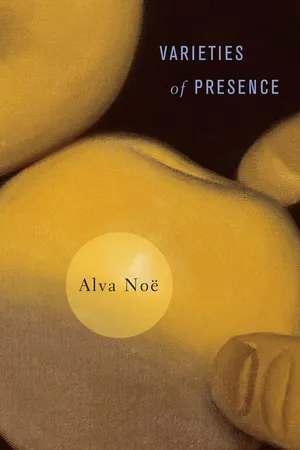
The world shows up for us—it is present in our thought and perception. But, as Alva Noë contends in his latest exploration of the problem of consciousness, it doesn't show up for free. The world is not simply available; it is achieved rather than given. As with a painting in a gallery, the world has no meaning—no presence to be experienced—apart from our able engagement with it. We must show up, too, and bring along what knowledge and skills we've cultivated. This means that education, skills acquisition, and technology can expand the world's availability to us and transform our consciousness.
Although deeply philosophical, Varieties of Presence is nurtured by collaboration with scientists and artists. Cognitive science, dance, and performance art as well as Kant and Wittgenstein inform this literary and personal work of scholarship intended no less for artists and art theorists, psychologists, cognitive scientists, and anthropologists than for philosophers.
Noë rejects the traditional representational theory of mind and its companion internalism, dismissing outright the notion that conceptual knowledge is radically distinct from other forms of practical ability or know-how. For him, perceptual presence and thought presence are species of the same genus. Both are varieties of exploration through which we achieve contact with the world. Forceful reflections on the nature of understanding, as well as substantial examination of the perceptual experience of pictures and what they depict or model are included in this far-ranging discussion.
eBook - PDF
About this book
Information
Topic
PhilosophySubtopic
Mind & Body in PhilosophyTable of contents
- Contents
- Preface
- Introduction: Free Presence
- 1. Conscious Reference
- 2. Fragile Styles
- 3. Real Presence
- 4. Experience of the World in Time
- 5. Presence in Pictures
- 6. On Over-Intellectualizing the Intellect
- 7. Ideology and the Third Realm
- Afterword
- Appendix: A List
- Bibliography
- Acknowledgments
- Index
Trusted by 375,005 students
Access to over 1.5 million titles for a fair monthly price.
Study more efficiently using our study tools.
Frequently asked questions
Yes, you can cancel anytime from the Subscription tab in your account settings on the Perlego website. Your subscription will stay active until the end of your current billing period. Learn how to cancel your subscription
No, books cannot be downloaded as external files, such as PDFs, for use outside of Perlego. However, you can download books within the Perlego app for offline reading on mobile or tablet. Learn how to download books offline
Perlego offers two plans: Essential and Complete
- Essential is ideal for learners and professionals who enjoy exploring a wide range of subjects. Access the Essential Library with 800,000+ trusted titles and best-sellers across business, personal growth, and the humanities. Includes unlimited reading time and Standard Read Aloud voice.
- Complete: Perfect for advanced learners and researchers needing full, unrestricted access. Unlock 1.5M+ books across hundreds of subjects, including academic and specialized titles. The Complete Plan also includes advanced features like Premium Read Aloud and Research Assistant.
We are an online textbook subscription service, where you can get access to an entire online library for less than the price of a single book per month. With over 1.5 million books across 990+ topics, we’ve got you covered! Learn about our mission
Look out for the read-aloud symbol on your next book to see if you can listen to it. The read-aloud tool reads text aloud for you, highlighting the text as it is being read. You can pause it, speed it up and slow it down. Learn more about Read Aloud
Yes! You can use the Perlego app on both iOS and Android devices to read anytime, anywhere — even offline. Perfect for commutes or when you’re on the go.
Please note we cannot support devices running on iOS 13 and Android 7 or earlier. Learn more about using the app
Please note we cannot support devices running on iOS 13 and Android 7 or earlier. Learn more about using the app
Yes, you can access Varieties of Presence by Alva Noë,Alva Noë in PDF and/or ePUB format, as well as other popular books in Philosophy & Mind & Body in Philosophy. We have over 1.5 million books available in our catalogue for you to explore.