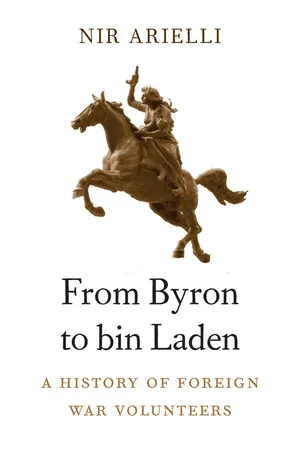
What makes people fight and risk their lives for countries other than their own? Why did diverse individuals such as Lord Byron, George Orwell, Che Guevara, and Osama bin Laden all volunteer for ostensibly foreign causes? Nir Arielli helps us understand this perplexing phenomenon with a wide-ranging history of foreign-war volunteers, from the wars of the French Revolution to the civil war in Syria.
Challenging narrow contemporary interpretations of foreign fighters as a security problem, Arielli opens up a broad range of questions about individuals' motivations and their political and social context, exploring such matters as ideology, gender, international law, military significance, and the memory of war. He shows that even though volunteers have fought for very different causes, they share a number of characteristics. Often driven by a personal search for meaning, they tend to superimpose their own beliefs and perceptions on the wars they join. They also serve to internationalize conflicts not just by being present at the front but by making wars abroad matter back at home. Arielli suggests an innovative way of distinguishing among different types of foreign volunteers, examines the mixed reputation they acquire, and provides the first in-depth comparative analysis of the military roles that foreigners have played in several conflicts.
Merging social, cultural, military, and diplomatic history, From Byron to bin Laden is the most comprehensive account yet of a vital, enduring, but rarely explored feature of warfare past and present.
- 295 pages
- English
- ePUB (mobile friendly)
- Available on iOS & Android
eBook - ePub
About this book
Information
1
Only a Nation in Arms?
“Foreigners” in Military Service before 1815
When Foreign Soldiers Were the Norm
January 1574. Roger Williams, a freelancer in the true sense of the word—a lancer by profession and a soldier of fortune—was trying to make his way back to England from Germany, having run out of money. Williams recounts that in the town of Lier, located in what is now northern Belgium, a Spanish commander
requested me earnestly to try his courtesy in the Spanish army, assuring me to depart when [it] pleased me. Having spent all my crowns, and being loath to return into England without seeing something, I promised to stay. Also, in those days there was no dispute betwixt Her Majesty [Queen Elizabeth I] and the Spanish king, to my knowledge. This was the manner and the first hour that I entered into the Spanish service.1
Considering the norms that were prevalent at the time, there was nothing exceptional about Williams’s decision. Not even the fact that in the two years previous, he had fought for the Dutch, the enemies of the Spanish in the Eighty Years’ War, also known as the Dutch War of Independence (1560s–1648). English, Scottish, Walloon, German, and Dutch soldiers were found in the ranks of the Spanish army, as well as on the opposing side. At one point in this prolonged conflict, French-born René Descartes, who later became one of the fathers of modern philosophy, served in the army of the Dutch States.
But let us return to Williams. In 1578 he switched sides again, fighting for the Dutch, first as a mercenary and later in an English contingent sent by Queen Elizabeth to aid the Netherlanders. In fact, Williams was able to move quite freely between the service of foreign rulers and that of his sovereign. In 1588–1589 he took part in preparations to repel the Spanish Armada, which was expected to land in England, and in the 1590s he fought in the wars of religion in France.2 A Welshman known for his valor in combat—he may or may not have been the inspiration for the character of Fluellen in Shakespeare’s Henry V—Williams also wrote extensively about his own experiences and about military theory. “Dutie, honor & welth, makes men follow the wars,” he argued, adding that there was “no disgrace for a poore Gentleman that lives by warres to serve any estate that is in league with his owne.”3 He admitted in retrospect that for a while he had been unhappy fighting for the Dutch and longed to quit their service, but “Hungry dogs must follow such that gives them bread.”4
This example from the late sixteenth century sits well with the classic historical narrative on the evolution of military recruitment in Europe from the late Middle Ages to the present. According to this narrative, the medieval West was dominated by “feudalism”: knights, who were feudal vassals, served their lords for forty days each year in return for fiefs.5 With the breakdown of the feudal system, knights who had amassed substantial amounts of money were able to pay rent to their lord instead of providing military services. This in turn led monarchs increasingly to rely on hired soldiers (derived from the Italian word “soldi”—money) to fight their wars. There were social and economic advantages to the employment of mercenaries. Hiring outsiders instead of using one’s own vassals guaranteed the continuity of agriculture, ensured the profitability of landed estates, avoided social disruption and minimized wastage of manpower.6
However, there were also problems inherent in this system of military recruitment. The fourteenth century saw the emergence of the phenomenon of the free companies—large organized bands that effectively replaced the individual recruitment of mercenaries. The Great Company, a band approximately 10,000 strong and composed of soldiers from different countries, ran what one modern-day historian has labeled “a protection racket” across the Italian peninsula from the 1330s to the 1350s.7 This unruly system became more stable and reliable with the rise of the condottieri toward the end of the century. These more institutionalized warlords were persuaded to put down roots in the states they served by receiving concessions of land in return for military service. A condottiero had an interest in preserving his name and reputation by achieving victories. But it would be ill-advised for such victories to be too crushing, lest there would be no need for further campaigns. Moreover, trained men were expensive and difficult to replace, and condottieri were want to waste them. Hence, when the great Italian historian, politician, and philosopher Niccolò Machiavelli (1469–1527) described the military conflicts of the fifteenth century in his History of Florence and of the Affairs of Italy, he famously lamented that “the practice of arms fell into such a state of decay, that wars were commenced without fear, continued without danger, and concluded without loss.”8
The fifteenth, sixteenth, and seventeenth centuries saw a gradual rise in the powers of the state, the creation of standing armies, and the persistence of international recruitment. Louis XI of France (1423–1483) was probably the first to maintain a large standing army in peacetime where troops were paid regularly, even when they did not fight. Approximately half of his forces were recruited from beyond the frontiers of France. At this stage, however, the king still did not have a monopoly over raising armies. Power struggles between the crown and the aristocracy continued until the conclusion of the Thirty Years’ War in 1648. In the second half of the seventeenth century, European princes generally acquired sufficient control of their territorial resources to maintain standing armies on a continuing basis. The central administration of armies took hold with the establishment of military secretaries in France (1635), Austria (1650), Britain (1661), and Piedmont (1717). Gradually, war became an activity regulated by the state.9
People from across the social range joined the ranks of the military for a variety of reasons. Many men chose the army because it offered employment at a time when civilian life did not. In 1572 the Venetian military engineer, General Giulio Savorgnan, explained that men enlisted
to escape from being craftsmen [or] working in a shop; to avoid a criminal sentence; to see new things; to pursue honour (though these are very few) … all in the hope of having enough to live on and a bit over for shoes, or some other trifle that will make life supportable.10
Others enlisted out of a sense of adventure or because they desired a change of scenery. Sir James Turner (1615–1686), who as a teenager fought for both Denmark and Sweden during the 1630s, confessed that he went to fight because “a restless desire [had] enter’d my mind to be, if not an actor, at least a spectator of those warrs which at the time made so much noise over all the world.”11 A customary form of recruitment during the Thirty Years’ War was for victorious commanders to fill their depleted ranks with recruits from the defeated armies of their opponents. This should come as no surprise in a war in which the soldiers were mercenaries and the officers entrepreneurs.12
Although their view has recently been challenged, key classic-narrative historians agree about the lack of esprit de corps among European forces during this period.13 John Childs has argued that “passion was absent from the battlefield and war was limited in every sense. Conflicts were between the leaders of dynasties without much reference to society.… Not only were the resources of the sixteenth-century state finite but the number of mercenaries in western Europe was strictly limited.”14 According to Michael Howard, one of the doyens of military history in Britain, “Whatever the rationale of wars during this period, whether disputes over inheritance or, as they became during the latter part of the sixteenth century, conflicts of religious belief, they were carried on by a largely international class of contractors on a purely commercial basis.”15 Similarly, Geoffrey Parker’s influential book The Military Revolution claimed that the “combination of heterogeneous methods of recruiting, high wastage rates, and considerable mobility within the ranks soon destroyed any sense of corporate identity among the individual formations of every early modern army.”16
A combination of profound changes led to a massive growth in the size of European armies in the eighteenth century. Developments in agriculture increased the availability of food for troops and fodder for their animals. Improved roads made it easier to transport forces. And, finally, European rulers, who devoted more than 70 percent of their revenues to war, needed to keep up with each other. Once one monarch enlarged his or her army, the others had to follow suit. The Habsburg army grew from approximately 50,000 in 1690 to 200,000 in 1778. The Prussian army, 39,000 strong in 1710, numbered 160,000 in 1778. In Russia the army expanded from 90,000 in the late seventeenth century to a staggering 500,000 in 1789. The growth in the size of European armies outstripped the increase in Europe’s population.17
This monumental growth led rulers to introduce early forms of conscription. Peter the Great of Russia (1672–1725) paved the way, and similar policies were implemented in Prussia and other Germanic states. Local magistrates were entrusted with selecting conscripts and were often tempted to enroll personal enemies and to rid themselves of society’s undesirables at the army’s expense. The Prussian monarchy specifically exempted valuable tax payers—merchants, artisans, manufacturers—and their sons from military service. Furthermore, a number of cities such as Berlin were relieved of the burden of military service. This was done to impose the least possible strain on the country’s fragile economy. Consequently, historians have tended to view eighteenth-century soldiers as a despised group on the periphery of society.18 Armies, in the words of Frederick the Great of Prussia (1712–1786), were “for the most part composed of the dregs of society—sluggards, rakes, debauchees, rioters, undutiful sons, and the like, who have little attachment to their masters or concern about them as do foreigners.”19
Desertion was a perennial problem for eighteenth-century armies. In the War of the Spanish Succession (1701–1714) one in four French soldiers deserted from the ranks. During the Seven Years’ War (1756–1763), some 80,000 men absconded from the Prussian army, 70,000 from the French, and 62,000 from the Austrian. Although penalties were severe—in France every third deserter who was recaptured was shot—it often proved difficult to keep press-ganged soldiers, many of whom were recruited from the peasantry, under arms.20
The unreliability of conscripts and the desire not to impose unnecessary strains on the local economy ensured the persistence of the recruitment of foreigners. Poorer, smaller German states rented their manpower to richer countries. During the American Revolution, for instance, the Hessian states in Germany furnished 30,000 men for the British army. Foreign troops entering the French Royal Army were organized into Swiss, German, Irish, Italian, and Liégeois regiments under their own officers. The words of command were usually given in the soldiers’ native language. Officers too were not restricted to serving in the army of their country of origin. Because European armies were organized along roughly equivalent lines, used very similar tactics and weapons, and offered comparable rewards, good officers could take up a commission with almost any army. Throughout the eighteenth century the number of foreigners in the armies of Europe fluctuated and varied from country to country. From lows of around 15 percent, it could reach as high as more than 50 percent, especially in times of peace. The advantages of employing foreigners were so noticeable that, as one French general remarked, “each foreign soldier was worth three men, one more for France, one less for the enemy, and one Frenchman left to pay taxes.”21
In the second half of the eighteenth century the ideas of the Enlightenment began to influence first the theory and eventually the practice of military recruitment. The witty and hugely influential Voltaire mocked the practice of press-ganging unsuspecting recruits into military service. The protagonist of his Candide (1759) is tricked, handcuffed, and carried away into a regiment of the king of the Bulgarians.22 In his Essai général de tactique (1772), the general and military theorist Jacques Antoine Hippolyte, Comte de Guibert, stressed the importance of the relationship between war and politics. He argued that the nature and composition of an army—in his case, the French—should be rooted in the nation’s customs and constitution instead of reflecting those of its neighbors. Drawing on the idealized classical models of ancient Sparta and Rome, he advocated the creation of an army of citizens, members of a nation whose patriotism would motivate them in action. At the heart of the problem for Guibert was the inability of governments “to compose our armies of citizens, men who have the zeal for the service, or soldiers, not merely...
Table of contents
- Cover
- Title Page
- Copyright
- Contents
- Introduction
- 1. Only a Nation in Arms? “Foreigners” in Military Service before 1815
- 2. Attractive Conflicts: The Changing Ideological Landscape
- 3. A Search for Meaning: Deciphering Motivations
- 4. Thoughts of Home: A Typology of Volunteer–State Relations
- 5. Controlling the Flow: Governmental Responses, Legislation, and Support Networks
- 6. Winning Wars? Assessing Military Significance
- 7. The Dark Side: Troublemakers, Soldiers of Misfortune, and Terrorists
- 8. Links in a Chain: Memory and Myth
- Epilogue
- Notes
- Acknowledgments
- Index
Trusted by 375,005 students
Access to over 1.5 million titles for a fair monthly price.
Study more efficiently using our study tools.
Frequently asked questions
Yes, you can cancel anytime from the Subscription tab in your account settings on the Perlego website. Your subscription will stay active until the end of your current billing period. Learn how to cancel your subscription
No, books cannot be downloaded as external files, such as PDFs, for use outside of Perlego. However, you can download books within the Perlego app for offline reading on mobile or tablet. Learn how to download books offline
Perlego offers two plans: Essential and Complete
- Essential is ideal for learners and professionals who enjoy exploring a wide range of subjects. Access the Essential Library with 800,000+ trusted titles and best-sellers across business, personal growth, and the humanities. Includes unlimited reading time and Standard Read Aloud voice.
- Complete: Perfect for advanced learners and researchers needing full, unrestricted access. Unlock 1.5M+ books across hundreds of subjects, including academic and specialized titles. The Complete Plan also includes advanced features like Premium Read Aloud and Research Assistant.
We are an online textbook subscription service, where you can get access to an entire online library for less than the price of a single book per month. With over 1.5 million books across 990+ topics, we’ve got you covered! Learn about our mission
Look out for the read-aloud symbol on your next book to see if you can listen to it. The read-aloud tool reads text aloud for you, highlighting the text as it is being read. You can pause it, speed it up and slow it down. Learn more about Read Aloud
Yes! You can use the Perlego app on both iOS and Android devices to read anytime, anywhere — even offline. Perfect for commutes or when you’re on the go.
Please note we cannot support devices running on iOS 13 and Android 7 or earlier. Learn more about using the app
Please note we cannot support devices running on iOS 13 and Android 7 or earlier. Learn more about using the app
Yes, you can access From Byron to bin Laden by Nir Arielli in PDF and/or ePUB format, as well as other popular books in History & Military & Maritime History. We have over 1.5 million books available in our catalogue for you to explore.