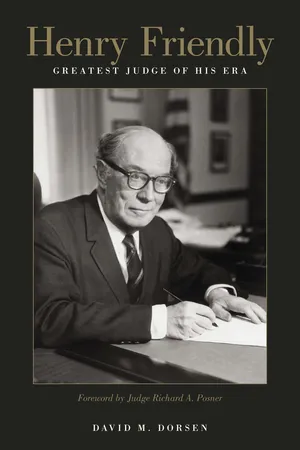
Henry Friendly is frequently grouped with Oliver Wendell Holmes, Louis Brandeis, Benjamin Cardozo, and Learned Hand as the best American jurists of the twentieth century. In this first, comprehensive biography of Friendly, David M. Dorsen opens a unique window onto how a judge of this caliber thinks and decides cases, and how Friendly lived his life.
During his time on the Court of Appeals for the Second Circuit (1959–1986), Judge Friendly was revered as a conservative who exemplified the tradition of judicial restraint. But he demonstrated remarkable creativity in circumventing precedent and formulating new rules in multiple areas of the law. Henry Friendly, Greatest Judge of His Era describes the inner workings of Friendly's chambers and his craftsmanship in writing opinions. His articles on habeas corpus, the Fourth Amendment, self-incrimination, and the reach of the state are still cited by the Supreme Court.
Dorsen draws on extensive research, employing private memoranda between the judges and interviews with all fifty-one of Friendly's law clerks—a veritable Who's Who that includes Chief Justice John R. Roberts, Jr., six other federal judges, and seventeen professors at Harvard, Yale, Stanford, and elsewhere. In his Foreword, Judge Richard Posner writes: "David Dorsen has produced the most illuminating, the most useful, judicial biography that I have ever read . . . We learn more about the American judiciary at its best than we can learn from any other . . . Some of what I've learned has already induced me to make certain changes in my judicial practice."
- English
- ePUB (mobile friendly)
- Available on iOS & Android
eBook - ePub
Henry Friendly, Greatest Judge of His Era
About this book
Information
CHAPTER ONE
Early Years
HENRY JACOB FRIENDLY’S ancestors were dairy farmers in Wittelshofen, Bavaria, in southern Germany, who, when Bavaria passed a law in the eighteenth century that required everyone to take a last name, adopted the name Freundlich (which translates to “Friendly”). While the extent of their religious devotion is unknown, the first Freundlichs in the nineteenth century had two seats at the local synagogue: one male seat and one female.1 Friendly’s great-grandfather, Josef Myer Freundlich, was born in 1803, married Lena Rosenfeld, also of Bavaria, in 1829, and died in 1880. According to a contemporary account, their estate burned down in 1831, apparently as the result of an accident. When their neighbors did nothing to extinguish the fire, because, the Freundlichs believed, they were Jewish, the couple sold their home and moved to the center of the village. Nevertheless, Josef remained a farmer and livestock dealer and prospered.
In 1852, to avoid serving in the German army, Josef’s son Heinrich, Friendly’s grandfather, and his brothers emigrated to the United States, changing their name to Friendly. A naturalized Henry Friendly (who changed his name from Heinrich) married Lena Hesslein, also from Bavaria, in New York City in 1860, and moved to the town of Cuba in upstate New York, where his parents joined him a decade later. Starting as a peddler, he soon owned a dry-goods store and then a carriage factory.2 He had two sons, the first of whom, Myer Henry, the father of the future judge, was born in Cuba in 1862.3 To work for his uncle Samson Friendly in the manufacturing and jobbing of shoes, Myer moved to Elmira, New York, at the age of eighteen.
At the turn of the century Elmira was a town of about forty thousand, as it is today. It was passionately Republican, from which there was no dissent within the Myer Friendly household. The family lived on the west side of town, which was primarily inhabited by Christians. The Jewish population, living mostly on the east side, was about four thousand. The German-Jewish community, of which the Friendly family was a prominent part, was quite small, with about a dozen families and few children. Grandfather Henry became active in civic affairs, serving as commissioner of parks and Jewish affairs and becoming president of a liberal temple, the Congregation B’nai Israel. A monograph on the first Jewish settlers in the area described him as “a man of stern and thrifty qualities” who was generous to Jewish congregations in the community. The same monograph credited him with innovative trimming of trees in one of the parks, a controversial move at the time, but one that experts from Cornell University validated. Another monograph, commemorating the centennial of B’nai Israel, referred to him as “generous” and “one of the leading men of Elmira in the late nineteenth century.”4
In 1897, at the age of thirty-five, Myer married Leah Hallo of Meshoppen, Pennsylvania, the youngest of four daughters, whose father was a shopkeeper.5 Named for his two grandfathers, Henry Friendly and Jacob Hallo, Henry Jacob Friendly was born on July 3, 1903. His parents were then forty-one and thirty-three, old in those days for a first child. In the early years of their marriage Leah had not been happy, once leaving and moving in with her sister Mattie and her husband, Max Heimerdinger, who lived in Chicago. Myer persuaded Leah to return; Friendly later commented, “I take it that I was the result of that persuasion.” At three years, five months, precocious little Henry Jacob used the words “interrupt,” “impatient,” “depend,” “consider,” and “properly”; two months later he knew the letters of the alphabet; at four years and eight months he could point out on a map and spell the names of most foreign countries. At seven he could read almost any book written for adults.6
Although not a high school graduate, Leah was diligent and precise and had a superb memory, remembering not only what had happened but when it did. Later, she became an excellent bridge player. Seeking to improve herself, she joined and became the head of the local Shakespeare Club. She liked to read to her son when he was having eye trouble, which started at an early age. Leah poured all her attention on her son—“there was absolutely nothing she wouldn’t have done for me,” he remembered. She was serious, reserved, unemotional, undemanding, and undemonstrative.7 When Henry was nine or ten she started taking him to local cultural events, which included a theater company that performed Gilbert and Sullivan and other, mostly musical, productions. The local streetcar company ran the theater, and for a time, if audience members came by streetcar, they would be allowed into the theater free rather than have to pay the twenty-five- or fifty-cent admission charge. When there was an evening performance, both his parents would take him.8
Somewhat dour and old-fashioned and without much fun in him, Myer was not intimately involved in his son’s daily life. “Except for the fact that he had a rather low flashpoint, I didn’t ever observe anything particularly objectionable about him,” Friendly told an interviewer. Father and son never had a heart-to-heart talk, and Friendly acknowledged, “We didn’t have a very close family.”9 As a child Friendly did some chores, but not an onerous number. “My father did require me to mow the lawn and, in the fall, rake the leaves, and since he was a bit of a perfectionist, he would survey my work with more acerbity than I thought was called for.” Fallen leaves on the lawn were a special problem. “He seemed to think I should have it in a state of absolute perfection for his arrival. And that struck me as unjust.”10 Just or unjust, Friendly seemed to accept his father’s standard for himself and in later years set high standards for the people who worked for him.
Although Friendly’s red hair might suggest the opposite, he was docile and obedient as a child. The only “major” incident that Friendly remembered resulted from his going to school on a rainy day without galoshes or a raincoat. He knew his mother would likely punish him by locking him in a small lavatory on the first floor, so he hid a couple of books there before he left home that morning. When he came home dripping, his mother locked him in the bathroom, where he read peacefully. She grew worried when he made no demands to be let out, afraid that he had suffocated. She finally opened the door and found him reading contentedly. “That must have been very disappointing to them,” Friendly recalled.11
Friendly’s reputation as a well-behaved and earnest child did not necessarily endear him to his contemporaries. Morris E. Lasker, a federal district judge whose stepfather grew up in Elmira, related that in the late 1960s his stepfather’s nephew, Dr. Ben Levy, visited him at the U.S. Courthouse in Manhattan. When Lasker told Levy that there was a judge from Elmira, Henry Friendly, and asked him whether he would like to pay him a visit, Levy replied, “Hell, no. When I was growing up, all I would hear from my mother was, ‘that is not the way Henry Friendly would do it.’ ”12
The Friendlys lived comfortably in a large house. As Friendly recalled, they always had two maids and a part-time handyman to do the heavy work. In 1910 Myer acquired one of the early cars, an open Chalmers. Frequently in the summer they would set out on a Sunday afternoon with Friendly’s grandmother and an aunt or two to visit Corning, Watkins Glen, Binghamton, or Ithaca for a picnic or other excursion.13
At about the same time, his parents started taking trips to the West during the summer, but, Friendly recalled, “for some reason they didn’t take me along.” They would park young Friendly in Chicago with his aunt Mattie and uncle Max, whose company he liked, as his mother did. One of Friendly’s memories of the period was going to baseball games to see the Chicago White Sox or Chicago Cubs. Because he considered himself a “great baseball fan in those days,” the annual visits to Chicago were no hardship. The Black Sox scandal shocked him.14 Friendly was disdainful about another of his mother’s sisters, telling an interviewer, “She led a rather useless existence [in her later years], so far as I could recall.… I never liked her very much.”15
Friendly did not have a particularly glowing picture of family life among his parents’ friends. He felt that “something must have gone terribly wrong with their family lives.… One could almost write a Buddenbrooks novel on what happened to the German Jewish families.… They certainly went in for zero population growth.” Many German Jews never married, and many of those who did had no children. Friendly never resolved whether “this was something very ingrown, incestuous or whatnot.” He once summed up his parents’ relationship this way: “I didn’t detect in my early youth that the marriage was any more unhappy than a great many others.”16
When Samson, the uncle with whom Myer had gone into the shoe business, retired, he sold his interest to Myer, who became president of Friendly Boot & Shoes Co. Friendly helped his father now and then, preferring work in the office to stacking boxes of shoes, at which he was far from proficient. For a time the business did very well, but shoe manufacturers decided to abolish many middlemen like Myer, and he retired in 1917. When he turned to investing in mortgages, he prospered.17 His success with mortgages, at which he appears to have had no formal training, suggests a good mind and financial acumen.
In the first decades of the twentieth century Elmira had two Orthodox synagogues and one Reform temple. Although Myer and Leah were not religiously observant, they joined the Reform temple with other German Jews, the same congregation that Myer’s father had headed, and their son was bar mitzvahed. The Friendlys celebrated Christmas, albeit “in a mild way”; there was no tree, but they exchanged presents.18
Myer believed that anti-Semitism was widespread in Elmira, although the only manifestations that Friendly recalled were that the country club had only one Jewish member and that their Christian neighbors would say good morning and good evening, but otherwise wanted nothing to do with them. Friendly thought his father was as responsible as the neighbors for the lack of sociability, and that his parents might have joined the country club had they wished. Although he remembered feeling discomfort with some Christians, Friendly’s friends were mostly Christian, which was uncharacteristic for most Jews at this time. Two of his friends, whom Friendly later described as “of the so-called superior group,” the country club crowd, were Hubert Mandeville, the son of a prominent lawyer and president of the school board, and the son of a state judge.19
Myer was prejudiced against Jews who did not come from Germany; he “thought they were tricky and dishonest. All the stereotypes that are applied to Jews generally, he applied to [them]; well, he called them Kikes, in no uncertain terms.” Myer did not prohibit his son from befriending them, but “he certainly did not encourage it.” It was all right to go out with girls who were not German Jews, but that was not where he should look for a future wife. And interfaith marriage did not exist. On the emerging issue of Zionism, Friendly’s father was very negative.20
About two thousand African-Americans lived in Elmira, Friendly remembered, most of them poor, except for a few who owned restaurants. There was no black ghetto, but all but a few lived in poorer integrated neighborhoods. Friendly played catch with some black children with whom he went to school. He later said, “Nobody thought anything about it. On the other hand, I don’t think there were any real social relations between the whites and the blacks. As far as school was concerned, nobody gave it a second thought.”21
While Friendly liked playing baseball in his large backyard, everything suggests that he was not a natural athlete. He was overweight in his teen years—at eighteen he was five feet eight inches tall and weighed 185 pounds—before he slimmed down in adulthood. Myer was a sportsman and fisherman, but after a few forays Friendly wanted no part of those activities, which disappointed his father.22 Throughout his life Friendly lacked manual dexterity and had difficulty with gadgets of all sorts, including a Sony Walkman, and doing anything much more challenging than turning doorknobs. “I couldn’t drive a nail in straight if my life depended on it,” he conceded.23
Fittingly, the one serious injury that Friendly suffered as a child was not incurred in sports, but when he punctured his hand with a lead pencil and got a life-threatening case of blood poisoning, which left him without the use of the pinky on his left hand.24 His eye problems, which began early, led in 1936 to detached retinas in both eyes, a condition that plagued him the rest of his life. As an adult his perennial vision problems required several operations, with accompanying periods of hospitalization. It may have been because of his poor eyesight or his lack of coordination, or perhaps for some other reason, but Friendly never drove an automobile.25
At thirteen Friendly wrote a letter to his mother on Mother’s Day, when she was at a hotel in Atlantic City. In clear script it began, “I am writing you specially today because tomorrow is ‘Mother’s Day’ and I feel it my sacred duty to tell you how often ...
Table of contents
- Cover
- Half Title
- Title Page
- Dedication
- Contents
- Foreword by Judge Richard A. Posner
- Copyright
- Introduction
- 1. Early Years
- 2. Private Practice
- 3. Nomination and Confirmation
- 4. Getting Started
- 5. Judge Friendly
- 6. Law Clerks
- 7. Judges and Justices
- 8. Away from the Courthouse
- 9. First Amendment
- 10. Fifth Amendment
- 11. Other Bill of Rights Amendments
- 12. Other Constitutional Provisions
- 13. Habeas Corpus
- 14. Nonconstitutional Criminal Procedure
- 15. Specific Crimes
- 16. Business Law
- 17. Intellectual Property
- 18. Management and Labor
- 19. Railroad Reorganization
- 20. Administrative Law
- 21. Common Law and Federal Common Law
- 22. Federal Court Jurisdiction
- 23. Other Procedural Issues
- 24. At the End
- 25. Friendly’s Legacy
- Appendix A: Friendly’s Clerks
- Appendix B: Friendly’s Published Nonjudicial Writings
- Notes
- Acknowledgments
- Index
Trusted by 375,005 students
Access to over 1.5 million titles for a fair monthly price.
Study more efficiently using our study tools.
Frequently asked questions
Yes, you can cancel anytime from the Subscription tab in your account settings on the Perlego website. Your subscription will stay active until the end of your current billing period. Learn how to cancel your subscription
No, books cannot be downloaded as external files, such as PDFs, for use outside of Perlego. However, you can download books within the Perlego app for offline reading on mobile or tablet. Learn how to download books offline
Perlego offers two plans: Essential and Complete
- Essential is ideal for learners and professionals who enjoy exploring a wide range of subjects. Access the Essential Library with 800,000+ trusted titles and best-sellers across business, personal growth, and the humanities. Includes unlimited reading time and Standard Read Aloud voice.
- Complete: Perfect for advanced learners and researchers needing full, unrestricted access. Unlock 1.5M+ books across hundreds of subjects, including academic and specialized titles. The Complete Plan also includes advanced features like Premium Read Aloud and Research Assistant.
We are an online textbook subscription service, where you can get access to an entire online library for less than the price of a single book per month. With over 1.5 million books across 990+ topics, we’ve got you covered! Learn about our mission
Look out for the read-aloud symbol on your next book to see if you can listen to it. The read-aloud tool reads text aloud for you, highlighting the text as it is being read. You can pause it, speed it up and slow it down. Learn more about Read Aloud
Yes! You can use the Perlego app on both iOS and Android devices to read anytime, anywhere — even offline. Perfect for commutes or when you’re on the go.
Please note we cannot support devices running on iOS 13 and Android 7 or earlier. Learn more about using the app
Please note we cannot support devices running on iOS 13 and Android 7 or earlier. Learn more about using the app
Yes, you can access Henry Friendly, Greatest Judge of His Era by David M. Dorsen in PDF and/or ePUB format, as well as other popular books in Law & Law Biographies. We have over 1.5 million books available in our catalogue for you to explore.