Lu Xun (1881–1936) is widely considered the greatest writer of twentieth-century China. Although primarily known for his two slim volumes of short fiction, he was a prolific and inventive essayist. Jottings under Lamplight showcases Lu Xun's versatility as a master of prose forms and his brilliance as a cultural critic with translations of sixty-two of his essays, twenty of which are translated here for the first time.
While a medical student in Tokyo, Lu Xun viewed a photographic slide that purportedly inspired his literary calling: it showed the decapitation of a Chinese man by a Japanese soldier, as Chinese bystanders watched apathetically. He felt that what his countrymen needed was a cure not for their physical ailments but for their souls. Autobiographical accounts describing this and other formative life experiences are included in Jottings, along with a wide variety of cultural commentaries, from letters, speeches, and memorials to parodies and treatises.
Lu Xun was remarkably well versed in Chinese tradition and playfully manipulated its ancient forms. But he also turned away from historical convention, experimenting with new literary techniques and excoriating the "slave mentality" of a population paralyzed by Confucian hierarchies. Tinged at times with notes of despair, yet also with pathos, humor, and an unparalleled caustic wit, Lu Xun's essays chronicle the tumultuous transformations of his own life and times, providing penetrating insights into Chinese culture and society.
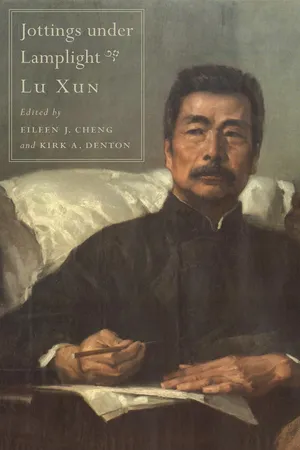
- 329 pages
- English
- ePUB (mobile friendly)
- Available on iOS & Android
eBook - ePub
Jottings under Lamplight
About this book
Information
PART 1
Self-Reflections
SECTION I
Prefaces and Autobiographical Essays
Preface to Outcry
自序
When I was young, I, too, had many dreams, most of which I later came to forget, but in this I see nothing to regret. While the thing called memory can make one feel delight, there are also, ineluctably, times when it makes one feel lonely. What is the point of tying the loose threads of one’s thoughts to those lonely bygone days? And yet, I am plagued by the inability to forget completely; some of the things I am unable to forget completely have now become the source for Outcry.
For a period of over four years, I often, almost daily, made my way in and out of the pawnshop and the apothecary. I no longer remember how old I was at the time, but the counter of the apothecary was just my height and the pawnshop’s twice that. Up over the counter that was twice my height I would hand clothes or trinkets and take the money given to me under a scornful gaze; then I would go to the counter that was my height to purchase medicine for my chronically ill father. After returning home, I had other matters to occupy me, because the doctor prescribing the medicine was preeminent and the formulas he used especially bizarre: aloe root dug up in the winter, sugar cane that had endured three years of frost, crickets had to be original mates, ardisia in the seed-bearing stage … mostly things that were not easy to come by. But my father’s illness worsened day by day until he finally died.
Those from comfortable circumstances who have slipped into poverty, I presume, are able to see people’s true nature along the way. My desire to go to N and enroll in K Academy1 seemed to have stemmed from a wish to strike a different path, to escape to a different locale, to seek out different kinds of people. My mother couldn’t do anything about it, so she gave me eight yuan as travel fare, telling me to use it as I saw fit. She cried nonetheless, as was to be expected, because at the time studying the classics and taking the examinations was regarded as the proper path. In the eyes of society, studying “Western learning” was only for the desperate who had no choice but to sell their souls to the foreign devils and therefore deserved to be doubly scorned and ostracized. Moreover, she would no longer be able to see her son. I, however, couldn’t be bothered with all this and, in the end, went to N and enrolled in K Academy. It was at this academy that I first learned that such things as science, arithmetic, geography, history, drawing, and physical education existed. Physiology wasn’t taught, but we did see some woodblock editions of texts such as A New Treatise on Anatomy and On Chemistry and Hygiene. I still remembered the theories and prescriptions of earlier doctors, and when I compared them to what I now knew, it gradually dawned on me that doctors of traditional Chinese medicine were nothing more than witting or unwitting charlatans. At that time, I also began to feel a great deal of sympathy for the patients and their family members who had been so deceived. Furthermore, from translated histories, I learned that the reforms in Japan largely came about with the introduction of Western medical science.
Such a naive understanding led me to pursue my studies at a medical academy in provincial Japan. My dream was a beautiful one: after graduation, I planned to return to cure the suffering of patients who, like my father, had been improperly treated; in times of war, I would serve as a military doctor and, at the same time, also strengthen my countrymen’s faith in reform. I do not know what advances have been made in the methods used to teach microbiology nowadays, but at that time photographic slides were used to display the forms of microorganisms. Sometimes when we completed a section of the lecture materials before the period was over, instructors would show some slides of natural scenery or contemporary events to the students to while away the remaining time. Since this happened during the Russo-Japanese war, there were, naturally, many more war-related slides. In this particular lecture hall, I often had to go along with the clapping and cheering of my classmates. On one occasion, I unexpectedly encountered Chinese people, whom I hadn’t seen in a long time, in a slide. There were many of them. One was bound in the middle and many others stood to his left and right, all physically strong bodies, yet displaying expressions of apathy. According to the explanatory caption, the one bound had served as a spy for the Russians and was about to be decapitated by a Japanese soldier, to serve as a public example to others. Surrounding him were people who had come to appreciate the grand spectacle.2
Before the academic term was over, I left for Tokyo, since from that moment on, I felt that studying medicine was not of foremost importance. Citizens of an ignorant and weak nation, no matter how healthy and sturdy their bodies, can serve as nothing more than subject matter for or spectators of meaningless public displays. That many of them die of disease is not, necessarily, something unfortunate. Our most important mission lies in transforming their spirits, and at the time I felt that the best way to transform their spirits was, of course, through literature, and so I wanted to promote a literary movement. Many of the Chinese students in Tokyo studied law, politics, physics, and chemistry, while some even majored in policing and industry, but no one studied literature or art. Amid this cheerless atmosphere, I was fortunate enough to find several comrades. Moreover, I was able to gather together a few crucial people, and after discussing it, we decided that the first step was, of course, to publish a magazine, the title of which was derived from the idea of creating “new life.” Because we were inclined toward reviving the classics at the time, we called it Vita Nova (New life).
As the publication date of New Life drew near, several of the contributing writers disappeared, then some of the funds vanished; the result was that only three people, none with a penny to their names, remained. Since the launching had an inauspicious start, when things failed, there was of course nothing more to be said about the matter. Afterward, even these three remaining people, each driven by their own destinies, could no longer gather together to freely discuss their dreams for the future. Such was the fate of our aborted New Life.
After this, I felt an emptiness unlike any I had experienced before. At the time, I didn’t understand the reason it came about. Later, it occurred to me that if a proposition is met with approval, it encourages you to go forward; if met with opposition, it encourages you to fight back. The real tragedy strikes when one raises one’s voice among the living, only to elicit no response, be it approval or opposition, as if one were helplessly stranded in a boundless wasteland. It was then that I became aware of the feeling of loneliness.
This loneliness grew day by day, like a giant poisonous snake wrapping itself around my soul.
Yet despite my inexplicable dejection, I was not resentful, because the experience prompted me to self-reflect and see myself for who I was: that is, I was by no means a hero who could rally the masses with a battle cry and a raised fist.
But my loneliness had to be dispelled because it was more painful than I could bear. And so I used various methods to numb my soul, submerging myself among the people and returning to ancient times. Afterward, I either witnessed or experienced firsthand several events that made me feel even more lonely and dejected, things I no longer wish to recall and am happy to see perish, along with what was in my mind, into the dust. But my method of anesthetizing my soul appears to have had some success; I have never again experienced the impassioned fervor of my youth.
S hostel had three rooms. It was said that a long time ago a woman had hanged herself on the locust tree in the courtyard. The locust tree is now tall beyond reach, but the rooms remain unoccupied. For many years, I resided here, copying ancient inscriptions. Few guests came to visit, and in the ancient stone tablets there were few “problems” and “isms” to be encountered, so a portion of my life was thus quietly whiled away, which was my only wish at the time. In the summer evenings when there were a lot of mosquitoes, I would wave my palm leaf fan as I sat under the locust tree, catching glimpses of the specks of blue sky that appeared through the dense foliage. The late-emerging caterpillars would often drop and land icily onto my head and neck.
At the time, one of those who occasionally dropped by to chat was an old friend, Jin Xinyi.3 He placed his big leather clutch bag on the dilapidated desk, took off his long robe, and sat down across from me. Because he was afraid of dogs, it seemed his heart was still pounding.
“What’s the purpose of copying these things?” he asked me pointedly one evening as he leafed through the ancient inscriptions I had hand-copied.
“There isn’t any purpose.”
“Then, what’s the point of you copying them?”
“There isn’t any point.”
“I’m thinking that you could write some essays …”
I understood what he meant. They were in the midst of launching New Youth, but it seemed that at the time not only did no one show approval, no one opposed it either. I felt they were probably feeling lonely, yet said:
“Suppose there is an iron house, without a single window or door and virtually indestructible. Inside are many inhabitants sleeping soundly, all about to suffocate to death. Since they would die in their sleep, they wouldn’t feel the agony of death. Now if you were to call out, awakening those few who are dozing lightly, leading these unfortunate few to suffer the agony of facing a sure death, do you think you would be doing them any good?”
“But if a few people are awakened, you can’t say that there’s absolutely no hope of destroying the iron house.”
Indeed, in spite of my own convictions, when it came to the matter of hope, I had no way of blotting out its existence. Because hope is something that lies in the future, I couldn’t possibly use my conviction in its nonexistence as evidence to refute his belief in it. So in the end, I agreed to write something, which turned out to be my first piece, “Diary of a Madman.” Once I started, I couldn’t stop and often wrote some things resembling fiction as a way of humoring the requests of my friends. In the course of time, my writings accumulated to over ten pieces.
As for myself, I felt I was no longer someone with a pressing need to express himself. But perhaps because I hadn’t yet been able to forget the grief from my past loneliness, I still couldn’t help calling out now and then, to console, for the time being, those brave warriors charging on in loneliness so that they would have the courage to pave the way. Whether my cries were brave or sorrowful, hateful or ridiculous, was of no concern to me. But since I was crying out, I naturally had to obey the commander’s orders. And so I seldom had qualms about resorting to sleights of the pen—making a garland of flowers appear out of nowhere on little Yu’s grave in “Medicine,” deliberately refraining to mention that Fourth Sister Shan in “Tomorrow” hadn’t seen her son in her dreams after all—because the commanding generals at the time did not advocate pessimism. For my part, I also did not want to infect the young people who were dreaming beautiful dreams, just as I had at the time of my own youth, with the loneliness I have found so bitter. Seen in this light, one can well imagine how far my stories fall short of being true works of art. Regardless, that these things can be passed off as fiction and even be published as a volume is, indeed, fortunate. Though this stroke of luck makes me feel ill at ease, knowing that for the time being they still have some readers in the world makes me glad all the same.
So this was how I came to gather my short stories together and have them printed in one volume. For the reasons mentioned above, I have titled it Outcry.
December 3, 1922, recorded in Beijing
TRANSLATED BY EILEEN J. CHENG
Published in the literary supplement to the Morning Post (Chen bao) on August 21, 1923, and in the story collection Outcry (Nahan, 1923, also translated as Call to Arms) released in the same month. Lu Xun, Lu Xun quanji (Complete works of Lu Xun) (Beijing: Renmin wenxue, 2005), 1: 437–443.
Preface to Inauspicious Star
《華蓋集》題記
Deep into...
Table of contents
- Cover
- Title Page
- Copyright
- Contents
- Editors’ Introduction: Lu Xun, the In-Between Critic
- Part 1: Self-Reflections
- Part 2: Reflections on Culture
- Notes
- Lu Xun’s Oeuvre
- Acknowledgments
- Illustration Credits
- Index
Trusted by 375,005 students
Access to over 1.5 million titles for a fair monthly price.
Study more efficiently using our study tools.
Frequently asked questions
Yes, you can cancel anytime from the Subscription tab in your account settings on the Perlego website. Your subscription will stay active until the end of your current billing period. Learn how to cancel your subscription
No, books cannot be downloaded as external files, such as PDFs, for use outside of Perlego. However, you can download books within the Perlego app for offline reading on mobile or tablet. Learn how to download books offline
Perlego offers two plans: Essential and Complete
- Essential is ideal for learners and professionals who enjoy exploring a wide range of subjects. Access the Essential Library with 800,000+ trusted titles and best-sellers across business, personal growth, and the humanities. Includes unlimited reading time and Standard Read Aloud voice.
- Complete: Perfect for advanced learners and researchers needing full, unrestricted access. Unlock 1.5M+ books across hundreds of subjects, including academic and specialized titles. The Complete Plan also includes advanced features like Premium Read Aloud and Research Assistant.
We are an online textbook subscription service, where you can get access to an entire online library for less than the price of a single book per month. With over 1.5 million books across 990+ topics, we’ve got you covered! Learn about our mission
Look out for the read-aloud symbol on your next book to see if you can listen to it. The read-aloud tool reads text aloud for you, highlighting the text as it is being read. You can pause it, speed it up and slow it down. Learn more about Read Aloud
Yes! You can use the Perlego app on both iOS and Android devices to read anytime, anywhere — even offline. Perfect for commutes or when you’re on the go.
Please note we cannot support devices running on iOS 13 and Android 7 or earlier. Learn more about using the app
Please note we cannot support devices running on iOS 13 and Android 7 or earlier. Learn more about using the app
Yes, you can access Jottings under Lamplight by Xun Lu,Lu Xun, Eileen J. Cheng,Kirk A. Denton in PDF and/or ePUB format, as well as other popular books in Literature & Chinese History. We have over 1.5 million books available in our catalogue for you to explore.