Winner of the Bancroft Prize
Winner of the James Bradford Best Biography Prize, Society for Historians of the Early American Republic
Finalist, Literary Award for Nonfiction, Library of Virginia
Finalist, George Washington Prize
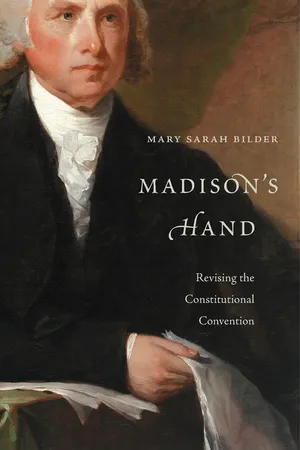
James Madison's Notes on the 1787 Constitutional Convention have long been treated as the definitive account of the Constitution's creation. No other document offers a fuller record of the deliberations in Philadelphia or portrays the Convention's charismatic figures, crushing disappointments, and hard-won compromises with such narrative force. But how reliable is this record?
In a groundbreaking study that combines digital tools with traditional textual analysis, Mary Sarah Bilder shows that Madison revised his Notes far more extensively than scholars had realized. Initially kept as a near-daily diary, the Notes were abandoned at a crucial point and left unfinished. Madison returned to them only years later, largely with Thomas Jefferson in mind as his audience—by which time his thinking had been reshaped by the new government's early struggles and Jefferson's political ideas. His evolving vision of republican government, his Virginia allegiances, his openness to constitutional protections for slavery, his interest in political maneuvering, and his portrayals of figures such as Alexander Hamilton and Charles Pinckney all shifted through successive rounds of revision. When the Notes were finally published in 1840, the layers of revision were invisible.
Madison's Hand uncovers the history of this influential manuscript and shows how a single, much-reworked document came to dominate our understanding of the Constitution's origins.
- 372 pages
- English
- ePUB (mobile friendly)
- Available on iOS & Android
eBook - ePub
About this book
Information
Publisher
Harvard University PressYear
2015Print ISBN
9780674979741
9780674055278
eBook ISBN
9780674495500
Topic
HistoriaSubtopic
Historia americana tempranaNOTES
Introduction
1. James Madison, Notes, JMP (DLC); PJM (Gilpin). For label, see digital images of Notes from Library of Congress provided to author with images labeled James Madison, Debate Notes, 1787, GR no. 142 (May 2003). On Treasures, see “American Treasures of the Library of Congress: Top Treasures Gallery,” DLC, www.loc.gov/exhibits/treasures/tr00.html#caselist. I am indebted to Jack Rakove who suggested that this book was a “biography” of the Notes.
2. Notes survive in original or revised form by Robert Yates, John Lansing, Rufus King, William Pierce, Alexander Hamilton, James Wilson, James McHenry, George Mason, Pierce Butler, Gunning Bedford, and William Paterson. For discussion of other note takers, see RFC, 1:xiv–xxii; SRFC, xviii. On official record, see Mary Sarah Bilder, “How Bad Were the Official Records of the Federal Convention?” George Washington Law Review 80, no.6 (2012): 1620–1682. For modern editions, see [James Madison], The Debates in The Federal Convention of 1787 which Framed the Constitution of the United States of America, eds. Gaillard Hunt and James Brown Scott (New York: Oxford University Press, 1920); Edward J. Larson and Michael P. Winship, The Constitutional Convention: A Narrative History from the Notes of James Madison (New York: Random House, Modern Library, 2005).
3. Outranks in, The Writings of James Madison, ed. Gaillard Hunt (New York: G. P. Putnam’s Sons, 1902), 3:ix. at once, Max Farrand, “The Records of the Federal Convention,” American Historical Review 13 (1907): 44–65, quotation at 51–52; John P. Kaminski, “Madison’s Gift,” Common Place, 2, no. 4 (July 2002), http://common-place.org. For reprints, see James Madison, The Debates in the Federal Convention of 1787 (Amherst, NY: Prometheus Books, 2007); Larson and Winship, Constitutional Convention.
4. Them transcribed, see Dolley P. Madison to the President (A. Jackson), 15 November 1836, in PJM (Gilpin), 1:xvi. For facsimile, see “Fac-simile of the last page of Mr. Madison’s Manuscript Debates of the Convention” in “Fac-similes of the Manuscripts of Mr. Madison carefully copied from the originals … ,” PJM (Gilpin), 3:[backmatter after ccxlvi]; Eric Slauter, The State as a Work of Art: The Cultural Origins of the Constitution (Chicago: University of Chicago Press, 2009), 1–8. For publications, see DHC, 3; RFC. the Debates, Charles R. Keller and George W. Pierson, “A New Madison Manuscript Relating to the Federal Convention of 1787,” American Historical Review 36 (October 1930): 17–30.
5. There has, SRFC, xx; see also James H. Hutson, “The Creation of the Constitution: The Integrity of the Documentary Record,” Texas Law Review 65 (1986): 1–39; James H. Hutson, “Riddles of the Federal Constitutional Convention,” William and Mary Quarterly 44 (1987): 411–423. On Hamilton charge, see John C. Hamilton, The Life of Alexander Hamilton, 2nd ed. (New York, D. Appleton & Co., 1841), 2:490–492 n.† & n. 492 n.*; John C. Hamilton, History of the Republic of the United States as traced in the writings of Alexander Hamilton (New York: D. Appleton, 1859), 3:301–302, 340, 344–348. For Crosskey claims, see William W. Crosskey, Politics and the Constitution in the History of the United States (Chicago: University of Chicago Press, 1953), 1:313 (addressing August 21 Notes), 2:1021 (addressing August 15 Notes); William W. Crosskey, “The Ex-Post-Facto Clause and the Contracts Clauses in the Federal Convention: A Note on the Editorial Ingenuity of James Madison,” University of Chicago Law Review 35 (1968) (posthumously published from repeatedly revised draft): 248–254 (addressing August 28 Notes). On claim rejection, see Irving Brant, James Madison: Commander in Chief, 1812–1836 (New York: Bobbs-Merrill Company, 1961), 435, 571 n. 18; SRFC, xxi–xxiii; Hutson, “Riddles,” 411–423.
6. Inspired by, Larson and Winship, Constitutional Convention, 10. impresses, Bernard Bailyn, The Ordeal of Thomas Hutchinson (Cambridge: Harvard University Press, 1974), ix.
7. Great collaboration, Adrienne Koch, Jefferson and Madison: The Great Collaboration (New York: Knopf, 1950). Andrew Burstein and Nancy Isenberg give more attention to the 1780s in their chapter, “Partners Apart,” in Madison and Jefferson (New York: Random House, 2010).
8. They are far, Hutson, “The Creation of the Constitution: The Integrity,” 1, 35. no more, Frederic Irland, “The Reporter Who Became President,” McClure’s Magazine 24 (1905): 258–265; see also Hutson, “The Creation of the Constitution: The Integrity,” 1, 33–34 (estimating 7–10% of proceedings at best). Madison could not, Hutson, “The Creation of the Constitution: The Integrity,” 35. Madison’s diligence, Richard Beeman, Plain, Honest Men: The Making of the American Constitution (New York: Random House, 2009), 85.
9. Lance Banning, The Sacred Fire of Liberty: James Madison and the Founding of the Federal Republic (Ithaca, NY: Cornell University Press, 1995), 8.
10. For an overview of the scholarship, see Alan Gibson, “Inventing the Extended Republic: The Debate over the Role of Madison’s Theory in the Creation of the Constitution,” in James Madison: Philosopher, Founder, and Statesman, eds. John R. Vile, William D. Pederson, and Frank J. Williams (Athens: Ohio University Press, 2008), 63–87. Excellent discussions of the conventional reading of the Vices and Federalist 10 are Larry D. Kramer, “Madison’s Audience,” Harvard Law Review, 112 (1999), 611–679, and Jack Rakove’s writing, in particular, James Madison and the Creation of the American Republic (Glenview, IL: HarperCollins, 1990); Rakove, “James Madison and the Extended Republic: Theory and Practice in American Politics,” in This Constitution: A Bicentennial Chronicle (Fall 1985), published by Project ’87 of the American Political Science Association and American Historical Association. Over the past decade, political scientists such as Colleen Sheehan, Alan Gibson, Robert Martin, Jenna Bednar, and many others have written abundantly on the extensive republic and federalism. Recent historians and legal scholars who have focused on the relationship to the Constitution include Charles Hobson, Larry Kramer, Jack Rakove, Garry Wills, Gordon Wood, and Stuart Leibiger.
11. The relationship between “population and constitution-making” was emphasized in a note to the apportionment numbers in the first volume of The Documentary History of the Ratification of the Constitution, edited by Merrill Jensen in 1976 with associate editors John Kaminski and Gaspare Saladino. DHRC, 1:297–301. Recent scholarship emphasizing the relationship between slavery and political power includes works by David Waldstreicher, George William Van Cleve, John Kaminski, Paul Finkelman, Robin Einhorn, Matthew Mason, Don Fehrenbacher, Mark Graber, Gary Nash, and authors represented in Contesting Slavery: The Politics of Bondage and Freedom in the New American Nation (Charlottesville: University of Virginia Press, 2011).
12. For scholarship on the documentary record, see John Franklin Jameson, “Studies in the History of the Federal Convention of 1787,” Annual Report of the American Historical Association (1902), 1:87–167 and works by Paul L. Ford, Worthington Ford, Gaillard Hunt, Max Farrand, William Crosskey, Irving Brant, James Hutson, Leonard Rapport, John Kaminski, and the editors of the Madison and Jefferson Papers. A helpful bibliographic aid is Carol D. Billings, “Sources for the Study of the Constitutional Era: A Bibliographic and Historiographical Essay,” Law Library Journal, 81 (1989): 47–67. The paper collections of particular assistance to this book have been those of Madison, Jefferson, Dolley Madison, Alexander Hamilton, and George Washington, as well as the various collections related to the old Congress and the first Federal Congress. Historians and political scientists include Douglass Adair, Joyce Appleby, Bernard Bailyn, Charles Beard, Richard Bernstein, Max Edling, Alan Gibson, David Hendrickson, Charles Hobson, David Konig, Forrest McDonald, Pauline Maier, R. Kent Newmyer, Jack Rakove, Michael Kammen, John Vile, Gordon Wood, and Peter Onuf. Legal scholars and legal historians include, among numerous others, Akhil Amar, Bruce Ackerman, Fabio Arcila, Hans Baade, Jack Balkin, Raoul Berger, Boris Bittker, Steven Calabresi, Thomas Colby, Saul Cornell, William Ewald, Daniel Farber, James Fleming, Barry Friedman, Jamal Greene, John Harrison, Richard Kay, Vasan Kesavan, Leonard Levy, Charles Lofgren, Gregory Maggs, John Manning, Maeva Marcus, William Meigs, Edwin Meese, Bernie Meyler, John Mikail, Robert Natelson, Caleb Nelson, Michael Stokes Paulsen, H. Jefferson Powell, Saikrishna Prakash, Michael Rappaport, Stephen Sachs, Suzanne Sherry, Louis Sirico, Peter Smith, Steven Smith, Lawrence Solum, Jacobus tenBroek, William Michael Treanor, Keith Whittington, and John Wofford. Narrative accounts have been written by Richard Beeman, Carol Berkin, Catherine Drinker Bowen, Frank Donovan, Max Farrand, Clinton Rossiter, David Stewart, as well as helpful compilations on the Convention by John Vile. On Madison and his circle, see Robert Alley, Lance Banning, Irving Brant, James Scott Brown, Edward Burns, Charles Cerami, Lynne Cheney, Francis Cogliano, Donald Dewey, Susan Dunn, Joseph Ellis, Joanne Freeman, Robert Goldwin, John Kaminski, Ralph Ketcham, Adrienne Koch, Richard Labunski, Stuart Leibiger, David Mattern, Richard Matthews, Drew McCoy, Marvin Meyers, Michael Meyerson, William Lee Miller, Gary Padula, Jack Rakove, Neal Riemer, Gary Rosen, Robert Rutland, Colleen Sheehan, Garrett Ward Sheldon, Sheila Simon, J. C. A. Stagg, Garry Wills, and the authors of essays in collected volumes (James Madison and the Future of Limited Government, ed. John Samples (Washington: Cato Institute, 2002); James Madison: The Theory and Practice of Republican Government, ed. Samuel Kernell (Stanford: Stanford University Press, 2003); James Madison: Philosopher, Founder, and Statesman, eds. John R. Vile, William D. Pederson, Frank J. Williams (Athens: Ohio University Press, 2008)). Scholars in the history of the book as it relates to legal texts include M. T. Clanchy, Walter Ong, David Hall, Ann Blair, Anthony Grafton, Robert Darnton, Eric Slauter, Alfred Brophy, Morris Cohen, John Gordan, Michael Hoeflich, Richard Ross, Stephen Wilf, and authors represented in two recent col...
Table of contents
- Cover
- Title Page
- Copyright
- Dedication
- Contents
- The Expository Society
- Part One: Clearing the Ground
- Part Two: The Birth of the Expository Society
- Part Three: The Perils of Digital Exposure
- Part Four: Digital Disobedience
- Notes
- Acknowledgments
- Index
Trusted by 375,005 students
Access to over 1.5 million titles for a fair monthly price.
Study more efficiently using our study tools.
Frequently asked questions
Yes, you can cancel anytime from the Subscription tab in your account settings on the Perlego website. Your subscription will stay active until the end of your current billing period. Learn how to cancel your subscription
No, books cannot be downloaded as external files, such as PDFs, for use outside of Perlego. However, you can download books within the Perlego app for offline reading on mobile or tablet. Learn how to download books offline
Perlego offers two plans: Essential and Complete
- Essential is ideal for learners and professionals who enjoy exploring a wide range of subjects. Access the Essential Library with 800,000+ trusted titles and best-sellers across business, personal growth, and the humanities. Includes unlimited reading time and Standard Read Aloud voice.
- Complete: Perfect for advanced learners and researchers needing full, unrestricted access. Unlock 1.5M+ books across hundreds of subjects, including academic and specialized titles. The Complete Plan also includes advanced features like Premium Read Aloud and Research Assistant.
We are an online textbook subscription service, where you can get access to an entire online library for less than the price of a single book per month. With over 1.5 million books across 990+ topics, we’ve got you covered! Learn about our mission
Look out for the read-aloud symbol on your next book to see if you can listen to it. The read-aloud tool reads text aloud for you, highlighting the text as it is being read. You can pause it, speed it up and slow it down. Learn more about Read Aloud
Yes! You can use the Perlego app on both iOS and Android devices to read anytime, anywhere — even offline. Perfect for commutes or when you’re on the go.
Please note we cannot support devices running on iOS 13 and Android 7 or earlier. Learn more about using the app
Please note we cannot support devices running on iOS 13 and Android 7 or earlier. Learn more about using the app
Yes, you can access Madison’s Hand by Mary Sarah Bilder in PDF and/or ePUB format, as well as other popular books in Historia & Historia americana temprana. We have over 1.5 million books available in our catalogue for you to explore.