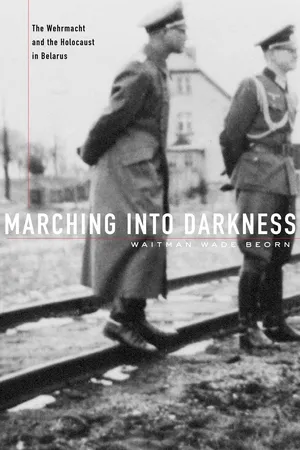
On October 10, 1941, the entire Jewish population of the Belarusian village of Krucha was rounded up and shot. While Nazi death squads routinely carried out mass executions on the Eastern Front, this particular atrocity was not the work of the SS but was committed by a regular German army unit acting on its own initiative. Marching into Darkness is a bone-chilling exposé of the ordinary footsoldiers who participated in the Final Solution on a daily basis.
Although scholars have exploded the myth that the Wehrmacht played no significant part in the Holocaust, a concrete picture of its involvement at the local level has been lacking. Among the crimes Waitman Wade Beorn unearths are forced labor, sexual violence, and graverobbing, though a few soldiers refused to participate and even helped Jews. By meticulously reconstructing the German army's activities in Belarus in 1941, Marching into Darkness reveals in stark detail how the army willingly fulfilled its role as an agent of murder on a massive scale. Early efforts at improvised extermination progressively became much more methodical, with some army units going so far as to organize "Jew hunts." Beorn also demonstrates how the Wehrmacht used the pretense of anti-partisan warfare as a subterfuge by reporting murdered Jews as partisans.
Through archival research into military and legal records, survivor testimonies, and eyewitness interviews, Beorn paints a searing portrait of a professional army's descent into ever more intimate participation in genocide.
- English
- ePUB (mobile friendly)
- Available on iOS & Android
eBook - ePub
About this book
Information
CHAPTER ONE
The Deadliest Place on Earth
PERHAPS NO PLACE in the former occupied Soviet territories deserves historical attention more than the present-day country of Belarus, which suffered a demographic disaster during World War II from which it is still recovering. It was most assuredly, as Tim Snyder notes, “the deadliest place on earth between 1941 and 1944.”1 Yet the experience of the Belarusians under Nazi rule has been by and large absent from the West’s widely popularized images of the Holocaust, such as Anne Frank and Auschwitz. Indeed, the Holocaust in Belarus can in many ways be defined by its local and personal nature. The majority of its victims met their deaths in or around the towns in which they had lived their whole lives, without ever having seen an extermination center like Auschwitz or Treblinka.
This other Holocaust remained remote for the Western public not just as a function of its physical distance. First, many of the Holocaust survivors who made it to the United States, for example, had passed through the concentration camp system. They were collected in displaced-persons camps in Germany before being allowed to emigrate. Thus, this group had a Holocaust experience defined in large part by the camp experience. Second, the almost immediate commencement of the Cold War made the West most reluctant to recognize the very real Soviet suffering under Nazi rule, as the Soviet Union had become the new enemy. Lastly, for a variety of reasons, the Soviet government itself was not interested in distinguishing any specifically Jewish victims from the rest of the victims of the “fascist occupiers.” This is particularly tragic, as up to one-third of all Jews who died in the Holocaust were under Soviet rule in 1940.2 Yet, from the Soviet perspective, where over twenty million Soviets had perished during the war, Jewish suffering was, numerically, just a small part of an immense loss.
This Soviet reluctance to officially commemorate Jewish suffering can be explained in several ways. There was first the ideological problem presented by Marxism, which could not recognize specifically Jewish suffering without recognizing nationality and ethnicity as legitimate social classes; this was deeply problematic for a political system based on the belief that only economic class divided peoples. There were other, less intellectual factors behind the marginalization of the Holocaust in the Soviet Union. After the war, the Soviet government and not least Stalin himself became increasingly antisemitic. Stalin, who had created a Jewish anti-fascist committee during the war, had the same group imprisoned or murdered after it.3 A lingering antisemitism had lasting effects, as can be seen in the suppression of the Black Book of Soviet Jewry, which chronicled the Holocaust and the less-than-respectful treatment of the Babi Yar massacre site where over thirty thousand Jews had been murdered; it was first turned into lake and has now been paved over. Thus, both international and domestic politics have marginalized the massive suffering of Jews in the Soviet Union as an aspect of our understanding of the Holocaust.
This is particularly unfortunate, as the scale of the human tragedy for all Belarusians resulting directing from Nazi policy was extraordinary. Seven hundred thousand Soviet prisoners of war were murdered or deliberately starved. Between 500,000 and 550,000 Jewish men, women, and children were murdered, as well as over 400,000 other civilians. In addition, 340,000 individuals were deported to the Reich as slave labor.4 It is estimated that one in three Belarusians died during World War II. The experience of Margarita Kosenkova is probably typical. Before she began describing the murder of the Jews in her hometown, she told her own family story of World War II in the East. Her father and brother were burned to death in a barn by the Germans. Her mother perished in a Nazi concentration camp in Belarus. One of her brothers died at the front as a Red Army soldier. She survived in the forests with her aunt after fleeing her native village.5 Because the true horror of the Nazi genocidal project was visible in all its incarnations in Belarus, this land is fertile ground for investigating the Wehrmacht’s role in that endeavor.
Part of the reason for the scale of destruction in Belarus can be found in its history. Belarus is truly—as sociologist Andrew Savchenko noted—a “perpetual borderland.”6 Indeed, no Belarusian state as such even existed before the twentieth century. It is a generally flat country, heavily forested, with large marshy areas to the south. The rivers Dnieper and Berezina have been highways through the region from Roman times, as was the Pripyat River to the south, connecting the Dnieper to the Vistula and thus to Poland. The Vikings traveled an arduous combination of these rivers to trade with the Byzantine Empire. With major population centers in Minsk, Gomel, Mogilev, Vitebsk, Brest, and Grodno, Belarus is now home to around ten million people.
For over a thousand years, the region formed part of other nations and empires, beginning with the Grand Duchy of Lithuania, which expanded to include all of modern-day Belarus in the mid-thirteenth century. Belarus remained part of the Grand Duchy for five hundred years before becoming part of the Russian Empire in the eighteenth century. The important Magdeburg Statutes granted self-rule to certain Belarusian cities, establishing them as centers of commerce, beginning in the fourteenth century. This fostered contact with western Europe, which in turn “ensured a fertile reception in Belarus of Renaissance and humanist ideas and values” and led to a “historical exposure to diverse intellectual currents … and traditional religious tolerance [which are] a major source of cultural difference between Belarus and its eastern neighbor, Russia.”7 The 1897 census, which lists nine separate nationalities (Belarusians, Jews, Russians, Poles, Ukrainians, Lithuanians, Latvians, Germans, and Tatars), indicates the multiethnic and multilinguistic nature of the area.8
Jews began arriving in large numbers from western Europe in the fourteenth century, many as a result of the increasingly numerous expulsions there. Skill in trades and finance was valued by the rulers of the region, and some Jews enjoyed considerable freedoms. Most Jews were poorer merchants, traders, and craftsmen, limited in their economic opportunities, forbidden to own land, and excluded from certain guilds. Here, as elsewhere in eastern Europe, much of Jewish life centered on the shtetl. Jews lived together in towns and villages, where they often formed the majority of the population; they traded with and provided services to non-Jewish peasants. Often they worked as traveling peddlers or pawnbrokers. Those better off served as middlemen between the farmers and larger markets, buying livestock and grain wholesale, or as tax farmers and estate managers for the nobility. For most in the shtetl, it was a hard life, with a slim margin. This is not to say that all was misery and poverty. These small communities had lively religious and cultural lives that at least somewhat compensated for the hardships of daily life. In towns and cities, where they often formed a large percentage or even a majority of the urban population, Jews lived in a Jewish street or quarter. This geographic and occupational concentration persisted until World War II.
By 1795, Belarus had become part of the Russian Empire in the wake of three great-power partitions of Poland. In the context of a struggle between Russia and its subject peoples in the region, the empire put down several nationalist uprisings in the nineteenth century. Particularly in western Belarus, which was mostly ethnically Polish, the tsars attempted to repress Belarusian national consciousness and to “Russianize” these areas. For Jews, annexation into the Russian Empire meant forced concentration in the Pale of Settlement, an area that stretched from Lithuania to the Crimea and included much of Belarus. According to the 1897 census, over 97 percent of Russian Jews lived inside the Pale.9 It was possible to legally escape the Pale under the tsars, but this opportunity was generally limited to the wealthier and more educated, a trend that worked to keep the remaining population poor and disadvantaged.
Still, Jewish settlements in Belarus, while more isolated and more traditional than those in the West, were nonetheless vibrant and diverse communities. They were marked, for example, by a commitment to education (Jews in Belarus had a literacy rate of 94 percent in 1939).10 This was due in large part to the high number and quality of Yiddish schools. Like Jewish communities elsewhere, the shtetls contained a variety of charitable organizations (tzedekahs), from loan organizations to aid for the elderly, which supported the members of the Jewish community in a nation that had marginalized them. Throughout the Pale, Jews strove to maintain the separate yet parallel administrative structures that formed a sort of self-government.
Belarus (or more accurately the parts of Poland and Russia it would later encompass) was also an important part of Jewish religious life. This area of eastern Europe saw the explosive expansion of Hasidism in the eighteenth century. This more charismatic version of Judaism that centered on important religious prophets and mysticism was a vital element in daily life, as ever-increasing numbers of eastern European Jews began practicing this more unifying and accessible form. Of course, the development of Hasidism was not without strife. More conservative Jews centered in Lithuania and known as the Mitnagadim (“those who oppose”) rejected this unscholarly and more ecstatic approach, advocating instead a rigorous, intellectual approach to Judaic texts. Throughout the eighteenth and nineteenth century, these two branches of Judaism and an accompanying religiosity were well represented throughout Belarus. This vibrant religious life was reflected geographically with famous yeshivas for Torah study in many towns, such as Minsk, Bobruisk, Slonim, Lida, Novogrudok, and Baranovichi, and many Hasidic dynasties appearing throughout the region.11
Under the tsars, Jews suffered periodically from both governmental oppression in the form of formal anti-Jewish laws and informal pogroms. The Chmielnicki massacres of Jews, which took place in Ukraine during an uprising of Cossacks against Polish rule, held a particularly prominent place in eastern European Jewish memory. Deadly pogroms such as those following the assassination of Alexander II in 1881, a tsar who had cautiously approached reform, were not infrequent. Indeed, these violent outbursts spurred much of the immigration of eastern European Jews to the United States during the last decades of the nineteenth century and up until World War I. However, systematically sustained mass violence was the exception rather than the rule. The bizarre combination of Jewish autonomy and ancient hatreds can be seen in the town of Slonim, where Jews were elected to a majority in the town council in 1921 in spite of the fact that a week earlier blood libel charges had been brought against a local Jew, who had subsequently been beaten and imprisoned.12
During the First World War, the Germans occupied practically all of Belarus until 1918. They confronted there a complex ethnic, religious, and linguistic landscape. As historian Vejas Liulevicius writes, “the terms of national identity [in the East] seemed unfamiliar and dangerously unstable to the newcomers.”13 The German military administration struggled to sort out the diverse groups in the East. It also sought to bring Kultur (German culture and civilization) to the region in the form of education, economic improvements, and cultural events. Though certainly paternalistic and often heavy-handed, the German occupation during World War I was an ambivalent one, which resulted in some very real improvements. For example, in Borisov near Minsk, electric lighting arrived for the first time with the German occupation troops.14 While latent German antisemitism occasionally presented itself, the occupation was not on the whole hostile to Jews; for example, cultural authorities in Ober Ost, the massive German military administration, took pains to protect Jewish “sacred objects” and artifacts, such as precious seventeenth- and eighteenth-century wooden synagogues.15 The character of this occupation would color the expectations and reactions of Jews and non-Jews alike to the arrival of the Nazis, often leading them to expect a more lenient experience, similar to what they remembered from the First World War.
The Bolshevik Revolution and post–World War I battles with Poland resulted in the division of Belarus between the Soviet Union and Poland at the Treaty of Riga in 1921. This left a small, largely powerless Belarusian Soviet Socialist Republic, which had been formed in 1919, while the remainder of Belarusian territory was incorporated completely into Poland without any recognition of its own particular demographic composition or historical background. This partition had significant impacts for both Jews and non-Jews. Indeed, this was a tale of two polities. By 1926, the Belarusian Soviet Socialist Republic (BSSR) had more than doubled in size to 48,500 square miles (125,000 sq km) and quintupled in population to almost five million. This territory came from the inclusion of Belarusian “ethnographic areas” that had remained within the Russian republic. Some 82 percent of Belarusians lived in rural areas, and 91 percent were peasants.16
The Bolshevik New Economic Policy began to slowly change this, increasing industrialization, commerce, and urbanization. Education also improved. In addition, in the 1920s and 1930s, emigration of younger Jews from the more traditional shtetls to the cities increased. However, to a large extent, these shtetls “preserved [their] unique character right up to the outbreak of the war with Nazi Germany.”17 A 1924 decree established equal language rights for Russian, Belarusian, Yiddish, and Polish.18 Hebrew was outlawed as a bourgeois language, and Hebrew schools and language education were repressed. Still, Yiddish enjoyed a resurgence, as the Soviets viewed it as a proletarian language.
The Bolshevik Revolution proved to be a mixed blessing. The USSR’s need for “literate cadres provided numerous economic opportunities,” and the state “assigned the Jews the status of a national minority, with all the advantages attached to it in the Soviet...
Table of contents
- Cover
- Half Title
- Title Page
- Copyright
- Contents
- Maps
- Introduction
- 1. The Deadliest Place on Earth
- 2. A Weapon of Mass Destruction
- 3. Improvised Murder in Krupki
- 4. Mogilev and the Deliberate Targeting of Jews
- 5. An Evil Seed Is Sown
- 6. Making Genocide Routine
- 7. The Golden Pheasant and the Brewer
- 8. Hunting Jews in Szczuczyn
- 9. Endgame
- Conclusion
- Illustrations
- Abbreviations
- Notes
- Acknowledgments
- Index
Trusted by 375,005 students
Access to over 1.5 million titles for a fair monthly price.
Study more efficiently using our study tools.
Frequently asked questions
Yes, you can cancel anytime from the Subscription tab in your account settings on the Perlego website. Your subscription will stay active until the end of your current billing period. Learn how to cancel your subscription
No, books cannot be downloaded as external files, such as PDFs, for use outside of Perlego. However, you can download books within the Perlego app for offline reading on mobile or tablet. Learn how to download books offline
Perlego offers two plans: Essential and Complete
- Essential is ideal for learners and professionals who enjoy exploring a wide range of subjects. Access the Essential Library with 800,000+ trusted titles and best-sellers across business, personal growth, and the humanities. Includes unlimited reading time and Standard Read Aloud voice.
- Complete: Perfect for advanced learners and researchers needing full, unrestricted access. Unlock 1.5M+ books across hundreds of subjects, including academic and specialized titles. The Complete Plan also includes advanced features like Premium Read Aloud and Research Assistant.
We are an online textbook subscription service, where you can get access to an entire online library for less than the price of a single book per month. With over 1.5 million books across 990+ topics, we’ve got you covered! Learn about our mission
Look out for the read-aloud symbol on your next book to see if you can listen to it. The read-aloud tool reads text aloud for you, highlighting the text as it is being read. You can pause it, speed it up and slow it down. Learn more about Read Aloud
Yes! You can use the Perlego app on both iOS and Android devices to read anytime, anywhere — even offline. Perfect for commutes or when you’re on the go.
Please note we cannot support devices running on iOS 13 and Android 7 or earlier. Learn more about using the app
Please note we cannot support devices running on iOS 13 and Android 7 or earlier. Learn more about using the app
Yes, you can access Marching into Darkness by Waitman Wade Beorn in PDF and/or ePUB format, as well as other popular books in History & German History. We have over 1.5 million books available in our catalogue for you to explore.