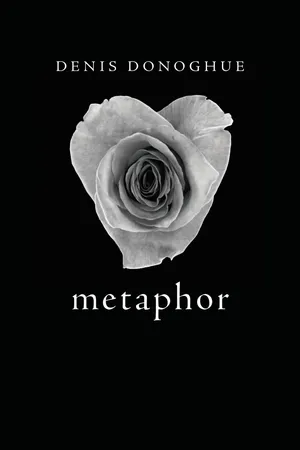
Denis Donoghue turns his attention to the practice of metaphor and to its lesser cousins, simile, metonym, and synecdoche. Metaphor ("a carrying or bearing across") supposes that an ordinary word could have been used in a statement but hasn't been. Instead, something else, something unexpected, appears. The point of a metaphor is to enrich the reader's experience by bringing different associations to mind. The force of a good metaphor is to give something a different life, a new life. The essential character of metaphor, Donoghue says, is prophetic. Metaphors intend to change the world by changing our sense of it.
At the center of Donoghue's study is the idea that metaphor permits the greatest freedom in the use of language because it exempts language from the local duties of reference and denotation. Metaphors conspire with the mind in its enjoyment of freedom. Metaphor celebrates imaginative life par excellence, from Donoghue's musings on Aquinas' Latin hymns, interspersed with autobiographical reflection, to his agile and perceptive readings of Wallace Stevens.
When Donoghue surveys the history of metaphor and resistance to it, going back to Aristotle and forward to George Lakoff, he is a sly, cogent, and persuasive companion. He also addresses the question of whether or not metaphors can ever truly die. Reflected on every page of Metaphor are the accumulated wisdom of decades of reading and a sheer love of language and life.
eBook - ePub
Metaphor
About this book
Information
Notes
Introduction
1. I. A. Richards, Practical Criticism: A Study of Literary Judgment (New York: Harcourt, Brace and World, 1929), p. 221.
2. T. S. Eliot, Collected Poems 1909–1962 (London: Faber and Faber, 1974), pp. 77–78.
3. Cyril Tourneur, The Revenger’s Tragedy (London: Nick Hern Books, 1996), pp. 54, 93.
4. Seamus Heaney, Human Chain (New York: Farrar, Straus and Giroux, 2010), p. 49.
5. J. Hillis Miller, Others (Princeton: Princeton University Press, 2001), p. 66.
6. James Wood, The Irresponsible Self: On Laughter and the Self (New York: Picador, 2005), p. 297.
7. T. S. Eliot, On Poetry and Poets (London: Faber and Faber, 1957), pp. 76–77.
8. Anonymous, “Roderick Hudson,” The Nation (March 9, 1876), n.p.
9. Henry James, Roderick Hudson (New York: Read Books, Ltd., 2012, reprint of the 1st ed., 1875), ch. 11, p. 394.
10. Pierre A. Walker and Greg W. Zacharias, eds., The Complete Letters of Henry James, 1872–1876, vol. 3 (London and Lincoln: University of Nebraska Press, 2011), p. 90 (letter of March 31, 1876). I am indebted to James Wood, How Fiction Works (New York: Farrar, Straus and Giroux, 2008), p. 206, for this reference. We are both indebted to Philip Horne, ed., Henry James: A Life in Letters (New York: Viking Penguin, 1999), pp. 67–69.
Figure
Paul Ricoeur, The Rule of Metaphor: The Creation of Meaning in Language, trans. Robert Czerny with Kathleen McLaughlin and John Costello, SG (London and New York: Routledge Classics, 2003), p. 19.
1. James Joyce, A Portrait of the Artist as a Young Man, ed. Seamus Deane (London: Penguin Books, 1992), p. 35.
2. Ibid.
3. Ibid., p. 43.
4. Alan Bennett writes: “26 August: When I was religious as a boy I used to envy Catholics who only had to say the words of the Mass and not have to mean them in the way that Anglicans did” (London Review of Books 35, 1 [January 3, 2013]: 34). Not entirely true. We could not have translated the Latin, but we felt the communal experience, and the knowledge that all over the world Catholics, like us, were celebrating the Eucharist, in Latin. I can’t comment on Anglicans.
5. Walter J. Ong, “Wit and Mystery: A Revaluation in Medieval Latin Hymnody,” Speculum 22, no. 3 (July 1947): 310–341.
6. Ibid., 311.
7. T. S. Eliot, “Andrew Marvell,” in Selected Essays: New Edition (New York: Harcourt, Brace and World, 1950), p. 252.
8. Guido Maria Dreves, ed., Hymnographi Latini, vol. 2 (Leipzig: Reisland, 1970), p. 586.
9. Peter G. Walsh, ed. and trans., with Christopher Husch, One Hundred Latin Hymns: Ambrose to Aquinas (Cambridge, MA: Harvard University Press, 2012), p. 365.
10. Ong, “Wit and Mystery,” p. 317.
11. Hugh Kenner, “Rhyme: An Unfinished Monograph,” Common Knowledge 10, no. 3 (2004): 424–425.
12. Roland Barthes, The Preparation of the Novel, trans. Kate Briggs (New York: Columbia University Press, 2011), p. 113.
13. Aquinas, “In Sententias Petri Lombardi Commentario,” prolog., qu.1, a.5, ad 3. Quoted in Ong, “Wit and Mystery,” p. 324.
14. Ong, “Wit and Mystery,” pp. 324–325.
15. Aquinas, Summa Theologiae 1/1, trans. Thomas Gilby (London: Eyre and Spottiswood, 1964), p. 35. Quoted in Hans Blumenberg, Paradigms for a Metaphorology, trans. Robert Savage (Ithaca: Cornell University Press, 2010), p. 45.
16. Aquinas, Summa Theologiae 1/1, p. 35.
17. Hugh Kenner, “Rhyme: An Unfinished Monograph,” Common Knowledge 10, no. 3 (2004): 424.
18. Walsh, One Hundred Latin Hymns, p. 367 (modified).
19. Ong, “Wit and Mystery,” pp. 317–318, n. 30, citing Dom André Wilmart, “La tradition littéraire et textuelle de l’Adoro Te deuote,” in Recherches de théologie ancienne et médiévale, vol. 1 (1929), p. 150.
20. Andrei Gotia, “Adoro Te Devote—A Synthesis of St. Thomas Aquinas’s Eucharistic Theology,” Verbum 6, no. 1 (2004): 112.
21. Robert Wielockx, “Poetry and Theology in the ‘Adoro te deuote’: Thomas Aquinas on the Eucharist and Christ’s Uniqueness,” in Christ among the Medieval Dominicans: Representations of Christ in the Texts and Images of the Order of Preachers, ed. Kent Emery Jr. and Joseph Wawrykow (Notre Dame: University of Notre ...
Table of contents
- Cover
- Half Title
- Title Page
- Copyright
- Dedication
- Contents
- Epigraph
- Introduction
- Figure
- After Aristotle
- No Resemblance
- “It Ensures That Nothing Goes without a Name”
- Not Quite against Metaphor
- The Motive for Metaphor
- Notes
- Acknowledgments
- Index
Trusted by 375,005 students
Access to over 1.5 million titles for a fair monthly price.
Study more efficiently using our study tools.
Frequently asked questions
Yes, you can cancel anytime from the Subscription tab in your account settings on the Perlego website. Your subscription will stay active until the end of your current billing period. Learn how to cancel your subscription
No, books cannot be downloaded as external files, such as PDFs, for use outside of Perlego. However, you can download books within the Perlego app for offline reading on mobile or tablet. Learn how to download books offline
Perlego offers two plans: Essential and Complete
- Essential is ideal for learners and professionals who enjoy exploring a wide range of subjects. Access the Essential Library with 800,000+ trusted titles and best-sellers across business, personal growth, and the humanities. Includes unlimited reading time and Standard Read Aloud voice.
- Complete: Perfect for advanced learners and researchers needing full, unrestricted access. Unlock 1.5M+ books across hundreds of subjects, including academic and specialized titles. The Complete Plan also includes advanced features like Premium Read Aloud and Research Assistant.
We are an online textbook subscription service, where you can get access to an entire online library for less than the price of a single book per month. With over 1.5 million books across 990+ topics, we’ve got you covered! Learn about our mission
Look out for the read-aloud symbol on your next book to see if you can listen to it. The read-aloud tool reads text aloud for you, highlighting the text as it is being read. You can pause it, speed it up and slow it down. Learn more about Read Aloud
Yes! You can use the Perlego app on both iOS and Android devices to read anytime, anywhere — even offline. Perfect for commutes or when you’re on the go.
Please note we cannot support devices running on iOS 13 and Android 7 or earlier. Learn more about using the app
Please note we cannot support devices running on iOS 13 and Android 7 or earlier. Learn more about using the app
Yes, you can access Metaphor by Denis Donoghue in PDF and/or ePUB format, as well as other popular books in Literature & Linguistics. We have over 1.5 million books available in our catalogue for you to explore.