When crisis requires American troops to deploy on American soil, the country depends on a rich and evolving body of law to establish clear lines of authority, safeguard civil liberties, and protect its democratic institutions and traditions. Since the attacks of 9/11, the governing law has changed rapidly even as domestic threats—from terror attacks, extreme weather, and pandemics—mount. Soldiers on the Home Front is the first book to systematically analyze the domestic role of the military as it is shaped by law, surveying America's history of judicial decisions, constitutional provisions, statutes, regulations, military orders, and martial law to ask what we must learn and do before the next crisis.
America's military is uniquely able to save lives and restore order in situations that overwhelm civilian institutions. Yet the U.S. military has also been called in for more coercive duties at home: breaking strikes, quelling riots, and enforcing federal laws in the face of state resistance. It has spied on and overseen the imprisonment of American citizens during wars, Red scares, and other emergencies. And while the fears of the Republic's founders that a strong army could undermine democracy have not been realized, history is replete with reasons for concern.
At a time when the military's domestic footprint is expanding, Banks and Dycus offer a thorough analysis of the relevant law and history to challenge all the stakeholders—within and outside the military—to critically assess the past in order to establish best practices for the crises to come.
eBook - ePub
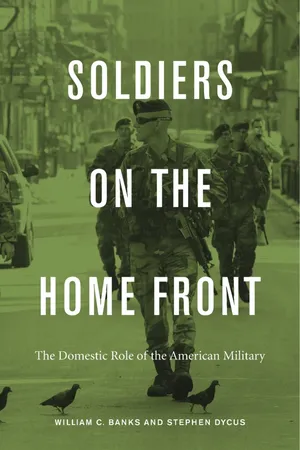
Soldiers on the Home Front
The Domestic Role of the American Military
- 350 pages
- English
- ePUB (mobile friendly)
- Available on iOS & Android
eBook - ePub
About this book
Information
CHAPTER ONE
The Military at Home in America
Think of the U.S. military as part of a large cast of characters in a dramatic production of domestic life in America. Troops have always played a key role. They have always stood ready to use their special training, equipment, and discipline to help out in emergencies when no else could. They have served bravely in the midst of hurricanes and forest fires to save lives and property. They have enforced the law when civilian officials were unwilling to do so. And they have helped restore order when civil unrest overwhelmed local authorities.
Most of the time, however, America’s military forces have remained behind the curtain, out of sight, waiting in the wings for a cue from their civilian director to step out onto the public stage and perform. Everyone in the theater knows their lines and recognizes their distinctive costumes, but no one else can play their part. When they have stepped into the spotlight they have almost always received a standing ovation.
Here is a recent example:
When Hurricane Katrina struck New Orleans and surrounding areas in 2005, political posturing and ineptness by federal and state officials, together with a Keystone Cops–like response from local leaders in the first days before and after landfall, made a bad situation worse. Only when combined National Guard forces from several states, the Coast Guard, and the regular army were finally deployed did help come to most of the storm victims. But for the many heroic rescues by these men and women in uniform, along with lots of heavy lifting to provide medical care, food, and water, the casualties from Katrina would have been much worse. Troops also helped restore order in the stricken city. Otherwise scathing after-action reports on Katrina gave high marks to military personnel.
Occasionally, military forces have gone off script to become involved in civilian life when their help was not needed. More often than not they have been goaded to do so by civilian political leaders. Then they were greeted by silence from the audience, sometimes even catcalls. One notable instance grew out of the arrest of a suspected terrorist:
On an otherwise unremarkable day in May 2002, a flight from Zürich landed at Chicago’s O’Hare Airport and taxied to the gate. FBI agents were waiting to take one of the passengers, José Padilla, into custody. They had a warrant that described him as a material witness in the ongoing investigation of the 9/11 terrorist attacks on the World Trade Center and the Pentagon. Padilla was transported to New York City and confined in the Metropolitan Correctional Center there, while he waited to be called to testify before a grand jury.As a former Chicago street gang member who had served time for murder and other offenses, Padilla was not a particularly sympathetic character. According to information reportedly obtained by CIA agents from terrorist suspect Abu Zubaydah, Padilla had traveled to Afghanistan for training with Al Qaeda, and he was returning home with plans to carry out a terrorist attack using a radioactive “dirty bomb” in the United States.Padilla was assigned a public defender, who quickly moved to dismiss the material witness warrant. Two days before a scheduled hearing on the motion, however, President George W. Bush signed an order naming Padilla an “enemy combatant” and directing his delivery to military officials. He was then transferred to a Navy brig in Charleston, South Carolina, where he was held for almost four years without charges and, for much of that time, without access to a lawyer.
Whether or not Padilla was guilty of the charges eventually brought against him (he was later convicted of different terrorism-related offenses by a civilian court), public safety clearly did not require his imprisonment by the military. The civilian facilities in New York held him securely.
In the future, America’s military might be called on to help out in ways wholly unexpected—in effect to perform improv. Consider this frightening, yet altogether plausible scenario:
While on a business trip to Macau, an American shakes hands with a hotel restaurant chef who is in the midst of preparing a pork dish for dinner. Unbeknown to either of them, the pig had recently ingested a bit of virus-infected banana dropped into its feeding area by an infected bat. When the American arrives home in Minneapolis a few days later, she is very sick with flu-like symptoms, and before she dies a few hours later she infects her husband and son. Other travelers on her trip home were also exposed. Within a few days the virus has spread around the world, and more than one quarter of those infected have died.As the Centers for Disease Control (CDC) works around the clock to identify the virus and develop an antidote, the outbreak continues to spread. Casualties mount and major metropolitan areas struggle to maintain essential infrastructure and services. State governors deploy National Guard units to transport those who show symptoms of the virus to medical facilities, and to patrol urban streets and neighborhoods to prevent looting and help control spreading panic. Food and other basic human needs are in short supply, and local law enforcement is collapsing in many cities, as overtaxed National Guard personnel are overwhelmed by the scope of the contagion. The president decides to call out regular army units to help.The combined military force is able to provide some relief in the cities with the delivery of emergency food, water, and medical supplies. They also stop some of the looting and violence (some directed at citizens who have stockpiled food and water). As days and weeks pass without an antidote to the virus, however, confusion grows about lines of authority among state and federal officials, as well as fatigue, leading to violent confrontations between military personnel and civilians, and open hostility between National Guard units and regular army personnel deployed in the same areas. Governors, mayors, and the president plead for patience. Meanwhile, army commanders in some of our largest cities begin planning for martial law.
This plot summary for a Hollywood movie shows that the very survival of the nation might depend on the intervention of military forces at home. Their involvement, however, could threaten some of the most basic principles of American government.
Our theater metaphor illustrates the need for balance in considering the military’s domestic role—a balance between freedom and security. One former movie actor, President Ronald Reagan, described the balance this way: “The primary objective of U.S.… security policy is to protect the integrity of our democratic institutions … embodied in the Declaration of Independence and the Constitution.”1 Reagan’s statement underscores the vulnerability of those institutions, and indeed of our very political identity. It stresses their defense as our highest priority, perhaps employing the military in that defense. It also suggests a perennial tension in our society—that actions perceived as needed to protect the lives and property of Americans may be unconstitutional, while efforts to defend democracy and the rule of law may compromise public safety.
History shows that we must expect the unexpected. It also demonstrates the importance of taking reasonable steps now to prepare for whatever domestic emergencies may arise in the future, even though we cannot predict the precise shape or scope of those crises. Two considerations seem particularly important here: (1) we should anticipate calling on military forces to help out if civilian agencies are not up to the job, and (2) we ought to be able to predict the military’s response with some measure of certainty. Planning should, in other words, reflect the balance suggested by President Reagan—reasonable flexibility to meet unforeseen needs, with limits to safeguard the very constitutional values our military is pledged to protect.
Plans for emergencies also must be based on the rule of law. Every U.S. commissioned officer, after all, takes an oath to “protect and defend the Constitution of the United States.” The Constitution, as interpreted by courts, implemented by Congress, and executed by the president, does not always provide perfectly clear authority for military action, nor does it always prescribe the exact limits of that authority. But the law in various forms does offer helpful guidance, and it lends some predictability for planners. It is an imperfect guide, but it is also a work in progress.
The law is in turn the product of a political process by which we continually decide how to govern ourselves. Law lies at the very core of the relationship between American civilians and their military on the home front. Indeed, this book is about the domestic role of the military as it is shaped by law.
LEARNING FROM EXPERIENCE
Much of the colorful history of the U.S. military’s involvement in domestic life is not widely known. Nor are the implications for American democracy and the rule of law fully appreciated, even among those who take an interest in government and civic affairs. Although we are concerned ultimately here with the military’s role in American society today, a brief review of the history is also important, for as Shakespeare’s Antonio reminds us, “what’s past is prologue.”2
Before the American Revolution, British soldiers intimidated citizens, enforced the laws arbitrarily, and used their strength in arms and numbers to overpower local officials. Prominent among the list of complaints addressed to King George in the Declaration of Independence was that he had “affected to render the military Independent of and superior to the Civil Power.” Revolutionary leader Samuel Adams warned of the potential risks of a strong domestic military: “A standing army, however necessary it may be at some times, is always dangerous to the liberties of the people. Soldiers are apt to consider themselves as a body distinct from the rest of the citizens.”3 Still, by winning the Revolution the American military furnished the basis for a new nation committed to the rule of law and protection of its citizens’ rights.
When the Framers of the Constitution met in Philadelphia in 1787, they provided for state militias and a regular army to protect against foreign and domestic enemies. They placed those military forces firmly under civilian control, however.
In the more than two centuries since then, Congress and the states have enacted measures to regulate the armed forces at home and abroad. Military personnel have employed their unique training, equipment, communications, and organization to protect the nation from internal and external threats. While they represent only about 1 percent of the U.S. workforce, they occupy a central place in this country’s politics, culture, and imagination. Our collective gratitude to these men and women in uniform is expressed in movies, stump speeches, and national holidays. Americans say they admire the military more than any other public institution.4
The U.S. armed forces have been most active in domestic life during great national crises, especially wars and natural disasters. Historically, more threats to American society have come from within than from abroad, although that may be changing with the emergence of international terrorism.5 Regardless of the source of the danger, the armed forces have often been able to do what no other government entity could—save lives and property in the face of disaster or disturbance—because of their numbers and wide dispersal among the population, as well their special training and discipline.
At times, however, these same forces have threatened the very interests they are sworn to protect—civil liberties, representative government, and the rule of law. Thus, from the earliest days of the Republic, we have developed a dependent, yet uneasy, relationship with our military. We have, in short, embraced our troops at home with caution.
The Framers’ fear that a standing army would overwhelm and destroy democratic government has not been realized. Indeed, the military has almost always been respectful of civilian authority. But civilian leaders have sometimes used military forces to violate civil liberties. Congressional timidity and judicial deference have enabled this use. This has happened most often during times of national crisis, as in the aftermath of the 9/11 terrorist attacks.6 Nearly 150 years ago the Supreme Court declared, optimistically, that it is “an unbending rule of law, that the exercise of military power, where the rights of the citizen are concerned, shall never be pushed beyond what the exigency requires.”7 Its optimism was not justified, because great emergencies have always invited abuses, and they will again.
Even in happier times, military units have occasionally jeopardized fundamental freedoms as they sought to keep us safe from physical harm. Soldiers assigned to enforce the laws in the midst of civil strife have sometimes treated civilians as enemies, not as persons fully deserving of constitutional rights. They have imprisoned civilians and tried them in military courts, denying them the protections offered by the civilian criminal justice system. And on rare occasions military commanders have declared martial law simply to suspend the Constitution.
Our task here is to celebrate the U.S. military’s profound historical and continuing contribution to domestic tranquility, while at the same time describing the threats it may pose to the American way of life. We hope to alert Americans to the risks that accompany increased military involvement in civilian affairs. We want to provoke both civilian and military policy makers to work toward a clearer, more nearly predictable balance between liberty and security, in accordance with the rule of law. With the growing threat from international terrorism, the need for clarification of that balance is urgent.
Our approach is deliberately practical and functional, corresponding to the various ways the military becomes involved in civilian life—keeping the peace, enforcing the laws, collecting intelligence, detaining and trying civilians, and responding to disasters. We have tried to be constructive in our criticisms, and practical in our recommendations.
This is not a comprehensive military history. Nor do we employ social science methods to evaluate the social dynamics of the military at home. We rely in...
Table of contents
- Cover
- Title Page
- Copyright
- Dedication
- Contents
- 1. The Military at Home in America
- 2. The Origins
- 3. Soldiers as Peacekeepers, Soldiers as Cops
- 4. Soldiers as Jailors
- 5. Soldiers as Judges
- 6. Soldiers as Investigators
- 7. Soldiers in Charge
- 8. Soldiers at Home in the Age of Terrorism
- 9. The Military in Twenty-First-Century America: Leaning Forward
- Notes
- Acknowledgments
- Index
Trusted by 375,005 students
Access to over 1.5 million titles for a fair monthly price.
Study more efficiently using our study tools.
Frequently asked questions
Yes, you can cancel anytime from the Subscription tab in your account settings on the Perlego website. Your subscription will stay active until the end of your current billing period. Learn how to cancel your subscription
No, books cannot be downloaded as external files, such as PDFs, for use outside of Perlego. However, you can download books within the Perlego app for offline reading on mobile or tablet. Learn how to download books offline
Perlego offers two plans: Essential and Complete
- Essential is ideal for learners and professionals who enjoy exploring a wide range of subjects. Access the Essential Library with 800,000+ trusted titles and best-sellers across business, personal growth, and the humanities. Includes unlimited reading time and Standard Read Aloud voice.
- Complete: Perfect for advanced learners and researchers needing full, unrestricted access. Unlock 1.5M+ books across hundreds of subjects, including academic and specialized titles. The Complete Plan also includes advanced features like Premium Read Aloud and Research Assistant.
We are an online textbook subscription service, where you can get access to an entire online library for less than the price of a single book per month. With over 1.5 million books across 990+ topics, we’ve got you covered! Learn about our mission
Look out for the read-aloud symbol on your next book to see if you can listen to it. The read-aloud tool reads text aloud for you, highlighting the text as it is being read. You can pause it, speed it up and slow it down. Learn more about Read Aloud
Yes! You can use the Perlego app on both iOS and Android devices to read anytime, anywhere — even offline. Perfect for commutes or when you’re on the go.
Please note we cannot support devices running on iOS 13 and Android 7 or earlier. Learn more about using the app
Please note we cannot support devices running on iOS 13 and Android 7 or earlier. Learn more about using the app
Yes, you can access Soldiers on the Home Front by William C. Banks,Stephen Dycus in PDF and/or ePUB format, as well as other popular books in History & Military & Maritime History. We have over 1.5 million books available in our catalogue for you to explore.