Listen to a short interview with Robert PaarlbergHost: Chris Gondek | Producer: Heron & Crane
Heading upcountry in Africa to visit small farms is absolutely exhilarating given the dramatic beauty of big skies, red soil, and arid vistas, but eventually the two-lane tarmac narrows to rutted dirt, and the journey must continue on foot. The farmers you eventually meet are mostly women, hardworking but visibly poor. They have no improved seeds, no chemical fertilizers, no irrigation, and with their meager crops they earn less than a dollar a day. Many are malnourished.
Nearly two-thirds of Africans are employed in agriculture, yet on a per-capita basis they produce roughly 20 percent less than they did in 1970. Although modern agricultural science was the key to reducing rural poverty in Asia, modern farm science—including biotechnology—has recently been kept out of Africa.
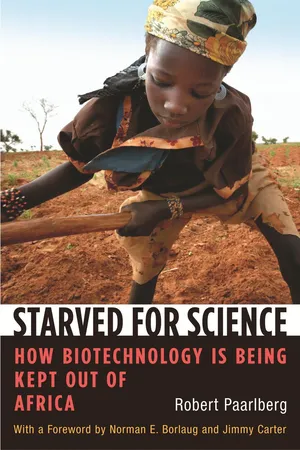
In Starved for Science Robert Paarlberg explains why poor African farmers are denied access to productive technologies, particularly genetically engineered seeds with improved resistance to insects and drought. He traces this obstacle to the current opposition to farm science in prosperous countries. Having embraced agricultural science to become well-fed themselves, those in wealthy countries are now instructing Africans—on the most dubious grounds—not to do the same.
In a book sure to generate intense debate, Paarlberg details how this cultural turn against agricultural science among affluent societies is now being exported, inappropriately, to Africa. Those who are opposed to the use of agricultural technologies are telling African farmers that, in effect, it would be just as well for them to remain poor.
- 254 pages
- English
- PDF
- Available on iOS & Android
eBook - PDF
About this book
Information
Publisher
Harvard University PressYear
2009Print ISBN
9780674033474
9780674029736
eBook ISBN
9780674041745
Table of contents
- CONTENTS
- Foreword by Norman E. Borlaug and Jimmy Carter
- Preface
- Introduction - Why Are Africans Rejecting Biotechnology?
- 1 Why Rich Countries Dislike Agricultural GMOs
- 2 Downgrading Agricultural Science in Rich Countries
- 3 Withdrawing Support for Agricultural Science in Africa
- 4 Keeping Genetically Engineered Crops Out of Africa
- 5 Drought-Tolerant Crops—Only for the Rich?
- Conclusion - An Imperialism of Rich Tastes
- References
- Index
Trusted by 375,005 students
Access to over 1.5 million titles for a fair monthly price.
Study more efficiently using our study tools.
Frequently asked questions
Yes, you can cancel anytime from the Subscription tab in your account settings on the Perlego website. Your subscription will stay active until the end of your current billing period. Learn how to cancel your subscription
No, books cannot be downloaded as external files, such as PDFs, for use outside of Perlego. However, you can download books within the Perlego app for offline reading on mobile or tablet. Learn how to download books offline
Perlego offers two plans: Essential and Complete
- Essential is ideal for learners and professionals who enjoy exploring a wide range of subjects. Access the Essential Library with 800,000+ trusted titles and best-sellers across business, personal growth, and the humanities. Includes unlimited reading time and Standard Read Aloud voice.
- Complete: Perfect for advanced learners and researchers needing full, unrestricted access. Unlock 1.5M+ books across hundreds of subjects, including academic and specialized titles. The Complete Plan also includes advanced features like Premium Read Aloud and Research Assistant.
We are an online textbook subscription service, where you can get access to an entire online library for less than the price of a single book per month. With over 1.5 million books across 990+ topics, we’ve got you covered! Learn about our mission
Look out for the read-aloud symbol on your next book to see if you can listen to it. The read-aloud tool reads text aloud for you, highlighting the text as it is being read. You can pause it, speed it up and slow it down. Learn more about Read Aloud
Yes! You can use the Perlego app on both iOS and Android devices to read anytime, anywhere — even offline. Perfect for commutes or when you’re on the go.
Please note we cannot support devices running on iOS 13 and Android 7 or earlier. Learn more about using the app
Please note we cannot support devices running on iOS 13 and Android 7 or earlier. Learn more about using the app
Yes, you can access Starved for Science by Robert Paarlberg in PDF and/or ePUB format, as well as other popular books in Politics & International Relations & Development Economics. We have over 1.5 million books available in our catalogue for you to explore.