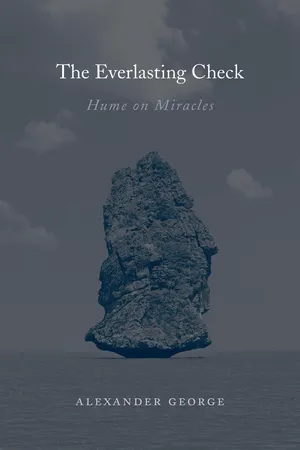
A touchstone of the Enlightenment dispute between rationality and religious belief, David Hume's essay "Of Miracles" has elicited much commentary from proponents and critics ever since it was published over 250 years ago. Alexander George's lucid and sustained interpretation of Hume's essay provides fresh insights into this provocative, occasionally elusive, and always subtle text. The Everlasting Check will be read with interest by both students new to Hume and seasoned scholars.
George does justice to the letter and spirit of Hume's essay, explaining the concepts and claims involved, making intelligible the essay's structure, and clarifying remarks that have long puzzled readers. Properly interpreted, the essay's central philosophical argument proves to be much hardier than Hume's detractors suggest. George considers a range of objections to Hume—some recent, some perennial—and shows why most fail, either because they are based on misinterpretations or because the larger body of Hume's philosophy answers them.
Beyond an analysis and defense of Hume's essay, George also offers a critique of his own, appealing to Ludwig Wittgenstein's thoughts on magic and ritual to demonstrate that Hume misconstrues the character of religious belief and its relationship to evidence and confirmation. Raising a host of important questions about the connection between religious and empirically verified beliefs, George discusses why Hume's master argument can fail to engage with committed religious thought and why philosophical argumentation in general often proves ineffective in shaking people's deeply held beliefs.
- 98 pages
- English
- ePUB (mobile friendly)
- Available on iOS & Android
eBook - ePub
About this book
Information
Topic
PhilosophySubtopic
Modern Philosophy1
HUME’S MIRACLES
1.1. Interpretative difficulties begin with the essay’s title: what does Hume mean by “miracle”? Given that Hume explicitly tells us what he means, this is more vexing than one might expect: “A miracle,” he says, “is a violation of the laws of nature.”1 On its face, this characterization immediately rules miracles out of existence by linguistic fiat. If a law of nature is a true description of some natural regularity—say, of the form, “Whenever something of this kind happens, something of that kind happens”—then there could not be events that fail to conform to a law. If to call something a law is to say that it correctly describes some pattern in the world—that is, that no events contravene it—then there simply are no miracles (as Hume here characterizes them) with respect to that law.
Another way to make the same point is to highlight the self-subverting nature of the claim that a miracle, so understood, has occurred. Assume that an event is a miracle. It then follows that there exists a law of nature that the event violates. But if a law is a correct description of the world, then there exists a description of the world that is both correct and incorrect, an absurdity. Hence, the event fails to be a miracle after all. By reductio ad absurdum, there are no miracles.2
Some, like Spinoza, have thought this the correct position to take concerning miracles. Many have suspected this is the argument that Hume ultimately relies on in his critique of miracles.3 And yet this cannot be anything like Hume’s argument. In “Of Miracles,” he divides his presentation into two parts, and both are shot through with empirical considerations. It would be impossible to explain why Hume extends his discussion over forty-one paragraphs and appeals to many facts about human psychology and history if he thought he had at his disposal an argument against miracles that could be presented in a single paragraph.
We can make interpretative progress if we temporarily turn away from Hume’s explicit definitions and instead attend to the conditions under which he actually employs the term miracle. Hume says:
It is no miracle that a man, seemingly in good health, should die on a sudden; because such a kind of death, though more unusual than any other, has yet been frequently observed to happen. But it is a miracle, that a dead man should come to life; because that has never been observed, in any age or country.4
Here, the critical consideration in determining whether an event is a miracle is whether it conflicts with a very well-confirmed regularity, one for which we have a tremendous amount of observational evidence.5 The conflict is with our present judgment about what the laws of nature are, not with the laws themselves; put otherwise, the conflict is not with a law of nature but with a well-confirmed candidate for such a law.
This thought is supported by other passages in Hume’s discussion. Consider, for instance, his claim that “[t]here must, therefore, be a uniform experience against every miraculous event, otherwise the event would not merit that appellation.”6 What gives one the right to call an event “miraculous” is that it violates a well-confirmed description of the world. Following Nelson Goodman, let us say that a statement is lawlike if it has all the requisite attributes of a law save perhaps for truth.7 We can then say that a miracle, for Hume, is an event that conflicts with a well-confirmed lawlike statement.8
How well confirmed the lawlike statement has to be in order to make a violation of it a miracle is something to which I shall turn in a moment. For now, note that a consequence of this conception is that it makes sense to talk of an event’s being more or less miraculous: as the confirmation of a lawlike statement increases, an event that violates it becomes more of a miracle. If instead we were to take miracles to be violations of natural law, understood in a straightforward fashion, such a graduated construal of miracles would be difficult to understand: either an event is such a violation or it is not, and whether it is should be independent of the level of confirmation for the lawlike statement with which it conflicts. Yet Hume does give voice to precisely such a graduated conception when he writes of one event’s being “more miraculous” than another or of one event’s being “the greater miracle.”9
If one takes Hume’s explicit definition of “miracle” flatly, then one will also have a difficult time making sense of his talk of marvelous events and their contrast with miracles. He writes, for instance, that “in order to encrease the probability against the testimony of witnesses, let us suppose, that the fact, which they affirm, instead of being only marvelous, is really miraculous.”10 Why should an event’s being miraculous rather than merely marvelous have the consequence that the probability of the incorrectness of testimony on its behalf increases? However, this does follow if we assume, first, that the probability of the testimony’s incorrectness increases with the probability that the lawlike statement the witnessed event violates is correct and, second, that the probability of correctness of a lawlike claim with which a miracle conflicts is greater than the probability of correctness of a lawlike claim with which a merely marvelous event conflicts. On this natural reading of Hume, the difference between a marvelous event and a miraculous one is indeed a matter of degree: as the evidence in favor of a lawlike statement increases, a violation of it moves from being merely extraordinary, to marvelous, and finally, to miraculous.11
If a miracle were a violation of a law of nature, there would be no link between an event’s being miraculous and the strength of our evidence against it. For we may have no idea that a given statement expresses a law of nature and so no idea that some particular event, which indeed violates it, is a miracle. Thus, from an event’s being a miracle, nothing could be inferred about the strength of our evidence against the correctness of testimony on its behalf. And yet as we shall see, this is a move that Hume makes throughout his discussion. By contrast, if to call something a miracle—to say it “merits that appellation”—is just to say that evidence of a certain weight exists against it, then it immediately follows that evidence of a certain weight exists against the correctness of testimony on its behalf.
Some passages might encourage the thought that Hume takes the notion of “miracle” to be nonepistemic. For instance, in the following, one might read Hume as saying that whether an event is a miracle is independent of our beliefs:
A miracle may either be discoverable by men or not. This alters not its nature and essence. The raising of a house or a ship into the air is a visible miracle. The raising of a feather, when the wind wants ever so little of a force requisite for that purpose, is as real a miracle, though not so sensible with regard to us.12
But this would be to misunderstand the independence in question. What Hume claims here is simply that a miracle might occur and we might not know that it has. This is different from the claim that an event’s being a miracle is independent of our epistemic state. Hume is drawing our attention to the fact that there could be an event which violates a well-confirmed lawlike statement yet remains unknown to us—for instance, a feather’s going from rest to motion despite an unrecognized absence of any force acting on it.
Thus, there is ample evidence to take Hume’s conception of a miracle to be that of an event that violates a well-confirmed lawlike statement: his criterion for application of the term; his talk of an event’s becoming miraculous and of one event’s being more miraculous than another; the way in which he relates marvelous events to miraculous ones; and most importantly, his general movement from an event’s being a miracle to the strength of evidence against it, and hence against the correctness of testimony on the event’s behalf. As will soon be clear, the entire structure of his argument depends on this movement, so we risk a complete failure of understanding if we interpret “miracle” in such a way as to make that transition problematic.
1.2. Before turning to Hume’s argument, we need to address two questions that this construal of “miracle” raises. First, does it not directly flout what Hume actually says? For as we saw, he writes several times that a miracle is a violation of the laws of nature. But does this signal a tension or even a confusion within Hume, or is it rather a tip-off about how best to understand his claim that a statement is a law of nature? Hume is frequently keen on having us attend to the conditions under which we apply a term or make a judgment. And there is a verificationistic streak in his thinking that often moves him to insist that there is nothing more to the content of the judgment in question beyond the thought that those conditions hold; this approach manifests itself on a number of occasions in the Enquiry. Now for Hume, we judge that some statement reports a causal regularity—that is, is a law of nature—under quite specific kinds of circumstances. We judge that “For all x, if Fx then Gx” is a law when our experience provides us with evidence that “Fx and Gx” holds for many values of x while failing to provide us with evidence that “Fx and not-Gx” holds for any value of x. Though I shall not press the point here, it is plausible to read Hume as saying that this is in fact part of what we mean when we judge a description to be a law.
If Hume does operate with something like this construal of natural law, then there need be no conflict in what he says about miracles: to say that an event has violated a law would just be to say that it has violated a statement for which we have a considerable degree of evidence. Of course, on this understanding, it makes sense to judge that a law of nature has been violated. But as we shall see, this is a desired result in this context because Hume does believe that one can imagine circumstances in which one would be justified in judging that a miracle had occurred.13
Second, we must ask how much evidence is required for us to claim that a general statement is a law of nature—that is, given Hume’s characterization, how strong must the evidence be against an event for it to qualify as a miracle? For Hume, laws just are lawlike statements for which our evidence rises to the level of what he calls “proof.” Consider what Hume says here, in a passage already partially quoted:
There must, therefore, be a uniform experience against every miraculous event, otherwise the event would not merit that appellation. And as a uniform experience amounts to a proof, there is here a direct and full proof, from the nature of the fact, against the existence of any miracle.14
The evidence against a miracle is just the evidence in favor of the confirmed lawli...
Table of contents
- Cover
- Title Page
- Copyright
- Dedication
- Epigraph
- Contents
- Preface
- 1. Hume’s Miracles
- 2. Hume’s Theorem
- 3. Hume and Self-Undermining
- 4. Hume and Testimony
- 5. Objections to Hume
- 6. Too Big for a Blunder?
- Acknowledgments
- Index
Trusted by 375,005 students
Access to over 1.5 million titles for a fair monthly price.
Study more efficiently using our study tools.
Frequently asked questions
Yes, you can cancel anytime from the Subscription tab in your account settings on the Perlego website. Your subscription will stay active until the end of your current billing period. Learn how to cancel your subscription
No, books cannot be downloaded as external files, such as PDFs, for use outside of Perlego. However, you can download books within the Perlego app for offline reading on mobile or tablet. Learn how to download books offline
Perlego offers two plans: Essential and Complete
- Essential is ideal for learners and professionals who enjoy exploring a wide range of subjects. Access the Essential Library with 800,000+ trusted titles and best-sellers across business, personal growth, and the humanities. Includes unlimited reading time and Standard Read Aloud voice.
- Complete: Perfect for advanced learners and researchers needing full, unrestricted access. Unlock 1.5M+ books across hundreds of subjects, including academic and specialized titles. The Complete Plan also includes advanced features like Premium Read Aloud and Research Assistant.
We are an online textbook subscription service, where you can get access to an entire online library for less than the price of a single book per month. With over 1.5 million books across 990+ topics, we’ve got you covered! Learn about our mission
Look out for the read-aloud symbol on your next book to see if you can listen to it. The read-aloud tool reads text aloud for you, highlighting the text as it is being read. You can pause it, speed it up and slow it down. Learn more about Read Aloud
Yes! You can use the Perlego app on both iOS and Android devices to read anytime, anywhere — even offline. Perfect for commutes or when you’re on the go.
Please note we cannot support devices running on iOS 13 and Android 7 or earlier. Learn more about using the app
Please note we cannot support devices running on iOS 13 and Android 7 or earlier. Learn more about using the app
Yes, you can access The Everlasting Check by Alexander George in PDF and/or ePUB format, as well as other popular books in Philosophy & Modern Philosophy. We have over 1.5 million books available in our catalogue for you to explore.