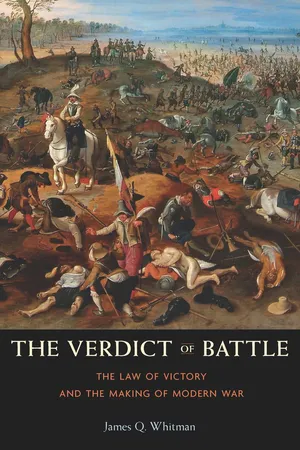
Today, war is considered a last resort for resolving disagreements. But a day of staged slaughter on the battlefield was once seen as a legitimate means of settling political disputes. James Whitman argues that pitched battle was essentially a trial with a lawful verdict. And when this contained form of battle ceased to exist, the law of victory gave way to the rule of unbridled force. The Verdict of Battle explains why the ritualized violence of the past was more effective than modern warfare in bringing carnage to an end, and why humanitarian laws that cling to a notion of war as evil have led to longer, more barbaric conflicts.
Belief that sovereigns could, by rights, wage war for profit made the eighteenth century battle's golden age. A pitched battle was understood as a kind of legal proceeding in which both sides agreed to be bound by the result. To the victor went the spoils, including the fate of kingdoms. But with the nineteenth-century decline of monarchical legitimacy and the rise of republican sentiment, the public no longer accepted the verdict of pitched battles. Ideology rather than politics became war's just cause. And because modern humanitarian law provided no means for declaring a victor or dispensing spoils at the end of battle, the violence of war dragged on.
The most dangerous wars, Whitman asserts in this iconoclastic tour de force, are the lawless wars we wage today to remake the world in the name of higher moral imperatives.
- English
- ePUB (mobile friendly)
- Available on iOS & Android
eBook - ePub
About this book
Information
Publisher
Harvard University PressYear
2012Print ISBN
9780674416871
9780674067141
eBook ISBN
9780674071872
CHAPTER 1
Why Battles Matter
Through the fateful outcome of open martial violence comes the plenitude of victory.
—Vegetius, Epitoma rei militaris
THIS IS A BOOK ABOUT PITCHED BATTLES, about the sorts of events that Vegetius, the ancient military writer, called “a fateful day of open confrontation” between armed groups. Many contemporary specialists in military history deny that the pitched battles of the past were really events of much military importance. It is important to begin by challenging what these specialists say, explaining why pitched battles really do matter.
Ordinary people generally think of pitched battles, these “fateful days” with their high drama, as the natural climax of war. Famous battles like Marathon, Hastings, and Waterloo were the classic topic for traditional military history, and there remain eminent and brilliant military historians who continue to write about them, figures like John Keegan, John Lynn, and Victor Davis Hanson. Nevertheless sophisticated contemporary specialists like to insist that pitched battles, dramatic and glamorous though they may have been, were in fact exceedingly rare events in most periods—so rare that they cannot be considered, in the words of one such specialist, “the most significant moments.”1 However much ordinary people may think of battles when they think of war, however much premodern military authors like Vegetius may have dwelt on them, the reality of warfare, these specialists say, lies elsewhere.
If not pitched battles, what? Specialists identify three principal forms of premodern land warfare: the pitched battle, the siege, and the raid.2 We speak of a battle when armed men directly confront other armed men. Sieges and raids are different, since both involve violence visited by armed men on unarmed victims. Sieges do typically involve the confrontation of two armed groups, one inside the fortifications, one outside, and to that extent they resemble battles. Nevertheless sieges always also target the unarmed general population of the besieged place to some extent. Indeed when sieges end in sacks they carry some of the most awful consequences that unarmed victims can suffer. Raids are defined as events that pit the armed against the unarmed, or at least the unwarned. As scholars use the term, the raid is a broad category, covering any military action in which armed men prey upon unarmed or surprised victims. Raids thus include surprise nighttime attacks on unfortified villages, the sweep of predatory horsemen through the countryside, slaving expeditions, and the widest variety of other forms of violent depredation as well.
All three forms of land warfare are well attested in history. But of the three, modern scholars unanimously conclude that raids are the most common by a very wide margin, while pitched battles have been by far the least common: “For long periods military events could best be described in terms of raids which were far more characteristic of the war than formal battles ever were.”3 The reality is that the vast majority of human warfare has involved not the riveting high drama of pitched battle but the sudden brutality of armed men descending upon unarmed victims, whether in slaving expeditions, the sweep of horsemen through undefended countryside, or the nighttime surprise attack on vulnerable villages. The reality is that human warfare has mostly corresponded to the definition given to war by Aristotle two and a half millennia ago. In the opening of his Politics, he defined war as a form of hunting, the hunt for human rather than animal prey.4 When we survey the history of human warfare with a careful professional eye, that is indeed what we overwhelmingly discover: not heroic confrontations between armed warriors in a “fateful day” of pitched battle but the brutal hunt for human prey, in which armed men turn their weapons on defenseless members of their own species.
That being the case, specialists ask, why should hardheaded scholars focus on formal battles, which were not “the most significant moments,” rather than on the predatory realities of the warfare of the past? Isn’t there something starstruck and ultimately unserious in writing about the occasional famous battle? Isn’t traditional military history, with its focus on great battles, outdated and quaint in much the way that traditional political history, with its focus on high politics, is outdated and quaint? If war, to take a standard social scientific definition, is “a series of acts of violence, usually involving killing, committed by members of two … politically unrelated groups,”5 then surely a rigorous scholar ought to concentrate on the “acts of violence” that are most common, and those are demonstrably not pitched battles.
Such arguments are made by scholars of many periods. For example, the recent anthropological literature on warfare in pre-state societies, what is usually called “primitive warfare,” insists that pitched battles were never the predominant form of warfare. Most primitive warfare, past and present, has involved unbridled, ruthless, and predatory raiding.
Our thinking about primitive warfare has changed over the past generation. For a long time, postwar anthropologists promoted the Rousseauian (or sometimes Marxist) view that primitive humans were peaceable creatures.6 However, the powerful drift of recent studies, especially since the early 1970s, has been to reject that notion. For better or for worse, humans are violent animals, and pre-state human societies were generally in a Hobbesian state. In fact the anthropologist Napoleon Chagnon, charmingly, adopted Hobbes’s spelling warre to describe the state of affairs among his subjects, the Yanomamo.7 Our best guess is that some measure of Hobbesian warre was ubiquitous among the humans of pre-state societies, who (like other primates) regularly engaged in deadly raids and the killing of their fellow human beings. As the pioneering German anthropologist Leo Frobenius concluded more than a century ago, early human warfare was largely just what Aristotle said it was: the Menschenjagd, the hunt for human prey.8
As contemporary anthropologists present it, this hunt for human prey in primitive warfare made particularly heavy use of ambushes and murderous surprise attacks, the kind of raiding warfare that American popular culture associates with the Indians of the old West. Recent scholarship has argued that raids of one kind or another have been by far the predominant form of land warfare over the long course of human history. “[T]he most lethal and common form of warfare,” writes Azar Gat, “was the raid, using surprise and taking place mostly at night.”9 Lawrence Keeley gives a similar summary of the findings of the literature in his fine book War before Civilization:
[T]he most common form of combat employed in primitive warfare … has been small raids or ambushes. These usually involve having a handful of men sneak into enemy territory to kill one or a few people on an encounter basis or by means of some more elaborate ambush. Women and children have commonly been killed in such raids.… [The] proportion of violent deaths is quite high. For example, the homicide rate of the prehistoric Illinois villagers would have been 1400 times that of modern Britain or about 700 times that of the United States in 1980.… [A] gradual scalar transition in primitive warfare leads from a small raid to massacres. The latter are larger surprise attacks whose purpose is to annihilate an enemy social unit. The simplest form involves surrounding or infiltrating an enemy village and, when the signal is given, attempting to kill everyone within reach. Such killing has usually been indiscriminate, although women and children evidently escaped in the confusion more often than adult males.10
This vicious form of warfare is massively documented in pre-state societies, whose fatality rates far dwarfed those of even such modern conflicts as World War II.11
That does not mean, however, that pitched battles never took place in pre-state societies. On the contrary, the great mystery presented by the literature is that almost all documented pre-state cultures have occasionally been able to resolve conflict through pitched battles, and indeed through remarkably limited pitched battles. As Frobenius observed, if the hunt for human prey dominates, there is always also the occasional Zweikampf, the formal trial by combat.12 Primitive pitched battles are described by Keeley as follows:
Many primitive battles were arranged—that is, a challenge or warning was issued to the enemy, and the battle site was named or understood.… Usually … the warriors are painted and dressed in special decorative or nonfunctional paraphernalia: warpaint, headdresses, armbands, and so on. Such battles are typically preceded and accompanied by considerable taunting and exchanging of insults. Many primitive battles consist of little more than two lines of warriors armed with throwing spears or bows, firing at one another at about the maximum effective range of their weapons.… Throughout the world, primitive battles—whether they last a few hours or a few days—are commonly terminated by agreement after each side has suffered a few serious casualties. These various features of prearrangement, elaborate dress, catcalling, long-distance skirmishing, and low casualties give primitive battles their ritualized allure.13
Primitive humans typically mounted raids against each other and perished in raids in great numbers. Yet at the same time the low-casualty pitched battle was a universal means of “limiting the engagement, and thus the losses.”14 If pitched battles were a ubiquitous phenomenon, however, Keeley and other contemporary scholars emphasize that they were also a sporadic one at best—an exceptional event in a world of endemic raiding.
Anthropologists are not alone in arguing that pitched battle was a rare occurrence in the past while raiding predominated. Recent scholarship paints a very similar picture of the complex premodern societies of antiquity and the Middle Ages. In particular, scholars paint a similar picture of three periods of premodern warfare that are of prime importance for the development of the Western law of war: the warfare of ancient Greece, of ancient Rome, and of the Western European Middle Ages.
Certainly we have evidence from many parts of the ancient world suggesting that pitched battle continued to be widespread, and that it perpetuated much of the “ritualized allure” we find in pre-state societies. For example, there is evidence for ritual practice in battle in the literature of the Warring States period in China, examined in Mark Lewis’s Sanctioned Violence in Early China. In China, as in the West, we find the standard marks of the trial by combat, the naming of the day and place for the clash: “When an enemy force was encountered in the field, the day and place of battle would be formally fixed by the two parties.… The battle proper was … preceded by a series of religious rituals.… A victorious army would often use the corpses of the defeated to erect a monument to its victory, like the Greek tropaion.… When the army returned to their own state after the battle, they performed the ceremony of ‘calling the army to order’ and then the ceremonial drinking to mark the conclusion of the campaign.” All of this took place, Lewis argues, within a culture of aggressive aristocratic honor, in which “combat was a ceremonial trial of strength.”15 Classical Indian literature is also rich in ritual prescriptions for the conduct of such battles.16 Looking further afield, we can find similar evidence of ritualized battle in pre-Columbian Mesoamerica, for example.17 Participants in the battles of these societies undoubtedly died at far higher rates than participants in pre-state battles. Nevertheless the ritualized battles of the ancient world are recognizably variants on a very old human type.
Yet if the institution of ritualized battle was widespread in the ancient world, it is wise to assume that it was still used only sporadically, at least to judge by the most thoroughly studied cases, those of classical Greece and classical Rome. Studies of the Greek warfare of the classical period—roughly from 480 to 338 BCE—give an account much like the account that anthropologists give of primitive warfare. It is commonplace among historians that the Greek world remained a world of warre, in which hostility was the normal state of affairs and peace the exception. As Arnaldo Momigliano famously observed, war was such an ordinary state of affairs among the ancient Greeks that no one ever bothered to ask what the ultimate cause of war was. It was “a natural fact like birth and death about which nothing could be done.”18 And within the Greek world of warre, leading specialists insist, pitched battle was neither a frequent event nor in the end the most important form of conflict. What dominated was raiding.
To be sure, Greek authors wrote regularly and avidly about formal pitched battles, and nobody doubts that they sometimes fought them. The Greeks of the fifth century BCE, like their Chinese contemporaries, treated combat as a “competition for prestige” that featured pitched battles as their iconic events.19 Ancient Greek authors prided themselves on the orderly and ritualized character of their battles, insisting that Greeks “fought wars according to rules and openly.”20 Those rules were, in theory, much like the rules of pre-state war, classical Indian war, or the Chinese war of the Warring States period. According to Polybius, Greek battle, like classical Chinese battle, was always preceded by a formal challenge, naming the time and place of the encounter. The battles that ensued involved the same taunting (and elaborate dress) that characterize pre-state societies: “Before engaging, the forces might remain and camp opposite one another for a few days, or even a week. They might try to sting the enemy into action by sending out cavalry to taunt them: ‘women!’ (Herodotus 9.20).”21 These battles were governed by rituals both religious and military, including prebattle sacrifices as well as the famous practice of requiring the victor to prove its victory by erecting a “trophy” to mark the turning point at which the defeated side took flight.
In particular the Greek sources mention an institution of notable interest: the formally arranged battle as a means of resolving disputes. Thus Thucydides reports an agreement between the Spartans and the Argives to settle future territorial conflicts by prearranged battle: the two sides agreed in advance that in case of disputes they would simply “fight it out” using pitched battle as a formal settlement procedure.22 An author like Polybius could treat all formal battles as effectively battles “by agreement,” fought when both sides consented to fight.23 Other similar...
Table of contents
- Cover
- Half Title
- Title Page
- Copyright
- Contents
- A Note to the Reader
- Introduction
- 1. Why Battles Matter
- 2. Accepting the Wager of Battle
- 3. Laying Just Claim to the Profits of War
- 4. The Monarchical Monopolization of Military Violence
- 5. Were There Really Rules?
- 6. The Death of Pitched Battle
- Conclusion
- Notes
- Acknowledgments
- Index
Trusted by 375,005 students
Access to over 1.5 million titles for a fair monthly price.
Study more efficiently using our study tools.
Frequently asked questions
Yes, you can cancel anytime from the Subscription tab in your account settings on the Perlego website. Your subscription will stay active until the end of your current billing period. Learn how to cancel your subscription
No, books cannot be downloaded as external files, such as PDFs, for use outside of Perlego. However, you can download books within the Perlego app for offline reading on mobile or tablet. Learn how to download books offline
Perlego offers two plans: Essential and Complete
- Essential is ideal for learners and professionals who enjoy exploring a wide range of subjects. Access the Essential Library with 800,000+ trusted titles and best-sellers across business, personal growth, and the humanities. Includes unlimited reading time and Standard Read Aloud voice.
- Complete: Perfect for advanced learners and researchers needing full, unrestricted access. Unlock 1.5M+ books across hundreds of subjects, including academic and specialized titles. The Complete Plan also includes advanced features like Premium Read Aloud and Research Assistant.
We are an online textbook subscription service, where you can get access to an entire online library for less than the price of a single book per month. With over 1.5 million books across 990+ topics, we’ve got you covered! Learn about our mission
Look out for the read-aloud symbol on your next book to see if you can listen to it. The read-aloud tool reads text aloud for you, highlighting the text as it is being read. You can pause it, speed it up and slow it down. Learn more about Read Aloud
Yes! You can use the Perlego app on both iOS and Android devices to read anytime, anywhere — even offline. Perfect for commutes or when you’re on the go.
Please note we cannot support devices running on iOS 13 and Android 7 or earlier. Learn more about using the app
Please note we cannot support devices running on iOS 13 and Android 7 or earlier. Learn more about using the app
Yes, you can access The Verdict of Battle by James Q. Whitman in PDF and/or ePUB format, as well as other popular books in History & Military & Maritime History. We have over 1.5 million books available in our catalogue for you to explore.