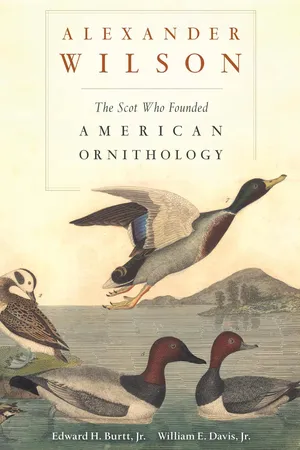
Audubon was not the father of American ornithology. That honorific belongs to Alexander Wilson, whose encyclopedic American Ornithology established a distinctive approach that emphasized the observation of live birds. In the first full-length study to reproduce all of Wilson's unpublished drawings for the nine-volume Ornithology, Edward Burtt and William Davis illustrate Wilson's pioneering and, today, underappreciated achievement as the first ornithologist to describe the birds of the North American wilderness.
Abandoning early ambitions to become a poet in the mold of his countryman Robert Burns, Wilson emigrated from Scotland to settle near Philadelphia, where the botanist William Bartram encouraged his proclivity for art and natural history. Wilson traveled 12,000 miles on foot, on horseback, in a rowboat, and by stage and ship, establishing a network of observers along the way. He wrote hundreds of accounts of indigenous birds, discovered many new species, and sketched the behavior and ecology of each species he encountered.
Drawing on their expertise in both science and art, Burtt and Davis show how Wilson defied eighteenth-century conventions of biological illustration by striving for realistic depiction of birds in their native habitats. He drew them in poses meant to facilitate identification, making his work the model for modern field guides and an inspiration for Audubon, Spencer Fullerton Baird, and other naturalists who followed. On the bicentennial of his death, this beautifully illustrated volume is a fitting tribute to Alexander Wilson and his unique contributions to ornithology, ecology, and the study of animal behavior.
eBook - ePub
Alexander Wilson
The Scot Who Founded American Ornithology
- 444 pages
- English
- ePUB (mobile friendly)
- Available on iOS & Android
eBook - ePub
Alexander Wilson
The Scot Who Founded American Ornithology
About this book
Information
Subtopic
Arte generalCHAPTER ONE
Themes in Wilson’s Life and Writings
Alexander Wilson, Scottish poet and Father of American Ornithology, was a child of the Enlightenment. Like Rousseau he saw in wilderness a natural order to be enjoyed and observed, not an alien world to be feared and conquered. He was an observant teenager whose poetry portrayed Scotland and its people with remarkable insight. Jefferson’s words and principles as stated in the Declaration of Independence, written when Wilson was ten, inspired him. Thomas Paine’s The Rights of Man spoke to his soul. A journeyman weaver, Wilson rebelled against the industrialization of weaving and the dishonesty of mill owners. Ultimately, he left Scotland for the United States, where he renounced his British citizenship and embraced the experiment in democracy.
Wilson’s nine-volume American Ornithology was a pioneering achievement in science. It established the United States as an equal partner with Europe in the study of natural history. The Ornithology was widely admired among European scientists for the excellence of its information, its stunning illustrations, and the superb quality of its printing and binding. The admiration voiced by Europeans may have been in part a reaction of surprise at the magnitude and excellence of a work about which they had no prior knowledge, written and illustrated by a man of whom they had never heard. Indeed American Ornithology was Alexander Wilson’s first and only venture into ornithology, his first and only venture into science. Nonetheless, one can find in his life and writing a number of themes that coalesced into his vision of the United States as a vibrant, young democracy on the threshold of greatness, whose vast wilderness of resources—symbolized by its diverse, colorful birds—made it different from the old, oppressive monarchies of Europe.
A Commitment to Individual Rights
Wilson spent his teenage years living in the country outside Paisley, Scotland, with his father who distilled and smuggled whiskey in violation of English law. Such activity was regarded with tolerance, even admiration, by the Scots who were restless under English rule. The sense of distrust of authority and the importance of the individual that young Sandy, as the boy was called, may have seen in his father found expression later when he completed his weaving apprenticeship and became active in the early effort to unionize the weavers. Regardless of his success in this endeavor, and regardless of the legality of his actions, about which there is some question, there can be little doubt that he was strongly committed to the concept of individual rights and the worth of the individual who worked at the loom. His sense of individualism is further expressed in his dislike of the emerging factory system, where he and fellow journeymen wove in crowded conditions, and his preference for roaming the countryside selling his cloth door to door.
Wilson’s commitment to the individual and the commoner was also evident in his poetry. In 1788 Robert Burns’s poetry about daily life, written in the Scottish dialect, captured the heart of Scottish culture. Wilson, too, decided to abandon his earlier English style and use his native Scottish dialect to write about people and situations he knew. His was a language that protested English dominance, and, like Burns, he focused on the trials and successes of daily Scottish life.
Wilson was ten when the American colonies declared their independence, twenty-one when the U.S. Constitution was signed, and twenty-three when George Washington was sworn in as the first president of the United States of America. Smuggled goods, especially whiskey and, later, gunpowder, flowed readily between western Scotland and the American colonies, where many local families had relatives. Undoubtedly sailors would have been eager to tell and local residents eager to hear news from America. During his formative years, Wilson would thus have heard and read about the rebellion in the colonies and experienced the increased vigilance of the English government as first the American colonies rebelled and then the French monarchy collapsed. As his own troubles with the local authorities grew, he came to the conclusion that his future lay in the United States, and he left Scotland forever.
Upon arriving in the United States, Wilson encountered the writings of Thomas Jefferson and became an advocate of Jefferson’s ideals. The difference between Jefferson’s ideal of the small landowner/farmer as the essential strength of America and Wilson’s commitment to the individual is impossible to measure because Wilson’s early views can only be inferred from his actions, poetry, and his few early letters. But Wilson’s focus on the rights of workers is certainly similar to Jefferson’s focus on the rights of small landowners, even though the backgrounds of the two men were dissimilar. Wilson grew up in one of Europe’s earliest industrial centers, Jefferson’s youth was spent in an agrarian setting. Wilson, like Jefferson, saw the North American fauna and flora as very different from those of Europe and reacted with passionate disbelief to the assertion of European scientists, most prominently the Comte de Buffon, that the animals and plants of the New World were degenerate versions of European species.
One of Wilson’s earliest experiences in the United States was related in his first letter home after landing near Wilmington, Delaware: “As we passed through the woods on our way to Philadelphia, I did not observe one bird such as those in Scotland, but all much richer in colour. We saw great numbers of squirrels, snakes about a yard long, and some red birds.”1 Over the next few months, Wilson held several jobs before taking a job as a schoolteacher, which he held for nine years. During this period, Wilson’s interest in natural history grew, as we can see from his enthusiastic accounts of students who eagerly brought him all sorts of small animals, from insects to birds and mammals. His commitment to the United States grew as well, as demonstrated by his declaration of citizenship and speech in honor of Jefferson’s first presidential inauguration. From these changes emerged Wilson’s plan to celebrate the wonders of democracy’s expanding across a wondrously rich continent by documenting all its birds.
Wilson’s commitment to the individual, the common man, also provided the impetus to sell American Ornithology as a subscription to individuals throughout the United States. His experience as a peddler selling cloth in Scotland stood him in good stead in this endeavor, but it was his commitment to the Jeffersonian citizen that made this exhausting task so attractive to him. Prior to Wilson’s project, works on natural history had been commissioned by wealthy Europeans who collected specimens or artworks depicting them. Such individuals financed expeditions and naturalists, and retained for their personal display or publication all that was found. By contrast, through his subscription plan, Wilson’s exploration was funded by contributions from hundreds of persons, many of whom were not wealthy and all of whom were Americans. He also established the first network of what today we would call citizen scientists, who corresponded with him concerning their observations and were recognized generously by Wilson for their contributions. Finally, Wilson’s commitment to the common man was underscored by donation of his specimens to the Peale Museum in Philadelphia, which was organized and curated by Charles Wilson Peale and open to the public for a small entrance fee.
Related to the democratization of his financial plan, Wilson used his species descriptions, and the prefaces to each volume of his collection, to stress the excellence of the American workmanship involved in American Ornithology’s publication: the paper made of American rags, the type designed and manufactured by Philadelphia printers, the inks and paints compounded from native materials by Charles Wilson Peale and sons of Philadelphia. He also emphasizes in these writings that European accounts of American birds are based on specimens, whereas his species accounts are based on observation of live birds in their native habitat. Whether his assertions of the excellence of American Ornithology are an effort to reassure customers of the value of their purchase, a reaction to Buffon’s and most Europeans’ stated belief that American birds were degenerate forms of the more perfect European species, or a response to his own experiences in Scotland prior to his flight, they each signify the prominent theme of American excellence.
Understanding God through Nature
Another prominent theme is Wilson’s concept of deism. Wilson saw in the distribution of birds and their interactions with the habitat and each other the pattern of life as it was before the arrival of Europeans. He also believed that these natural patterns reflected the presence of some superior being. As he noted in the opening paragraphs of volume 1: “A study thus tending . . . to lead us, by such pleasing gradations, to the contemplation and worship of the Great First Cause, the Father and Preserver of all, can neither be idle nor useless, but is worthy of rational beings, and doubtless agreeable to the Deity.”2
Wilson’s belief in a deity seems to have been a generalized one that probably emerged during his early childhood, perhaps as a result of tutoring by a theological student his mother had hired to supplement his education. As a religious woman she may have intended to prepare him for the Presbyterian ministry, the Protestant denomination into which Wilson was baptized and the prevailing Scottish sect at the time. Yet despite his frequent reference to a generalized deity, Wilson does not attribute the creation of species to a supernatural being. Similarly, when he marvels at how well adapted a species may be, he may make a generalized comment about how an adaptation reflects the wisdom of a supernatural presence, but he does not specifically attribute the adaptation to God’s manufacture. Wilson’s belief in God can be found throughout his text, but he believed in a remote presence that established the system, one that takes satisfaction in the pattern of natural interaction. Nowhere does he describe a God who tinkers with the daily details of adaptation.
Nature: The Love of His Life
Wilson began his literary career as a poet in Scotland, where he could draw on a rich literary tradition and participate in an active literary community that included Robert Burns, Robert Tannahill, several minor poets, and poetry contests. The infant United States had no such tradition, no such community. He chose to become a citizen in a nation without a history, without an oppressive class system to protest, without legends or ruins to contemplate. What the United States did have in abundance, however, was nature. Not surprisingly then, while Wilson continued to write poetry and prose after his immigration to the United States, he no longer wrote about working conditions or interpersonal relationships, and he no longer composed protest poetry: instead, he wrote about nature. Yet unlike the naturalist writers who preceded him, such as Cotton Mather, John Smith, Mark Catesby, even William Bartram, he did not write about nature as something to be feared, conquered, and tamed. Instead Wilson wrote about the wonder of wilderness. He wrote as an observer of nature, an observer who was fascinated by what he saw. Even William Bartram, who would figure prominently in Wilson’s achievement, even Bartram who described nature in loving detail, always had an eye on what an excellent farm a stretch of land would be or how navigable the river was. Wilson wrote about the wilderness itself, about its aesthetic and spiritual value, about the wonder of birds and their lives. He established this theme in a wonderful anecdote in the preface to volume 1:
In one of my late visits to a friend in the country, I found their youngest son, a fine boy of eight or nine years of age, who usually resides in town for his education, just returning from a ramble thro the neighbouring woods and fields, where he had collected a large and very handsome bunch of wild flowers, of a great many different colors; and presenting them to his mother, said, with much animation in his countenance, “Look my dear ’ma, what beautiful flowers I have found growing on our place! Why all the woods are full of them! Red, orange, blue, and ’most every color. O I can gather you a whole parcel of them, much handsomer than these, all growing our own woods! Shall I ’ma? Shall I go and bring you more?” The good woman received the bunch of flowers with a smile of affectionate complacency; and after admiring for some time the beautiful simplicity of nature, gave her willing consent; and the little fellow went off, on the wings of ecstasy, to execute his delightful commission.
The similitude of this little boy’s enthusiasm to my own, struck me; and the reader will need no explanations of mine to make the application. Should my country receive with the same gracious indulgence the specimens which I here humbly present her; should she express a desire for me to go and bring her more, the highest wishes of my ambition will be gratified; for, in the language of my little friend, our whole woods are full of them! And I can collect hundreds more, much handsomer than these.3
Wilson clearly relates to the innocent pleasure of the little boy, to the delight the boy expresses in what he has found in the woods. Indeed, he uses the little boy’s own words to describe his collection of birds and its display to the reader. There is no hint of the terror of the woods so often conveyed by earlier authors. The theme is nature as a source of inspiration and joy, as it clearly is for the mother, her son, and Alexander Wilson. Such a theme as applied to the American wilderness was new, but Wilson carried it throughout his own journeys in search of birds and throughout his writing. This deep appreciation of wilderness, a perspective of wonder at the natural world, was picked up by those like Emerson and Thoreau who came after him.
Preservation amid Abundance?
Wilson’s sense that the wonder of nature revealed the presence of a deity and his intense pleasure in the American wilderness led to his concern for its preservation. Time and again he refers to the habitat preferences of birds, the natural patterns of distribution and migration that result from these preferences, and frequently, how European settlers’ alterations to landscapes used as habitats had changed the birds’ distribution. At times he even speculates briefly on what a future without wilderness will be like. Both William Bartram, Wilson’s teacher and mentor, himself a traveler in the wilderness, and Thomas Jefferson also wrote about the disappearance of the wilderness, but with only a tinge of regret; they seemed to feel that the loss was more than compensated for by the possibility of farms and towns dotting the landscape and commerce traveling the rivers. Alexander Wilson shares their vision of the future, but for him the loss of wilderness causes genuine, poignant regret. One cannot read his text or look at his drawings without realizing that part of what drove him to write about America’s birds was a desire to make every American realize the value of our birds and thereby want to ensure their survival for all time.
A More Meaningful Excellence
Throughout his literary career Wilson was driven to excel. While not specifically stated in his poetry or prose, he mentions his need to excel and his desire for recognition in letters to friends. As a young poet he was concerned with his public reputation and his standing among the poets of his generation. He recognized that Robert Burns was on a different literary plateau and was sufficiently realistic to regard such heights as beyond him, but that did not dissuade him from entering poetry competitions in which he recited his own work and in which he finished as high as second, a considerable achievement given the large number of young poets in Scotland in the 1780s and 1790s. His narrative poem “Watty and Meg,” about domestic strife, sold tens of thousands of copies. His books of poems sold less well and earned little, although Mrs. Dunlop, a patron and friend of Robert Burns, praised the book in a letter to Burns.
Wilson’s failure to achieve widespread recognition for his poetry may have contributed to his decision to leave Scotland for the United States. After his arrival, he continued to write poetry and his work was regularly published in Port Folio, a literary magazine published in Philadelphia. The audience for poetry in the United States around the turn of the nineteenth century, however, was a mere shadow of the audience in Scotland. Wilson may have gained satisfaction from the frequent publication of his work, but his success in terms of recognition as a poet was limited at best. Did his failure to achieve recognition as a poet contribute to his idea to describe all the birds of the United States? The attempt had never been made. If he succeeded, excellence would be his.
There can be little doubt that Wilson wished his American Ornithology to be outstanding in every detail. He states as much in the introduction:
It is intended to comprehend description, and representation of every species of our native birds . . . engraved in a style superior to any thing of the kind hitherto published and colored from nature, with the most scrupulous adherence to the true tints of the original.
. . . As time may prey on the best of colors, what is necessary in this respect will by no means be omitted, that the figures and descriptions may mutually corroborate each other. It is also my design to enter more largely than usual into the manners and disposition of each respective species; to become, as it were, their faithful biographer, and to delineate their various p...
Table of contents
- Cover
- Frontispiece
- Title Page
- Copyright
- Dedication
- Contents
- Preface
- Epigraph
- 1. Themes in Wilson’s Life and Writings
- 2. A Varied Life
- 3. Illustrating American Ornithology
- 4. Pioneer Ornithologist
- 5. Wilson’s Legacy
- Appendix A. On the Shoulders of Giants: Wilson’s Predecessors
- Appendix B. Wilson’s Contemporaries and Correspondents
- Notes
- Selected Bibliography
- Acknowledgments
- Index
Trusted by 375,005 students
Access to over 1.5 million titles for a fair monthly price.
Study more efficiently using our study tools.
Frequently asked questions
Yes, you can cancel anytime from the Subscription tab in your account settings on the Perlego website. Your subscription will stay active until the end of your current billing period. Learn how to cancel your subscription
No, books cannot be downloaded as external files, such as PDFs, for use outside of Perlego. However, you can download books within the Perlego app for offline reading on mobile or tablet. Learn how to download books offline
Perlego offers two plans: Essential and Complete
- Essential is ideal for learners and professionals who enjoy exploring a wide range of subjects. Access the Essential Library with 800,000+ trusted titles and best-sellers across business, personal growth, and the humanities. Includes unlimited reading time and Standard Read Aloud voice.
- Complete: Perfect for advanced learners and researchers needing full, unrestricted access. Unlock 1.5M+ books across hundreds of subjects, including academic and specialized titles. The Complete Plan also includes advanced features like Premium Read Aloud and Research Assistant.
We are an online textbook subscription service, where you can get access to an entire online library for less than the price of a single book per month. With over 1.5 million books across 990+ topics, we’ve got you covered! Learn about our mission
Look out for the read-aloud symbol on your next book to see if you can listen to it. The read-aloud tool reads text aloud for you, highlighting the text as it is being read. You can pause it, speed it up and slow it down. Learn more about Read Aloud
Yes! You can use the Perlego app on both iOS and Android devices to read anytime, anywhere — even offline. Perfect for commutes or when you’re on the go.
Please note we cannot support devices running on iOS 13 and Android 7 or earlier. Learn more about using the app
Please note we cannot support devices running on iOS 13 and Android 7 or earlier. Learn more about using the app
Yes, you can access Alexander Wilson by Edward H. Burtt Jr.,William E. Davis Jr.,Edward H. Burtt, Jr.,William E. Davis, Jr. in PDF and/or ePUB format, as well as other popular books in Tecnología e ingeniería & Arte general. We have over 1.5 million books available in our catalogue for you to explore.