Like all cellular organisms, humans run on electricity. Slight imbalances of electric charge across cell membranes result in sensation, movement, awareness, and thinking—nearly everything we associate with being alive. Robert Campenot offers a comprehensive overview of animal electricity, examining its physiological mechanisms as well as the experimental discoveries that form the basis for our modern understanding of nervous systems across the animal kingdom.
Cells work much like batteries. Concentration gradients of sodium and potassium cause these ions to flow in and out of cells by way of protein channels, creating tiny voltages across the cell membrane. The cellular mechanisms that switch these ion currents on and off drive all the functions associated with animal nervous systems, from nerve impulses and heartbeats to the 600-volt shocks produced by electric eels.
Campenot's examination of the nervous system is presented in the context of ideas as they evolved in the past, as well as today's research and its future implications. The discussion ranges from the pre-Renaissance notion of animal spirits and Galvani's eighteenth-century discovery of animal electricity, to modern insights into how electrical activity produces learning and how electrical signals in the cortex can be used to connect the brains of paralyzed individuals to limbs or prosthetic devices. Campenot provides the necessary scientific background to make the book highly accessible for general readers while conveying much about the process of scientific discovery.
eBook - ePub
Animal Electricity
How We Learned That the Body and Brain Are Electric Machines
- 340 pages
- English
- ePUB (mobile friendly)
- Available on iOS & Android
eBook - ePub
About this book
Information
1
ANIMAL ELECTRICITY
Anthropologists have never discovered a society where the people believe that they have no idea what the hell is happening. There are always explanations for mysterious phenomena handed down from past “authorities,” and before the advent of the scientific method such explanations lasted for millennia. The function of the nervous system and muscle was “explained” by the animal spirits theory promoted by Praxagoras (b. 340 B.C.E.), a younger contemporary of Aristotle (384–322 B.C.E.), and by Erasistratus (304–250 B.C.E.), Aristotle’s son-in-law (Smith et al. 2012). Erasistratus dissected executed criminals and came to believe that the body is made of tubes and all mechanisms are basically plumbing. This conclusion was not unwarranted given all the fluid and tubes that he encountered during his dissections and the mechanisms he had at his disposal. Apparently it was not easy to understand what filled some of the tubes, even in the case of the most obvious body fluid—blood. Praxagoras recognized the difference between arteries and veins, but the arteries he encountered during his dissections were empty, likely because the dissection technique used in the Lyceum produced arterial spasm, causing the arteries to collapse and forcing the blood they had contained to engorge the veins. Thus, the veins could well have appeared to be the major carriers of blood, while the arteries with their thicker walls must have held the evanescent pneuma, the breath of life, collected by the lungs but now escaped into thin air through the incision made during the dissection. You might ask: Why does blood spurt out when an artery is cut in a living animal? Because, Praxagoras believed, the escaping pneuma is replaced by blood extremely fast in the living animal, as if it was never there. Erasistratus went on to identify three fluids: the most obvious but lowly blood, which is the nutritive fluid produced from food that keeps the body alive; pneuma zootikon, the vital spirits, captured by the lungs (oxygen was not discovered until the latter part of the eighteenth century); and pneuma psychikon, or animal spirits, produced from vital spirits by the brain, which is responsible for consciousness, thinking, sensation, and movement. Animal was not used in the zoological sense. Anima is the Latin translation of the Greek psyche. The psyche is the human mind, and animal spirits are the spirits that animate us.
No one is more responsible for perpetuating the view of the nervous system as plumbing carrying animal spirits than Claudius Galen (129–ca. 216 C.E.), one of the fathers of medicine. Galen was born into a wealthy family in the ancient Greek city of Pergamon, a cultural and intellectual center. His rich, ambitious, architect father chose medicine for Galen’s career. Galen cooperated, graduated from the medical school at Alexandria, and then returned to Pergamon for five years where he served as a physician to gladiators, so he knew something about blood and guts. Then he moved to Rome where he became a physician to a series of emperors and possibly the most prolific writer of medical books that ever lived. His writings propelled Galen’s influence on medical thinking for over a millennium, until the Renaissance.
It is customary to credit Francis Bacon (1578–1626) with originating the scientific method during the Renaissance, but experimentation has likely always been with us. Galen himself was something of an experimentalist and made some advances. He discovered that intact arteries contain blood by tying off an artery in two positions in a living animal and showing that the section of artery in between bled when punctured. Thus, the section of artery must have contained blood when it was tied off, before the blood had a chance to replace the escaping vital spirits. Galen also discovered some of the circuitry of the nervous system by showing that certain parts of the animal body were paralyzed when the nerves supplying them were cut. He showed conclusively that the brain, not the heart, is the recipient of sensation and the source of willful movement, contrary to the beliefs of Aristotle and many others. However, Galen perpetuated the belief that motor commands were carried by animal spirits flowing to the muscles through hollow nerves. Discoveries in the fields of electricity and cell biology that would eventually provide the framework for explaining the functioning of nerve and muscle would not begin to accumulate until the eighteenth century. The actual electrical mechanism of conduction in nerve was not established until the mid-twentieth century. In the meantime, many more physicians, philosophers, and other thinkers threw their ideas into the ring. What emerged was a slowly evolving, often highly nuanced, but always fundamentally wrong picture of how nerves and muscles work.
As the ideas of Praxagoras, Erasistratus, and Galen illustrate, in our attempts to explain the world, none of us has any option other than to rely on the mechanisms that we know about, or believe we know about. The ancients knew about the world available to the unaided senses. When they evoked unseen entities to explain how the body and brain work, those entities were simply unseen forms of what they were familiar with. Thus, nerves were considered to be tubes through which animal spirits flowed like water through a pipe. One might fault the ancients for believing in ethereal entities they could never observe that travel through tubes in the body, but no one has ever seen an electron, and the laws of electricity were established long before anyone knew what electric charge flowing through wires really is. The difference lies in the framework through which people see the world and the methods they deem appropriate to build and refine that framework. Until the seventeenth century the results of experiments were not given much credence against the word handed down from ancient authorities.
The unseen world of the scientific era is replete with entities that are unavailable to the unaided senses. A huge part of science has been occupied with making them visible in the broadest sense. In some cases they became literally visible as, for example, the cell and some of its internal structures that were seen under the microscope. Structures a little bit smaller such as the cell membrane are beyond the resolution of the light microscope and only become “visible” in pictures of dead cells taken with the electron microscope. Objects on the molecular, atomic, and subatomic scales have been made “visible” by their influence upon the visible world; for example, individual electrons were never “seen” until their presence was made “visible” in the Millikan oil-drop experiment (see Chapter 2).
In order to explain how electricity makes our bodies and brains work we must delve into the world of electricity and the worlds of the cell and the molecules and atoms that make cells work the way they do. These worlds have rules of their own that are in many respects unlike the rules governing the world available to our unaided senses. We begin with the world of electricity. It is one thing to “understand” electricity by memorizing a few rules about how electric current flows in circuits, but it is quite another to develop the imagination required to understand what electric current would look like if we could somehow get down to its level and actually see it. Although it will be necessary for readers to understand the workings of a simple circuit diagram, it is the view of electricity that is only available to the imagination that we are really after. This view, along with the view of cells, molecules, and atoms that is developed in Chapter 2, will set the stage for describing how nerve cells make and conduct the electricity to produce our sensations and actions and everything that goes on in between.
THE HEAT THEORY OF THE ELEVATOR BUTTON
I began my personal inquiries into the foreboding world of electricity at UCLA where I was a graduate student in physiology in 1968. One day a fellow student and I began some tests of the heat theory of the elevator button. We were not the first to develop this theory; it was surely developed independently by many people. Although this theory is as wrong as the animal spirits theory of nerve conduction, I occasionally run across someone who still believes in it today. The source of the great mystery was the elevator buttons that light up when touched without any detectable mechanical movement. How do they sense the presence of a finger? Like Praxagoras, Erasistratus, and Galen, we took the only approach that humans can when trying to figure out a mystery—we tried to explain it in terms of phenomena already known to us. This was long before the era of personal computers with track pads and touch screens. Now the phenomenon is so commonplace, and therefore accepted, that nobody bothers to think about how nonmechanical buttons work, and I am sure the vast majority of computer users have no clue. Back then the nonmechanical elevator button was just about the only example, so familiarity had not yet obscured its mystery.
My friend and I hypothesized that nonmechanical elevator buttons work by sensing the warm temperature of a finger. Like other primitive people of the time, we focused on heat rather than electricity because the plastic surface of the button could certainly conduct heat. We couldn’t see how it could conduct an electrical signal; since plastic is an electrical insulator we “knew” that electric current cannot pass through it. Moreover, we could not see how our finger could produce an electrical signal when we touched the elevator button since we were not connected in a circuit, and we “knew” that a person has to be “grounded” to get a shock. As I remember, the experimental basis for our belief in the heat theory was primarily the failure of the hard press with the finger of a gloved hand to light up the button, but the data were confusing because occasionally even a bare finger failed to light up the button. In some cases this could be explained because the finger, having just come in from the outdoors, may have been too cold. But other times it seemed capricious whether the button would light up or not when touched by a bare finger. It never occurred to us that the electrical insulation provided by dry skin could be the problem. We eventually forgot about the issue and moved on to more productive endeavors.
My greater familiarity with the principles of electricity along with the prevalence of track pads and touch screens have caused me to reconsider the heat theory of the elevator button. The fine discriminations made by track pads and touch screens must certainly rule out finger temperature as their operating principle. My new theory, again not original with me, is the capacitance theory of the elevator button. Unlike investigations of natural phenomena, where the truth of an explanation must rest solely on observation and experimental evidence, elevator buttons are human inventions, so we can read about how they really work, and the Web makes explanations of such things readily accessible. Back in the 1960s it was just too much trouble for me to find out, but now I know that the capacitance theory is correct. The concept of electrical capacitance explains how electric current can pass through a thin insulating material like the plastic surface of the button and how contact with our bodies, even when we are not grounded, can alter the behavior of a circuit behind the surface of the button, signaling that someone wants to ride the elevator.
VOLTAGE, CHARGE, CURRENT, RESISTANCE, AND CAPACITANCE
Nonmechanical elevator buttons have several features in common with the conduction of impulses along nerves and muscle fibers. Most important, both involve the flow of electricity through body fluids and both involve the charging and discharging of a capacitor. Elevator buttons are simpler than nerve and muscle, so let’s begin by dispelling the great mystery behind elevator buttons that make no movement when pressed. A few concepts of electricity are necessary: namely, voltage, charge, current, resistance, and capacitance. Understanding capacitance requires understanding the other four, so we will deal with capacitance last.
German physicist Georg Ohm (1789–1854) first published his law in 1827. Ohm’s law is one of those delightfully commonsense relationships of the following form: the flow of something is determined by the combined effect of the force driving the flow and the resistance opposing the flow. The familiar form of Ohm’s law is I = V/R, where electric current (I) is equal to the voltage (V) driving the current divided by the resistance (R) to the flow of current (Figure 1.1). This makes sense; current is doubled by doubling the voltage driving it and halved by doubling the resistance against it. The same kind of relationship holds for water flowing through a pipe where the amount of water flowing is determined by the water pressure driving the flow divided by the resistance in the pipe opposing the flow.
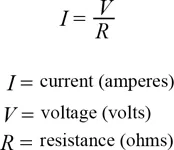
Figure 1.1. Ohm’s law.
Ohm’s law seems simple and obvious enough to us now. However, it was not immediately accepted, and Ohm was ridiculed as unfit to teach science because he was promoting “a web of naked fancies [and] an incurable delusion, whose sole effort is to detract from the dignity of nature” (Davies 1980, 57). Heaping invective in print upon another scientist was more or less normal scientific discourse at the time.
Electrons were discovered in 1897 by a team of British physicists led by J. J. Thomson. When Ohm developed his law he did not know what was actually flowing in wires, but he did have the means to apply a voltage and indirectly measure the resulting current flow in a circuit. When Ohm measured the current driven through a wire by a certain voltage, the current doubled when he doubled the voltage, and when he doubled the length of wire, the current was reduced in half, so the resistance must have doubled. Ohm also found that the same lengths of wire made of different metals had different resistances; some metals are better conductors of electricity than others.
Everything in our world that we can touch is made of atoms, and atoms consist of nuclei made of protons and neutrons surrounded by orbiting electrons. We now know that all negative charge is in the form of electrons, all positive charge is in the form of protons, and the charge of a single electron equals the charge of a single proton. It is a fundamental rule of physics that like charges repel each other and unlike charges attract each other; that is, electrons repel each other, protons repel each other, but electrons and protons attract each other. I will bet you have no idea of the immense strength of electrical repulsion and attraction. Their true magnitude came as a shock to me when I first encountered the following quotation from The Feynman Lectures on Physics (Feynman, Leighton, and Sands 1964, 1.1):
Consider a force like gravitation which varies predominantly inversely as the square of the distance, but which is about a billion-billion-billion-billion times stronger. And with another difference. There are two kinds of “matter,” which we can call positive and negative. Like kinds repel and unlike kinds attract—unlike gravity where there is only attraction.…There is such a force: the electrical force. And all matter is a mixture of positive protons and negative electrons which are attracting and repelling with this great force. So perfect is the balance, however, that when you stand near someone else you don’t feel any force at all. If there were even a little bit of unbalance you would know it. If you were standing at arm’s length from someone and each of you had one percent more electrons than protons, the repelling force would be incredible. How great? Enough to lift the Empire State Building? No! To lift Mount Everest? No! The repulsion would be enough to lift a “weight” equal to that of the entire earth!
Electrons are the only charged particles that are free to move in a solid conductor such as a metal wire. The movable electrons originate from the outer electron orbitals of atoms that make up the solid structure of the metal. In contrast, the atomic nuclei containing the protons are immobilized in the structure of the metal, so positive charge cannot move along a wire. Think of a wire as a solid matrix of fixed positive charges, which are neutralized by an equal number of mobile electrons, so the wire has no net electric charge. The electrons are free to move around, exchanging positions with one another, but on average they are spread evenly throughout the wire. If the wire is used to connect the negative and positive terminals of a battery, electrons will flow from the negative terminal into...
Table of contents
- Cover
- Title Page
- Copyright
- Dedication
- Contents
- Preface
- Introduction
- 1. Animal Electricity
- 2. A World of Cells, Molecules, and Atoms
- 3. The Animal Battery
- 4. Hodgkin and Huxley before the War
- 5. The Mystery of Nerve Conduction Explained
- 6. Heart to Heart
- 7. Nerve to Muscle
- 8. Use It or Lose It
- 9. Broadcasting in the Volume Conductor
- 10. The Bionic Century
- Epilogue
- Notes
- References
- Acknowledgments
- Index
Trusted by 375,005 students
Access to over 1.5 million titles for a fair monthly price.
Study more efficiently using our study tools.
Frequently asked questions
Yes, you can cancel anytime from the Subscription tab in your account settings on the Perlego website. Your subscription will stay active until the end of your current billing period. Learn how to cancel your subscription
No, books cannot be downloaded as external files, such as PDFs, for use outside of Perlego. However, you can download books within the Perlego app for offline reading on mobile or tablet. Learn how to download books offline
Perlego offers two plans: Essential and Complete
- Essential is ideal for learners and professionals who enjoy exploring a wide range of subjects. Access the Essential Library with 800,000+ trusted titles and best-sellers across business, personal growth, and the humanities. Includes unlimited reading time and Standard Read Aloud voice.
- Complete: Perfect for advanced learners and researchers needing full, unrestricted access. Unlock 1.5M+ books across hundreds of subjects, including academic and specialized titles. The Complete Plan also includes advanced features like Premium Read Aloud and Research Assistant.
We are an online textbook subscription service, where you can get access to an entire online library for less than the price of a single book per month. With over 1.5 million books across 990+ topics, we’ve got you covered! Learn about our mission
Look out for the read-aloud symbol on your next book to see if you can listen to it. The read-aloud tool reads text aloud for you, highlighting the text as it is being read. You can pause it, speed it up and slow it down. Learn more about Read Aloud
Yes! You can use the Perlego app on both iOS and Android devices to read anytime, anywhere — even offline. Perfect for commutes or when you’re on the go.
Please note we cannot support devices running on iOS 13 and Android 7 or earlier. Learn more about using the app
Please note we cannot support devices running on iOS 13 and Android 7 or earlier. Learn more about using the app
Yes, you can access Animal Electricity by Robert B. Campenot in PDF and/or ePUB format, as well as other popular books in Biological Sciences & Biology. We have over 1.5 million books available in our catalogue for you to explore.