In 1992 Deng Xiaoping famously declared, "Development is the only hard imperative." What ensued was the transformation of China from a socialist state to a capitalist market economy. The spirit of development has since become the prevailing creed of the People's Republic, helping to bring about unprecedented modern prosperity, but also creating new forms of poverty, staggering social upheaval, physical dislocation, and environmental destruction.
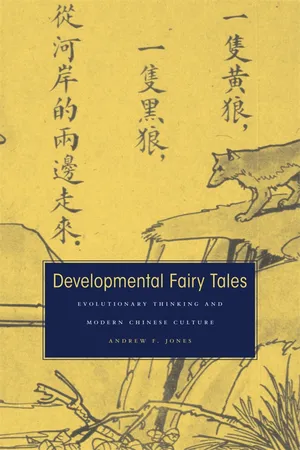
In Developmental Fairy Tales, Andrew F. Jones asserts that the groundwork for this recent transformation was laid in the late nineteenth century, with the translation of the evolutionary works of Lamarck, Darwin, and Spencer into Chinese letters. He traces the ways that the evolutionary narrative itself evolved into a form of vernacular knowledge which dissolved the boundaries between beast and man and reframed childhood development as a recapitulation of civilizational ascent, through which a beleaguered China might struggle for existence and claim a place in the modern world-system.
This narrative left an indelible imprint on China's literature and popular media, from children's primers to print culture, from fairy tales to filmmaking. Jones's analysis offers an innovative and interdisciplinary angle of vision on China's cultural evolution. He focuses especially on China's foremost modern writer and public intellectual, Lu Xun, in whose work the fierce contradictions of his generation's developmentalist aspirations became the stuff of pedagogical parable. Developmental Fairy Tales revises our understanding of literature's role in the making of modern China by revising our understanding of developmentalism's role in modern Chinese literature.
eBook - PDF
Developmental Fairy Tales
Evolutionary Thinking and Modern Chinese Culture
- 268 pages
- English
- PDF
- Available on iOS & Android
eBook - PDF
About this book
Information
Topic
LittératureSubtopic
Histoire du 19ème siècleTable of contents
- Cover
- Title Page
- Copyright
- Contents
- Introduction: The Development of Modern Chinese Literature
- Chapter 1. The Iron House of Narrative: Lu Xun and the Late Qing Fiction of Evolutionary Adventure
- Chapter 2. Inherit the Wolf: Lu Xun, Natural History, and Narrative Form
- Chapter 3. The Child as History in Republican China: A Discourse on Development
- Chapter 4. Playthings of History
- Chapter 5. A Narrow Cage: Lu Xun, Eroshenko, and the Modern Chinese Fairy Tale
- Appendix: “A Narrow Cage” by Vasilii Eroshenko
- Glossary of Selected Chinese and Japa nese Terms
- Notes
- Acknowledgments
- Index
Trusted by 375,005 students
Access to over 1.5 million titles for a fair monthly price.
Study more efficiently using our study tools.
Frequently asked questions
Yes, you can cancel anytime from the Subscription tab in your account settings on the Perlego website. Your subscription will stay active until the end of your current billing period. Learn how to cancel your subscription
No, books cannot be downloaded as external files, such as PDFs, for use outside of Perlego. However, you can download books within the Perlego app for offline reading on mobile or tablet. Learn how to download books offline
Perlego offers two plans: Essential and Complete
- Essential is ideal for learners and professionals who enjoy exploring a wide range of subjects. Access the Essential Library with 800,000+ trusted titles and best-sellers across business, personal growth, and the humanities. Includes unlimited reading time and Standard Read Aloud voice.
- Complete: Perfect for advanced learners and researchers needing full, unrestricted access. Unlock 1.5M+ books across hundreds of subjects, including academic and specialized titles. The Complete Plan also includes advanced features like Premium Read Aloud and Research Assistant.
We are an online textbook subscription service, where you can get access to an entire online library for less than the price of a single book per month. With over 1.5 million books across 990+ topics, we’ve got you covered! Learn about our mission
Look out for the read-aloud symbol on your next book to see if you can listen to it. The read-aloud tool reads text aloud for you, highlighting the text as it is being read. You can pause it, speed it up and slow it down. Learn more about Read Aloud
Yes! You can use the Perlego app on both iOS and Android devices to read anytime, anywhere — even offline. Perfect for commutes or when you’re on the go.
Please note we cannot support devices running on iOS 13 and Android 7 or earlier. Learn more about using the app
Please note we cannot support devices running on iOS 13 and Android 7 or earlier. Learn more about using the app
Yes, you can access Developmental Fairy Tales by Andrew F. Jones in PDF and/or ePUB format, as well as other popular books in Littérature & Histoire du 19ème siècle. We have over 1.5 million books available in our catalogue for you to explore.