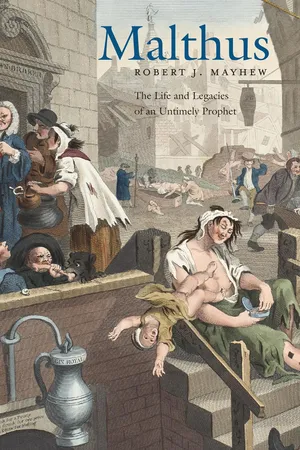
Thomas Robert Malthus's An Essay on the Principle of Population was an immediate succès de scandale when it appeared in 1798. Arguing that nature is niggardly and that societies, both human and animal, tend to overstep the limits of natural resources in "perpetual oscillation between happiness and misery," he found himself attacked on all sides—by Romantic poets, utopian thinkers, and the religious establishment. Though Malthus has never disappeared, he has been perpetually misunderstood. This book is at once a major reassessment of Malthus's ideas and an intellectual history of the origins of modern debates about demography, resources, and the environment.
Against the ferment of Enlightenment ideals about the perfectibility of mankind and the grim realities of life in the eighteenth century, Robert Mayhew explains the genesis of the Essay and Malthus's preoccupation with birth and death rates. He traces Malthus's collision course with the Lake poets, his important revisions to the Essay, and composition of his other great work, Principles of Political Economy. Mayhew suggests we see the author in his later writings as an environmental economist for his persistent concern with natural resources, land, and the conditions of their use. Mayhew then pursues Malthus's many afterlives in the Victorian world and beyond.
Today, the Malthusian dilemma makes itself felt once again, as demography and climate change come together on the same environmental agenda. By opening a new door onto Malthus's arguments and their transmission to the present day, Robert Mayhew gives historical depth to our current planetary concerns.
- English
- ePUB (mobile friendly)
- Available on iOS & Android
eBook - ePub
About this book
Information
Topic
HistoriaSubtopic
Biografías históricasCHAPTER ONE
Before Malthus
A Shandean Opening: Hatches, Matches, and Dispatches
It is hard to imagine two more contrasting characters than those of Thomas Robert Malthus, the subject of this book, and his most famous eighteenth-century predecessor at Jesus College, Cambridge, the novelist Laurence Sterne. Where Malthus is the great progenitor of the “dismal science” of classical economics, Sterne possesses irreverent Rabelaisian wit; sex is a realm of reproduction for the one, of double entendre for the other. While Malthus was a good family man and a diligent Anglican clergyman, quite the Dr. Primrose from Oliver Goldsmith’s Vicar of Wakefield (1766), Sterne the cleric spiraled out of control as he became enmeshed in the libertine society of midcentury London and in anticlerical circles in Paris, his wife leaving him when she could no longer bear the burden of his dalliances with other women.1 And yet, for all the differences between their characters and their lifestyles, Sterne and Malthus in fact shared one preoccupation: vital events. Their very differing contributions to eighteenth-century culture were both shot through with an attention to births, marriages, and deaths, or, in a more Shandean vein, to hatches, matches, and dispatches.
Laurence Sterne’s masterpiece, The Life and Opinions of Tristram Shandy (1760–1767), opens with Tristram’s conception, and the woes that ensue from Mrs. Shandy’s otherwise innocent question as to whether Mr. Shandy has remembered to wind up a long case clock: “it was a very unseasonable question at least,—because it scattered and dispersed the animal spirits, whose business it was to have escorted and gone hand-in-hand with the HOMUNCULUS, and conducted him safe to the place destined for his reception.” To this event Tristram ascribes the eccentricity of his character that the rest of the novel exemplifies and that spawned the eighteenth-century adjective “Shandean.” In doing so, Tristram also argues that character is determined by (Shandean) genetics, not by environmental conditions: “he derived the singularity of his temper more from blood, than either wind or water, or any modifications or combinations of them whatever.”2
And yet the Shandean analysis of the centrality of “hatching” to character is by no means concluded by this opening sally as might be the case in a conventional autobiography. On the contrary, well over half the book is digressively preoccupied with Tristram’s birth as we meet the local midwife, mired in myth and muddle about childbirth, and then Dr. Slop, the local man-midwife, whose bag of obstetrical tricks looks set fair to kill Tristram before he is born and whose forceps leave Tristram with a mangled nose that his father sees as wholly unpropitious to greatness. Sterne depicts the experts on childbirth as ignorant and barbarous, their combined incompetence making it a miracle that anyone successfully arrives in this world. And when Tristram is finally delivered, “almost into the middle of my fourth volume—and no farther than to my first day’s life,” all foretell his immediate death as he is born in a fit. The haste to baptize the newborn before his death (thereby allowing him a Christian burial under Anglican rites) leads to the bungle whereby he is named “Tristram,” the one name his father thinks it impossible to bear and make any mark in the world.3
All the traumas Tristram endures—his botched name, his squashed nose, his ruffled animal spirits—take place in Shandy Hall in Sterne’s native Yorkshire. And yet the first two of these events in the mock epic that is Tristram’s birth would have been located in London but for Mr. Shandy’s marriage contract, which is laid before the reader in volume 1, chapter 15 of Tristram Shandy. Fearful of the barbaric ignorance of rural midwifery, Mrs. Elizabeth Shandy is allowed by her marriage settlement to go to London for childbirth, as she had done with Tristram’s elder brother Bobby, except, as an additional clause states, on such an occasion as when she has previously had a phantom pregnancy and gone up to London for no purpose. “The fact was this, That in the latter end of September, 1717, which was the year before I was born, my mother having carried my father up to town much against the grain,—he peremptorily insisted upon the clause;—so that I was doomed, by marriage articles, to have my nose squeezed as flat to my face, as if the destinies had actually spun me without one.” The terms of Mr. Shandy’s matching, then, lead to the catalogue of catastrophes stretched over four volumes that is Tristram’s hatching at Shandy Hall.4
Tristram Shandy’s lightheartedness about hatches and matches does not conceal the central reality of death either. One of the most fêted moments in the novel, the opening to volume 7, sees an encounter between Tristram Shandy and the Grim Reaper that was immortalized by the artist Thomas Patch in a picture that hangs in Malthus and Sterne’s alma mater. Praising his animal spirits for endowing him with good humor, Tristram recalls the encounter that led to his hasty decision to travel to France:
when DEATH himself knocked at my door—ye bad him come again; and in so gay a tone of careless indifference did ye do it, that he doubted of his commission—
“—There must certainly be some mistake in this matter,” quoth he.
“—Did ever so grave a personage get into so vile a scrape?” quoth Death.
Celebrated as this moment is, the specter of death punctuates Sterne’s tale more generally. We have already seen that Tristram himself nearly meets his maker at birth, but before this we have already encountered his midwife, whose career was determined by her being widowed, and also within the first volume is narrated the mock sentimental death of Parson Yorick. Toward the close of volume 4, and shortly after Tristram’s birth, Mr. Shandy hears of the death of his eldest son, Bobby, a fact he is still taking in at the opening of volume 5. If the Grim Reaper is bamboozled by Tristram’s eccentric humor, he takes his toll on others in the course of the novel.5
Thomas Patch’s picture of the encounter with the Grim Reaper actually substitutes Laurence Sterne himself for Tristram Shandy in imaging that moment. The intertwinings of Sterne and his comic creation, Tristram Shandy, are many and have been the fodder of Sterne’s biographers for two-and-a-half centuries. Certainly with regard to the vital events that amount to obsessive mooring points in the digressive structure of Tristram Shandy, we can say that they reflect Sterne’s own unavoidable preoccupation with disease, death, and life. Like Tristram, Sterne had repeated encounters with the Grim Reaper, and attempted to find in comedy his way out of the situation. As he wrote to his fellow humorist, the actor David Garrick, about his removal to Paris in 1761, “I Shandy it more than ever, and verily do believe, that by mere Shandeism sublimated by a laughter-loving people, I fence as much against infirmities, as I do by the benefit of air and climate.” Sterne was to die in 1768, two years after Malthus’s birth, at the age of fifty-three, but in a letter of 1762 penned in Paris, where he, like Tristram, had fled to improve his health, he reports that he had nearly died while up at Jesus College, “of breaking a vessel in my lungs. It happen’d in the night, and I bled the bed full.” In the end it would be the consumption—pulmonary tuberculosis—of which this student experience was the first sign, that would kill Sterne. In the meantime, Sterne’s eventual dispatcher also led to his matching, in that he was, as his biographer notes, drawn into marriage to Elizabeth Lumley when she was on death’s door with consumption in 1741.6
Within two years, Sterne’s marriage was “in a downward spiral” and he was repeatedly drawn into sentimental amours with other women who were wracked by illness, most notably Elizabeth Draper, the subject of Sterne’s late masterpiece, the Journal to Eliza (1767). One of the reasons for the unraveling of Sterne’s marriage was undoubtedly his anxiety about the failure of his matching to lead to hatching; while the evidence is scant, it appears that Elizabeth Sterne had several stillborn children, for which Sterne may have blamed himself on the grounds of his syphilis. With certainty we know that Sterne’s first daughter, Lydia, was born on October 1, 1745. She, like Tristram Shandy, was baptized on the same day, but unlike him did not escape an immediate return to her maker, being recorded by Sterne in his capacity as parish priest as buried on the next day. For all the humor that characterizes Tristram’s naming debacle, it was in fact the transmutation of Sterne’s personal pain into literary creativity. The Sternes did eventually have another daughter, also named Lydia, who would survive into adulthood. She, like her father, suffered from chronic poor health, most probably due to epilepsy.7
Simply put, if hatches, matches, and dispatches were at the heart of the Shandean success of Sterne’s literary masterpiece, this was not simply literary gamesmanship, a comic parlor game produced by an insouciant genius, but is more accurately seen as an expression of Sterne’s anxieties about the unceasing round of illness, loss, and pain that he felt in his personal life.
Diarists of the Eighteenth Century
If Sterne’s genius was in good part the sublimation of the pain that lies behind the exterior of vital statistics, the sheer centrality of births, marriages, and deaths, of disease and the struggle to negotiate a niggardly environment are also at the core of those more prosaic windows onto life in the age of Malthus provided by contemporary diarists. There is a tendency to domesticate many of the great diaries of the eighteenth century with such mildly demeaning epithets as “charming” and “delightful.” Both things they may be, but they are also windows onto the struggle for existence visited upon individuals on all rungs of the social ladder.
We can make good this claim by looking to three diarists whose work marks out the arc of Malthus’s own life from his birth in 1766, through the great breakthrough of his Essay at the middle point in his life in 1798, to his death in 1834. In the decade before Malthus was born, and tailing off in the year before his birth, the Sussex shopkeeper, undertaker, schoolmaster, churchwarden, and overseer of the poor Thomas Turner (1729–1793) was writing his diary, a private document never intended for publication. Turner’s diary only saw the light of day in 1859, and it owes its modern popularity to an edition that came out in 1984. Turner is an ideal representative of the “middling sort” whose virtues of prudential calculation Malthus was to champion in his Essay. Turner’s calculations are littered through his diaries, pages of entries being devoted to his expenditures, debts, and receipts. In 1754 alone, the first year of Turner’s diary, we are told of his losing money at cards (tuppence), the cost of his hiring of a live-in servant (30 shillings for the year), the price he had paid for pipes to sell in his shop, and so on. Turner also notes that he has helped friends to call in their debts in his village of East Hoathly. And alongside this litany of prices, of financial incomings and outgoings, is a roll call of births, marriages, deaths, and illnesses. Again for 1754, Turner records in March the death of the local dignitary and former prime minister Henry Pelham “on Wednesday the 6th instant about 6 o’clock in the morn.” Eight days after Pelham’s funeral, Turner recorded the burial of Thomas Butler’s wife. Whereas Pelham was reported to have died from immoderate eating, Butler’s wife may well have been a victim of the bitterly cold weather Turner records at this time, the snow being sixteen inches deep by his reckoning at the time of Pelham’s funeral, with even more snow having fallen in the interim. If the Henry Pelhams of Turner’s world had the wealth to overcome an exceptionally harsh winter, those lower down the social spectrum like Thomas Butler’s wife struggled to make ends meet even at the best of times, a tough winter sometimes quite literally making the difference between life and death. And yet as the seasons turned and the harsh winter of 1753–1754 became a mere memory, happier events visited Turner, his wife, Margaret, being pregnant. Ever the calculator, Turner noted that he had paid “Dame Smith to nurse my wife at 2s 6d per week.” Whether Dame Smith was more effectual than Sterne’s midwife in Tristram Shandy is hard to tell; all we can say is that Margaret Turner was safely delivered of a son, Peter, on August 19, but that she was “very bad” such that Thomas “Sent for Dr. Stone to her” within a week of Peter’s birth. Turner’s diary breaks off in this climacteric, only to resume in January 1755 with both his wife and son “very bad.” Peter died on January 16, and Turner’s entry for that day and the following sum up the interweaving of the economic and the demographic that the diary more generally performs:
Thurs. 16 Jan. This morning about 1 o’clock I had the misfortune to lose my little boy Peter, aged 21 weeks, 3 days. Paid for flour and other small things 16d. … Fri. 17 Jan. Went to Framfield concerning the burying of little Peter. Met at Framfield Messrs. Grant, Barlow and Wigginton’s man. My mother paid him £30 in full to September last. This day balanced accounts with John Dulake and paid him for the carriage of 2½ tuns salt, 2 bushels sand and 2 cwt. Cheser cheese: 18 s., which with 6s.6d. received of him was in full to this day.8
If Turner’s ability to conjoin deaths and accounting seems callous to the modern eye, we need to remember the sheer frequency of childhood death at this time, something that may have inured God-fearing men like Turner to its sting and that this was a private diary of short memos and jottings, never aimed at posterity. Furthermore, at the next great moment of loss in Turner’s life, his pain is palpable. In 1761, Turner records the death of his wife, Margaret: “About 1.50 it pleased Almighty God to take from me my beloved wife, who, poor creature, has laboured under a severe though lingering illness for these 38 weeks past, which she bore with the greatest resignation to the Divine will. In her I have lost a sincere friend and virtuous wife, a prudent and good economist in her family and a very valuable companion.” Margaret was only twenty-seven at the time of her death, something that in advanced modern societies would be a terrible and anomalous tragedy, but that was a far more routine part of life expectations in Turner’s time. Turner’s diary finally breaks off in 1765, just a year before Malthus’s birth, and this not because of Turner’s death but a very different and far happier vital event, his remarriage to Mary Hicks, who would outlive him and indeed see in the new century. And yet, while we do not have Turner’s words to trace the details, the twining of economy and vital events clearly continued to set the pattern of his life, Turner accruing substantial capital in later life and investing in some land, while also having some seven children with Mary, only three of whom outlived him.9
Thomas Turner died in 1793, some five years before the publication of Malthus’s epochal Essay and thirty since he had laid down his diarist’s pen. Yet still going strong at that time was another of the great diarists of the eighteenth century, Parson James Woodforde. Like Tristram Shandy, Woodforde had nearly died at birth, being baptized by his father at three days old in 1740. By 1758, Woodforde had begun to write a diary that would extend over the better part of a half century until his death in 1803. As his father’s profession suggests, Woodforde was born into the comfortable clerical classes, a rung up the social ladder from Thomas Turner but at very much the same stratum in which Malthus was born and in which he would live out his days. Woodforde likewise remained in this part of the social spectrum, going to Winchester and Oxford before taking holy orders as rector of Weston Longeville in Norfolk. Woodforde’s diary is beloved of coffeetable consumers of history for his obsession with food and drink; he seems to personify our stereotype of the worldly clergyman in a secular eighteenth century. And yet if we look at his diary for 1798, the year of Malthus’s Essay, there is much of interest beyond Woodforde’s detailing of “rost Beef, Tripe &c,” much that links to the worlds of Thomas Turner and Robert Malthus. As with Turner, there is the punctuation of daily life by the specter of death: as the rector, Woodforde was called to send his curate to perform the last rites for a Mrs. Mann in February. Likewise in December Woodforde’s clerk, Thomas Thurston, died “by a sudden & rapid Swelling in his Throat which suffocated him” and hard on the heels of this, within the same week, he learned of the death of “my dear Sister Pounsett.” This latter was of particular concern to him as Pounsett’s daughter had in the same year married one Frederick Grove under a settlement that Woodforde considered in shades of Mr. Shandy’s additional clauses to be “a very bad one & a very cunning one.” Woodforde himself was by this time in poor health, complaining in November of a fainting fit. And meshed with these events that marked out Woodforde’s year as a cleric were the concerns he shared as a landowner with his rural parishioners about weather and harvests, about yields and taxes, about the economic conditions that helped or hindered human flourishing. In this particular year, Woodforde noted that January was “hazy & unpleasant,” but by springtime he was encouraged as two of his sows had large litters and his cow had a bull-calf. By late summer, he was positively rejoicing: “Never was known scarce ever so fine a Harvest Season. Lord! make us truly thankful & grateful for the same.” All this at least counteracted Woodforde’s gripes about the heavy new taxes on the clergy and his repeated concerns about a potential Napoleonic invasion via Ireland. Rather like Thomas Turner, Woodforde was keenly aware of the ways in which economic balance sheets and the rhythm of vital events interacted, and of the complex connections that both of these had with political and environmental conditions. In that same year of 1798, a clergyman of the next generation, Robert Malthus, would pen perhaps the most important treatise ever written on this most essential of conjunctions.10
Around the time of Malthus’s death in 1834, Samuel Bamford, sometime radical agitator, weaver, and journalist, abandoned his other activities to become a full-time writer, mainly of autobiographical works. Just as early Victorian England started to express concern about the conditions in the great industrial cities that were mushrooming in Malthus’s declining years, Bamford was able to depict the horrors of the lives led in these environments with an intensity that neither the bien-pensant novels of Elizabeth Gaskell and Benjamin Disraeli nor the social reportage of the wealthy industrialist Friedrich Engels could muster, for the simple reason that Bamford had been born and had lived out his years as a laborer in this environment. If Turner’s diary epitomizes the frugal middle classes whom Malthus praised and Woodforde’s encapsulated...
Table of contents
- Cover
- Half Title
- Title Page
- Copyright
- Dedication
- Contents
- Prologue: Opening the Door on Malthus’s Roller Coaster
- 1. Before Malthus
- 2. Prophets of Perfection: A Revolutionary Triptych
- 3. Malthus’s Essay and the Quiet Revolution of 1798
- 4. Malthus as the Malign Muse of Romanticism
- 5. Malthus and the Making of Environmental Economics
- 6. Malthus and the Victorians
- 7. Malthus and the Dismal Age
- 8. Malthus the Transatlantic Celebrity
- 9. Malthus Today
- Epilogue: High Time for the Untimely Prophet
- Notes
- Acknowledgments
- Index
Trusted by 375,005 students
Access to over 1.5 million titles for a fair monthly price.
Study more efficiently using our study tools.
Frequently asked questions
Yes, you can cancel anytime from the Subscription tab in your account settings on the Perlego website. Your subscription will stay active until the end of your current billing period. Learn how to cancel your subscription
No, books cannot be downloaded as external files, such as PDFs, for use outside of Perlego. However, you can download books within the Perlego app for offline reading on mobile or tablet. Learn how to download books offline
Perlego offers two plans: Essential and Complete
- Essential is ideal for learners and professionals who enjoy exploring a wide range of subjects. Access the Essential Library with 800,000+ trusted titles and best-sellers across business, personal growth, and the humanities. Includes unlimited reading time and Standard Read Aloud voice.
- Complete: Perfect for advanced learners and researchers needing full, unrestricted access. Unlock 1.5M+ books across hundreds of subjects, including academic and specialized titles. The Complete Plan also includes advanced features like Premium Read Aloud and Research Assistant.
We are an online textbook subscription service, where you can get access to an entire online library for less than the price of a single book per month. With over 1.5 million books across 990+ topics, we’ve got you covered! Learn about our mission
Look out for the read-aloud symbol on your next book to see if you can listen to it. The read-aloud tool reads text aloud for you, highlighting the text as it is being read. You can pause it, speed it up and slow it down. Learn more about Read Aloud
Yes! You can use the Perlego app on both iOS and Android devices to read anytime, anywhere — even offline. Perfect for commutes or when you’re on the go.
Please note we cannot support devices running on iOS 13 and Android 7 or earlier. Learn more about using the app
Please note we cannot support devices running on iOS 13 and Android 7 or earlier. Learn more about using the app
Yes, you can access Malthus by Robert J. Mayhew in PDF and/or ePUB format, as well as other popular books in Historia & Biografías históricas. We have over 1.5 million books available in our catalogue for you to explore.