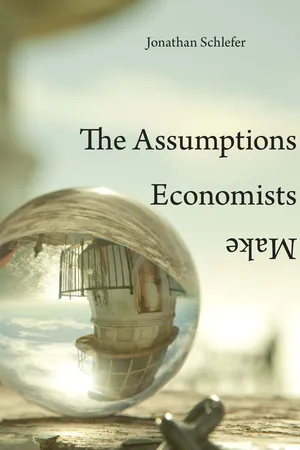
Economists make confident assertions in op-ed columns and on cable news—so why are their explanations often at odds with equally confident assertions from other economists? And why are all economic predictions so rarely borne out? Harnessing his frustration with these contradictions, Jonathan Schlefer set out to investigate how economists arrive at their opinions.
While economists cloak their views in the aura of science, what they actually do is make assumptions about the world, use those assumptions to build imaginary economies (known as models), and from those models generate conclusions. Their models can be useful or dangerous, and it is surprisingly difficult to tell which is which. Schlefer arms us with an understanding of rival assumptions and models reaching back to Adam Smith and forward to cutting-edge theorists today. Although abstract, mathematical thinking characterizes economists' work, Schlefer reminds us that economists are unavoidably human. They fall prey to fads and enthusiasms and subscribe to ideologies that shape their assumptions, sometimes in problematic ways.
Schlefer takes up current controversies such as income inequality and the financial crisis, for which he holds economists in large part accountable. Although theorists won international acclaim for creating models that demonstrated the inherent instability of markets, ostensibly practical economists ignored those accepted theories and instead relied on their blind faith in the invisible hand of unregulated enterprise. Schlefer explains how the politics of economics allowed them to do so. The Assumptions Economists Make renders the behavior of economists much more comprehensible, if not less irrational.
- 331 pages
- English
- ePUB (mobile friendly)
- Available on iOS & Android
eBook - ePub
The Assumptions Economists Make
About this book
Information
Index
Abramovitz, Moses, on total-factor productivity, 177
Abstract capital, 115–116, 118, 170–172
Abstract labor, 116, 118, 170–171
Ackerman, Frank, 14, 15, 19–20
Acts of God, 153
Administered wages, 172
Agents, heterogeneous, 268, 269–271
Agents, representative, 17, 170, 210, 211, 212, 240, 267, 268
Aggregate capital, 116, 118, 170–171
Aggregate demand. See Market demand
Aggregate labor, 118, 170–172
Aggregate output/commodity, 118, 170–172
Aggregate production function: Clark on, 116–120, 170–171, 172, 211, 218–219, 264; dual of, 122; and income inequality, 122–123, 131
Allende, Salvador, 6, 222
Altruism, 78, 263, 266
American Economic Association, 2–3, 18, 100, 200
American Economic Review, 105
American International Group (AIG), 7, 161, 244
American Revolution, 33, 46; Declaration of Independence, 39, 71
Anarchists, 99–100
Animal spirits and investment decisions, 150, 151, 159, 169, 173, 223, 246, 253, 261
Argentine financial crisis of 2001, 7
Arrow, Kenneth, 172, 221; general-equilibrium model of, 9, 11–15, 17, 20–21, 89, 157, 170, 204, 242, 267, 279, 296n8
Arthur, W. Brian, 268–271
Artificial intelligence, 268
Asian Development Bank, 117, 193–194
Asian financial crisis of 1997, 7
Asian model, 183, 184, 215–216
Aspe, Pedro, 154
Asset price cycle, 241
Asset transformation, 242, 243, 244
Asymmetric information, 243
AT&T’s Bell Labs, 185
Auctioneer, 12–14, 21, 268, 285n37
Automobile industry, 107–108, 109, 113, 117, 134, 231
Bagehot problem, 244–245
Baily, Martin, 216
Baker, Dean, “Fact Sheet,” 241
Bankers Trust, 154
Bankruptcy, 5
Banks: commercial vs. investment, 7; investment by, 7, 242–244; cash hoarded by, 51–52, 150, 160, 161, 162, 277–278, 289n17, 301n17, 315n32; asset transformation by, 242, 243, 244; banking crises, 242–245; Taylor on, 284n16
Barbosa, ...
Table of contents
- Cover
- Title Page
- Copyright
- Dedication
- Contents
- A Personal Note
- ONE The Metaphor of the Invisible Hand
- TWO What Do Economists Do?
- THREE In Search of a Model
- FOUR Economics When Society Matters
- FIVE Chasing a Chimera
- SIX Utopia
- SEVEN This Imperfect World
- EIGHT Entering the Realm of Production
- NINE What Caused Income Inequality?
- TEN Understanding an Uncertain World
- ELEVEN In the Long Run
- TWELVE In the Short Run
- THIRTEEN The Puzzle of the Golden Age of Capitalism
- FOURTEEN Economies in Crisis
- FIFTEEN Thinking about Economies
- Notes
- References
- Index
Trusted by 375,005 students
Access to over 1.5 million titles for a fair monthly price.
Study more efficiently using our study tools.
Frequently asked questions
Yes, you can cancel anytime from the Subscription tab in your account settings on the Perlego website. Your subscription will stay active until the end of your current billing period. Learn how to cancel your subscription
No, books cannot be downloaded as external files, such as PDFs, for use outside of Perlego. However, you can download books within the Perlego app for offline reading on mobile or tablet. Learn how to download books offline
Perlego offers two plans: Essential and Complete
- Essential is ideal for learners and professionals who enjoy exploring a wide range of subjects. Access the Essential Library with 800,000+ trusted titles and best-sellers across business, personal growth, and the humanities. Includes unlimited reading time and Standard Read Aloud voice.
- Complete: Perfect for advanced learners and researchers needing full, unrestricted access. Unlock 1.5M+ books across hundreds of subjects, including academic and specialized titles. The Complete Plan also includes advanced features like Premium Read Aloud and Research Assistant.
We are an online textbook subscription service, where you can get access to an entire online library for less than the price of a single book per month. With over 1.5 million books across 990+ topics, we’ve got you covered! Learn about our mission
Look out for the read-aloud symbol on your next book to see if you can listen to it. The read-aloud tool reads text aloud for you, highlighting the text as it is being read. You can pause it, speed it up and slow it down. Learn more about Read Aloud
Yes! You can use the Perlego app on both iOS and Android devices to read anytime, anywhere — even offline. Perfect for commutes or when you’re on the go.
Please note we cannot support devices running on iOS 13 and Android 7 or earlier. Learn more about using the app
Please note we cannot support devices running on iOS 13 and Android 7 or earlier. Learn more about using the app
Yes, you can access The Assumptions Economists Make by Jonathan Schlefer in PDF and/or ePUB format, as well as other popular books in Economics & Comparative Economics. We have over 1.5 million books available in our catalogue for you to explore.