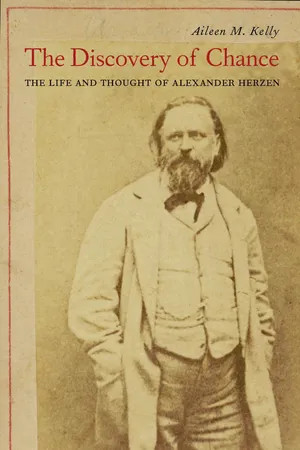
Alexander Herzen—philosopher, novelist, essayist, political agitator, and one of the leading Russian intellectuals of the nineteenth century—was as famous in his day as Tolstoy and Dostoevsky. While he is remembered for his masterpiece My Past and Thoughts and as the father of Russian socialism, his contributions to the history of ideas defy easy categorization because they are so numerous. Aileen Kelly presents the first fully rounded study of the farsighted genius whom Isaiah Berlin called "the forerunner of much twentieth-century thought."
In an era dominated by ideologies of human progress, Herzen resisted them because they conflicted with his sense of reality, a sense honed by his unusually comprehensive understanding of history, philosophy, and the natural sciences. Following his unconventional decision to study science at university, he came to recognize the implications of early evolutionary theory, not just for the natural world but for human history. In this respect, he was a Darwinian even before Darwin.
Socialism for Russia, as Herzen conceived it, was not an ideology—least of all Marxian "scientific socialism"—but a concrete means of grappling with unique historical circumstances, a way for Russians to combine the best of Western achievements with the possibilities of their own cultural milieu in order to move forward. In the same year that Marx declared communism to be the "solution to the riddle of history," Herzen denied that any such solution could exist. History, like nature, was contingent—an improvisation both constrained and encouraged by chance.
- 596 pages
- English
- ePUB (mobile friendly)
- Available on iOS & Android
eBook - ePub
About this book
Information
[ CHAPTER ONE ]
Who Was Herzen?
Herzen awaits his readers in the future. Far above the heads of the present crowd, he transmits his thoughts to those who will be able to comprehend them.
L. N. TOLSTOY, DIARY ENTRY OF 12 OCTOBER 1905
HE has been described more than once as a Russian Voltaire. Nietzsche wrote of his readiness to credit “such a noble-spirited and tenacious soul” with “every gift of distinction”; Tolstoy declared that he had never met anyone with “so rare a combination of scintillating brilliance and depth.”1 On his death the historian Jules Michelet wrote that the voice of millions had been silenced.2
Philosopher, novelist, essayist, publicist, and political agitator, Alexander Ivanovich Herzen was one of the most talented and complex figures of his time. The first socialist in Russian history, he played a crucial role in the assimilation of Western ideas into Russian thought. As a political émigré in Europe, he is acknowledged as having single-handedly created Russian public opinion by providing his native country with its first uncensored news organ, smuggled into Russia from his Free Russian Press in London: the celebrated periodical The Bell. In the West, his fame rivaled that of the great Russian novelists who were his contemporaries. An engaged observer of the 1848 revolution in France, he was admired by some of the most eminent members of Europe’s progressive elite. His friends and collaborators included Garibaldi, Mazzini, Michelet, Louis Blanc, Proudhon, Victor Hugo, and Thomas Carlyle. His political writings, infused with moral passion and a fiery imagination, have all the vitality of the spoken word. His monumental memoirs, the work of an uncommonly perceptive social observer, with their vivid insights into personalities, ideas, and events at turning points in the history of Russia and Europe, are recognized as a literary classic, while as a philosopher he gave early expression to values that became prominent only a century later.
But he left no body of doctrine, and anyone inquiring into the nature of his intellectual legacy is faced with a bewildering variety of interpretations. The outlook and aims of this extraordinarily multifaceted figure continue to be a matter of contention. In his own country Slavophiles and Westernizers, Romantics and realists, moderates and extremists, communists, anarchists, and liberals, have on occasion claimed him as their own, or reviled him as an implacable opponent. Comparisons have been made with Stirner, Nietzsche, Kierkegaard, and Camus, to name only a few.3 He won tributes from Dostoevsky and Solzhenitsyn, who acknowledged his formative influence on their work in both content and style. But he was also accorded the dubious honor of elevation to the Soviet pantheon, thanks to Lenin’s much-quoted essay “In Memory of Herzen,” lauding Herzen for his “selfless devotion” to the cause of revolution—a phrase that determined (and strictly limited) the approach of generations of Soviet scholars to his work.4
The official Russian interpretation of Herzen disappeared from circulation after 1991. The three speakers at a very modest conference held in 2010 in the Institute of Philosophy of the Russian Academy of Sciences to mark the 140th anniversary of his death stressed the “nontypicality” (nestandartnost) of his thought as a critic both of Western liberalism and Russian Slavophilism, and his misfortune to have been cited repeatedly for pragmatic purposes by Lenin and his successors as part of the prologue to bolshevism (defining him in this way had made it possible to assert the distinctiveness of Russian communism as no mere offshoot of Marxism.)5 A very much larger conference with a light sprinkling of foreign delegates was held in 2012, again in Moscow, to discuss Herzen’s heritage on the bicentenary of his birth. The opening speaker acknowledged that in the two previous post-Soviet decades, “we were silent about Herzen.… [He] was neither refuted nor rejected, not even intentionally forgotten; he simply disappeared from sight. It was as if he had fallen into a black hole.”6 Or rather as if he had fallen between two stools (popal pod razdachu slonov), pigeonholed either as the ideological ally of bolshevism or the ideological foe of the tsarist regime it destroyed. Two speakers give the main credit for the recent sudden growth of interest in his life and ideas (a phenomenon described by one as “a genuine landmark in the history of Russian social and political thought”) to Isaiah Berlin, who, by approaching his personality and ideas in their historical context, had rescued Herzen from oblivion to become a significant figure in the cultural life of both Russia and the English-speaking world. They note that Berlin’s writings on Herzen were the inspiration for The Coast of Utopia, the English dramatist Tom Stoppard’s set of plays devoted to Herzen’s life, which had themselves become a minor cultural phenomenon, with an extended run in Moscow.7
Even though the papers at that conference ranged widely (few in original directions) over Herzen’s multifaceted talents as writer, philosopher, and political activist, none addressed his own frequently repeated explanation for the unpopularity of his view of history: the fear of freedom.8 In an essay published five years after the end of Russian communism, the historian A. I. Volodin had pointed out that for all his enormous erudition and the vividness of his style, Herzen produced no system, no body of doctrine categorizable as “Herzenism.” Revolutionaries and reformers, materialists and idealists alike were alarmed and repelled by his refusal to recognize any absolutes, his rejection of the logic of “either / or,” and above all his contention that history follows no path of progress to a final goal, contrary to all the theories of progress that had sustained European optimism over two millennia. Volodin cites a letter to Herzen from Tolstoy in the early 1860s—“There are many people, and 99 out of a hundred Russians, who will be too frightened to give credence to your thoughts.… (You appear to be addressing only the intelligent and the brave.) Those who are neither intelligent nor brave will say that it is better to be silent when one has reached such conclusions”—and contends that Tolstoy’s prediction was correct: the principal reason few commentators on Herzen have been prepared to consider objectively his views on socialism, religion, Russia’s relation to the West, the nature of history and progress, and the goals of revolution is that “taken as a whole, his heritage is acceptable to no one.”9
Only two Western scholars have given detailed attention to the view of history and freedom that inspired Herzen’s work, and they reached opposing conclusions. In essays first published in the 1950s, Isaiah Berlin contended that the boldness and originality of Herzen’s thought had been overlooked because of the tendency to classify it as yet another variety of early socialism. Focusing on Herzen’s campaign for individual liberty against the great utopian visions of his time, Berlin stressed the farsightedness of his perception of the destructive power of ideological abstractions over human lives: “Herzen’s sense of reality, in particular of the need for, and the price of, revolution, is unique in his own, and perhaps in any age.”10 The first major study of Herzen in English was Martin Malia’s 1961 biography; although it is incomplete, it has strongly influenced the interpretation of Herzen accepted in the West, painting a picture that is the antithesis of Berlin’s: Herzen as a utopian thinker motivated by “an almost unique existential egoism.”11
Edward Acton’s study of Herzen’s activities in western Europe convincingly challenges this view, but presents him as increasingly behind his time in his failure to influence a new generation of Russian revolutionaries.12 Neither Malia’s interpretation nor Acton’s does proper justice to Herzen’s own image of himself as the herald of truths that were too alien to received ideas to be acceptable or even comprehensible to the majority. He would express ironic amusement at his contemporaries’ efforts to locate him on their political spectrum—liberal, radical, gradualist, extremist. Most irritating of all, he maintained, they would accuse him of inconsistency, whereas for most of his life he had been preaching the same “two or three ideas”; but these had proved too contrary to long-cherished beliefs to be given sanctuary in the brain.
My own interest in Herzen was sparked by an exception to this rule: Isaiah Berlin’s essays. These still seem to me to have best captured the distinctiveness of Herzen’s thought by identifying him as a precursor, spelling out truths too novel for most of his contemporaries to understand and far too frightening for them to accept. The present study will approach his ideas in the context of the revolution in European thinking on man’s place in nature that would culminate in Darwin’s treatise on the origin of species.
Few commentators on Herzen’s thought have given significance to his early training in the natural sciences as a student at Moscow University. The subject is not even mentioned in the chapter on Herzen in a history of Russian philosophy published in 2010, while the texts selected for translation into English in A Herzen Reader, published two years later, include no extracts from his most original essays, on the natural sciences and the theme of evolution: no surprise, perhaps, as the critical commentary that follows the translations dates his adoption of evolutionary theories no farther back than his “English period.”13 But I shall show that the evolutionary science he imbibed at Moscow University twenty years earlier shaped his subsequent approach to history and philosophy: he would be unique among his contemporaries in the depth and extent of his knowledge in these three disparate disciplines. This combination of perspectives lay behind his demythologizing approach to history and society, allowing him to discern (two decades before Nietzsche announced the “death of God”) the erosion of that faith in a purposive universe in which the great nineteenth-century optimistic systems were grounded. In the same year as Marx’s pronouncement that communism was “the solution of the riddle of history,” Herzen declared that there were “no solutions”: history, like nature, was an improvisation, subject to the play of chance.
We shall see that Herzen was both keenly interested in the developments in evolutionary theory that were leading to Darwin’s discoveries and deeply aware of the threat they posed to cherished beliefs about the nature of history and the meaning and purpose of human life. This book will chart both Herzen’s intellectual journey and his struggle to exemplify what he called “the courage of consistency” in his personal life and his political life.
His “Russian socialism,” habitually portrayed as a messianic construct, was built on this pragmatic philosophy: anticipating many “third world” economists of the next century, he insisted that instead of following a notionally universal path of progress—that of the West—Russia should seek to develop the potential immanent in its own culture. As Darwin was to do in On the Origin of Species, Herzen incorporated the development of human societies into the domain of natural laws. From the Other Shore—Herzen’s confession de foi composed in the light of the failed revolutions of 1848—urges his contemporaries to cease their pursuit of unattainable goals and address themselves to the “physiology” of history, adapting their ideals and their personal hopes to the contingencies of time and place. This precept he consistently applied to the personal and political defeats and tragedies in his own life. The account of his life that follows will give particular attention to his letters (which occupy ten untranslated volumes in the Soviet edition of his works) as reflections of his stubborn resistance to what Nietzsche was to call the “craving for metaphysical comfort.”
His early intellectual development took place under the combined influence of the two movements of ideas that began in the eighteenth century to transform humans’ vision of the nature and purpose of our lives and the world in which we live: the Romantic movement and the growth of the natural sciences. The influence of the former has received due attention from Herzen’s biographers;14 this study aims to do the same for the latter. It will emphasize his role as a pioneer in addressing the theme of contingency that would be central to Darwin’s theory of evolution, situating Herzen within a demythologizing tradition in European humanism that stretches back to Francis Bacon and includes Friedrich Schiller’s and John Stuart Mill’s assaults on the universalist assumptions of rationalist ethical systems. These all informed Herzen’s attacks on the philosophies of progress that inspired so much political thought and practice in the last two centuries; he would also expose the logical and empirical defects of pessimistic antirationalism as preached by Schopenhauer (and subsequently Nietzsche).
Central emphasis will be given here to a hitherto unexplored aspect of his thought: his lifelong interest in scientific modes of inquiry and their relevance to the study of history. These were essential to his vision of the openness of time and the power and the limitations of reason. He was among the first to welcome Darwin’s discovery of the primary role of chance in evolution as a momentous step toward dismantling teleological systems that misrepresent the world and humans’ place in it; his own ideas were singular anticipations of the subsequent cross-fertilizations between scientific and historical thought.
In the preface to his study of science in Russian culture, published in 1963, Alexander Vucinich remarks: “Political history, social and religious thought, the arts, and most of the other dimensions of Russian life have been dealt with rather extensively in Western historical literature, but science as a component of Russian culture has been almost completely ignored.… Historians have often concluded that science, at least until the twentieth century, was a rationalist aberration operating on the fringes of Russian life.”15 It would seem that this preconception has distracted attention from Herzen’s most significant contributions to the history of ideas. He was not only the first Russian socialist: he was also, in the words of Isaiah Berlin, “the forerunner of much twentieth-century thought … a man with a quality a...
Table of contents
- Cover
- Title Page
- Copyright
- Dedication
- Epigraph
- Contents
- Acknowledgments
- 1. Who Was Herzen?
- 2. Russia and the Romantic Revolution
- 3. A Romantic Youth
- 4. A Revolution in Science
- 5. Science and History
- 6. An Education in Method
- 7. Science and Saint-Simonism
- 8. Prison and Exile
- 9. Awakening
- 10. The Discovery of Chance
- 11. From Bacon to Feuerbach: Nature and Time
- 12. Man in the Middle
- 13. A Conservative Revolution
- 14. A Glowing Footprint: Herzen and Proudhon
- 15. Toward Another Shore
- 16. View from the Other Shore
- 17. The Living Truth
- 18. In Defense of Inconsistency
- 19. What Is History?
- 20. The Polish Uprising
- 21. True Nihilism
- 22. The Last Years
- Epilogue
- Notes
- Illustration Credits
- Index
Trusted by 375,005 students
Access to over 1.5 million titles for a fair monthly price.
Study more efficiently using our study tools.
Frequently asked questions
Yes, you can cancel anytime from the Subscription tab in your account settings on the Perlego website. Your subscription will stay active until the end of your current billing period. Learn how to cancel your subscription
No, books cannot be downloaded as external files, such as PDFs, for use outside of Perlego. However, you can download books within the Perlego app for offline reading on mobile or tablet. Learn how to download books offline
Perlego offers two plans: Essential and Complete
- Essential is ideal for learners and professionals who enjoy exploring a wide range of subjects. Access the Essential Library with 800,000+ trusted titles and best-sellers across business, personal growth, and the humanities. Includes unlimited reading time and Standard Read Aloud voice.
- Complete: Perfect for advanced learners and researchers needing full, unrestricted access. Unlock 1.5M+ books across hundreds of subjects, including academic and specialized titles. The Complete Plan also includes advanced features like Premium Read Aloud and Research Assistant.
We are an online textbook subscription service, where you can get access to an entire online library for less than the price of a single book per month. With over 1.5 million books across 990+ topics, we’ve got you covered! Learn about our mission
Look out for the read-aloud symbol on your next book to see if you can listen to it. The read-aloud tool reads text aloud for you, highlighting the text as it is being read. You can pause it, speed it up and slow it down. Learn more about Read Aloud
Yes! You can use the Perlego app on both iOS and Android devices to read anytime, anywhere — even offline. Perfect for commutes or when you’re on the go.
Please note we cannot support devices running on iOS 13 and Android 7 or earlier. Learn more about using the app
Please note we cannot support devices running on iOS 13 and Android 7 or earlier. Learn more about using the app
Yes, you can access The Discovery of Chance by Aileen M. Kelly in PDF and/or ePUB format, as well as other popular books in History & Russian History. We have over 1.5 million books available in our catalogue for you to explore.