The American founders did not endorse a citizen's right to know. More openness in government, more frankness in a doctor's communication with patients, more disclosure in a food manufacturer's package labeling, and more public notice of actions that might damage the environment emerged in our own time.
As Michael Schudson shows in The Rise of the Right to Know, modern transparency dates to the 1950s, 1960s, and 1970s—well before the Internet—as reform-oriented politicians, journalists, watchdog groups, and social movements won new leverage. At the same time, the rapid growth of higher education after 1945, together with its expansive ethos of inquiry and criticism, fostered both insight and oversight as public values.
"One of the many strengths of The Rise of the Right To Know is its insistent emphasis on culture and its interaction with law…What Schudson shows is that enforceable access to official information creates a momentum towards a better use of what is disclosed and a refinement of how disclosure is best done."
—George Brock, Times Literary Supplement
"This book is a reminder that the right to know is not an automatic right. It was hard-won, and fought for by many unknown political soldiers."
—Monica Horten, LSE Review of Books
eBook - ePub
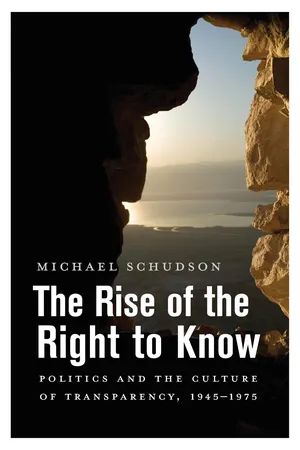
The Rise of the Right to Know
Politics and the Culture of Transparency, 1945–1975
- 356 pages
- English
- ePUB (mobile friendly)
- Available on iOS & Android
eBook - ePub
About this book
Information
Notes
1. A Cultural Right to Know
1. The website for the Thomas Jefferson Foundation, the private foundation that operates Jefferson’s home, Monticello, and compiles the online Thomas Jefferson Encyclopedia, lists in one part of the website thirty-eight famous Jefferson quotations—and forty-eight spurious ones. To read more about “information is the currency of democracy,” see www.monticello.org/site/jefferson/information-currency-democracy-quotation. The earliest mention the Thomas Jefferson Foundation has located that attributes this quotation to Jefferson is 1987. Various websites attribute the quote to Jefferson—for instance, ThinkExist.com with its motto “Finding Quotations Was Never This Easy!” or BookBrowse.com (both accessed July 14, 2014). That Jefferson never said or wrote this is further confirmed in email to the author from Anna Berkeles, research librarian, Thomas Jefferson Foundation, June 7, 2013.
2. Ralph Nader, The Ralph Nader Reader (New York: Seven Stories Press, 2000). “Information is the currency of democracy” appears in both Nader’s January 10, 1986, article from the New Statesman, “Knowledge Helps Citizens, Secrecy Helps Bureaucrats” (51) and his December 2, 1996, article from Forbes, “Digital Democracy in Action” (403). In an important early critique of the Freedom of Information Act (“Freedom from Information: The Act and the Agencies”), Nader wrote: “A well informed citizenry is the lifeblood of democracy; and in all arenas of government, information, particularly timely information, is the currency of power.” See “Freedom from Information: The Act and the Agencies,” Harvard Civil Rights–Civil Liberties Law Review 5 (1970): 1–15, at 1.
3. Gerald Markowitz and David Rosner, Deceit and Denial: The Deadly Politics of Industrial Pollution (Berkeley: University of California Press, 2002), 3.
4. David M. O’Brien, The Public’s Right to Know (New York: Praeger, 1981), 32.
5. Hugh Heclo, “The Sixties’ False Dawn: Awakenings, Movements, and Postmodern Policy-making,” in Brian Balogh, ed., Integrating the Sixties (University Park: Pennsylvania State University Press, 1996), 34–63, at 57.
6. Interview with Sarah Cohen, September 24, 2009, former Washington Post reporter, in 2009 professor of public policy at Duke University, and now a reporter and editor at the New York Times.
7. James Wilson, cited in O’Brien, The Public’s Right to Know, 38.
8. “Draft Structural Amendments to the Constitution, ante-27 June,” in John P. Kaminski, Gaspare J. Saladino, Charles H. Schoenleber, and Margaret A. Hogan, eds., The Documentary History of the Ratification of the Constitution Digital Edition (Charlottesville: University of Virginia Press, 2009), 10:1548–1549.
9. Patrick Henry and George Mason, cited in O’Brien, The Public’s Right to Know, 39.
10. Cooper’s remarks (from a speech at Temple Emanu-El in New York) are cited in an editorial, “The Right to Know,” New York Times, January 23, 1945. The Times calls it “a good new phrase for an old freedom.”
11. Simon Hoggart, “Once Again, Bafflement Abroad,” New York Times, March 23, 1994. Hoggart had served as Washington correspondent for the Observer and was a political reporter for the Guardian at the time.
12. Amy Farrell, “Attentive to Difference: Ms. Magazine, Coalition Building and Sisterhood,” in Stephanie Gilmore, ed., Feminist Coalitions: Historical Perspectives on Second-Wave Feminism in the United States (Urbana: University of Illinois Press, 2008), 48–62.
13. John B. Thompson, “The New Visibility,” Theory, Culture and Society 22 (2005): 31–51, at 38.
14. Dominique Mehl, “The Public on the Television Screen: Towards a Public Sphere of Exhibition,” in Sonia Livingstone, ed., Audiences and Publics (Bristol, UK: Intellect Books, 2005), 77–96, at 90.
15. On Johnson’s gall bladder operation, see Robert E. Gilbert, “The Political Effects of Presidential Illness: The Case of Lyndon B. Johnson,” Political Psychology 16, no. 4 (December 1995): 761–776. On the Eisenhower-Johnson meeting, see Jack Valenti, “Memorandum of Presidential Visit with General Eisenhower,” October 13, 1965, entered into the President’s daily diary, Lyndon B. Johnson Presidential Library, Austin, Texas. The phrase “abdominal showman” became a popular joke as George Dixon reported in his “Washington Scene” column in the Washington Post, November 6, 1965.
16. Rick Perlstein, “Betty Ford, Pioneer,” New York Times, July 12, 2011.
17. Betty Ford, “Betty Ford Today: Still Speaking Out” (interview by Gloria Steinem), Ms., April 1984, 41–42, 94–95, at 42. See also John Robert Greene, Betty Ford (Lawrence: University Press of Kansas, 2004), 45–51, and Ron Nessen, It Sure Looks Different from the Inside (Chicago: Play Press, 1978), 19–28. A valuable discussion of changing doctor-patient relations is Jonathan Imber, “Doctor No Longer Knows Best,” in Alan Wolfe, ed., America at Century’s End (Berkeley: University of California Press, 1991), 298–317.
18. Donald Oken, “What to Tell Cancer Patients,” Journal of the American Medical Association 175, no. 13 (April 1, 1961): 86–94.
19. Dennis H. Novack, Robin Plumer, Raymond L. Smith, Herbert Ochitill, Gary R. Morrow, and John M. Bennett, “Changes in Physicians’ Attitudes toward Telling the Cancer Patient,” Journal of the American Medical Association 241, no. 9 (March 2, 1979): 897–899.
20. Elisabeth Kübler-Ross, On Death and Dying (New York: Macmillan, 1969).
21. David J. Rothman, Strangers at the Bedside (New York: Basic Books, 1991).
22. Ibid., 89.
23. Joshua Gamson, Freaks Talk Back (Chicago: University of Chicago Press, 1991), 68.
24. Ibid., 70.
25. Ibid., 100.
26. Ibid., 118.
27. Ibid., 167.
28. Thomas Nagel, “Concealment and Exposure,” Philosophy and Public Affairs 27 (1998): 3–30. On civil inattention, see Erving Goffman, Relations in Public (New York: Basic Books, 1971). Goffman uses the term many times in this book, defining it as “persons circumspectly treating one another with polite and glancing concern while each goes about his own separate business” (331–332). On the decision legitimating the privacy from government of the NAACP’s membership lists, see N.A.A.C.P. v. Alabama, 357 U.S. 449 (1958).
29. Ann Douglas, Terrible Honesty: Mongrel Manhattan in the 1920s (New York: Farrar, Straus and Giroux, 1995), 33–34.
30. Cas Wouters, Informalization: Manners and Emotion since 1890 (London: Sage, 2007).
31. In Grand Expectations: The United States, 1945–1974 (New York: Oxford University Press, 1996), prominent historian James Patterson offers a sentence on the Freedom of Information Act and a couple of pages on campaign finance reform with but a single sentence on disclosure, no mention of informed consent in medicine, and half a dozen mentions of Gerald Ford but none of Betty Ford. In a popular history of the 1970s with the striking title It Seemed like Nothing Happened: The Tragedy and Promise of America in the 1970s (New York: Holt, Rinehart and Winston, 1982), Peter Carroll mentions campaign finance reform, but without noting that disclosure was among its provisions. He does not mention informed consent in medicine or medical research, nor the Freedom of Information Act (passed in 1966 but made into a significant force only when it was strengthened in 1974). Carroll mentions the National Environme...
Table of contents
- Cover
- Title Page
- Copyright
- Dedication
- Contents
- One: A Cultural Right to Know
- Two: Origins of the Freedom of Information Act
- Three: The Consumer’s Right to Be Informed
- Four: Opening Up Congress
- Five: The Media’s Presence
- Six: “To Let People Know in Time”
- Seven: Transparency in a Transformed Democracy
- Eight: Disclosure and Its Discontents
- Notes
- Acknowledgments
- Index
Trusted by 375,005 students
Access to over 1.5 million titles for a fair monthly price.
Study more efficiently using our study tools.
Frequently asked questions
Yes, you can cancel anytime from the Subscription tab in your account settings on the Perlego website. Your subscription will stay active until the end of your current billing period. Learn how to cancel your subscription
No, books cannot be downloaded as external files, such as PDFs, for use outside of Perlego. However, you can download books within the Perlego app for offline reading on mobile or tablet. Learn how to download books offline
Perlego offers two plans: Essential and Complete
- Essential is ideal for learners and professionals who enjoy exploring a wide range of subjects. Access the Essential Library with 800,000+ trusted titles and best-sellers across business, personal growth, and the humanities. Includes unlimited reading time and Standard Read Aloud voice.
- Complete: Perfect for advanced learners and researchers needing full, unrestricted access. Unlock 1.5M+ books across hundreds of subjects, including academic and specialized titles. The Complete Plan also includes advanced features like Premium Read Aloud and Research Assistant.
We are an online textbook subscription service, where you can get access to an entire online library for less than the price of a single book per month. With over 1.5 million books across 990+ topics, we’ve got you covered! Learn about our mission
Look out for the read-aloud symbol on your next book to see if you can listen to it. The read-aloud tool reads text aloud for you, highlighting the text as it is being read. You can pause it, speed it up and slow it down. Learn more about Read Aloud
Yes! You can use the Perlego app on both iOS and Android devices to read anytime, anywhere — even offline. Perfect for commutes or when you’re on the go.
Please note we cannot support devices running on iOS 13 and Android 7 or earlier. Learn more about using the app
Please note we cannot support devices running on iOS 13 and Android 7 or earlier. Learn more about using the app
Yes, you can access The Rise of the Right to Know by Michael Schudson in PDF and/or ePUB format, as well as other popular books in Politics & International Relations & North American History. We have over 1.5 million books available in our catalogue for you to explore.