Histories of ancient Rome have long emphasized the ways in which the empire assimilated the societies it conquered, bringing civilization to the supposed barbarians. Yet interpretations of this "Romanization" of Western Europe tend to erase local identities and traditions from the historical picture, leaving us with an incomplete understanding of the diverse cultures that flourished in the provinces far from Rome.
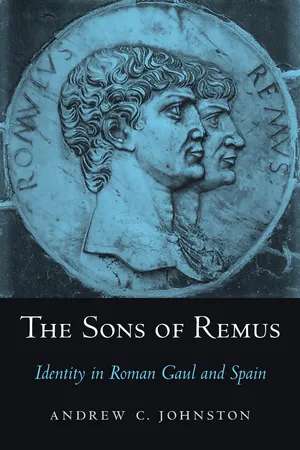
The Sons of Remus recaptures the experiences, memories, and discourses of the societies that made up the variegated patchwork fabric of the western provinces of the Roman Empire. Focusing on Gaul and Spain, Andrew Johnston explores how the inhabitants of these provinces, though they willingly adopted certain Roman customs and recognized imperial authority, never became exclusively Roman. Their self-representations in literature, inscriptions, and visual art reflect identities rooted in a sense of belonging to indigenous communities. Provincials performed shifting roles for different audiences, rehearsing traditions at home while subverting Roman stereotypes of druids and rustics abroad.
Deriving keen insights from ancient sources—travelers' records, myths and hero cults, timekeeping systems, genealogies, monuments—Johnston shows how the communities of Gaul and Spain balanced their local identities with their status as Roman subjects, as they preserved a cultural memory of their pre-Roman past and wove their own narratives into Roman mythology. The Romans saw themselves as the heirs of Romulus, the legendary founder of the eternal city; from the other brother, the provincials of the west received a complicated inheritance, which shaped the history of the sons of Remus.
- 420 pages
- English
- ePUB (mobile friendly)
- Available on iOS & Android
eBook - ePub
About this book
Information
1
SELVES

IN THE HEART OF GAUL, where a togate Roman might find all that mysterious life of the wilderness that stirs in the forest and in the hearts of wild men, was a thermal spring. The place was originally called Neriomagos by its Gaulish-speaking inhabitants, “the plain of Nerios,” though it later acquired the Latin toponym Aquae Nerii, “the waters of Nerios.”1 The eponymous Nerios was a quintessentially local divinity, whose worship is attested nowhere else.2 Sometime in the early second century CE, a local grandee set up the following dedicatory inscription to the god, memorializing the munificent building projects that he and his two sons had undertaken in the area surrounding the spring:
To the godheads of the Emperors and the god Nerius, and for the use of the state of the Bituriges Cubi and the villagers of Neriomagus, Lucius Julius Equester, son of Equester, chief magistrate, priest of Rome and the Emperors, and likewise priest of the province of Aquitania, together with his sons Lucius Julius Cimber and Lucius Julius Equester, themselves priests of Rome and the Emperors, completed the construction of voting-buildings [diribitoria], shops, and porticoes by which the springs of Nerius and the public baths are enclosed, together with all of their ornaments, in honor of their election to the priesthood.3
This rich text presents the reader with a complex nexus of identities, mapped onto a series of communities that progressively widen in their compass: the town (vicus) of the Neriomagienses, the ethnic community (res publica or civitas) of the Bituriges Cubi, the province of Aquitania, and ultimately Roma herself, whose worship—through the institution of the imperial cult—bound together the far-flung and heterogeneous peoples of the whole Empire. As the Latin terminology (vicus, res publica, provincia) suggests, these concentric circles of administrative hierarchy can be understood to a certain degree as artificial Roman constructs imposed upon a preexisting cultural and political geography. But while such imperial overlays may at times obscure the contours of traditional sites of authority and units of belonging, they did not erase them; rather, complex accommodations on the part of the provincials themselves drew and redrew the boundaries of meaningful communities within the map of a new and Roman world. Thus, when viewed as communities, the Neriomagienses or Bituriges Cubi become fundamentally important objects of analysis as products of the agency of local actors, the results of continual processes of communalization.4
Despite the potential ethnogenerative impact of empire—the marked tendency of imperial encounters with steep imbalances of power to stimulate the formation of new ethnic groups among conquered peoples—these communities in the province of Aquitania had not sprung into existence ex nihilo with the advent of the Romans.5 As was the case for most of the peoples in what came to be called Gallia and Hispania, the Bituriges had existed as a self-defined ethnos long before they were subject to the imperium of Roman magistrates or the representational power of Roman writers.6 According to the historian Livy, who mentions the Bituriges in a digression on the historical population movements of the Gauls that culminated in the infamous sack of Rome, during the reign of the Roman king Tarquinius Priscus they were the most powerful group among the Celtae.7 While the reliability of the Roman author’s testimony, at a great temporal and cultural distance, is not beyond doubt, the Gaulish name of the Bituriges does mean “rulers of the world” or “perpetual kings,” perhaps not entirely a misnomer from their own point of view in the sixth century BCE. In this backstory is presumably preserved an authentic kernel of local tradition, gathered by one of Livy’s sources. Five hundred years later, however, Caesar upon his arrival in central Gaul found them in a comparatively humble position, under the protection of the much more powerful Aedui.8 In the final revolt of 52 BCE, the last gasp of Gallic freedom, the Bituriges treacherously broke from the Aedui and went over to the side of the Arverni at the instigation of the rebel leader Vercingetorix himself. Some twenty of their own towns were burnt as part of his scorched-earth strategy. Avaricum, “the safeguard and ornament of their civitas,” was barely saved from the torches of their allies by the earnest entreaties of the Bituriges, only to become soon thereafter the site of the near-annihilation of almost forty thousand of its inhabitants and defenders at the hands of the Roman legions, who were anxious to avenge the recent slaughter of the garrison at Cenabum.9
In the wake of the Roman conquest, the Bituriges were divided into two states (civitates), called the Cubi and the Vivisci; the latter were resettled some three hundred kilometers to the southwest across the Garumna river (the modern Garonne) around Burdigala (Bordeaux), while the former remained in their original territory centered on Avaricum (Bourges).10 This separation, both spatial and civic, catalyzed the formation of new identities, but the social memory of a continuous Biturigan past—a past that had once warranted the ethnonym “rulers of the world”—must have informed and shaped each of these communities.11 Furthermore, the sub-ethnics of Cubus and Viviscus also implicate a memorial discourse: the pre-conquest coinage of the united Bituriges appears to attest to the preexistence of a subdivision between Cubi and Vivisci.12 Although the nature and origin of this earlier division is uncertain, it was clearly appropriated as a meaningful continuity in the ethnogenesis of these two civitates in the late republican and early imperial periods. Discontinuities foster imagined continuities. Concomitant with these internal debates over the meaning of Biturix was the cultural confrontation of the Bituriges with the Aquitani, a historically distinct ethnic group whose constituent peoples had formerly emphasized the otherness of this “Gallic” civitas. The Greek geographer Strabo notes that in the Augustan period the Bituriges Vivisci were the only people of an ethnic origin different from the rest of the Aquitani in the region south of the Garumna, and that they did not participate in their confederation.13 Indeed, the fact that the native languages of each group would have been mutually unintelligible must have fostered a felt sense of alienation: most of the Aquitani seem to have spoken a form of proto-Basque, a linguistic isolate, while the Bituriges spoke Gaulish, one of the now extinct members of the linguistic family of continental Celtic. But the abstention in the early imperial period of the Vivisci in particular from political interaction with the Aquitanian “others” in whose ancestral territory they were now settled gave way, in time, to a certain degree of cooperation, and a gradual incorporation of the Bituriges into the larger fold of the Aquitani. In this context, the attendant involvement of Biturigan elites—such as Equester—in Aquitanian politico-religious institutions reflects more than a geography of Roman power;14 the locally generated meanings of Aquitania were not necessarily co-present or co-extensive with the externally imposed Roman meaning of the provincia Aquitaniae.
Ultimately, however, the deep-seated rhetoric of ethnic difference was not easily quieted by the superficial imposition of imperial unity. By the early third century, discord between the ethnic groups of the province compelled local elites of nine peoples of the Aquitani to take the initiative and venture upon an embassy to the emperor to seek official permission to form a new political community of their own, hereafter known simply as the “Nine Peoples” (Novem Populi). A verse inscription from Aquae Tarbellicae (Dax) provides insight into this process and its motivations, highlighting the role of a certain Verus, who had been one of the chief magistrates of the Tarbelli:
Priest, as well as chief magistrate, financial official and overseer of the rural district, Verus, having performed his duty as legate to the Emperor, obtained on behalf of the Nine Peoples the right to separate themselves from the Gauls. When he had returned from the City [i.e., Rome], he dedicated this altar to the spirit of the rural community [pagus].15
It is striking that even more than two and a half centuries after being united in the same province, the local discourse of ethnic identity among the Aquitani was still characterized by complexity and diversity. The ethnogenesis of the community of the Novem Populi seems to have been predicated upon the representation of the Galli as “others.”
Neriomagienses, Cubi, Bituriges, Aquitani, Novem Populi—these were all communities that, like Rome herself, were continually being reimagined,16 whose members discursively renegotiated the bounds of inclusivity and exclusivity—ideas of the self and the other—and the meaning of those bounds. In such cases, where complex interactions that involved primarily local performances of identity were played out within or between provincial communities, rather than between “indigenes” and “Romans,” the shortcomings of bilateral core-periphery or top-down interpretations of the Roman imperial experience readily emerge.17 Moreover, the construction of community and identity found in the multivocal inscription of L. Julius Equester does not allow a simplistic reading in terms of antithetical oppositions between change and continuity, “Roman” and “native,” “acculturated” or “resistant.” Provincials like Equester actively participated in constructions of identity that drew simultaneously upon multiple—and malleable—cultural vocabularies: his euergetism, while staged at an important place of memory in honor of a divinity with a Gaulish name, is nonetheless manifested in typically “Roman” cultural forms like the porticus. But porticoes, temples, statues, triumphal arches, monumental writing, imported luxury items, and grid-planned streets—in short the material culture that we are supposed to understand went along with the “complete ideological package”—are never mere indices of acculturation; recognizing how “Roman” the uses of such spaces, technologies, and goods were, or unpacking the meanings with which they were invested by the local viewer, is highly problematic.18
High in the foothills of the Pyrenees on the border of Aquitania and Iberia, a similar conversation conducted in a creole of Roman and local terms played out among another of the Nine Peoples, the Convenae. Unlike the Bituriges, their name does not evoke a vernacular past, but is rather a Latin noun meaning, most basically, “those who have come together,” though the word more frequently carries a slight air of the pejorative or unfortunate: “the huddled masses, refugees, dregs.” The earliest history of the community is shrouded in mystery: their chief place, Lugdunum (Saint-Bertrand-de-Comminges), shows no archaeological traces of occupation before the middle of the first century BCE, although it would eventually develop into a monumental urban center.19 In the early imperial period, the Convenae attracted only the barest notice of Greek and Roman geographical writers: Strabo mentions their privileged legal status, advantageous geographic situation, and thermal springs, and gives a Greek translation of the ethnonym, while Pliny the Elder mentions them in passing as “having been united together in one town.”20 They do not appear in the literary record again until the first decade of the fifth century CE, when the Church father Jerome composed a bitter invective against a certain priest called Vigilantius, a native of the Convenae, whom he accused of opposing orthodox practices. In this fierce polemical debate, the heresy of Vigilantius was attributed, in part, to the very origins of the community from which he sprang:
Surely he reflects his race, as someone who was born from the seed of brigands and assembled rabble [“Convenae”], whom Cn. Pompeius, after Spain had been pacified and he was hastening to return to Rome in triumph, brought down from the heights of the Pyrenees and herded together in a single city: whence the community got the name of Convenae. In this manner he would be a brigand against the Church of God, and—being a true descendant of the Vectones, Arrebaci, and Celtiberians [three peoples of north-central Iberia]—he would raid the churches of the Gallic provinces, and would carry not the standard of the cross, but the banner of the Devil.21
This late and tendentious deployment of the trope of ethnic essentialism against Vigilantius constitutes the most detailed extant account of the foundation myth of the Convenae, an original, locally generated version of which Jerome’s polemical agenda and ethnographic gaze seem to have twisted and recolored into the story as we have it.22 There are some innocuous mistakes that show the potential ...
Table of contents
- Cover
- Title Page
- Copyright
- Dedication
- Contents
- Introduction
- 1. Selves
- 2. Others
- 3. Local Pasts
- 4. Roman Pasts
- 5. Performances of Identity
- Conclusion
- Abbreviations
- Notes
- Bibliography
- Acknowledgments
- Index
Trusted by 375,005 students
Access to over 1.5 million titles for a fair monthly price.
Study more efficiently using our study tools.
Frequently asked questions
Yes, you can cancel anytime from the Subscription tab in your account settings on the Perlego website. Your subscription will stay active until the end of your current billing period. Learn how to cancel your subscription
No, books cannot be downloaded as external files, such as PDFs, for use outside of Perlego. However, you can download books within the Perlego app for offline reading on mobile or tablet. Learn how to download books offline
Perlego offers two plans: Essential and Complete
- Essential is ideal for learners and professionals who enjoy exploring a wide range of subjects. Access the Essential Library with 800,000+ trusted titles and best-sellers across business, personal growth, and the humanities. Includes unlimited reading time and Standard Read Aloud voice.
- Complete: Perfect for advanced learners and researchers needing full, unrestricted access. Unlock 1.5M+ books across hundreds of subjects, including academic and specialized titles. The Complete Plan also includes advanced features like Premium Read Aloud and Research Assistant.
We are an online textbook subscription service, where you can get access to an entire online library for less than the price of a single book per month. With over 1.5 million books across 990+ topics, we’ve got you covered! Learn about our mission
Look out for the read-aloud symbol on your next book to see if you can listen to it. The read-aloud tool reads text aloud for you, highlighting the text as it is being read. You can pause it, speed it up and slow it down. Learn more about Read Aloud
Yes! You can use the Perlego app on both iOS and Android devices to read anytime, anywhere — even offline. Perfect for commutes or when you’re on the go.
Please note we cannot support devices running on iOS 13 and Android 7 or earlier. Learn more about using the app
Please note we cannot support devices running on iOS 13 and Android 7 or earlier. Learn more about using the app
Yes, you can access The Sons of Remus by Andrew C. Johnston in PDF and/or ePUB format, as well as other popular books in History & European History. We have over 1.5 million books available in our catalogue for you to explore.