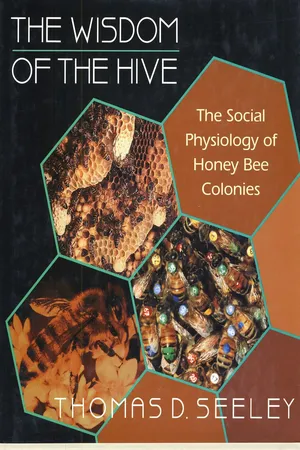
This book is about the inner workings of one of nature's most complex animal societies: the honey bee colony. It describes and illustrates the results of more than fifteen years of elegant experimental studies conducted by the author. In his investigations, Thomas Seeley has sought the answer to the question of how a colony of bees is organized to gather its resources. The results of his research—including studies of the shaking signal, tremble dance, and waggle dance, and other, more subtle means by which information is exchanged among bees—offer the clearest, most detailed picture available of how a highly integrated animal society works. By showing how several thousand bees function together as an integrated whole to collect the nectar, pollen, and water that sustain the life of the hive, Seeley sheds light on one of the central puzzles of biology: how units at one level of organization can work together to form a higher-level entity.
In explaining why a hive is organized the way it is, Seeley draws on the literature of molecular biology, cell biology, animal and human sociology, economics, and operations research. He compares the honey bee colony to other functionally organized groups: multicellular organisms, colonies of marine invertebrates, and human societies. All highly cooperative groups share basic problems: of allocating their members among tasks so that more urgent needs are met before less urgent ones, and of coordinating individual actions into a coherent whole. By comparing such systems in different species, Seeley argues, we can deepen our understanding of the mechanisms that make close cooperation a reality.
eBook - PDF
The Wisdom of the Hive
The Social Physiology of Honey Bee Colonies
- 318 pages
- English
- PDF
- Available on iOS & Android
eBook - PDF
About this book
Information
Table of contents
- Contents
- Preface
- Part I: Introduction
- Part II: Experimental Analysis
- Part III: Overview
- Glossary
- Bibliography
- Index
Trusted by 375,005 students
Access to over 1.5 million titles for a fair monthly price.
Study more efficiently using our study tools.
Frequently asked questions
Yes, you can cancel anytime from the Subscription tab in your account settings on the Perlego website. Your subscription will stay active until the end of your current billing period. Learn how to cancel your subscription
No, books cannot be downloaded as external files, such as PDFs, for use outside of Perlego. However, you can download books within the Perlego app for offline reading on mobile or tablet. Learn how to download books offline
Perlego offers two plans: Essential and Complete
- Essential is ideal for learners and professionals who enjoy exploring a wide range of subjects. Access the Essential Library with 800,000+ trusted titles and best-sellers across business, personal growth, and the humanities. Includes unlimited reading time and Standard Read Aloud voice.
- Complete: Perfect for advanced learners and researchers needing full, unrestricted access. Unlock 1.5M+ books across hundreds of subjects, including academic and specialized titles. The Complete Plan also includes advanced features like Premium Read Aloud and Research Assistant.
We are an online textbook subscription service, where you can get access to an entire online library for less than the price of a single book per month. With over 1.5 million books across 990+ topics, we’ve got you covered! Learn about our mission
Look out for the read-aloud symbol on your next book to see if you can listen to it. The read-aloud tool reads text aloud for you, highlighting the text as it is being read. You can pause it, speed it up and slow it down. Learn more about Read Aloud
Yes! You can use the Perlego app on both iOS and Android devices to read anytime, anywhere — even offline. Perfect for commutes or when you’re on the go.
Please note we cannot support devices running on iOS 13 and Android 7 or earlier. Learn more about using the app
Please note we cannot support devices running on iOS 13 and Android 7 or earlier. Learn more about using the app
Yes, you can access The Wisdom of the Hive by Thomas D. Seeley,Thomas D Seeley in PDF and/or ePUB format, as well as other popular books in Biological Sciences & Biology. We have over 1.5 million books available in our catalogue for you to explore.