A Wall Street Journal Favorite Read of the Year
A Guardian Top Science Book of the Year
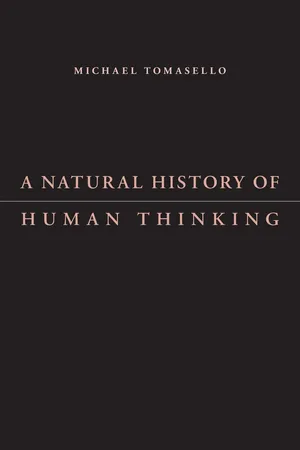
Tool-making or culture, language or religious belief: ever since Darwin, thinkers have struggled to identify what fundamentally differentiates human beings from other animals. In this much-anticipated book, Michael Tomasello weaves his twenty years of comparative studies of humans and great apes into a compelling argument that cooperative social interaction is the key to our cognitive uniqueness. Once our ancestors learned to put their heads together with others to pursue shared goals, humankind was on an evolutionary path all its own.
"Michael Tomasello is one of the few psychologists to have conducted intensive research on both human children and chimpanzees, and A Natural History of Human Thinking reflects not only the insights enabled by such cross-species comparisons but also the wisdom of a researcher who appreciates the need for asking questions whose answers generate biological insight. His book helps us to understand the differences, as well as the similarities, between human brains and other brains."
—David P. Barash, Wall Street Journal
- English
- ePUB (mobile friendly)
- Available on iOS & Android
eBook - ePub
A Natural History of Human Thinking
About this book
Information
Publisher
Harvard University PressYear
2014Print ISBN
9780674986831
9780674724778
eBook ISBN
9780674727564
1
The Shared Intentionality Hypothesis
Only cooperation constitutes a process that can produce reason.
—JEAN PIAGET, SOCIOLOGICAL STUDIES
Thinking would seem to be a completely solitary activity. And so it is for other animal species. But for humans, thinking is like a jazz musician improvising a novel riff in the privacy of his own room. It is a solitary activity all right, but on an instrument made by others for that general purpose, after years of playing with and learning from other practitioners, in a musical genre with a rich history of legendary riffs, for an imagined audience of jazz aficionados. Human thinking is individual improvisation enmeshed in a sociocultural matrix.
How did this novel form of socially infused thinking come to be, and how does it work? One set of classic theorists has emphasized the role of culture and its artifacts in making possible certain types of individual thinking. For example, Hegel (1807) argued that the social practices, institutions, and ideologies of a particular culture at a particular historical epoch constitute a necessary conceptual framework for individual human reason (see also Collingwood, 1946). Peirce (1931–1935) claimed more specifically that virtually all of humans’ most sophisticated types of thinking, including most especially mathematics and formal logic, are possible only because individuals have available to them culturally created symbolic artifacts such as Arabic numerals and logical notation. Vygotsky (1978) emphasized that human children grow up in the midst of the tools and symbols of their culture, including especially the linguistic symbols that preorganize their worlds for them, and during ontogeny they internalize the use of these artifacts, leading to the kind of internal dialogue that is one prototype of human thinking (see also Bakhtin, 1981).
The other set of classic theorists has focused on the fundamental processes of social coordination that make human culture and language possible in the first place. Mead (1934) pointed out that when humans interact with one another, especially in communication, they are able to imagine themselves in the role of the other and to take the other’s perspective on themselves. Piaget (1928) argued further that these role-taking and perspective-taking abilities—along with a cooperative attitude—not only make culture and language possible but also make possible reasoning in which individuals subordinate their own point of view to the normative standards of the group. And Wittgenstein (1955) explicated several different ways in which the appropriate use of a linguistic convention or cultural rule depends on a preexisting set of shared social practices and judgments (“forms of life”), which constitute the pragmatic infrastructure from which all uses of language and rules gain their interpersonal significance. These social infrastructure theorists, as we may call them, all share the belief that language and culture are only the “icing on the cake” of humans’ ultrasocial ways of relating to the world cognitively.
Insightful as they were, all of these classic theorists were operating without several new pieces of the puzzle, both empirical and theoretical, that have emerged only in recent years. Empirically, one new finding is the surprisingly sophisticated cognitive abilities of nonhuman primates, which have been discovered mostly in the last few decades (for reviews, see Tomasello and Call, 1997; Call and Tomasello, 2008). Thus, great apes, as the closest living relatives of humans, already understand in human-like ways many aspects of their physical and social worlds, including the causal and intentional relations that structure those worlds. This means that many important aspects of human thinking derive not from humans’ unique forms of sociality, culture, and language but, rather, from something like the individual problem-solving abilities of great apes in general.
Another new set of findings concern prelinguistic (or just linguistic) human infants, who have yet to partake fully of the culture and language around them. These still fledgling human beings nevertheless operate with some cognitive processes that great apes do not, enabling them to engage with others socially in some ways that great apes cannot, for example, via joint attention and cooperative communication (Tomasello et al., 2005). The fact that these precultural and prelinguistic creatures are already cognitively unique provides empirical support for the social infrastructure theorists’ claim that important aspects of human thinking emanate not from culture and language per se but, rather, from some deeper and more primitive forms of uniquely human social engagement.
Theoretically, recent advances in the philosophy of action have provided powerful new ways of thinking about these deeper and more primitive forms of uniquely human social engagement. A small group of philosophers of action (e.g., Bratman, 1992; Searle, 1995; Gilbert, 1989; Tuomela, 2007) have investigated how humans put their heads together with others in acts of so-called shared intentionality, or “we” intentionality. When individuals participate with others in collaborative activities, together they form joint goals and joint attention, which then create individual roles and individual perspectives that must be coordinated within them (Moll and Tomasello, 2007). Moreover, there is a deep continuity between such concrete manifestations of joint action and attention and more abstract cultural practices and products such as cultural institutions, which are structured—indeed, created—by agreed-upon social conventions and norms (Tomasello, 2009). In general, humans are able to coordinate with others, in a way that other primates seemingly are not, to form a “we” that acts as a kind of plural agent to create everything from a collaborative hunting party to a cultural institution.
Further in this theoretical direction, as a specific form of human collaborative activity and shared intentionality, human cooperative communication involves a set of special intentional and inferential processes—first identified by Grice (1957, 1975) and since elaborated and amended by Sperber and Wilson (1996), Clark (1996), Levinson (2000), and Tomasello (2008). Human communicators conceptualize situations and entities via external communicative vehicles for other persons; these other persons then attempt to determine why the communicator thinks that these situations and entities will be relevant for them. This dialogic process involves not only skills and motivations for shared intentionality but also a number of complex and recursive inferences about others’ intentions toward my intentional states. This unique form of communication—characteristic not just of mature language use but also of the prelinguistic gestural communication of human infants—presupposes both a shared conceptual framework between communicative partners (a.k.a. common conceptual ground) and an appreciation of those partners’ individual intentions and perspectives within it.
These new empirical and theoretical advances enable us to construct a much more detailed account than was previously possible of the social dimensions of human cognition in general. Our focus in this book is on the social dimensions of human thinking in particular. Although humans and other animals solve many problems and make many decisions based on evolved intuitive heuristics (so-called system 1 processes), humans and at least some other animals also solve some problems and make some decisions by thinking (system 2 processes; e.g., Kahneman, 2011). A specific focus on thinking is useful because it restricts our topic to a single cognitive process, but one that involves several key components, especially (1) the ability to cognitively represent experiences to oneself “off-line”; (2) the ability to simulate or make inferences transforming these representations causally, intentionally, and/or logically; and (3) the ability to self-monitor and evaluate how these simulated experiences might lead to specific behavioral outcomes—and so to make a thoughtful behavioral decision.
It seems obvious that, compared with other animal species, humans think in special ways. But this difference is hard to characterize using traditional theories of human thinking since they presuppose key aspects of the process that are actually evolutionary achievements. These are precisely the social aspects of human thinking that are our primary focus here. Thus, although many animal species can cognitively represent situations and entities at least somewhat abstractly, only humans can conceptualize one and the same situation or entity under differing, even conflicting, social perspectives (leading ultimately to a sense of “objectivity”). Further, although many animals also make simple causal and intentional inferences about external events, only humans make socially recursive and self-reflective inferences about others’ or their own intentional states. And, finally, although many animals monitor and evaluate their own actions with respect to instrumental success, only humans self-monitor and evaluate their own thinking with respect to the normative perspectives and standards (“reasons”) of others or the group. These fundamentally social differences lead to an identifiably different type of thinking, what we may call, for the sake of brevity, objective-reflective-normative thinking.
In this book we attempt to reconstruct the evolutionary origins of this uniquely human objective-reflective-normative thinking. The shared intentionality hypothesis is that what created this unique type of thinking—its processes of representation, inference, and self-monitoring—were adaptations for dealing with problems of social coordination, specifically, problems presented by individuals’ attempts to collaborate and communicate with others (to co-operate with others). Although humans’ great ape ancestors were social beings, they lived mostly individualistic and competitive lives, and so their thinking was geared toward achieving individual goals. But early humans were at some point forced by ecological circumstances into more cooperative lifeways, and so their thinking became more directed toward figuring out ways to coordinate with others to achieve joint goals or even collective group goals. And this changed everything.
There were two key evolutionary steps. The first step, reflecting the focus of social infrastructure theorists such as Mead and Wittgenstein, involved the creation of a novel type of small-scale collaboration in human foraging. Participants in this collaborative foraging created socially shared joint goals and joint attention (common ground), which created the possibility of individual roles and perspectives within that ad hoc shared world or “form of life.” To coordinate these newly created roles and perspectives, individuals evolved a new type of cooperative communication based on the natural gestures of pointing and pantomiming: one partner directed the attention or imagination of the other perspectivally and/or symbolically about something “relevant” to their joint activity, and then that partner made cooperative (recursive) inferences about what was intended. To self-monitor this process the communicator had to simulate ahead of time the recipient’s likely inferences. Because the collaboration and communication at this point were between ad hoc pairs of individuals in the moment—based on purely second-personal social engagement between “I” and “you”—we may refer to all of this as joint intentionality. When put to use in thinking, joint intentionality comprises perspectival and symbolic representations, socially recursive inferences, and second-personal self-monitoring.
The second step, reflecting the focus of culture theorists such as Vygotsky and Bakhtin, came as human populations began growing in size and competing with one another. This competition meant that group life as a whole became one big collaborative activity, creating a much larger and more permanent shared world, that is to say, a culture. The resulting group-mindedness among all members of the cultural group (including in-group strangers) was based on a new ability to construct common cultural ground via collectively known cultural conventions, norms, and institutions. As part of this process, cooperative communication became conventionalized linguistic communication. In the context of cooperative argumentation in group decision making, linguistic conventions could be used to justify and make explicit one’s reasons for an assertion within the framework of the group’s norms of rationality. This meant that individuals now could reason “objectively” from the group’s agent-neutral point of view (“from nowhere”). Because the collaboration and communication at this point were conventional, institutional, and normative, we may refer to all of this as collective intentionality. When put to use in thinking, collective intentionality comprises not just symbolic and perspectival representations but conventional and “objective” representations; not just recursive inferences but self-reflective and reasoned inferences; and not just second-personal self-monitoring but normative self-governance based on the culture’s norms of rationality.
Importantly, this evolutionary scenario does not mean that humans today are hardwired to think in these new ways. A modern child raised on a desert island would not automatically construct fully human processes of thinking on its own. Quite the contrary. Children are born with adaptations for collaborating and communicating and learning from others in particular ways—evolution selects for adaptive actions. But it is only in actually exercising these skills in social interaction with others during ontogeny that children create new representational formats and new inferential reasoning possibilities as they internalize, in Vygotskian fashion, their coordinative interactions with others into thinking for the self. The result is a kind of cooperative cognition and thinking, not so much creating new skills as cooperativizing and collectivizing those of great apes in general.
And so let us tell a story, a natural history, of how human thinking came to be, beginning with our great ape ancestors, proceeding through some early humans who collaborated and communicated in species-unique ways, and ending with modern humans and their fundamentally cultural and linguistic ways of being.
2
Individual Intentionality
Understanding consists in imagining the fact.
—LUDWIG WITTGENSTEIN, THE BIG TYPESCRIPT
Cognitive processes are a product of natural selection, but they are not its target. Indeed, natural selection cannot even “see” cognition; it can only “see” the effects of cognition in organizing and regulating overt actions (Piaget, 1971). In evolution, being smart counts for nothing if it does not lead to acting smart.
The two classic theories of animal behavior, behaviorism and ethology, both focused on overt actions, but they somehow forgot the cognition. Classical ethology had little or no interest in animal cognition, and classical behaviorism was downright hostile to the idea. Although contemporary instantiations of ethology and behaviorism take some account of cognitive processes, they provide no systematic theoretical accounts. Nor are any other modern approaches to the evolution of cognition sufficient for current purposes.
And so to begin this account of the evolutionary emergence of uniquely human thinking, we must first formulate, in broad outline, a theory of the evolution of cognition more generally. We may then begin our natural history proper by using this theoretical framework to characterize processes of cognition and thinking in modern-day great apes, as representative of humans’ evolutionary starting point before they separated from other primates some six million years ago.
Evolution of Cognition
All organisms possess some reflexive reactions that are organized linearly as stimulus-response linkages. Behaviorists think that all behavior is organized in this way, though in complex organisms the linkages may be learned and become associated with others in various ways. The alternative is to recognize that complex organisms also possess some adaptive specializations that are organized circularly, as feedback control systems, with built-in goal states and action possibilities. Starting from this foundation, cognition evolves not from a complexifying of stimulus-response linkages but, rather, from the individual organism gaining (1) powers of flexible decision-making and behavioral control in its various adaptive specializations, and (2) capacities for cognitively representing and making inferences from the casual and intentional relations structuring relevant events.
Adaptive specializations are organized as self-regulating systems, as are many physiological processes such as the homeostatic regulation of blood sugar and body temperature in mammals. These specializations go beyond reflexes in their capacity to produce adaptive behavior in a much wider range of circumstances, and indeed, they may be quite complex, for example, spiders spinning webs. There is no way that a spider can spin a web using only stimulus-response linkages. The process is too dynamic and dependent on local context. Instead, the spider must have goal states that it is motivated to bring about, and the ability to perceive and act so as to bring them about in a self-regulated manner. But adaptive specializations are still not cognitive (or only weakly cognitive) because they are unknowing and inflexible by definition: perceived situations and behavioral possibilities for goal attainment are mostly connected in an inflexible manner. The individual organism does not have the kind of causal or intentional understanding of the situation that would enable it to deal flexibly with “novel” situations. Natural selection has designed these adaptive specializations to work invariantly in “the same” situations as those encountered in the past, and so cleverness from the individual is not needed.
Cognition and thinking enter the picture when organisms live in less predictable worlds and natural selection crafts cognitive and decision making processes that empower the individual to recognize novel situations and to deal flexibly, on its own, with unpredictable exigencies. What enables effective handling of a novel situation is some understanding of the causal and/or intentional relations involved, which then suggests an appropriate and potentially novel behavioral response. For example, a chimpanzee might recognize that the only tool available to her in a given situation demands, based on the physical causality involved, manipulations she has never before performed toward this goal. A cognitively competent organism, then, operates as a control system with reference values or goals,...
Table of contents
- Cover
- Half Title
- Title Page
- Copyright
- Dedication
- Contents
- Preface
- 1. The Shared Intentionality Hypothesis
- 2. Individual Intentionality
- 3. Joint Intentionality
- 4. Collective Intentionality
- 5. Human Thinking as Cooperation
- 6. Conclusion
- Notes
- References
- Index
Trusted by 375,005 students
Access to over 1.5 million titles for a fair monthly price.
Study more efficiently using our study tools.
Frequently asked questions
Yes, you can cancel anytime from the Subscription tab in your account settings on the Perlego website. Your subscription will stay active until the end of your current billing period. Learn how to cancel your subscription
No, books cannot be downloaded as external files, such as PDFs, for use outside of Perlego. However, you can download books within the Perlego app for offline reading on mobile or tablet. Learn how to download books offline
Perlego offers two plans: Essential and Complete
- Essential is ideal for learners and professionals who enjoy exploring a wide range of subjects. Access the Essential Library with 800,000+ trusted titles and best-sellers across business, personal growth, and the humanities. Includes unlimited reading time and Standard Read Aloud voice.
- Complete: Perfect for advanced learners and researchers needing full, unrestricted access. Unlock 1.5M+ books across hundreds of subjects, including academic and specialized titles. The Complete Plan also includes advanced features like Premium Read Aloud and Research Assistant.
We are an online textbook subscription service, where you can get access to an entire online library for less than the price of a single book per month. With over 1.5 million books across 990+ topics, we’ve got you covered! Learn about our mission
Look out for the read-aloud symbol on your next book to see if you can listen to it. The read-aloud tool reads text aloud for you, highlighting the text as it is being read. You can pause it, speed it up and slow it down. Learn more about Read Aloud
Yes! You can use the Perlego app on both iOS and Android devices to read anytime, anywhere — even offline. Perfect for commutes or when you’re on the go.
Please note we cannot support devices running on iOS 13 and Android 7 or earlier. Learn more about using the app
Please note we cannot support devices running on iOS 13 and Android 7 or earlier. Learn more about using the app
Yes, you can access A Natural History of Human Thinking by Michael Tomasello in PDF and/or ePUB format, as well as other popular books in Psychology & Cognitive Psychology & Cognition. We have over 1.5 million books available in our catalogue for you to explore.