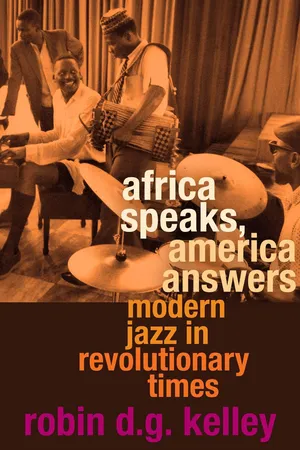
In Bedford-Stuyvesant, Brooklyn, pianist Randy Weston and bassist Ahmed Abdul-Malik celebrated with song the revolutions spreading across Africa. In Ghana and South Africa, drummer Guy Warren and vocalist Sathima Bea Benjamin fused local musical forms with the dizzying innovations of modern jazz. These four were among hundreds of musicians in the 1950s and '60s who forged connections between jazz and Africa that definitively reshaped both their music and the world.
Each artist identified in particular ways with Africa's struggle for liberation and made music dedicated to, or inspired by, demands for independence and self-determination. That music was the wild, boundary-breaking exultation of modern jazz. The result was an abundance of conversation, collaboration, and tension between African and African American musicians during the era of decolonization. This collective biography demonstrates how modern Africa reshaped jazz, how modern jazz helped form a new African identity, and how musical convergences and crossings altered politics and culture on both continents.
In a crucial moment when freedom electrified the African diaspora, these black artists sought one another out to create new modes of expression. Documenting individuals and places, from Lagos to Chicago, from New York to Cape Town, Robin Kelley gives us a meditation on modernity: we see innovation not as an imposition from the West but rather as indigenous, multilingual, and messy, the result of innumerable exchanges across a breadth of cultures.
- 243 pages
- English
- ePUB (mobile friendly)
- Available on iOS & Android
eBook - ePub
About this book
Information
1 | The Drum Wars of Guy Warren
Jazz is new to the native African . . . and he has no ear for it. He may have heard it on records but it has no special appeal. He does understand drums, though. That, so far as I can see, is the only affinity between the African Negro and the American Negro.
—Wilbur de Paris, bandleader, on his visit to Africa, New York Times, 1957
I would like to confess here that in all my experience in America, I never found one single drummer who could play drums.
—Guy Warren, I Have a Story to Tell (1962)
The Boy Kumasenu (1951), written and directed by the British filmmaker Sean Graham, tells an archetypal story about a restless boy anxious to escape his quiet, traditional life in a Gold Coast fishing village for the big city of Accra. Kumasenu was first enticed by the city while working in a local store known for trafficking in smuggled goods. The smuggler, a lorry driver named Yeboah—played by none other than drummer Guy Warren—epitomized modern urban life. And if his dark shades and hipster hat did not make this apparent, the film’s narrator drove home the point: “Here in this little story, Kumasenu first met the 20th century. The lorry driver’s swagger told of the big town . . . and their tongues spoke a language half foreign to Kumasenu.” The storeowner then pulls out a phonograph and the men begin dancing to highlife music—with Warren leading the way.1
Jump forward forty-two years. In 1993, Ethiopian-born filmmaker Haile Gerima released his critically acclaimed Sankofa, named for the Asante Adinkra symbol of a mythic bird turned backward, meaning “remember your past, return to your roots.” In the film’s opening scene, an African American model in a reddish-blonde wig is being photographed on the beach in Cape Coast, Ghana, beneath the shadows of the infamous slave castle. Interspersed are scenes of an elder, wrapped in white cloth and doused in white powder, playing a modified drum kit consisting of carved wooden drums—two placed on their side and played with foot pedals as bass drums, and at least four other drums on stands played with two long curved wooden sticks.2 He is the Sankofa. A few minutes into the first scene, the Sankofa confronts the model, shouting in Akan, “Back to your past! Return to your source!” He reminds the young model and the tourists gathered around that they stand on the very site where enslaved Africans were taken to the Americas; it is “sacred ground, covered with the blood of people who suffered.”3 The part of the Sankofa is played by Kofi Ghanaba, formerly known as Guy Warren.
As the enlightened Kofi Ghanaba, he saw the contrast between his role in The Boy Kumasenu and Sankofa as a metaphor for his own cultural evolution. When someone from the British Film Institute showed him a still photograph of him dancing in The Boy Kumasenu, “I said, who is this darn idiot? . . . I was dancing the jitterbug. So I said, Jesus, I’ve been through this too? But then when you come to Sankofa, you can see how I, this character has changed, from his American bound imprisonment to his free African life. It’s very interesting.”4
Interesting, indeed, but to characterize Guy Warren’s artistic development as an evolution from American imprisonment to African liberation oversimplifies Warren’s complicated, vexed, often productive relationship with the United States and, specifically, the cultural worlds of postwar Chicago and New York, as well as those of West Africa and England. Warren entered the United States full of energy and hubris, ready to Africanize jazz and establish a place for himself in the annals of music history. By the time he returned to Ghana, he had lost interest in America, and the American recording industry had lost interest in him. But he left his mark on the music—a mark that has been severely overlooked by critics and musicians alike, and yet exaggerated by Warren himself.
African Dances and Modern Rhythms
Contrary to Warren’s claims, he did not introduce West African music to the United States. It is an incontrovertible fact that African music and dance arrived in North America with enslaved Africans, but by the early twentieth century only a few anthropologists and folklorists thought the musical and cultural practices of “American Negroes” bore some resemblance to those of Africa. What came to be regarded as “authentic” African music and dance made its way to the mainstream U.S. stage in the 1930s with the arrival of Asadata Dafora, a dancer, choreographer, and drummer. Born in 1890 in Freetown, Sierra Leone, a colony founded by British abolitionists in 1787 to resettle freed slaves (his great-great-grandfather was part of a group of former slaves from Nova Scotia, Canada), Dafora’s mother was a renowned concert pianist who trained in Europe and encouraged her son to study opera. He traveled throughout Europe as a professional singer, and over time he began to incorporate elements of African dance. In 1929 he moved to Harlem, where he began producing a series of dance-dramas employing African and African American dancers.5 Some of his better-known productions, Zunguru (1940) and Batanga (1941), introduced African dance and music to fairly elite audiences in the United States, often staged by the African Academy of Arts and Research, founded by Kingsley Ozuombo Mbadiwe.
The African Academy organized annual festivals beginning in 1942 showcasing African music and dance. Its second festival in 1943, titled “African Dances and Modern Rhythms,” not only brought together music and dance from Brazil, Trinidad, Haiti, and Cuba, but included American jazz with performances by pianist Mary Lou Williams and tap dancer Bill Robinson.6 These AAAR concerts apparently influenced jazz musicians fascinated with African music, including Charlie Parker and Dizzy Gillespie, who “found the connections between Afro-Cuban and African music and discovered the identity of our music with theirs.” Gillespie noted, “Those concerts should definitely have been recorded because we had a ball discovering our identity.”7
Among the participants was Prince Efrom Odok, a revered master drummer from Nigeria. Born in 1890 in the Calabar region, he learned to play and make drums under his father’s tutelage. In 1920, he left Nigeria for the United States, preceding Asadata Dafora by nine years, and opened a small center in Harlem where he taught African music and dance. As more and more Nigerians made their way across the Atlantic, he was able to organize an ensemble made up entirely of drummers from Calabar. By 1938, the group performed at the Dance International Festival, at the Rainbow Room, and at Columbia University, among other noteworthy venues.8 Still, the number of trained drummers in the United States was exceedingly small. In 1943, Odok could count only “20 really expert African drummers in the United States.”9 As much as he appreciated jazz, for many years he never accepted an invitation to play in a jazz band, “being somewhat scornful of such comparatively primitive rhythms and tone effects on the drums.”10 Yet he frequently pointed to the affinities between jazz and African music, asserting that swing was “nothing but an imitation of native African music.” One of his main objectives was to teach black New Yorkers “the music and dances of their forefathers.”11 Whether out of economic necessity or recognition that his stance on jazz was contradictory, he eventually chose to collaborate with jazz musicians. In 1945, he teamed up with trumpeter Frankie Newton and pianist Ray Parker to participate in “Primitive and Concert Jazz,” a dance program choreographed by dancer Mura Dehn.12
Other dancers and choreographers followed suit—notably Katherine Dunham and Pearl Primus, who drew on dance forms from Africa and the African diaspora. Of particular importance was Pearl Primus’s drummer, Moses Mianns, a Nigerian who has been credited by several African American drummers (including Chief Bey) with introducing the ashiko drum to the United States and training an entire generation of drummers on this side of the Atlantic. But much of the popularization of hand drumming during the 1940s can be attributed to the Haitian drummer Tiroro, whose solo and ensemble recordings had become quite a sensation, and to an explosion of ethnographic recordings of African music that circulated widely within popular, nonacademic circles.13
Some of the earliest such recordings were made by Thurston Knudson and Augie Goupil beginning in 1941. Knudson and Goupil collected percussion instruments from around the world, learned how to play them by observing or studying with master musicians, and recorded what they heard. On the one hand, they were quite precise about the kinds of rhythms they played, where they originated, and the history and functions of the various instruments they used. On the other hand, it is hard to take them too seriously when—in the liner notes to Knudson’s album, Primitive Percussion—he explains that the bata and ngoma drums they were using come from “the exotic milieu of the world-famous Don the Beachcomber Restaurant in Hollywood.”14
The ethnographic recording many African American musicians did take seriously was African and Afro-American Drums, a two-LP collection assembled by anthropologist Harold Courlander and derived from field recordings made in Rwanda, Nigeria, Congo, South Africa, and Madagascar, as well as Cuba, Haiti, Brazil, Jamaica, Suriname, and New York City.15 This record circulated widely in the early to mid-1950s, enabling a new generation of musicians to hear a variety of African and Afro-diasporic rhythms and instrumentation. Courlander also documented a growing number of U.S.-born African Americans participating in African or Afro-Caribbean percussion groups. He was surprised to find that “a preponderant number of these newer groups are composed not of Puerto Ricans or other West Indians, but of native Americans, many of whom come from rural areas of the South.”16
It has become axiomatic to date the appearance of “authentic” African drums in modern jazz to 1947, when Chano Pozo, the renowned Cuban drummer, composer, and dancer, moved to the United States and joined Dizzy Gillespie’s big band. Gillespie and Pozo’s collaboration on George Russell’s “Cubano Be, Cubano Bop” is generally regarded as a landmark recording, not only for its use of heavy Afro-Cuban percussion but because Pozo injects West African–derived spiritual and cultural practices into his performance. At one point midway into the song, Pozo delivers a Lucumi chant (Lucumi, or Santeria, is the Cuban version of Yoruba religion). Pozo had the credentials to perform such sacred music; he was initiated into the Abakua secret society, whose origins can be traced back to the Calabar region of southern Nigeria.17 The early fusions of jazz and what was understood to be authentic West African musical practices initially came by way of Cuba, or the African diaspora in Latin America.
Chano Pozo’s short-lived experiments (he died a year later from injuries sustained in a bar fight) were soon taken up by Art Blakey. In 1953, Blakey recorded an all-percussion track with Puerto Rican conga player Sabu Martinez titled “Message from Kenya.”18 The title obviously referred to the uprising of the Kikuyu Land and Freedom Army in Kenya, known as the Mau Mau rebellion. The piece has no apparent relationship to Kenya or East Africa generally. Rather, it is based on a story reportedly told to Blakey by Moses Mianns about a hunter “whose cries celebrate the news that he has captured more game than any other hunter in the village, in order to convince the girl he loves of his prowess.”19 Four years later, Blakey recorded another all-percussion piece inspired by African rhythms titled “Ritual,” which bore more than a passing resemblance to passages in “Message from Kenya.” In his spoken preface he recounts the exact same story, but this time he claims he learned the song directly from the Ijaw people on a visit to Nigeria from 1947 to 1948. He makes no mention of Mianns, who had been in the United States since the early 1940s and who just happened to be Ijaw. The point is that learning the music directly from West Africa gives it greater authenticity, and thus greater cultural cachet.20
Introducing Guy Warren
This is what the African music scene in the United States looked like when Guy Warren arrived in Chicago in December 1954 ready to make his mark on the jazz world. As far as Warren was concerned, none of it was authentic or even interesting. He was never impressed with Art Blakey, for example. “Art Blakey bores me to death,” he once told an interviewer. “He excites you at first; the first two seconds—and then that’s it—he can’t go any further than that.”21 Only Warren was capable of infusing jazz with African rhythms, which in his view was tantamount to saving the music. His drive, determination, and musical imagination were matched only by his ego. As he once wrote, “There has never been anybody in the history of Jazz music like me . . . I am to Jazz music what Kwame Nkrumah was to modern African politics.”22
Warren was born in Accra, in what was then the British colony of the Gold Coast, on May 4, 1923, to Susana Awula Abla Moore, an unmarried teenaged mother, and Richard Mabuo Akwei, a respected educator and headmaster of the Ghana National School. Susana was born in 1905 to Hanna Ahiefor, a native of the Gold Coast, and a British mining engineer known simply as Mr. Moore. As soon as Ahiefor became pregnant with Moore’s child, he returned to England before he could meet his daughter or provide her with adequate financial support. When Susana was old enough to begin her studies, she attended Accra Grammar School, where Richard Akwei taught. It is not clear how their relationship evolved, but in 1922 she was carrying his child.23
Guy’s father named him Kpakpo Warren Gamaliel Akwei, after U.S. president Warren Gamaliel Harding. But besides naming him and financing his education, Richard Akwei barely acknowledged his son. And Guy clearly felt unacknowledged, which is why he refused to take his surname. Not long after Warren left Ghana and relocated to Chicago, Richard Akwei sent him a letter seeking reconciliation, but it was laced with disparaging remarks about his career. “Failure,” he advised, “is and must be a stepping stone to success.” And as if to rub salt in his wounds, Akwei boasted that his other son, Richard Akwei Jr., had just been appointed to the Gold Coast diplomatic corps.24 Warren’s estrangement from his father would have a profound effect on his music.
Warren attended the Government Elementary Boys’ School in Accra, where he led the school band in his last two years (1937–1939) and acted in various local productions.25 His formative music education, however, came from outside of school: “My house was located next to a bar called the Basshoun. It was a cowboy bar, an imitation of the Western saloon where little bands came to play night after night. They would let me in as a child because I loved to listen to Harry Dodoo, a first class drummer who used to perform tricks an...
Table of contents
- Cover
- Title Page
- Copyright
- Dedication
- Contents
- Preface
- Prelude
- 1 The Drum Wars of Guy Warren
- 2 The Sojourns of Randy Weston
- 3 Ahmed Abdul-Malik’s Islamic Experimentalism
- 4 The Making of Sathima Bea Benjamin
- Coda
- Notes
- Further Listening
- Acknowledgments
- Index
Trusted by 375,005 students
Access to over 1.5 million titles for a fair monthly price.
Study more efficiently using our study tools.
Frequently asked questions
Yes, you can cancel anytime from the Subscription tab in your account settings on the Perlego website. Your subscription will stay active until the end of your current billing period. Learn how to cancel your subscription
No, books cannot be downloaded as external files, such as PDFs, for use outside of Perlego. However, you can download books within the Perlego app for offline reading on mobile or tablet. Learn how to download books offline
Perlego offers two plans: Essential and Complete
- Essential is ideal for learners and professionals who enjoy exploring a wide range of subjects. Access the Essential Library with 800,000+ trusted titles and best-sellers across business, personal growth, and the humanities. Includes unlimited reading time and Standard Read Aloud voice.
- Complete: Perfect for advanced learners and researchers needing full, unrestricted access. Unlock 1.5M+ books across hundreds of subjects, including academic and specialized titles. The Complete Plan also includes advanced features like Premium Read Aloud and Research Assistant.
We are an online textbook subscription service, where you can get access to an entire online library for less than the price of a single book per month. With over 1.5 million books across 990+ topics, we’ve got you covered! Learn about our mission
Look out for the read-aloud symbol on your next book to see if you can listen to it. The read-aloud tool reads text aloud for you, highlighting the text as it is being read. You can pause it, speed it up and slow it down. Learn more about Read Aloud
Yes! You can use the Perlego app on both iOS and Android devices to read anytime, anywhere — even offline. Perfect for commutes or when you’re on the go.
Please note we cannot support devices running on iOS 13 and Android 7 or earlier. Learn more about using the app
Please note we cannot support devices running on iOS 13 and Android 7 or earlier. Learn more about using the app
Yes, you can access Africa Speaks, America Answers by Robin D. G. Kelley in PDF and/or ePUB format, as well as other popular books in Social Sciences & Music Biographies. We have over 1.5 million books available in our catalogue for you to explore.