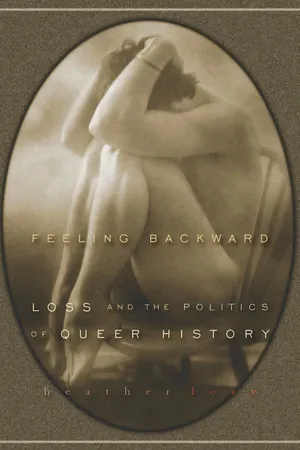
Feeling Backward weighs the costs of the contemporary move to the mainstream in lesbian and gay culture. While the widening tolerance for same-sex marriage and for gay-themed media brings clear benefits, gay assimilation entails other losses--losses that have been hard to identify or mourn, since many aspects of historical gay culture are so closely associated with the pain and shame of the closet.
Feeling Backward makes an effort to value aspects of historical gay experience that now threaten to disappear, branded as embarrassing evidence of the bad old days before Stonewall. It looks at early-twentieth-century queer novels often dismissed as "too depressing" and asks how we might value and reclaim the dark feelings that they represent. Heather Love argues that instead of moving on, we need to look backward and consider how this history continues to affect us in the present.
Through elegant readings of Walter Pater, Willa Cather, Radclyffe Hall, and Sylvia Townsend Warner, and through stimulating engagement with a range of critical sources, Feeling Backward argues for a form of politics attentive to social exclusion and its effects.
- 193 pages
- English
- ePUB (mobile friendly)
- Available on iOS & Android
eBook - ePub
About this book
Information
Publisher
Harvard University PressYear
2009Print ISBN
9780674032392
9780674026520
eBook ISBN
9780674736412
1
Emotional Rescue
The Demands of Queer History
Take history at night; have you ever thought of that, now? Was it at night that Sodom became Gomorrah? It was at night, I swear! A city given over to the shades, and that’s why it has never been countenanced or understood to this day.
—Djuna Barnes, Nightwood
Recently, long-standing debates about gay and lesbian history have shifted from discussions of the stability of sexual categories over time to explorations of the relation between queer historians and the subjects they study. The turn from a focus on “effective history” to a focus on “affective history” has meant that critics have stopped asking, “Were there gay people in the past?” but rather have focused on questions such as: “Why do we care so much if there were gay people in the past?” or even, perhaps, “What relation with these figures do we hope to cultivate?” Critics such as Christopher Nealon, Carolyn Dinshaw, Ann Cvetkovich, David Halperin, Carla Freccero, Scott Bravmann, Elizabeth Freeman, L. O. A. Fradenburg, and Valerie Traub have shifted the focus away from epistemological questions in the approach to the queer past; rather, they make central “the desires that propel such engagements, the affects that drive relationality even across time.”1 Exploring the vagaries of cross-historical desire and the queer impulse to forge communities between the living and the dead, this work has made explicit the affective stakes of debates on method and knowledge. Mixing psychoanalytic approaches with more wide-ranging treatments of affect, they have traced the identifications, the desires, the longings, and the love that structure the encounter with the queer past.2
My approach to queer history is profoundly indebted to this new field of inquiry. I focus on the negative affects—the need, the aversion, and the longing—that characterize the relation between past and present. This decision to look on the dark side comes out of my sense that contemporary critics tend to describe the encounter with the past in idealizing terms. In particular, the models that these critics have used to describe queer cross-historical relations—friendship, love, desire, and community—seem strangely free of the wounds, the switchbacks, and the false starts that give these structures their specific appeal, their binding power. Friendship and love have served as the most significant models for thinking about how contemporary critics reach out to the ones they study. I would like to suggest that more capacious and deidealized accounts of love and friendship would serve to account for the ambivalence and violence of the relation to the past—to what is most queer in that relation.
Today, many critics attest that since Stonewall the worst difficulties of queer life are behind us. Yet the discomfort that contemporary queer subjects continue to feel in response to the most harrowing representations from the past attests to their continuing relevance. The experience of queer historical subjects is not at a safe distance from contemporary experience; rather, their social marginality and abjection mirror our own. The relation to the queer past is suffused not only by feelings of regret, despair, and loss but also by the shame of identification. In attempting to construct a positive genealogy of gay identity, queer critics and historians have often found themselves at a loss about what to do with the sad old queens and long-suffering dykes who haunt the historical record. They have disavowed the difficulties of the queer past, arguing that our true history has not been written. If critics do admit the difficulties of the queer past, it is most often in order to redeem them. By including queer figures from the past in a positive genealogy of gay identity, we make good on their suffering, transforming their shame into pride after the fact. I understand this impulse not only as a widespread but as a structural feature of the field, a way of counteracting the shame of having a dark past.3
Someone Will Remember Us
In A Lover’s Discourse, Roland Barthes writes that “the discourse of Absence is a text with two ideograms: there are the raised arms of Desire, and there are the wide-open arms of Need. I oscillate, I vacillate between the phallic image of the raised arms, and the babyish image of the wide-open arms.”4 Barthes construes the relation between desire and need as consecutive: the lover vacillates between two different responses to absence. It is striking to note, however, how often these images converge. Desire in its most infantile, its most reduced state is difficult to distinguish from need; need in its most tyrannical form nearly approaches the phallic image of desire. Barthes offers an image of such convergence in the photograph of himself as a boy in his mother’s arms reproduced at the beginning of Roland Barthes by Roland Barthes. The caption reads, “The demand for love.”5 For Barthes, the notion of “demand” captures the close link between need and desire.6 In this photograph, the young Barthes offers an image of the demanding child, that slumped, pathetic figure who nonetheless manages to press his needs home with real force.7
If this photograph reveals the adult force of childish need, we can call to mind many examples that reveal the babyish element in adult desire. Think, for instance, of the sneering, sulking pout of that consummate erotic bully, Mick Jagger. In almost any song by the Rolling Stones, the call to “just come upstairs” gets its heat not only from the authority of the desiring father but also from the hunger of the prodigal son. In “Emotional Rescue,” for instance, macho posturing shades into schoolboy whining as Jagger intersperses deep-voiced promises to be your “knight in shining armor,” to “come to your emotional rescue,” with half-mumbled assertions that last night he was “crying like a child, like a child.” In the chorus, Jagger gives us the cry itself: “You will be mine, mine, mine, mine, mine, all mine / You could be mine, could be mine, / Be mine, all mine.” In the infantile repetition of the possessive, one hears the pathetic cry of the child who is not in a position to own anything.8
You will be mine; you could be mine—but you probably won’t be mine. This combination of demand and desperation characterizes the relation to the gay past. But queer critics tend to disavow their need for the past by focusing on the heroic aspect of their work of historical recovery. Like many demanding lovers, queer critics promise to rescue the past when in fact they dream of being rescued themselves.
In imagining historical rescue as a one-way street, we fail to acknowledge the dependence of the present on the past. Contemporary critics tend to frame the past as the unique site of need, as if the practice of history were not motivated by a sense of lack in the present. We might conceive of the work of historical affirmation not, as it is often presented, as a lifeline thrown to those figures drowning in the bad gay past, but rather as a means of securing a more stable and positive identity in the present.9 At the same time, such acts of resolve allow us to ignore the resistance of queer historical figures to our advances toward them.
In order to better describe how this fantasy works, I consider an exchange between the Greek poet Sappho and one of her most rapt modern readers. Anne Carson offers the following version of one of Sappho’s lyrics: “Someone will remember us / I say / even in another time.”10 Sappho’s poem offers to its audience what sounds like foreknowledge: “Someone will remember us.” The prediction seems to have the simple status of truth, but the “I say” at the center of this lyric attests to the longing and uncertainty that is the poem’s motive and its subject. In making the prediction more emphatic, “I say” tips the hand of the speaker, shows this prophecy to be a matter of wishful thinking. The speaker protects her audience from the unpredictability of the future by means of a personal guarantee; the “I” of the poem offers its auditors a shelter from oblivion. (One of the uncanny aspects of the poem is its ability to offer this consolation—in person, as it were—not only to its immediate audience but also to its future readers.)
The sheer density of longing in this short poem is striking. Crack the shell of its confident assertion of immortality and questions emerge: “Can one be remembered in one’s absence?” “When I leave the room, will you still think about me?” “Will we be remembered after death?” The poem answers “yes”: “Someone will remember us / I say / even in another time.” The speaker promises her audience that they will be thought of not only tomorrow, or the day after, but “in another time,” and by strangers. Sappho’s lyric promises memory across death: once we and everyone we know and everyone who knows us is dead, someone is still going to think about us. We will be in history.
This fragment offers a nearly irresistible version of what queer subjects want to hear from their imagined ancestors. It is what Christopher Nealon refers to in Foundlings as the “message in the bottle” dispatched from the queer past—sent seeking a “particular historical kind of afterlife,” “some historical ‘other’ place” where “the unspeakability” of same-sex love “can gain audition” (182). For the early twentieth-century lesbian poet Renée Vivien, Sappho’s poetry was just such a message in a bottle. In order to read it, she learned Greek and began obsessively translating and expanding Sappho’s fragments and even traveled to the island of Lesbos with her lover Natalie Clifford Barney to recreate the legendary school for girls. In her 1903 volume Sapho, Vivien offers translations and expansions of Sappho’s fragmentary lyrics that take up themes of tormented desire, isolation, and lost love in the originals and amplify the historical resonances in them.
Vivien’s attention to the vulnerability of cross-historical contacts is legible in her version of “Someone will remember us.”
Quelqu’un, je crois, se souviendra dans
l’avenir de nous.
Dans les lendemains que le sort file et tresse,
Les êtres futurs ne nous oublieront pas . . .
Nous ne craignons point, Atthis, ô ma Maîtresse!
L’ombre du trépas.
Car ceux qui naîtront après nous dans ce monde
Où râlent les chants jetteront leur soupir
Vers moi, qui t’aimais d’une angoisse profonde,
Vers toi, mon Désir.
Les jours ondoyants que la clarté nuance,
Les nuits de parfums viendront éterniser
Nos frémissements, notre ardente souffrance
Et notre baiser.
[Someone, I believe, will remember us
in the future.
In the tomorrows that fate spins and weaves,
Those who come after us will not forget us . . .
We have no fear, O, Atthis my Mistress!
Of the shadow of death.
Because those who are born after us in this world
Filled with death-cries will cast their sighs
Toward me, who loved you with deep anguish,
Toward you, my Desire.
The wavering days that the clear light limns
And the perfumed night will render eternal
Our tremblings, our ardent suffering,
And our kiss.]11
Although “making the moment last” is a commonplace of the Western lyric tradition, this trope takes on tremendous weight in Vivien’s rewritings of Sappho’s lyrics. The promise of immortality that is associated with the aesthetic is put to work here as a bulwark against historical isolation and social exclusion. How can connections across time be forged out of fear and erotic torments? Vivien compares the transformation of fleeting moments into tradition to the way that “les jours ondoyants” make up an eternity even though they are made of nothing more substantial than light and shade. In this comparison, a love that is fleeting and filled with anguish becomes eternal simply by aging—by being continually exposed to the light of day and the perfumed shades of night.12 Vivien also invokes a specifically erotic mystery: how the experience of shared erotic suffering, obsession, and anxiety can add up to eternal devotion.
Of course, it is not assured that such torments do lead to eternal devotion (just as it is not assured that the messages cast out in bottles ever get read). The fantasy of permanence is, however, the central conceit of the poem and it represents the deepest wish of Sappho’s lonely historical correspondent. Vivien makes true love the model for cross-historical fidelity, and, speaking in Sappho’s voice, promises recognition. Taking up the role of adoring lover, Vivien answers Sappho’s call, leaving no doubt that someone in another time would in fact think of her. Through such a response, Vivien seems to rescue Sappho—to repair the torn fragments of her text, and to stitch up the gap in the temporal fabric that her lyric address opens. But it is clear that by translating Sappho Vivien was working against the profound sense of alienation and historical isolation that she felt at the turn of the twentieth century. By coming to Sappho’s rescue, Vivien manages to rescue herself. She enters history by becoming Sappho’s imagined and desired “someone.”13
Although many cast queer historical subjects in the role of Sappho—as lonely, isolated subjects in search of communion with future readers—I want to suggest that it makes sense to see ourselves in the role of Vivien. That is to say, contemporary queer subjects are also isolated, lonely subjects looking for other lonely people, just like them. Vivien finds in Sappho an almost perfect interlocutor; the echo chamber in which she replayed Sappho’s fragments afforded profound satisfactions. But few encounters with the queer past run so smoothly. These texts rarely express such a perfect longing for rescue and are often characterized by a resistance to future readers and to the very idea of community. We do encounter some texts that say, “Someone will remember us / I say / even in another time.” But some of these lost figures do not want to be found. What then?
Noli Me Tangere
Carolyn Dinshaw’s book, Getting Medieval, investigates the affective dynamics of queer history. Dinshaw focuses on the metaphorics of touch in the relation of contemporary critics to the medieval past; she explores the “strange fellowships” and the “partial connections” that link queer subjects across time. Through such connections, queer subjects build an imagined community of the marginal and the excluded. By trying to create relations across time, Dinshaw follows what she calls “a queer historical impulse, an impulse toward making connections ...
Table of contents
- Cover
- Title
- Copyright
- Dedication
- Contents
- Introduction
- 1 Emotional Rescue: The Demands of Queer History
- 2 Forced Exile: Walter Pater’s Backward Modernism
- 3 The End of Friendship: Willa Cather’s Sad Kindred
- 4 Spoiled Identity: Radclyffe Hall’s Unwanted Being
- 5 Impossible Objects: Sylvia Townsend Warner and the Longing for Revolution
- Epilogue: The Politics of Refusal
- Notes
- Acknowledgments
- Index
Trusted by 375,005 students
Access to over 1.5 million titles for a fair monthly price.
Study more efficiently using our study tools.
Frequently asked questions
Yes, you can cancel anytime from the Subscription tab in your account settings on the Perlego website. Your subscription will stay active until the end of your current billing period. Learn how to cancel your subscription
No, books cannot be downloaded as external files, such as PDFs, for use outside of Perlego. However, you can download books within the Perlego app for offline reading on mobile or tablet. Learn how to download books offline
Perlego offers two plans: Essential and Complete
- Essential is ideal for learners and professionals who enjoy exploring a wide range of subjects. Access the Essential Library with 800,000+ trusted titles and best-sellers across business, personal growth, and the humanities. Includes unlimited reading time and Standard Read Aloud voice.
- Complete: Perfect for advanced learners and researchers needing full, unrestricted access. Unlock 1.5M+ books across hundreds of subjects, including academic and specialized titles. The Complete Plan also includes advanced features like Premium Read Aloud and Research Assistant.
We are an online textbook subscription service, where you can get access to an entire online library for less than the price of a single book per month. With over 1.5 million books across 990+ topics, we’ve got you covered! Learn about our mission
Look out for the read-aloud symbol on your next book to see if you can listen to it. The read-aloud tool reads text aloud for you, highlighting the text as it is being read. You can pause it, speed it up and slow it down. Learn more about Read Aloud
Yes! You can use the Perlego app on both iOS and Android devices to read anytime, anywhere — even offline. Perfect for commutes or when you’re on the go.
Please note we cannot support devices running on iOS 13 and Android 7 or earlier. Learn more about using the app
Please note we cannot support devices running on iOS 13 and Android 7 or earlier. Learn more about using the app
Yes, you can access Feeling Backward by Heather Love in PDF and/or ePUB format, as well as other popular books in Literature & LGBT Literary Criticism. We have over 1.5 million books available in our catalogue for you to explore.