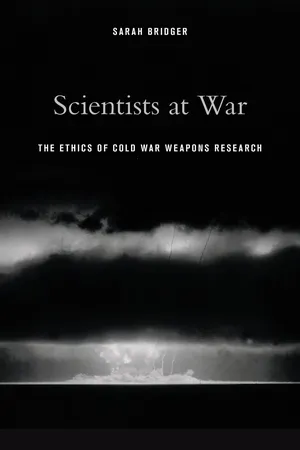
Scientists at War examines the ethical debates that severely tested the American scientific community during the Cold War. Sarah Bridger highlights the contributions of scientists to military technologies and strategic policymaking, from the dawning atomic age in the 1940s through the Strategic Defense Initiative ("Star Wars") in the 1980s, which sparked a cross-generational opposition among scientists.
The Manhattan Project in the early 1940s and the crisis provoked by the launch of Sputnik in 1957 greatly enhanced the political clout of American scientists. Yet many who took up government roles felt a duty to advocate arms control. Bridger investigates the internal debate over nuclear weapons policy during the Eisenhower and Kennedy administrations, when scientific advisors did not restrict themselves to technical assessments but made an impassioned moral case for a nuclear test ban. The relationship between government and science began to fray further during the Vietnam War, as younger scientists inside and outside of government questioned the morality of using chemical defoliants, napalm, and other non-nuclear weapons. With campuses erupting in protest over classified weapons research conducted in university labs, many elder statesmen of science, who once believed they could wield influence from within, became alienated. The result was a coalition that opposed "Star Wars" during the 1980s—and a diminished role for scientists as counselors to future presidents.
- 354 pages
- English
- ePUB (mobile friendly)
- Available on iOS & Android
eBook - ePub
About this book
Information
ONE
The Sputnik Opportunity
THE MANHATTAN PROJECT veterans emerged from the postwar years with tremendous national and international stature. Though chastened by their failure to prevent an international arms race after the Soviet nuclear test of 1949, and scarred by bitter disputes over the development of the hydrogen bomb, the community of elite physicists was, at least outwardly, still uniformly committed to political action on behalf of an arms-control agenda. Even the hawkish Edward Teller, the physicist popularly dubbed “the father of the hydrogen bomb,” served on the Board of Sponsors of the Bulletin of the Atomic Scientists, warning of the dangers of nuclear warfare. Still holding their monopoly on the understanding of precisely how the power of the atom could be harnessed in weaponry, these scientists found their expertise and advice in high demand in Washington, DC.
But nuclear policy in the 1950s was a messy business. Despite authorizing the use of atomic weapons in Japan and the development of the hydrogen bomb, President Truman had left little in the way of a coherent nuclear strategy for his successor, Dwight Eisenhower. Truman had presided over the crucial postwar years during which the Cold War deepened into irreconcilable global conflict: he had pledged support for anticommunist movements across the globe, implemented the Marshall Plan’s aid to western Europe, overseen the creation of the North Atlantic Treaty Organization, and waged the Korean War amid fears that the Soviet Union would seek expansion through proxy actions throughout the world.1
Initially, Truman’s rhetoric of containment had emphasized nuclear “symmetry”: U.S. military responses calibrated to the level of an enemy’s provoking action. But the allure of the stockpile and pressure from the military services, particularly the air force, were too great. The state of nuclear weapons technology in the early 1950s required bomb delivery via aircraft, and the air force stood to gain enormously in stature and influence with a shift in security policy that emphasized nuclear capabilities. Pressed by the Joint Chiefs of Staff and the air force’s Curtis LeMay, who headed the Strategic Air Command (SAC), Truman eventually approved a dramatic expansion of the nation’s nuclear stockpile.2
Eisenhower’s election in 1952 was thus a cause for optimism for the ascendant air force. Historian David Rosenberg writes in his chronicle of nuclear weapons policy during this period: “Where Harry Truman viewed the atomic bomb as an instrument of terror and a weapon of last resort, Dwight Eisenhower viewed it as an integral part of American defense, and, in effect, a weapon of first resort.” Whatever Eisenhower’s private views of nuclear weapons, his nuclear strategy, dubbed the New Look, relied on enormous first-strike capabilities that Secretary of State John Foster Dulles referred to as a “deterrent of massive retaliatory power.” The new posture of asymmetry rested upon Eisenhower’s publicly stated willingness to respond to minor threats with overwhelming, potentially nuclear, force.3
Curiously, the shift in policy arose from Eisenhower’s desire to avoid the kind of “garrison state” he feared would be created with enormous military budgets. The New Look, with its emphasis on nuclear weapons rather than conventional forces, was cheap, and military expenditures, calculated as a percentage of GDP, actually declined during the Eisenhower years. Moreover, by promoting deterrence through the fear of nuclear attack and relying on allies to provide lesser conventional forces, Eisenhower hoped to prevent American involvement in protracted limited wars. He wanted to avoid another Korea.4
All this meant that in the mid-1950s, the nation’s nuclear scientists enjoyed the benefits of government funding and political power. At the urging of Teller, the Lawrence Livermore Laboratory, a massive nuclear weapons research facility meant to rival Los Alamos, was constructed in Southern California in 1952. From 1953 to 1958, the lab’s staff expanded from just under seven hundred to over three thousand employees, with a budget increase of over 1,500 percent. Meanwhile, air force leaders engaged in a process critics dubbed “bootstrapping”: generating lengthy target lists that justified increased weapons stockpiles and overall funding. In 1953 the nuclear stockpile contained roughly one thousand weapons; by 1960 it had expanded eighteenfold. All the while, Curtis LeMay pushed for massive strike capabilities and expanded target lists of Soviet cities and industrial centers.5
✴ ✴ ✴
The prominence of the SAC and the New Look did not go unchallenged. Arrayed against the SAC and its supporters were the Joint Chiefs of Staff, much of the army and navy leadership, and even consultants from the air force’s spin-off RAND Corporation, all of whom rejected the SAC focus on urban areas as key targets. Within the army, Maxwell Taylor led the push for a reorientation toward limited war and conventional forces. He debated military priorities with the president on multiple occasions, urging “mutual deterrence” rather than “massive retaliation,” but Eisenhower resisted.6
Scientists, caught in this infighting, were increasingly asked to weigh in on the value and feasibility of various weapons systems, even while some harbored hopes for a world without nuclear weaponry and a shift away from Eisenhower’s New Look. Princeton mathematician John von Neumann had chaired a committee that recommended the development of intercontinental ballistic missiles, a technology that would strip the air force of its nuclear dominance by allowing nuclear weapons to be delivered via missiles rather than bombers. In March 1954 the Office of Defense Mobilization’s Science Advisory Committee met with Eisenhower to discuss the state of the country’s “technological capabilities” in the context of nuclear war. At the meeting, Eisenhower warned the scientists of the nation’s vulnerability to a surprise attack and requested that they evaluate potential technical solutions. They established a special task force headed by a steering committee of James Killian from the Massachusetts Institute of Technology (MIT), Lee DuBridge from the California Institute of Technology (Caltech), Edwin Land from Polaroid, and a handful of other advisors, assisted by forty additional scientists and engineers serving as a “professional staff.”7
The 1954 report of the Technological Capabilities Panel, as it came to be called, offered a prescient view of the future of the arms race. The panel urged numerous improvements: enhanced intelligence, including a program of high-altitude U-2 surveillance; expanded communications capabilities; greater support for basic science; and better preparedness in the case of a surprise attack. On this last point, the scientists pinpointed existing SAC weaknesses and urged that bases be “hardened” and nuclear resources be dispersed or airborne to prevent easy targeting. Most crucially, the panel predicted that by the end of the decade, the age of the bomber would wane and the age of intercontinental and intermediate range missiles would begin. As von Neumann had earlier recommended, the panel called for the development of both land-based and submarine-based missiles and for early “theoretical and experimental” investigation into antimissile defenses.8
Eisenhower was smitten by both the advisors and their advice; three years before Sputnik and the creation of the President’s Science Advisory Committee (PSAC), the panel had established an important precedent regarding the value of science advising. He viewed the assembled scientific experts as honest, independent, and keenly intelligent, immune from the tawdry pressures of politics. But though the president expressed enthusiasm for the work of the Technological Capabilities Panel, he and the panel scientists parted ways on the fundamental strategy of the New Look. Killian and his colleagues had pushed for a renewed emphasis on technologies appropriate for nonnuclear “limited wars” to little avail. Killian himself later acknowledged that “in making these and other recommendations, the panel clearly was dissatisfied with the ‘new look’ defense policy and the concept of ‘massive retaliation.’ ” But Eisenhower was not immediately persuaded.9
Nevertheless, Eisenhower’s appreciation of the government advisors’ work served an important, additional function. He was reaching out at the very moment that many in the scientific community were learning to fear the chilling power of Cold War anticommunism. In the spring of 1954, Robert Oppenheimer, accused of Communist sympathies, had been stripped of his security clearance after lengthy hearings, during which many of the leading Manhattan Project physicists testified on his behalf. Teller, the hawkish Hungarian physicist who had already clashed with his fellow Manhattan Project veterans over his work on the hydrogen bomb, had taken the opposing side, a position that would permanently alienate him from much of physics’ academic elite. The case came to symbolize the excesses of McCarthyist America. Years later, Killian would credit the Technological Capabilities Panel with helping to re-knit the frayed relations between scientists and the federal government. The scientists on the panel were “citizens who felt an obligation to their country that overrode their dismay about a single administration,” he wrote, and Eisenhower’s respect and request for assistance paved the way for renewed cooperation. Killian’s retroactive gloss likely overstated the panel’s impact, but within three years, in the aftermath of Sputnik, the bonds between the White House and elite physicists would strengthen enormously.10
✴ ✴ ✴
If the Manhattan Project catapulted elite scientists into the political sphere and the Oppenheimer case alienated them, the launch of Sputnik in October 1957 brought them into the government fold in even greater numbers. James Killian, the MIT president soon to be tapped as Eisenhower’s special assistant for science and technology, later reflected that “while scientists possessed immense prestige in Washington during the years following World War II and historic actions were taken during the Truman administration to institutionalize science and technology in government, science had a uniquely close relationship to the presidency during Eisenhower’s second term and extending into the Kennedy administration.” Sputnik was the pivotal event. The Soviet satellite, at 184 pounds and just under two feet in diameter, orbited the earth every 96.2 minutes, emitting a steady stream of gentle radio beeps, a repeating audio reminder of Soviet technical superiority. The New York Times reported that the satellite launch was “an achievement of profound scientific significance for all mankind” but one “inevitably … sobering” for the United States. The public demonstration of Soviet achievements in space and rocket technology signified a potential “science gap” afflicting the United States. The event launched the creation of an extensive federal science advisory apparatus in the United States, a splurge in funding for research and development, and a short-lived “golden age” for the political influence of science advisors.11
Eisenhower had initially downplayed the significance of the satellite, but intense media coverage quickly required further presidential action. In response, Eisenhower announced the creation of a new cabinet position: the special assistant for science and technology, who would also head up the new PSAC. His choice for this influential position was James Killian, a nonscientist who had amassed an impressive track record in science administration, first with the World War II-era National Defense Research Committee and, since 1948, as president of MIT. The PSAC was not an entirely novel creation; Eisenhower had simply reconstituted and enlarged the Office of Defense Mobilization’s advisory committee. Killian, a prominent member of the earlier group, had witnessed firsthand the respect accorded to its Technological Capabilities Panel in 1954. The panel had operated largely behind the scenes, however, and Killian was honored to chair the more exalted PSAC, which, as he put it, “was to be positioned at the very summit of government.”12
In his letter to Killian explaining his new duties as the special assistant, Eisenhower directed him to keep abreast of “the use of science and technology in relation to national security” and to advise the president on all related matters. The president granted Killian “full access to all plans, programs, and activities involving science and technology in the Government, including the Department of Defense, Atomic Energy Commission, and CIA [Central Intelligence Agency],” and invited him to National Security Council and other classified meetings. He also tasked Killian with staffing and organizing the PSAC, which subsequently included an extraordinary collection of the nation’s top scientists: Hans Bethe, the Cornell physicist and future Nobel Prize winner; Jerome Wiesner, the future president of MIT; George Kistiakowsky of Harvard; Edward Purcell and I. I. Rabi, both Nobel Prize winners in physics; Livermore director Herbert York (who considered himself the token representative from the “nuclear weapons establishment”); and others with similarly prestigious pedigrees.13
These scientists, in many ways the architects of the Sputnik boom, were largely academic physicists. Veterans of the Manhattan Project or radar research during World War II, they were patriotic, anticommunist, and idealistic, happy to offer part-time or full-time government service while maintaining their academic positions. Whatever disillusionment had been spawned by the Oppenheimer case, the PSAC scientists were enthusiastic about their new, expanded roles as government advisors; they considered national service and national security to be part of their obligation as scientists. As Killian recalled, perhaps a bit rosily in hindsight, “The group was held together in close harmony not only by the challenge of the scientific and technical work they were asked to undertake but by their abiding sense of the opportunity they had to serve a president they admired and the country they loved.”14
Not surprisingly, much of the PSAC’s early work concerned science and technology related to defense and the space program. Although some PSAC materials remain classified and no formal minutes of their meetings were kept, “in order to promote full and uninhibited discussion,” internal summaries of their work are now available. During the first years of its existence, the PSAC participated in defense budget reviews, submitting “specific recommendations … concerning strategic delivery systems, air and ballistic missile defense, limited war, anti-submarine warfare, communications, and intelligence.” The scientists’ concerns were discussed at the top levels of government: by the president, the secretary of defense, and the Joint Chiefs of Staff. With its memberships organized into technology-specific panels, the PSAC also provided “progress reports” for all the major “missile and satellite programs.” George Kistiakowsky, who would succeed Killian as Eisenhower’s second special assistant for science and technology, chaired the enormously influential PSAC Ballistic Missiles Panel. In March 1958 Kistiakowsky and Killian met with Eisenhower to discuss the ballistic missile program, after the panel had prepared a technical report building on the conclusions of the old Technological Capabilities Panel and offering a “national program for ballistic missile development over the coming years.”15
The PSAC quickly revealed itself as unafraid to call for the cancellation of major weapons programs. In nearly every case, members opted to elevate technologies necessary for minimal deterrence over those required for massive first- and second-strike capabilities. Kistiakowsky’s panel called for the cancellation of the liquid-fueled Jupiter missile, the continuation of the more easily transportable Thor intermediate-range missiles, and the accelerated development of solid, storable propellants. (These solid propellants would so...
Table of contents
- Cover
- Title Page
- Copyright
- Dedication
- Contents
- Abbreviations Used in Text
- Prologue: The Conscience of a Physicist
- 1. The Sputnik Opportunity
- 2. The Moral Case for a Test Ban
- 3. The Science of Nonnuclear War
- 4. Into the Ethical Hot Pot
- 5. Disaster and Disillusionment in Vietnam
- 6. Institutional Reckonings at MIT
- 7. The New Left Assault on Neutrality
- 8. Collapse of the Sputnik Order
- 9. A United Front against Star Wars
- Epilogue: Science and Ethics after the Cold War
- Notes
- Acknowledgments
- Index
Trusted by 375,005 students
Access to over 1.5 million titles for a fair monthly price.
Study more efficiently using our study tools.
Frequently asked questions
Yes, you can cancel anytime from the Subscription tab in your account settings on the Perlego website. Your subscription will stay active until the end of your current billing period. Learn how to cancel your subscription
No, books cannot be downloaded as external files, such as PDFs, for use outside of Perlego. However, you can download books within the Perlego app for offline reading on mobile or tablet. Learn how to download books offline
Perlego offers two plans: Essential and Complete
- Essential is ideal for learners and professionals who enjoy exploring a wide range of subjects. Access the Essential Library with 800,000+ trusted titles and best-sellers across business, personal growth, and the humanities. Includes unlimited reading time and Standard Read Aloud voice.
- Complete: Perfect for advanced learners and researchers needing full, unrestricted access. Unlock 1.5M+ books across hundreds of subjects, including academic and specialized titles. The Complete Plan also includes advanced features like Premium Read Aloud and Research Assistant.
We are an online textbook subscription service, where you can get access to an entire online library for less than the price of a single book per month. With over 1.5 million books across 990+ topics, we’ve got you covered! Learn about our mission
Look out for the read-aloud symbol on your next book to see if you can listen to it. The read-aloud tool reads text aloud for you, highlighting the text as it is being read. You can pause it, speed it up and slow it down. Learn more about Read Aloud
Yes! You can use the Perlego app on both iOS and Android devices to read anytime, anywhere — even offline. Perfect for commutes or when you’re on the go.
Please note we cannot support devices running on iOS 13 and Android 7 or earlier. Learn more about using the app
Please note we cannot support devices running on iOS 13 and Android 7 or earlier. Learn more about using the app
Yes, you can access Scientists at War by Sarah Bridger in PDF and/or ePUB format, as well as other popular books in History & Military & Maritime History. We have over 1.5 million books available in our catalogue for you to explore.