Spoken by eighty million people in South Asia and a diaspora that stretches across the globe, Tamil is one of the great world languages, and one of the few ancient languages that survives as a mother tongue for so many speakers. David Shulman presents a comprehensive cultural history of Tamil—language, literature, and civilization—emphasizing how Tamil speakers and poets have understood the unique features of their language over its long history. Impetuous, musical, whimsical, in constant flux, Tamil is a living entity, and this is its biography.
Two stories animate Shulman's narrative. The first concerns the evolution of Tamil's distinctive modes of speaking, thinking, and singing. The second describes Tamil's major expressive themes, the stunning poems of love and war known as Sangam poetry, and Tamil's influence as a shaping force within Hinduism. Shulman tracks Tamil from its earliest traces at the end of the first millennium BCE through the classical period, 850 to 1200 CE, when Tamil-speaking rulers held sway over southern India, and into late-medieval and modern times, including the deeply contentious politics that overshadow Tamil today.
Tamil is more than a language, Shulman says. It is a body of knowledge, much of it intrinsic to an ancient culture and sensibility. "Tamil" can mean both "knowing how to love"—in the manner of classical love poetry—and "being a civilized person." It is thus a kind of grammar, not merely of the language in its spoken and written forms but of the creative potential of its speakers.
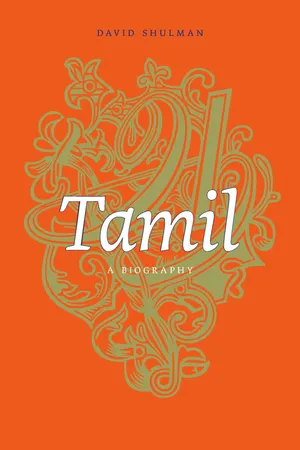
- 402 pages
- English
- ePUB (mobile friendly)
- Available on iOS & Android
eBook - ePub
About this book
Information
ONE
Beginnings
Ālāpana
What Is Tamil?
The word or name “Tamil” ends in a sound proudly seen by its speakers as characteristic of this language. Linguists transcribe it as ḻ. It would be best if you, the reader, were simply to hear it uttered by a native speaker, but I can try to describe it. The tongue slides backwards in the mouth without stopping the flow of air, and the result is an r-like sound (a retroflex liquid in the terminology of the grammarians) somewhat similar to the way many Americans pronounce the r in “girl.” The sound survives in colloquial speech in most Tamil dialects and in Tamil’s sister language Malayalam, spoken in Kerala. A few Tamil dialects have transformed it to a retroflex ḷ in certain phonetic environments, but in formal contexts—speeches, news broadcasts, recitation or singing of verses, and the like—you can always hear the original sound, which adds a pleasant purring quality to what may sound like the rapid rushing of a rivulet, for Tamil, like other south Indian languages, is among the most rapidly spoken of human languages. When I first heard it, many years ago, I wasn’t sure that it was really akin to what one calls “language,” and even today I find it hard to believe that the human tongue is capable of such swift twists and turns. That said, I hasten to add that to my ears Tamil, both in everyday speech and in contexts of formal recitation, is always a delicious, bewitching, incantational music, unlike any other that I have heard.
Indeed, “music,” or “the Tamil that is music,” icaittamiḻ, is one of the meanings of the name itself in the ancient grammatical and poetic sources. More specifically, this music-Tamil is one of three categorical divisions, along with iyaltamiḻ, that is, the “natural” (literary) language, and nāṭakattamiḻ, the Tamil of (dramatic) performance. The normative texts thus like to speak of muttamiḻ, the threefold Tamil. But this slightly mechanical division is very far from summing up the meaning of the term “Tamil.” We would, I think, be better to think of more comprehensive definitions, such as the following:
- Tamil is, first, the name of an ancient language, spoken today by some eighty million people in south India, Sri Lanka, and a large diaspora that includes Malaysia, Singapore, Fiji, South Africa, Paris, Toronto, and many other sites throughout the world. This language is attested from at least the first century B.C., though its roots go back much farther into the past, as we will see. Among the South Asian languages, Tamil is perhaps the only case of a very ancient language that still survives as a vibrant mother-tongue for tens of millions of speakers.
- Tamil is a certain body of knowledge, some of it technical, much of it intrinsic to an ancient culture and sensibility well documented in a continuous literary tradition going back many centuries. Specifically, tamiḻ means something like “knowing how to love”—in the manner of the classical love poetry with its conventions, its heroes and heroines, its powerful expressive and suggestive techniques. Thus the great poet Cuntaramūrtti Nāyaṉār (you will have to get used to these long names) says to his god, the beautiful but unpredictable Lord Śiva, at a temple called Tiruppainnili: “Do you know proper Tamil?”1 He means by this: “Do you know how to behave properly as a male lover should? Can you understand the hints and implicit meanings that a proficient lover ought to be able to decipher?” The poet has some doubts about this, for in the next line he says to the god:
Why are you just standing there
with a red-eyed serpent
dancing in your hand?
In fact, “Tamil” as a body of knowledge has a still wider application, so that “to know Tamil” can also mean “to be a civilized being.” We could say that “Tamil” in this sense is a kind of grammar, not merely of the language in its spoken and written forms but of the ways of life that have been created and lived out by its speakers.
- Here we already touch on the next, much wider sense of the term. Tamil was one of the languages of a great south Indian civilization and, as such, of one of the most creative geographical domains in historical South Asia. Some people would say that this civilization reached its apogee in the Chola period, roughly from 850 to 1200, when Tamil speakers ruled a state that brought large parts of the southern subcontinent under its control; this period is often seen as “classical,” in several senses of this word. Others, like me, might think that no less vibrant and significant achievements of south Indian civilization began long before the Chola period and continued on right up to the early modern age. Here is a topic we will want to explore in this book. In general, I think of Tamil as a living being—impetuous, sensitive, passionate, whimsical, in constant movement—hence worthy of a biography. There is also reason to put aside the dynastic-political periodizations that are still prevalent for south Indian history in favor of more organic, thematic continuities that cut through the periods of dynastic rule.
The cultural role of Tamil is not, in any case, truly analogous to that of, say, Latin for the Roman Empire or of Sanskrit for what Sheldon Pollock has called the “Sanskrit Cosmopolis,” that is, the vast swath of Asia within which Sanskrit grammar and the political ideology couched in Sanskrit had a pervasive and stable presence for well over a thousand years. Nor was Tamil ever the sole or, for that matter, even the clearly predominant language of the south Indian civilization that I’m referring to. It shared pride of place with other languages such as Sanskrit, the various Prakrits, Telugu, Kannada, and Malayalam. I will thus refrain, in this book, from speaking about a “Tamil civilization,” which seems to me a modern, nationalist construction bearing little relation to any historical reality. We can, nevertheless, agree that the Tamil language and its particular themes, images, and traditions informed and in many ways shaped an extraordinarily long-lived, heterogeneous, and richly elaborated culture or series of cultures along with the political and social orders that emerged out of those cultural matrices.
- Tamil is, at its most basic, an intoxicating, godly fragrance (tĕyvat tamiḻ maṇam). It is thus something light, delicate, and pervasive, an existential undercurrent flowing through everything that lives, and as such intimately linked to the human faculty of memory and to musical poetry as the voice of memory and awareness.2 Not everyone can take in or recognize this fragrance, but the First Sage, Agastya, did and, overcome by its power, proceeded to write a grammar of this sweet vital force after learning to speak and understand with the help of Lord Śiva.3 Moreover, as a fragrant breath of air Tamil is also, by definition, both “bright” or golden (cĕn tamiḻ) and cool (taṇ ṭamiḻ), like all good things in south India.4 Blake Wentworth has shown that in the very earliest strata of Tamil literature, the so-called Sangam corpus, the word “Tamil” is regularly paired with the idea of something deliciously cool.5 Incidentally, like Tamil itself, the Tamil land has a gentle nature (mĕlliyal).6
- Finally—or perhaps this should have been our point of departure—Tamil is a living goddess, her body constituted by the phonemes (in their oral and also written forms) that make up the language and its grammar, in the wide sense of the latter term intimated above. Tamil, that is, is entirely permeated by divine forces that are accessible to those who know the language and that may be amenable to pragmatic uses that can make, or change, a world.
Does the word tamiḻ have an accepted etymology? Do we know what it originally meant? Unfortunately, the answer is no. The medieval lexicons, such as the Piṅkala nikaṇṭu (10: 580), say tamiḻ means “sweetness” (iṉimai) and also “coolness” or, literally, “waterness” (nīrmai),7 two associations we have already noted. Modern dictionaries such as the Madras Tamil Lexicon follow this gloss, adding others. Kamil Zvelebil, after an exhaustive discussion of the problem, suggests an etymology from the root taku, “to be fit or proper” (medial k being capable of elision or of shifting to m, and –iḻ being seen as a nominalizing ending). Thus tamiḻ would mean “the excellent [resounding] process,” “the proper [process of] speaking.”8 I find this far-fetched, but no less so than other suggestions, for example S. V. Subrahmanian’s, deriving the word from the reflexive pronoun tam: thus “our own (sweet sound).” The Tamil Lexicon suggests that the name goes back to tami, “solitude,” “loneliness”—so this would be a rare case of a language calling itself lonely or, perhaps, singular.
Whatever the correct etymology, tamiḻ clearly underlies the Sanskrit word draviḍa. The Sanskrit word reveals the attempt by speakers of Sanskrit or other north Indian languages to capture two distinctive Tamil sounds: the initial t, which is pronounced with the tongue slightly backed up and touching the back of the teeth and the alveolar ridge—thus a sharper sound than Sanskrit t—and the final retroflex ḻ, which I have already discussed. Classical Sanskrit uses draviḍa both to refer to Tamil speakers specifically and, at times, to indicate south Indians generally: in the royal palace at Ujjayini in central India, in the mid-first millennium A.D., lightly armed servants were mostly men identified by their home region as “Āndhra, Draviḍa, and Sinhala” (the Draviḍas presumably speaking Tamil);9 the great prose writer and poetician Daṇḍin (seventh century), himself a Tamilian, tells a story located draviḍeṣu—in the Tamil country;10 and the topos of the “Draviḍa ascetic” (drāviḍa-dhārmika) became something of a cliché in Sanskrit narratives.11
Sanskrit drāviḍa (with long initial ā; also dramiḷa, middle-Indic damiḷa) has given us the name of the language family to which Tamil belongs: Dravidian. The existence of such a family, like the existence of the Indo-European family of languages stretching from Calcutta to Iceland, is a modern discovery.12 Credit for identifying the major south Indian languages as a distinct family, unrelated to Sanskrit, goes to Francis Whyte Ellis (1777–1819), a British savant-cum-administrator linked to the vibrant early days of College Fort St. George in Madras. Ellis established that Tamil (both colloquial and literary), Telugu, Malayalam, and Kannada were close relatives; he published his findings as a “Note to Introduction” to Alexander Duncan Campbell’s Teloogoo Grammar (1816).13 However, the first attempt to produce a comparative overview of the Dravidian languages was carried out a generation later by Bishop Robert Caldwell in his Comparative Grammar of the Dravidian or South Indian Family of Languages (1856). By Caldwell’s time, the number of recognized Dravidian languages had grown; today we count some three dozen, most of them tribal languages with relatively few speakers, apart from the four major literary languages of Tamil, Telugu (the language of the states of Andhra Pradesh and Telangana), Kannada (the language of Karnataka), and Malayalam (the language of Kerala). To do justice to medieval south Indian scholarship, we should mention that Līlā-tilakam, probably a fifteenth- or sixteenth-century grammar in Sanskrit of the mixed language of Kerala known as Maṇi-pravāḷam,14 already recognized that the spoken languages of Kerala and the southern Tamil regions were close to one another and deserved to be called “Dramiḍa” (that is, “Tamil”); but the learned author of the Līlā-tilakam excludes the “Karṇṇāṭa and Āndhra” languages from this category (though he admits that some people would include them) since they are too far removed from the language of the “Tamil Veda,” that is, the Vaishṇava poet Nammāḻvār’s canonical Tiruvāymŏḻi poems.15
More precisely, Tamil belongs to what is called South Dravidian and is thus relatively close to its sister languages, Kannada and Malayalam. There has been a tendency among historical linguists to think of Malayalam as having diverged directly from Tamil (the Tamil spoken from ancient times in what is today Kerala), perhaps as late as the thirteenth century. But this view is almost certainly wrong. Tamil and...
Table of contents
- Cover
- Title Page
- Copyright
- Dedication
- Contents
- Preface
- Note on Transliteration
- 1. Beginnings
- 2. First Budding: Tamil from the Inside
- 3. Second Budding: The Musical Self
- 4. The Imperial Moment, Truth, and Sound
- 5. Republic of Syllables
- 6. A Tamil Modernity
- 7. Beyond the Merely Modern
- Notes
- References
- Credits
- Index
Trusted by 375,005 students
Access to over 1.5 million titles for a fair monthly price.
Study more efficiently using our study tools.
Frequently asked questions
Yes, you can cancel anytime from the Subscription tab in your account settings on the Perlego website. Your subscription will stay active until the end of your current billing period. Learn how to cancel your subscription
No, books cannot be downloaded as external files, such as PDFs, for use outside of Perlego. However, you can download books within the Perlego app for offline reading on mobile or tablet. Learn how to download books offline
Perlego offers two plans: Essential and Complete
- Essential is ideal for learners and professionals who enjoy exploring a wide range of subjects. Access the Essential Library with 800,000+ trusted titles and best-sellers across business, personal growth, and the humanities. Includes unlimited reading time and Standard Read Aloud voice.
- Complete: Perfect for advanced learners and researchers needing full, unrestricted access. Unlock 1.5M+ books across hundreds of subjects, including academic and specialized titles. The Complete Plan also includes advanced features like Premium Read Aloud and Research Assistant.
We are an online textbook subscription service, where you can get access to an entire online library for less than the price of a single book per month. With over 1.5 million books across 990+ topics, we’ve got you covered! Learn about our mission
Look out for the read-aloud symbol on your next book to see if you can listen to it. The read-aloud tool reads text aloud for you, highlighting the text as it is being read. You can pause it, speed it up and slow it down. Learn more about Read Aloud
Yes! You can use the Perlego app on both iOS and Android devices to read anytime, anywhere — even offline. Perfect for commutes or when you’re on the go.
Please note we cannot support devices running on iOS 13 and Android 7 or earlier. Learn more about using the app
Please note we cannot support devices running on iOS 13 and Android 7 or earlier. Learn more about using the app
Yes, you can access Tamil by David Shulman in PDF and/or ePUB format, as well as other popular books in History & Indian & South Asian History. We have over 1.5 million books available in our catalogue for you to explore.