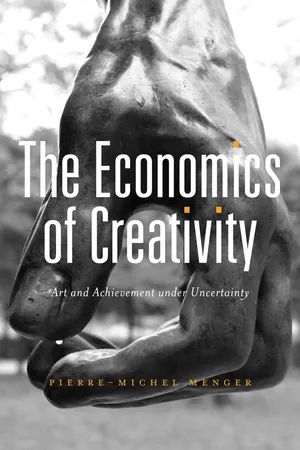
Creative work has been celebrated as the highest form of achievement since at least Aristotle. But our understanding of the dynamics and market for creative work--artistic work in particular--often relies on unexamined clichés about individual genius, industrial engineering of talent, and the fickleness of fashion. Pierre-Michel Menger approaches the subject with new rigor, drawing on sociology, economics, and philosophy to build on the central insight that, unlike the work most of us do most of the time, creative work is governed by uncertainty. Without uncertainty, neither self-realization nor creative innovation is possible. And without techniques for managing uncertainty, neither careers nor profitable ventures would surface.
In the absence of clear paths to success, an oversupply of artists and artworks generates boundless differentiation and competition. How can artists, customers, entrepreneurs, and critics judge merit? Menger disputes the notion that artistic success depends solely on good connections or influential managers and patrons. Talent matters. But the disparity between superstardom and obscurity may hinge initially on minor gaps in intrinsic ability. The benefits of early promise in competition and the tendency of elite professionals to team up with one another amplify and disproportionately reward even small differences.
Menger applies his temporal and causal analysis of behavior under uncertainty to the careers and oeuvres of Beethoven and Rodin. The result is a thought-provoking book that brings clarity to our understanding of a world widely seen as either irrational or so free of standards that only power and manipulation count.
eBook - ePub
The Economics of Creativity
Art and Achievement under Uncertainty
- English
- ePUB (mobile friendly)
- Available on iOS & Android
eBook - ePub
The Economics of Creativity
Art and Achievement under Uncertainty
About this book
Information
CHAPTER ONE
Time, Causes, and Reasons in Action
ACTION ANALYSIS in both sociology and economics faces a persistent tension. To understand how individuals differ in their behavior, we may need to define each individual’s characteristics, preferences, and resources at the onset of the course of action. This essentially leads to a long-term, propelling view of the causal determination of individual action. However, as action unfolds sequentially, within an environment of interactions, people learn from each other and about themselves in ways that cannot be fully anticipated. Can we, simultaneously, fully define the identities of social actors and the situations that bring those actors together? My view is that any attempt to do so needs to bring into play the related notions of temporality of action and differences among individuals, and that these notions represent a link between sociology and economics rather than a line of separation. My approach focuses on the sets of theories in the two disciplines that most effectively facilitate the comparative analysis of coordinated treatment of individual differences and temporality of action.
I begin with a critical comparison of two families of theories in sociology and then consider how the same questions are handled in economic theory. In looking at each discipline, the first type of model we will consider compresses or effaces the dynamic properties of action and individual behaviors.
Actors and Time in Sociology
It is common to mark the opposition between the two sciences by associating sociology with deterministic causal analysis and economics with intentional, strategic causal analysis. Elster and Dupuy1 note that one of the two elementary structuring principles of this antagonism is the temporal orientation of causation; that is, determination by the past versus determination by intentional aim or focus on a goal, and therefore by anticipation of the future (in particularly reductive versions, this polarization takes the form of mechanism versus finalism). Critiques of goal-oriented action theory and, symmetrically, of a theory that understands action as a mere routine automatically adopted through the functionally stabilizing power of habit have become ritualized. They lead to either an attempt to absorb the opponent’s objections and viewpoint—a kind of strategy of imperialist encirclement discernible in the respective aspirations of Gary Becker2 and Pierre Bourdieu3—or to more eclectic compromises in which the behavior categories and the environments for action and interaction implied by the respective paradigms are selectively assigned. Following an obviously asymmetrical distribution, the sociologist is confined to routine, normed behaviors and the economist to rational, goal-oriented ones, with very few exceptions.
In fact, the distinction between deterministic and nondeterministic models runs through both sciences; the two sets of theories face off against each other within both. Before going further, it is important to preclude any confusion arising from my choice of vocabulary. The debate about determinism in science at large and in the social sciences that concern us here would be incomprehensible if we merely assimilated determinism to causal analysis.4
It is important to define clearly what is at issue. What type of dependence exists among the states, behaviors, and initiatives of successive moments in the actor’s existence? Do we have to understand each act or behavior as an event linked to the act and behavior immediately preceding, through a strict relation of causal dependence? If so, do we have to remain within the boundaries of a deterministic model of causal engendering in which the successive points on an individual trajectory are all derived from “determined initial conditions,” with the environment acting only as a disruptive milieu that the agent has to deal with, its power to shape outcomes only in exceptional cases having a significant effect on the trajectory of behavior? How should we model temporal dependence as a constraint that is in turn encompassed within the probabilizable space of a “course of action” so as to let the actor come to exercise a variable degree of control on, in accordance with the situations he encounters and his particular objectives?
Deterministic Theories in Sociology
In deterministic theories, causal analysis places the agent under the control of a set of forces that constrain individual action. The actor is propelled by her past in the manner of a vis a tergo (as a force from behind), and the situation in which she moves amounts to an “arena,” a field in which the factors that determine an individual’s behavior and action fully operate. There are, of course, several possible ways of specifying the deterministic paradigm, but in all cases it is crucial to provide the actor with a past, and to decipher his behavior by means of this past, using a grammar-like logic. The concepts of role, status, norm, and value are to be understood as crystallizations of collective influence on individual behavior. They are “in charge” of making the individual’s actions coherent and coordinating the multiple individual behaviors, and they are what make it possible to explain the (recognized or unrecognized) adjustment or maladjustment of those behaviors. These concepts are bearers of a history, that of the supra-individual constraints determining action and action coordination, and they serve to characterize the homeostatic properties of the functioning of social groups. But using them amounts to hollowing out the action arena, evacuating its particularities, transforming it instead into a medium or receptacle for the causal influence of the supra-individual forces understood to govern individual behavior.
In deterministic theories, specification of the actor’s environment is generally aligned with specification of the determinants of his action. In Durkheim’s homeostatic model, achieving the stability of the social order amounts to establishing the conditions in which the individual will have a sufficiently strong perception of the relation of dependence between her set of preferences and the social whole—the idea being that she can only contribute to the harmonious functioning of that whole if she allows herself to be guided by the force of collective ideals.5
Another canonical example is Parsons’s structural-functionalist theory, where a correspondence is understood to exist between, on the one hand, normative and value systems, and, on the other hand, the interaction situation or environment, the latter defined as a set of constraints that are stable and coherent for the actor. Clearly this amounts to congruence between situation and functions. Institutions are themselves crystallized systems of positions: a time, a past, frozen into arrangements that are constantly being reactivated without having to be remotivated. The social system could not preserve its equilibrium without this quadrilateral of functional imperatives—normative stability, the attainment of goals, adaptation, integration—or without socialization, which ensures that the individual internalizes those imperatives.
Parsons does not overlook the differences among individuals, but he argues that socialization makes people similar, allowing mutual comprehension and social cohesion. Although socialization creates autonomous actors, interdependence is also characteristic of the fully developed socialized being. Interactions in which Self and Other are mutually dependent could not have a determined outcome and could not therefore be stable if expectations and roles were not complementary. As shown by Bourricaud,6 a world of autonomous and interdependent actors could not reach an equilibrium in the Parsonian system if actors’ autonomy were not firmly fastened to mechanisms—constraints, obligations, norms—that bring about the convergence of actions. What is most likely to ensure social equilibrium is early socialization, which guarantees strong, enduring internalization. Once contracted and compressed to generate individual behavior, the active power of inherited time does indeed ensure the harmonious differentiation of actors—the severely restricted form of differentiation represented by the relation of complementarity.
Deterministic theories seldom claim they can produce outlines for strict conditioning of individual action. They generally include a probabilistic dimension7 that makes it possible to specify the conditions in which the determining power of the actor’s initial socialization operates. They also make it possible, perhaps, to link that first socialization to later socialization and to attribute strategic capacities to the actor, if only in the form of a felicitous disposition to choose what is “best suited” in each situation.
However, most of the theoretical contortions that deterministic theories go through to preserve a probabilistic margin for the analysis of action prove inadequate or at the very least mysterious, because they lack explicit, duly instrumented probabilistic reasoning and a notion of social facts as dynamic.
Among the many breathtaking instances of this sort of contortion, we can cite Bourdieu’s rejection of the accusation that his thinking is deterministic. In the following sentence he first protests against that accusation, then proceeds to reject antideterministic concessions:
The habitus is not destiny as some have made it out to be. As the product of history, it is an open system of dispositions, which is then constantly being confronted with new experiences and thus constantly being affected by them. It is lasting but not immutable. That being said, I should immediately add that most people are statistically destined to encounter circumstances consistent with those that originally fashioned their habitus, and therefore to have experiences that will work to reinforce their dispositions.8
The next paragraph displays the same winding argument, yet the order is reversed. First comes the deterministic affirmation, then the concession:
All stimuli and conditioning experiences are perceived at every moment through categories already constructed by previous experiences. The result is that privilege inevitably goes to first experiences and consequently, the system of dispositions making up the habitus is a relatively closed one. But this is not all: The habitus is only revealed—it must be remembered that this is a system of dispositions, meaning virtualities, potentialities—in relation to a determined situation.9
Twisting in one direction, then the other. The final result, as expressed one page later, looks very much like a folding of the individual back onto itself, managed by means of a quite singular version of self-determinism:
Social agents actively determine the situation that determines them, through the intermediary of socially and historically constituted categories of perception and valuation. It can even be said that social agents are determined only to the extent that they determine themselves. But the perception and valuation categories that are the first principle of this (self-)determination are themselves in large measure determined by the economic and social conditions in which they were constituted.10
Detailed analysis of the wording here would show how each term is twisted by the speaker’s use of its opposite, as well as the considerable effort exerted to ensure that emancipation remains subordinate to determinism, while qualifications such as “in large measure” and “relatively closed” offer a sort of impossible probabilistic compensation, no sooner mentioned than annulled.
How does this paradoxical probabilism affect the notion of temporality of action?
Bourdieu himself noted a kinship between his constructive structuralism and phenomenological analyses of action and temporality, the understanding being that the first had critically overtaken the second. Rejecting “the detemporalized notion of action that informs structuralist and rationalist visions of action” (Wacquant’s wording), Bourdieu claimed to have temporalized the habitus, and thus to have moved beyond both Husserlian understandings of temporality and rational choice theory. There are two aspects to this operation.
The first of these—which remains perfectly within the boundaries of phenomenology rather than going beyond them—consists in inscribing determinism in a kind of temporality where the future gets folded back onto the past via the actualizing power of the present.11 The close proximity of this understanding to phenomenological theory has been analyzed with great insight by Héran (1987), who shows Bourdieu’s use of the kind of switching or “toggle” move central to Husserl’s phenomenology:
We have to presuppose, however mysterious this may be, that the deposited disposition somehow reverses itself; we have to assume the existence of something that activates the passive, actualizes the past. The habitus is, at the very least, a way of naming this switching system … Most definitions of the habitus seem to involve activation of something passive. These definitions readily take the form of diptychs in which two sides of the concept—the passive and the active, the before and the after—are juxtaposed, without our understanding very clearly how that reversal occurs or is genetically constituted: “as a product of history, the habitus produces individual and collective practices, and therefore history”; “as incorporated history, history-that-has-been-made-into-nature and is therefore forgotten as history, the habitus is the active, effective presence of the entire past that produced it”; the autonomy that [the habitus] confers on practices, in contrast to external determinations of the immediate present, is “that of the [already] enacted and [yet] active, effective past [passé agi et agissant], which, functioning as accumulated capital, produces history out of history.”12
This phenomenologized structural constructivism requires three spectacular simplifications, which may be described as follows:
• Sedimentation of past experience into a habitual body occurs without loss or cost. The body is conceived as a surface that allows for perfect inscription and retrieval of exchanges with the environment through continuous activation of an internalization-externalization mechanism;
• The grammar of the habitus recognizes very few behavior-determining predicates. In deterministic analyses that take into account biographical determinants, individual history is given the shape of an accumulation trajectory. In theory, and consistent with the phenomenological source of Bourdieu’s analysis in terms of complete incorporation of experience, the actor’s entire past is retained, stocked, reactivatible. But the perception and representation filters form grids for categorizing perceptual information that in fact configure and predetermine the meaning of experiences, so the knowledge content of past experiences is inherently reduced from the outset. The next move is to assign a single origin—social class position—to the various filters and the way they function, thereby drastically simplifying the sedimentary accumulation hypothesis;
• Since individuals can only meet others who resemble them in situations that reinforce the determinants of their actions and confirm their representations—better yet, since individuals are destined to anticipate that what is the most probable for them, and therefore to bring into being, via their representations, that which determines them to be nothing but the product of their determinations—then by definition the range of actualizable possibilities open to them is limited to the characteristics of regularly encountered situations.
Looking at the obverse of this move to temporalize the habitus will enable us to locate the margin of chance that Bourdieu says provides this determinism with its probabilistic dimension. On the one hand, reproduction of the social structure is ensured by the switching game that goes on between (1) the set of habituses and (2) reproduction strategies that are “at once independent, often to the point of conflict, and orchestrated by all the agents involved, all working continuously to reproduce the social structure.” On the other hand we have “unknown factors” and “failures”—that is, the sum of individual deviations from the trajectories that would ensure strict perpetuation of inherited positions in social space—and these are due to “contradictions inherent in the structures and to conflict or competition among agents operating in those structures.”13 Competition is thus invoked to explain both the properties that keep the social system stationary and chance departures from the rule, departures that taken together do affect the system, but only by shifting it as a structural whole.
There is not enough space here to demonstrate that the problems caused for this theory by recognizing a margin of indetermination are rooted in a quite mysterious understanding of collective realities, an understanding in terms of classes, fractions of classes, and institutions. Those collective levels are at times c...
Table of contents
- Cover
- Half Title
- Title Page
- Copyright
- Dedication
- Contents
- Introduction
- 1. Time, Causes, and Reasons in Action
- 2. Is Working to Achieve Self-Fulfillment Rational?
- 3. Rationality and Uncertainty in the Artist’s Life
- 4. Talent and Reputation: Social Science Explanations for Varying Degrees of Success
- 5. How Can Artistic Greatness Be Analyzed? Beethoven and His Genius
- 6. Profiles of the Unfinished: Rodin’s Work and the Varieties of Incompleteness
- Conclusion
- Notes
- Acknowledgments
- Index
Trusted by 375,005 students
Access to over 1.5 million titles for a fair monthly price.
Study more efficiently using our study tools.
Frequently asked questions
Yes, you can cancel anytime from the Subscription tab in your account settings on the Perlego website. Your subscription will stay active until the end of your current billing period. Learn how to cancel your subscription
No, books cannot be downloaded as external files, such as PDFs, for use outside of Perlego. However, you can download books within the Perlego app for offline reading on mobile or tablet. Learn how to download books offline
Perlego offers two plans: Essential and Complete
- Essential is ideal for learners and professionals who enjoy exploring a wide range of subjects. Access the Essential Library with 800,000+ trusted titles and best-sellers across business, personal growth, and the humanities. Includes unlimited reading time and Standard Read Aloud voice.
- Complete: Perfect for advanced learners and researchers needing full, unrestricted access. Unlock 1.5M+ books across hundreds of subjects, including academic and specialized titles. The Complete Plan also includes advanced features like Premium Read Aloud and Research Assistant.
We are an online textbook subscription service, where you can get access to an entire online library for less than the price of a single book per month. With over 1.5 million books across 990+ topics, we’ve got you covered! Learn about our mission
Look out for the read-aloud symbol on your next book to see if you can listen to it. The read-aloud tool reads text aloud for you, highlighting the text as it is being read. You can pause it, speed it up and slow it down. Learn more about Read Aloud
Yes! You can use the Perlego app on both iOS and Android devices to read anytime, anywhere — even offline. Perfect for commutes or when you’re on the go.
Please note we cannot support devices running on iOS 13 and Android 7 or earlier. Learn more about using the app
Please note we cannot support devices running on iOS 13 and Android 7 or earlier. Learn more about using the app
Yes, you can access The Economics of Creativity by Pierre-Michel Menger, Steven Rendall, Amy Jacobs, Arianne Dorval, Lisette Eskinazi, Emmanuelle Saada, Joe Karaganis, Steven Rendall,Amy Jacobs,Arianne Dorval,Lisette Eskinazi,Emmanuelle Saada,Joe Karaganis in PDF and/or ePUB format, as well as other popular books in Social Sciences & Entertainment Industry. We have over 1.5 million books available in our catalogue for you to explore.