In his masterwork Muqaddimah, the Arab Muslim Ibn Khaldun (1332–1406), a Tunisian descendant of Andalusian scholars and officials in Seville, developed a method of evaluating historical evidence that allowed him to identify the underlying causes of events. His methodology was derived from Aristotelian notions of nature and causation, and he applied it to create a dialectical model that explained the cyclical rise and fall of North African dynasties. The Muqaddimah represents the world's first example of structural history and historical sociology. Four centuries before the European Enlightenment, this work anticipated modern historiography and social science.
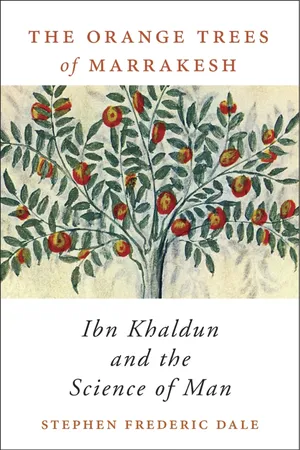
In Stephen F. Dale's The Orange Trees of Marrakesh, Ibn Khaldun emerges as a cultured urban intellectual and professional religious judge who demanded his fellow Muslim historians abandon their worthless tradition of narrative historiography and instead base their works on a philosophically informed understanding of social organizations. His strikingly modern approach to historical research established him as the premodern world's preeminent historical scholar. It also demonstrated his membership in an intellectual lineage that begins with Plato, Aristotle, and Galen; continues with the Greco-Muslim philosophers al-Farabi, Avicenna, and Averroes; and is renewed with Montesquieu, Hume, Adam Smith, and Durkheim.
- English
- ePUB (mobile friendly)
- Available on iOS & Android
eBook - ePub
About this book
Information
1
IBN KHALDUN’S WORLD
IBN KHALDUN WAS BORN in 1332 in Tunis, where his ancestors had fled shortly before Seville fell to the Christian forces of Castile in 1248. Until 1382, when he was forty years old and settled in Cairo, Ibn Khaldun lived, studied, and worked mainly in Tunis, Fez, and other towns and villages of North Africa, the region that includes the modern states of Libya, Tunisia, Algeria, and Morocco. He and Arab geographers distinguished two sections within this region: “Ifriqiyah,” or Roman Africa, comprising Tunis and eastern North Africa but not Egypt, and the Maghrib, the Arabic “West,” encompassing Algeria and Morocco.1 He also spent brief periods of his adult life at the Arab Muslim Nasrid court of Granada, then the last state in al-Andalus or Andalusia, the Arab name for the Muslim-ruled areas of Portugal and Spain within the Iberian Peninsula. In composing the Muqaddimah, Ibn Khaldun assumed readers would be familiar with these closely entwined regions of the western Islamic world, a world he knew, analyzed, and, in certain respects, mourned. His theories are rooted in these regions’ geography, settlement patterns, histories, and societies, and if modern readers are to find their way through Ibn Khaldun’s sprawling work and come away with an accurate understanding of his science of man, they too must familiarize themselves with Ibn Khaldun’s world.
NORTH AFRICA
Ibn Khaldun based his model on the premise that environment, directly or indirectly, determined human nature. Environment was responsible, therefore, for the distinctive traits or natures of particular human social organizations. He attributed the dynamics of his dialectical model in the first instance to the contrasting rural and urban environments of the North African landscape.2 North Africa consists of two major regions, a largely arid interior and a Mediterranean coastal plain. The interior comprises a broad swath of extremely dry territory, interrupted by two mountain ranges. These two ranges are the Rif, a continuation of a geologic formation from Gibraltar and southern Spain, which continues into the heart of central Morocco, and the Atlas, a range comprising a complex series of chains, extending from southwestern Morocco northeast to the Mediterranean coast and continuing eastward through both coastal and interior Algeria as far as northern Tunisia. South of these mountain chains lie steppe land and the vast Sahara, separating Ifriqiyah and the Maghrib from Africa proper.
Lacking major river systems, no area of North Africa contains terrain suitable for dense human settlement such as developed in Andalusia, Egypt, and Iraq. “Atlantic” Morocco, south-southwest of Tangier and the Rif, and west of the Middle and High Atlas chains, contains the most productive agricultural lands in the region. It benefits from an Atlantic climate, which produces rains and mild, humid weather, so plains in this area between the mountains and the sea support numerous agricultural villages and a few substantial towns. Fez in the north and Marrakesh in the southwest, oasis towns founded by different dynasties during the Islamic era, are located here along the western slopes of the mountains. The remainder of North Africa is far less hospitable. Eastern Morocco, Algeria, Tunisia, and Libya have sparse rainfall and a narrow Mediterranean coastal plain, hemmed in by rugged mountains, with steppe and desert immediately to the south.
Apart from a few areas such as Atlantic Morocco and some sections of the Mediterranean coast, the entire North African region has remained sparsely populated throughout its recorded history. Historically, urban settlements, even in Atlantic Morocco, were relatively small—relative, that is, to towns and cities throughout the eastern Mediterranean. As Ibn Khaldun remarks about North Africa in the Muqaddimah, “There are few cities and towns in Ifriqiya and the Maghrib. The reason for this is that these regions belonged to the Berbers for thousands of years before Islam.”3 Three principal types of towns, however modest, were nonetheless found in the two sections before and during his lifetime: Mediterranean coastal settlements, military or political centers, and interior commercial entrepōts.
Historically, the most populous North African towns and cities were scattered along the Mediterranean coast, a significant area of human habitation since Phoenician times during the second and first millennium B.C.E. Tunis, a major port in later Roman times, which regained its importance following the Muslim conquest of North Africa in the seventh century, was one of the most important of these settlements. Tunis possessed valuable agricultural lands that supported a substantial population, but it prospered because of its links with both Mediterranean and also trans-Saharan commercial networks. Ibn Khaldun’s home, it represented the only North African urban center he thought to be comparable in certain limited respects with the great cities of Andalusia, Egypt, and Iraq. With its religious buildings, libraries, scholarly traditions, and vibrant economy, Tunis manifested the type of Arab Islamic urban culture he valued, and that he directly associated with densely populated human settlements elsewhere in the Islamic world.4 In fact, as seen in the later analysis of his dialectical model, he equated the strength of an economy and the level of civilization or cultural sophistication of any town or city with the size of its population.
Apart from historic coastal sites, there were two other major types of urban settlements in North Africa: military and political towns and interior trading centers. Qayrawan, whose name was derived from the Persian karvan or caravansary, was founded about 670 by an army of the Umayyad Caliphate of Damascus (661–750). It was the earliest Arab Muslim settlement in the region. Located just south of Tunis on the site of a former Byzantine military camp, the city began life as a military encampment but evolved into a fortified city that became Ifriqiyah’s most important Muslim religious center from the early ninth to the middle of the eleventh century. The city’s legal scholars composed, among other works, fundamental texts of Maliki law, the conservative Sunni madhhab or legal school that took root throughout North Africa and Andalusia well before the fourteenth century, when Ibn Khaldun studied it and later became a Maliki judge in Cairo.
North Africa’s two most important political centers from the eleventh century until Ibn Khaldun’s day were the Moroccan oasis towns of Fez and Marrakesh. Fez, first founded in 789, was rebuilt in 1276, while Marrakesh, situated along the piedmont of the Atlas Mountains, was established in 1062. As capitals of different dynasties, these towns also developed into religious and cultural centers of the Maghrib at different times, which attracted scholars from throughout North Africa, including Ibn Khaldun. In the twelfth and thirteenth centuries, Marrakesh became the single-most important city in North Africa, but by Ibn Khaldun’s day, following extended periods of political turmoil, it had become a shadow of its former self, although the magnificent walls of the city remained intact as they do to the present day. By the fourteenth century, when Ibn Khaldun traveled to Morocco, Fez had become the most important city in Morocco, owing to the dynastic shifts in the region.
Apart from these military and political centers, there were important commercial towns situated inland from the coast or farther south in the desert, owing their size and prosperity primarily to their strategic locations on trans-Saharan trade routes. These included, among several others, two particularly important settlements, Tilimsan, located in the highlands, southwest of Oran in western Algeria, which began life as a Roman garrison in the fourth century, and Sijilmasa, initially founded as a Berber tribal camp in the eighth century, which is situated south of the Atlas Mountains, at the northern edge of the Sahara. Both cities were thriving in Ibn Khaldun’s day. After visiting Sijilmasa in 1351, his contemporary Ibn Battuta (1304–1368), praised the beauty and prosperity of the town, the principal northern terminus of African gold caravans.5
Outside its few towns and cities, the prevalent human settlement pattern throughout most of the North African interior before and during Ibn Khaldun’s era featured tribal populations. They were composed of small, isolated hamlets of farmers, scattered throughout the mountains but found in greater concentrations in a few well-watered oases and plains, as well as substantial numbers of pastoral nomads living in the steppe areas and the slopes of the Atlas Mountains and farther south along the fringes of the Sahara.6 According to Ibn Khaldun, during his lifetime agriculturalists living in the plains and in the mountains comprised the majority of indigenous tribes and non-Arabs in North Africa, while nomadic pastoralists, camel herders, whose mounts were adapted for the dry, austere North African environment, accounted for the remainder of the rural population.7 Within any particular locality, farmers and herders traditionally belonged to the same tribe, whose chiefs or religious leaders founded most of the dynasties Ibn Khaldun cited to illustrate his dialectical model.
At the time of the Muslim conquests in the seventh century and during Ibn Khaldun’s lifetime, as well, the bulk of these rural tribes consisted of an indigenous, ethnically mixed population known to Greeks, Romans, and Muslims as Berbers, that is, “barbarians.” These people called themselves Imazighen, “noble” or freeborn, a term emphasizing an individualized, heroic warrior image typical of the ideology of pastoral nomadic tribesmen, which Berber tribal poets conveyed in their verse and sometimes proclaimed in defiant song before battles, stirring tribal warriors to self-sacrifice.8 It was a self-image verified in a purported tenth-century statement of one tribesman, who said: “Each man of us [in the Kutamah tribe] is his own master, although each tribe has its elders and advisers in matters of (religious) conduct to whom we take our disputes.”9
In Ibn Khaldun’s day, most Berbers were Muslims to varying degrees of sophistication, but they spoke their own language and most remained culturally distinct from Arabs in both North Africa and Andalusia. Nearly all Berbers were identified with one or another of the region’s tribes living in the countryside, and, as Ibn Khaldun remarks in one of his innumerable expressions of regret about the lack of vibrant urban centers in his North African homeland, “No sedentary society existed among (the Berbers) long enough to reach any degree of perfection.”10 The greatest part of North African society was, therefore, in Ibn Khaldun’s phrase, “a bedouin one,” using the Arabic word bedouin here and throughout the Muqaddimah as a generic term for all pastoral nomadic and rural agrarian tribal populations. In his mind this environmentally determined social reality amid its few modest towns shaped the political and cultural history of the region.
In fact, centuries before Ibn Khaldun’s time, many true Bedouins, members of Arabic-speaking tribes from the Arabian Peninsula, had also settled in parts of the Maghrib. Some were members of the original Arab Muslim armies, such as those who lived in Qayrawan, but there were others who came later and in greater numbers. He identified one particular Arab tribal confederation, whose members arrived in the eleventh century, the Banu Hilal, as bedouins, that is, tribesmen, who initially at least seem to have been made up entirely of pastoral nomads and to have epitomized nomadic society at its most anarchic and destructive.11 Ibn Khaldun and other Arab scholars condemned the appalling havoc this tribal group wreaked on North African sedentary society over several centuries, expressing themselves with the same vehemence Chinese or Iranian observers spoke of Mongols after they tore through Eurasia in the twelfth and thirteenth centuries. Ibn Khaldun blamed the Banu Hilal especially for much of the decay of North African urbanism over a period of 350 years. He wrote, with some exaggeration, that while the entire region between the Sudan and the Mediterranean had historically been settled, as architectural ruins testified, the Banu Hilal had destroyed all traces of urban society.12
In his memoir Ibn Khaldun compared pastoral nomads generally, including both Arabs and Berbers, with Mongols. “Like the bedouins [Arab and Berber tribes], they [the Mongols] show an extraordinary disposition for raids and pillages and acts of violence against civilized populations.”13 Neither he nor any other commentator would have applied the phrase ʿumran badawi to the Mongols or the Banu Hilal in the sense of tribal civilization. Not when, as he said, the “nature” of Arabs, that is, the nature of Arab tribes, was “antithetical to and incompatible with [sedentary] society.” Indeed, “the nature of Arab existence” was antithetical even to built structures, the physical basis of sedentary society.14 Unstructured, fluid, chaotic, and destructive were only some of the derogatory adjectives Ibn Khaldun applied to tribes, that is, to bedouins of all ethnicities: Arab, Berber, Mongol, and Turk.
ANDALUSIA
Andalusia, Ibn Khaldun’s ancestral home, contrasted favorably with the difficult environment and thinly populated North African landscape. Its relatively fertile agricultural lands supported far more dense settlement, which in turn gave rise to populous and culturally vibrant Muslim towns and cities. In some cases, such as Granada, these natural and human resources provided the basis of enduring kingdoms. The contrast between the few North African towns and their vast, lightly populated, arid hinterland and Andalusia’s relatively well-watered agricultural lands and numerous cities comes into high relief on a map of Iberia, which plots the pattern of the largest cities on major river systems of the kind absent in the Maghrib. These included Lisbon and Toledo, both situated on the Tagus River in western Iberia; Zaragoza or Saragossa, located on the Ebro River in Aragon; Valencia, a coastal city at the mouth of the Guadalaviar or Turia River in the east and three major southern cities at the heart of Andalusia; Cordoba and Seville, situated along the Guadalquivir River; and nearby Granada, located at the confluence of the Beiro and two other rivers. Iberia contains extensive mountainous regions and areas of low agricultural productivity, but one needs only to fly into a North African oasis city such as Marrakesh and then into Seville over its lush surrounding fields to understand the starkly different levels of agrarian wealth and urban prosperity in North Africa and Andalusia.15
Ibn Khaldun served at the court of Granada between 1362 and 1365, and he accounted the rule of the kingdom between 1228 and 1492 as one of the two great periods of urban cultural florescence in Iberia. The other, he reported, occurred during the golden age of the western Umayyad Caliphate in the tenth century, architecturally commemorated by the great mosque at Cordoba, its capital city.16 Ibn Khaldun indicates that no North African city or dynasty attained a similar level. The magnificent Alhambra fortress and palaces in Granada, partly constructed before he arrived in the city, represented the architectural emblems of the type of wealthy, populous, sophisticated urban culture he appreciated and preferred for himself. As Ibn Khaldun repeatedly observes, the monuments of a dynasty were proportionate to its power, and the Alhambra complex exhibited monumental structures and pleasure gardens, which were difficult to replicate on the same scale or in as many cities in North Africa.17 The poetry he quotes, which extolls the pleasures of Seville and Granada, is only one sign of the attraction he and other Muslims felt for the Andalusian environment. A poet contemporary of ...
Table of contents
- Cover
- Frontispiece
- Title Page
- Copyright
- Dedication
- Contents
- Preface
- Map
- Introduction: Principles and Purpose
- 1. Ibn Khaldun’s World
- 2. The Two Paths to Knowledge
- 3. A Scholar-Official in a Dangerous World
- 4. The Method and the Model
- 5. The Rational State and the Laissez-Faire Economy
- 6. The Science of Man
- Conclusion: A Question of Knowledge
- Chronology
- Notes
- Glossary
- Bibliography
- Index
Trusted by 375,005 students
Access to over 1.5 million titles for a fair monthly price.
Study more efficiently using our study tools.
Frequently asked questions
Yes, you can cancel anytime from the Subscription tab in your account settings on the Perlego website. Your subscription will stay active until the end of your current billing period. Learn how to cancel your subscription
No, books cannot be downloaded as external files, such as PDFs, for use outside of Perlego. However, you can download books within the Perlego app for offline reading on mobile or tablet. Learn how to download books offline
We are an online textbook subscription service, where you can get access to an entire online library for less than the price of a single book per month. With over 1.5 million books across 990+ topics, we’ve got you covered! Learn about our mission
Look out for the read-aloud symbol on your next book to see if you can listen to it. The read-aloud tool reads text aloud for you, highlighting the text as it is being read. You can pause it, speed it up and slow it down. Learn more about Read Aloud
Yes! You can use the Perlego app on both iOS and Android devices to read anytime, anywhere — even offline. Perfect for commutes or when you’re on the go.
Please note we cannot support devices running on iOS 13 and Android 7 or earlier. Learn more about using the app
Please note we cannot support devices running on iOS 13 and Android 7 or earlier. Learn more about using the app
Yes, you can access The Orange Trees of Marrakesh by Stephen Frederic Dale in PDF and/or ePUB format, as well as other popular books in History & Historical Biographies. We have over 1.5 million books available in our catalogue for you to explore.