A blind musician with amazing talent is called upon to perform for the dead. Faceless creatures haunt an unwary traveler. A beautiful woman — the personification of winter at its cruelest — ruthlessly kills unsuspecting mortals. These and seventeen other chilling supernatural tales — based on legends, myths, and beliefs of ancient Japan — represent the very best of Lafcadio Hearn's literary style. They are also a culmination of his lifelong interest in the endlessly fascinating customs and tales of the country where he spent the last fourteen years of his life, translating into English the atmospheric stories he so avidly collected. Teeming with undead samurais, man-eating goblins, and other terrifying demons, these twenty classic ghost stories inspired the Oscar®-nominated 1964 film of the same name.
Would that I could hope for the luck of that Chinese scholar known to Japanese literature as “R
san”! For he was beloved by two spirit-maidens, celestial sisters, who every ten days came to visit him and to tell him stories about butterflies. Now there are marvelous Chinese stories about butterflies—ghostly stories; and I want to know them. But never shall I be able to read Chinese, nor even Japanese; and the little Japanese poetry that I manage, with exceeding difficulty, to translate, contains so many allusions to Chinese stories of butterflies that I am tormented with the torment of Tantalus. . . . And, of course, no spirit-maidens will ever deign to visit so skeptical a person as myself.
I want to know, for example, the whole story of that Chinese maiden whom the butterflies took to be a flower, and followed in multitude—so fragrant and so fair was she. Also I should like to know something more concerning the butterflies of the Emperor Gens
, or Ming Hwang, who made them choose his loves for him. . . . He used to hold wine-parties in his amazing garden; and ladies of exceeding beauty were in attendance; and caged butterflies, set free among them, would fly to the fairest; and then, upon that fairest the Imperial favor was bestowed. But after Gens
K
tei had seen Y
kihi (whom the Chinese call Yang-Kwei-Fei), he would not suffer the butterflies to choose for him—which was unlucky, as Y
kihi got him into serious trouble. . . . Again, I should like to know more about the experience of that Chinese scholar, celebrated in Japan under the name of S
sh
, who dreamed that he was a butterfly, and had all the sensations of a butterfly in that dream. For his spirit had really been wandering about in the shape of a butterfly; and, when he awoke, the memories and the feelings of butterfly existence remained so vivid in his mind that he could not act like a human being.... Finally I should like to know the text of a certain Chinese official recognition of sundry butterflies as the spirits of an Emperor and of his attendants. . . .
Most of the Japanese literature about butterflies, excepting poetry, appears to be of Chinese origin; and even that old national aesthetic feeling on the subject, which found such delightful expression in Japanese art and song and custom, may have been first developed under Chinese teaching. Chinese precedent doubtless explains why Japanese poets and painters chose so often for their geimy
, or professional appellations, such names as Ch
mu (“Butterfly-Dream”), Ich
(“Solitary Butterfly”), etc. And even to this day such geimy
as Ch
hana (“Butterfly-Blossom”), Ch
kichi (“Butterfly-Luck”), or Ch
nosuké (“Butterfly-Help”), are affected by dancing-girls. Besides artistic names having reference to butterflies, there are still in use real personal names (yobina) of this kind—such as Koch
, or Cho, meaning “Butterfly”. They are borne by women only, as a rule—though there are some strange exceptions. . . . And here I may mention that, in the province of Mutsu, there still exists the curious old custom of calling the youngest daughter in a family Tekona—which quaint word, obsolete elsewhere, signifies in Mutsu dialect a butterfly. In classic time this word signified also a beautiful woman. . . .
It is possible also that some weird Japanese beliefs about butterflies are of Chinese derivation; but these beliefs might be older than China herself. The most interesting one, I think, is that the soul of a living person may wander about in the form of a butterfly. Some pretty fancies have been evolved out of this belief—such as the notion that if a butterfly enters your guestroom and perches behind the bamboo screen, the person whom you most love is coming to see you. That a butterfly may be the spirit of somebody is not a reason for being afraid of it. Nevertheless there are times when even butterflies can inspire fear by appearing in prodigious numbers; and Japanese history records such an event. When Taïra-no-Masakado was secretly preparing for his famous revolt, there appeared in Ky
to so vast a swarm of butterflies that the people were frightened—thinking the apparition to be a portent of coming evil. . . . Perhaps those butterflies were supposed to be the spirits of the thousands doomed to perish in battle, and agitated on the eve of war by some mysterious premonition of death.
However, in Japanese belief, a butterfly may be the soul of a dead person as well as of a living person. Indeed it is a custom of souls to take butterfly-shape in order to announce the fact of their final departure from the body; and for this reason any butterfly which enters a house ought to be kindly treated.
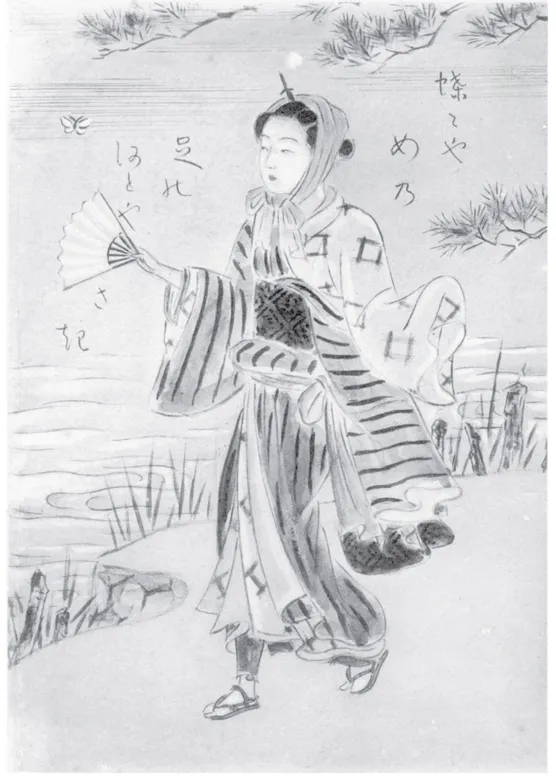
To this belief, and to queer fancies connected with it, there are many allusions in popular drama. For example, there is a well-known play called Tondé-déru-Koch
-no-Kanzashi; or, “The Flying Hairpin of Koch
”. Koch
is a beautiful person who kills herself because of false accusations and cruel treatment. Her would-be avenger long seeks in vain for the author of the wrong. But at last the dead woman’s hairpin turns into a butterfly, and serves as a guide to vengeance by hovering above the place whe...
Table of contents
Title Page
Copyright Page
Introduction
Table of Contents
Preface
KWAIDAN
OSHIDORI
THE STORY OF O-TEI
UBAZAKURA
DIPLOMACY
OF A MIRROR AND A BELL
JIKININKI
MUJINA
ROKURO-KUBI
A DEAD SECRET
YUKI–ONNA
THE STORY OF AOYAGI
JIU-ROKU-ZAKURA
THE DREAM OF AKINOSUKÉ
RIKI-BAKA
HI-MAWARI
HRAI
INSECT STUDIES - BUTTERFLIES
MOSQUITOES
ANTS
Trusted by 375,005 students
Access to over 1.5 million titles for a fair monthly price.
Study more efficiently using our study tools.
Frequently asked questions
Yes, you can cancel anytime from the Subscription tab in your account settings on the Perlego website. Your subscription will stay active until the end of your current billing period. Learn how to cancel your subscription
No, books cannot be downloaded as external files, such as PDFs, for use outside of Perlego. However, you can download books within the Perlego app for offline reading on mobile or tablet. Learn how to download books offline
Perlego offers two plans: Essential and Complete
Essential is ideal for learners and professionals who enjoy exploring a wide range of subjects. Access the Essential Library with 800,000+ trusted titles and best-sellers across business, personal growth, and the humanities. Includes unlimited reading time and Standard Read Aloud voice.
Complete: Perfect for advanced learners and researchers needing full, unrestricted access. Unlock 1.5M+ books across hundreds of subjects, including academic and specialized titles. The Complete Plan also includes advanced features like Premium Read Aloud and Research Assistant.
Both plans are available with monthly, semester, or annual billing cycles.
We are an online textbook subscription service, where you can get access to an entire online library for less than the price of a single book per month. With over 1.5 million books across 990+ topics, we’ve got you covered! Learn about our mission
Look out for the read-aloud symbol on your next book to see if you can listen to it. The read-aloud tool reads text aloud for you, highlighting the text as it is being read. You can pause it, speed it up and slow it down. Learn more about Read Aloud
Yes! You can use the Perlego app on both iOS and Android devices to read anytime, anywhere — even offline. Perfect for commutes or when you’re on the go. Please note we cannot support devices running on iOS 13 and Android 7 or earlier. Learn more about using the app
Yes, you can access Kwaidan by Lafcadio Hearn,Yasumasa Fujita, Yasumasa Fujita, Oscar Lewis in PDF and/or ePUB format, as well as other popular books in Literature & Classics. We have over 1.5 million books available in our catalogue for you to explore.