"A moving story of action — direct, forceful, and plain-spoken.…It would be difficult to overestimate the importance of this autobiography." — Saturday Review of Literature.
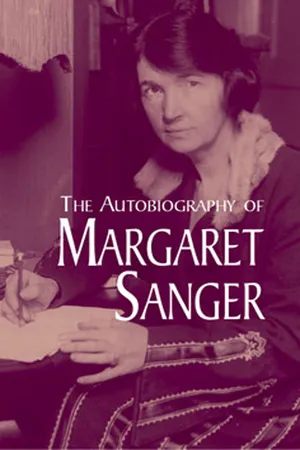
While working as a nurse amid the squalor of New York's Lower East Side in the early twentieth century, Margaret Sanger witnessed the devastating effects of unwanted pregnancies. Women already overwhelmed by the burdens of poverty had no recourse; their doctors were either ignorant of effective methods of birth control or were unwilling to risk defying the law.
Sanger resolved to dedicate her life to establishing birth control as a basic human right. Her battles brought a world of troubles — arrest, indictment, and exile among them — but ultimately she triumphed, opening the first American birth control clinic in 1916 and serving as the first president of the International Planned Parenthood Federation in 1953.
A fascinating firsthand account of an early crusade for women's healthcare, this autobiography is a classic of women's studies and social reform.
- 512 pages
- English
- ePUB (mobile friendly)
- Available on iOS & Android
eBook - ePub
The Autobiography of Margaret Sanger
About this book
Information
Chapter One
FROM WHICH I SPRING
“ ‘Where shall I begin, please your Majesty?’ he asked. ‘Begin at the beginning,’ the King said, very gravely, ‘and go on till you come to the end: then stop.’ ”
LEWIS CARROLL
THE streets of Corning, New York, where I was born, climb right up from the Chemung River, which cuts the town in two; the people who live there have floppy knees from going up and down. When I was a little girl the oaks and the pines met the stone walks at the top of the hill, and there in the woods my father built his house, hoping mother’s “congestion of the lungs” would be helped if she could breathe the pure, balsam-laden air.
My mother, Anne Purcell, always had a cough, and when she braced herself against the wall the conversation, which was forever echoing from room to room, had to stop until she recovered. She was slender and straight as an arrow, with head well set on sloping shoulders, black, wavy hair, skin white and spotless, and with wide-apart eyes, gray-green, flecked with amber. Her family had been Irish as far back as she could trace; the strain of the Norman conquerors had run true throughout the generations, and may have accounted for her unfaltering courage.
Mother’s sensitivity to beauty found some of its expression in flowers. We had no money with which to buy them, and she had no time to grow them, but the woods and fields were our garden. I can never remember sitting at a table not brightened with blossoms; from the first spring arbutus to the last goldenrod of autumn we had an abundance.
Although this was the Victorian Age, our home was almost free from Victorianism. Father himself had made our furniture. He had even cut and polished the slab of the big “marble-topped table,” as it was always called. Only in the spare room stood a piece bought at a store—a varnished washstand. The things you made yourself were not considered quite good enough for guests. Sometimes father’s visitors were doctors, teachers, or perhaps the village priest, but mostly they were the artisans of the community—cabinet makers, masons, carpenters who admired his ideas as well as shared his passion for hunting. In between tramping the woods and talking they had helped to frame and roof the house, working after hours to do this.
Father, Michael Hennessy Higgins, born in Ireland, was a nonconformist through and through. All other men had beards or mustaches—not he. His bright red mane, worn much too long according to the family, swept back from his massive brow; he would not clip it short as most fathers did. Actually it suited his finely-modeled head. He was nearly six feet tall and hard-muscled; his keen blue eyes were set off by pinkish, freckled skin. Homily and humor rippled unceasingly from his generous mouth in a brogue which he never lost. The jokes with which he punctuated every story were picked up, retold, and scattered about. When I was little they were beyond me, but I could hear my elders laughing.
The scar on father’s forehead was his badge of war service. When Lincoln had called for volunteers against the rebellious South, he had taken his only possessions, a gold watch inherited from his grandfather and his own father’s legacy of three hundred dollars, and had run away from his home in Canada to enlist. But he had been told he was not old enough, and was obliged to wait impatiently a year and a half until, on his fifteenth birthday, he had joined the Twelfth New York Volunteer Cavalry as a drummer boy.
One of father’s adventures had been the capture of a Confederate captain on a fine mule, the latter being counted the more valuable acquisition to the regiment. We were brought up in the tradition that he had been one of three men selected by Sherman for bravery. That made us very proud of him. Better not start anything with father; he could beat anybody! But he himself had been appalled by the brutalities of war; never thereafter was he interested in fighting, unless perhaps his Irish sportsmanship cropped out when two well-matched dogs were set against each other.
Immediately upon leaving the Army father had studied anatomy, medicine, and phrenology, but these had been merely for perfecting his skill in modeling. He made his living by chiseling angels and saints out of huge blocks of white marble or gray granite for tombstones in cemeteries. He was a philosopher, a rebel, and an artist, none of which was calculated to produce wealth. Our existence was like that of any artist’s family—chickens today and feathers tomorrow.
Christmases were on the poverty line. If any of us needed a new winter overcoat or pair of overshoes, these constituted our presents. I was the youngest of six, but after me others kept coming until we were eleven. Our dolls were babies—living, wriggling bodies to bathe and dress instead of lifeless faces that never cried or slept. A pine beside the door was our Christmas tree. Father liked us to use natural things and we had to rely upon ingenuity rather than the village stores, so we decorated it with white popcorn and red cranberries which we strung ourselves. Our most valuable gift was that of imagination.
We had little time for recreation. School was five miles away and we had to walk back and forth twice a day as well as perform household duties. The boys milked the cow, tended the chickens, and took care of Tom, the old white horse which pulled our sleigh up and down the hill. The girls helped put the younger children to bed, mended clothes, set the table, cleaned the vegetables, and washed the dishes. We accepted all this with no sense of deprivation or aggrievement, being, if anything, proud of sharing responsibility.
And we made the most of our vacations. There were so many of us that we did not have to depend upon outsiders, and Saturday afternoons used to put on plays by ourselves in the barn. Ordinarily we were shy about displaying emotions; we looked upon tears and temper in other homes with shocked amazement as signs of ill-breeding. Play-acting, however, was something else again. Here we could find outlet for histrionic talent and win admiration instead of lifted eyebrows. I rather fancied myself as an actress, and often mimicked some of the local characters, to the apparent pleasure of my limited audience of family and neighbors. It was not long before I slipped into declaiming. The Lady of Lyons was one of my specialties:
This is thy palace, where the perfumed light
Steals through the mist of alabaster lamps,
And every air is heavy with the sighs
Of orange groves, and music from the sweet lutes
And murmurs of low fountains, that gush forth
I’ the midst of roses!
Steals through the mist of alabaster lamps,
And every air is heavy with the sighs
Of orange groves, and music from the sweet lutes
And murmurs of low fountains, that gush forth
I’ the midst of roses!
All outdoors was our playground, but I was not conscious at the time of my love for the country. Things in childhood change perspective. What was taken for granted then assumes great significance in later life. I knew how the oak tree grew and where the white and yellow violets could be found, and with a slight feeling of superiority I showed and expounded these mysteries to town children. Not until pavements were my paths did I realize how much a part of me the country was, and how I missed it.
We were all, brothers and sisters alike, healthy and strong, vigorous and active; our appetites were curtailed only through necessity. We played the same games together and shared the same sports—baseball, skating, swimming, hunting. Nevertheless, except that we all had red hair, shading from carrot to bronze, we were sharply distinct physically. The girls were small and feminine, the boys husky and brawny. When I went out into the world and observed men, otherwise admirable, who could not pound a nail or use a saw, pick, shovel, or ax, I was dumfounded. I had always taken for granted that any man could make things with his hands.
I expected this even of women. My oldest sister, Mary, possessed, more than the rest of us, an innate charm and gentleness. She could do anything along domestic lines—embroidery, dress making, tailoring, cooking; she could concoct the most delicious and unusual foods, and mix delicate pastries. But she was also an expert at upholstering, carpentry, painting, roofing with shingles or with thatch. When Mary was in the house, we never had to send for a plumber. She rode gracefully and handled the reins from the carriage seat with equal dexterity; she could milk a cow and deliver a baby; neighbors called her to tend their sick cattle, or, when death came, to lay out the body; she tutored in mathematics and Latin, and was well-read in the classics, yet she liked most the theater, and was a dramatic critic whose judgment was often sought. In all that she did her sweetness and dearness were apparent, though she performed her many kindnesses in secret. She left the home roof while I was still a child, but she never failed to send Christmas boxes in which every member of the family shared, each gift beautifully wrapped and decorated with ribbons and cards.
My brothers were ardent sportsmen, although they might not have been outstanding scholars. They could use their fists and were as good shots as their father. For that matter, we all knew how to shoot; any normal person could manage a gun. Father was a great hunter. Our best times were when friends of his came to spend the night, talking late, starting early the next morning for the heavy woods which were full of foxes, rabbits, partridge, quail, and pheasant.
Someone was always cleaning and oiling a gun in the kitchen or carrying food to the kennels. The boys were devoted to their fox and rabbit hounds, but father lavished his affection on bird dogs. Our favorite came to us unsought, unbought, and I had a prideful part in his joining the family. One afternoon I was sitting alone by the nameless brook which ran by our house, clear and cool, deep enough in some places to take little swims on hot summer days. I was engaged in pinning together with thorns a wreath of leaves to adorn my head when a large, white dog ambled up, sniffed, wagged his tail, and seemed to want to belong. This was no ordinary cur, but a well-bred English setter which had evidently been lost. How father would love him!
Even though the dog had no collar, I was slightly uneasy as to my right of ownership. One conspicuous brown-red spot on the back of his neck simplified my problem. Unobtrusively I slipped him into the barn, tied him up, selected a brush, dipped it in one of the cans of paint always on hand, and multiplied the one spot by ten. For a day, waiting for them to dry, I fed him well with food filched from the rations of the other kennel occupants, then led him forth, his hairy dots stiffened with paint, and offered him to father as a special present.
Accepting the gift in the spirit in which it was intended, father admired the dog’s points, and, with an unmistakable twinkle, lent himself to a deception which, of course, could deceive nobody. When Saturday night came, the neighborhood looked the animal over; none knew him so we named him Toss and admitted him to the house. Later he bred with an Irish setter of no importance, and one of the resultant puppies, Beauty, shared his privileges.
Toss, as well as everybody else, subscribed to the idea that the “artist” in father must be catered to. With the first sound of his clearing his throat in the morning Toss picked up the shoes which had been left out to be cleaned, and carried them one at a time to the bedroom door, then stood wagging his tail, waiting to be patted. Father’s shoes were always polished, his trousers always creased. Every day, even when going to work, he put on spotless white shirts with starched collars and attachable cuffs; these were something of a luxury, because they had to be laundered at home, but they got done somehow.
Father took little or no responsibility for the minute details of the daily tasks. I can see him when he had nothing on hand, laughing and joking or reading poetry. Mother, however, was everlastingly busy sewing, cooking, doing this and that. For so ardent and courageous a woman he must have been trying, and I still wonder at her patience. She loved her children deeply, but no one ever doubted that she idolized her husband, and through the years of her wedded life to her early death never wavered in her constancy. Father’s devotion to mother, though equally profound, never evidenced itself in practical ways.
The relation existing between our parents was unusual for its day; they had the idea of comradeship and not merely loved but liked and respected each other. There was no quarreling or bickering; none of us had to take sides, saying, “Father is right,” or, “Mother is right.” We knew that if we pleased one we pleased the other, and such an atmosphere leaves its mark; we felt secure from emotional uncertainty, and were ourselves guided towards certainty in our future. We were all friends together, though not in the modern sense of familiarity. A little dignity and formality were always maintained and we were invariably addressed by our full names. The century of the child had not yet been ushered in.
In those days young people, unless invited to speak, were seen and not heard. But as soon as father considered us old enough to have ideas or opinions, we were given full scope to express them, no matter how adolescent. He hated the slavery of pattern and following of examples and believed in the equality of the sexes; not only did he come out strongly for woman suffrage in the wake of Susan B. Anthony, but he advocated Mrs. Bloomer’s bloomers as attire for women, though his wife and daughters never wore them. He fought for free libraries, free education, free books in the public schools, and freedom of the mind from dogma and cant. Sitting comfortably with his feet on the table he used to say, “You should give something back to your country because you as a child were rocked in the cradle of liberty and nursed at the breast of the goddess of truth.” Father always talked like that.
Although the first Socialist in the community, father also took single tax in his stride and became the champion and friend of Henry George. Progress and Poverty was one of the latest additions to our meager bookshelf. He laughed and rejoiced when he came upon what to him were meaty sentences, reading them aloud to mother, who accepted them as fine because he said they were fine. The rest of us all had to plow through the book in order, as he said, to “elevate the mind.” To me it still remains one of the dullest ever written.
Mother’s loyalty to father was tested repeatedly. Hers were the responsibilities of feeding and clothing and managing on his income, combined with the earnings of the oldest children. But father’s generosity took no cognizance of fact. Once he was asked to buy a dozen bananas for supper. Instead, he purchased a stalk of fifteen dozen, and on his way home gave every single one to schoolboys and girls playing at recess. On another occasion he showed up with eight of a neighbor’s children; the ninth had been quarantined for diphtheria. They lived with us for two months, crowded into our beds, tucked in between us at the table. Mother welcomed them as she did his other guests. The house was always open. She was not so much social-minded as inherently hospitable. But with her frail body and slim pocketbook, it took courage to smile.
Once only that I can remember did mother’s patience give way. That was when father invaded her realm too drastically and invited Henry George to lecture at the leading hotel—with banquet thrown in. From the money saved for the winter coal he had taken enough to entertain fifty men whose children were well-fed and well-clothed. This was the sole time I ever knew my parents to be at odds, though even then I heard no quarreling words. Whatever happened between them I was not sure, but father spent several days wooing back the smile and light to her eyes.
After Henry George’s visit we had to go without coal most of the winter.
With more pleasure than Progress and Poverty I recall a History of the World, Lalla Rookh, Gulliver’s Travels, and Aesop’s Fables. The last-named touched a sympathetic, philosophical chord in father. “Wolf! Wolf!” and “Sour Grapes” were often used to exemplify the trifling imperfections to which all human beings were subject. For his parables he drew also on the Bible, the most enormous volume you ever laid eyes on, brass bound, with heavy clasps, which was the repository of the family statistics; every birth, marriage, death was entered there. The handbooks to father’s work were the physiologies, one of which was combined with a materia medica. These were especially attractive to me, perhaps because they were illustrated with vivid plates, mostly red and blue, and described the fascinating, unknown interior of the human body.
Neighbors were constantly coming to father for help. “What do you think is the matter with this child?” Even without a thermometer he could tell by feeling the skin whether you were feverish. He prescribed bismuth if the diagnosis were “summer complaint,” castor oil if you had eaten something which had disagreed with you, and always sulphur and molasses in the spring “to clean the blood.”
Father’s cure-all was whiskey—“good whiskey,” which “liberated the spirit.” There was nothing from a deranged system to a depressed mind that it could not fix up. He never drank alone, but no masculine guest ever entered the door or sat down to pass the time of day without his producing the bottle. “Have a little shtimulant?”
The chief value of whiskey to father, however, was medicinal. If mumps turned into a large, ugly abscess, he put the blade of his jackknife in the fire, lanced the gland, and cleaned the wound with whiskey—good whiskey. When my face was swollen with erysipelas, he painted it morning, afternoon, and evening with tincture of iodine ; the doctor had so ordered. I was held firmly in place each time this torture was inflicted, and, as soon as released, jumped and ran screaming and howling into the cellar, where I plunged my burning face into a pan of cool buttermilk until the pain subsided. This went on for several days, and I was growing exhausted from the dreaded iodine. Finally father decided to abandon the treatment and substitute good whiskey. Then I recovered.
As necessary to father as the physiologies was a book by the famous phrenologist, Orson Fowler, under whom he had studied. Father believed implicitly that the head was the sculptured expression of the soul. Straight or slanting eyes, a ridge between them, a turned-up nose, full lips, bulges in front of or behind the ears—all these traits had definite meaning for him. A research worker had to be inquisitive, a seeker with more than normal curiosity-bumps ; a musician had to have order and time over the eyebrows; a pugilist could not be made but had to have the proper protuberances around the ears.
One of father’s phrases was, “Nature is the perfect sculptor; she is never wrong. If you seem to have made a mistake in reading, it is because you have not read correctly.” He himself seldom made a mistake, and his reputation spread far and wide. Young men in confusion of mind and the customary puzzled, pre-graduation state came from Cornell and other colleges to consult him about their careers. He examined heads and faces, told them where he thought their true vocations lay, and supplemented this advice later with voluminous interested correspondence. I could not help picking up his principles and some of his ardor, though I have never been able to analyze character so well. No amount of front or salesmanship could divert him, whereas I have often been taken in by a person’s self-confidence and estimation of himself.
In the predominantly Roman Catholic community of Corning, set crosses in the cemeteries wer...
Table of contents
- Title Page
- Copyright Page
- Dedication
- ACKNOWLEDGMENTS
- Table of Contents
- Chapter One - FROM WHICH I SPRING
- Chapter Two - BLIND GERM OF DAYS TO BE
- Chapter Three - BOOKS ARE THE COMPASSES
- Chapter Four - DARKNESS THERE AND NOTHING MORE
- Chapter Five - CORALS TO CUT LIFE UPON
- Chapter Six - FANATICS OF THEIR PURE IDEALS
- Chapter Seven - THE TURBID EBB AND FLOW OF MISERY
- Chapter Eight - I HAVE PROMISES TO KEEP
- Chapter Nine - THE WOMAN REBEL
- Chapter Ten - WE SPEAK THE SAME GOOD TONGUE
- Chapter Eleven - HAVELOCK ELLIS
- Chapter Twelve - STORK OVER HOLLAND
- Chapter Thirteen - THE PEASANTS ARE KINGS
- Chapter Fourteen - O, TO BE IN ENGLAND
- Chapter Fifteen - HIGH HANGS THE GAUNTLET
- Chapter Sixteen - HEAR ME FOR MY CAUSE
- Chapter Seventeen - FAITH I HAVE BEEN A TRUANT IN THE LAW
- Chapter Eighteen - LEAN HUNGER AND GREEN THIRST
- Chapter Nineteen - THIS PRISON WHERE I LIVE
- Chapter Twenty - A STOUT HEART TO A STEEP HILL
- Chapter Twenty-one - THUS TO REVISIT
- Chapter Twenty-two - DO YE HEAR THE CHILDREN WEEPING?
- Chapter Twenty-three - IN TIME WE ONLY CAN BEGIN
- Chapter Twenty-four - LAWS WERE LIKE COBWEBS
- Chapter Twenty-five - ALIEN STARS ARISE
- Chapter Twenty-six - THE EAST IS BLOSSOMING
- Chapter Twenty-seven - ANCIENTS OF THE EARTH
- Chapter Twenty-eight - THE WORLD IS MUCH THE SAME EVERYWHERE
- Chapter Twenty-nine - WHILE THE DOCTORS CONSULT
- Chapter Thirty - NOW IS THE TIME FOR CONVERSE
- Chapter Thirty-one - GREAT HEIGHTS ARE HAZARDOUS
- Chapter Thirty-two - CHANGE IS HOPEFULLY BEGUN
- Chapter Thirty-three - OLD FATHER ANTIC, THE LAW
- Chapter Thirty-four - SENATORS, BE NOT AFFRIGHTED
- Chapter Thirty-five - A PAST WHICH IS GONE FOREVER
- Chapter Thirty-six - FAITH IS A FINE INVENTION
- Chapter Thirty-seven - WHO CAN TAKE A DREAM FOR TRUTH?
- Chapter Thirty-eight - DEPTH BUT NOT TUMULT
- Chapter Thirty-nine - SLOW GROWS THE SPLENDID PATTERN
- INDEX
- A CATALOG OF SELECTED DOVER BOOKS IN ALL FIELDS OF INTEREST
- A CATALOG OF SELECTED DOVER BOOKS IN ALL FIELDS OF INTEREST
Trusted by 375,005 students
Access to over 1.5 million titles for a fair monthly price.
Study more efficiently using our study tools.
Frequently asked questions
Yes, you can cancel anytime from the Subscription tab in your account settings on the Perlego website. Your subscription will stay active until the end of your current billing period. Learn how to cancel your subscription
No, books cannot be downloaded as external files, such as PDFs, for use outside of Perlego. However, you can download books within the Perlego app for offline reading on mobile or tablet. Learn how to download books offline
We are an online textbook subscription service, where you can get access to an entire online library for less than the price of a single book per month. With over 1.5 million books across 990+ topics, we’ve got you covered! Learn about our mission
Look out for the read-aloud symbol on your next book to see if you can listen to it. The read-aloud tool reads text aloud for you, highlighting the text as it is being read. You can pause it, speed it up and slow it down. Learn more about Read Aloud
Yes! You can use the Perlego app on both iOS and Android devices to read anytime, anywhere — even offline. Perfect for commutes or when you’re on the go.
Please note we cannot support devices running on iOS 13 and Android 7 or earlier. Learn more about using the app
Please note we cannot support devices running on iOS 13 and Android 7 or earlier. Learn more about using the app
Yes, you can access The Autobiography of Margaret Sanger by Margaret Sanger in PDF and/or ePUB format, as well as other popular books in Social Sciences & Gender Studies. We have over 1.5 million books available in our catalogue for you to explore.