Intended to convert religiously indifferent readers to Christianity, Pascal's Pensees were published posthumously to wide and ongoing acclaim. This selection of highlights from the Pensees focuses on their most secular aspects, including extensive coverage of the author's sensitive examination of human psychology and his much-appreciated epigrams. Pascal's Provincial Letters, written in 1656 and 1657 in support of the Jansenist cause, captivated a large audience (including opponents of the cause) with their satirical wit, righteous indignation, and effervescent style. This is the only dual-language edition available.
eBook - ePub
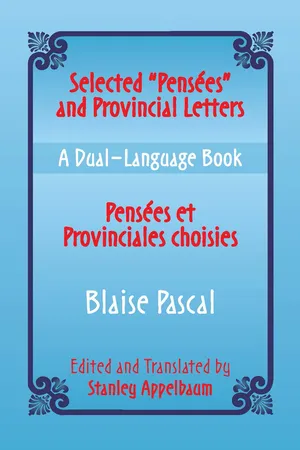
Selected "Pensees" and Provincial Letters/Pensees et Provinciales choisies
A Dual-Language Book
- 224 pages
- English
- ePUB (mobile friendly)
- Available on iOS & Android
eBook - ePub
Selected "Pensees" and Provincial Letters/Pensees et Provinciales choisies
A Dual-Language Book
About this book
Information
PENSÉES
La puissance des mouches, elles gagnent des batailles, empêchent notre âme d’agir, mangent notre corps. [LG 20, B 367, L 22]
La coutume de voir les rois accompagnés de gardes, de tambours, d’officiers et de toutes les choses qui ploient la machine vers le respect et la terreur font que leur visage, quand il est quelquefois seul et sans ses accompagnements, imprime dans leurs sujets le respect et la terreur parce qu’on ne sépare point dans la pensée leurs personnes d’avec leurs suites qu’on y voit d’ordinaire jointes; et le monde qui ne sait pas que cet effet vient de cette coutume croit qu’il vient d’une force naturelle, et de là viennent ces mots: le caractère de la divinité est empreint sur son visage, etc. [LG 23, B 308, L 25]
On ne choisit pas pour gouverner un vaisseau celui des voyageurs qui est de la meilleure maison. [LG 28, B 320, L 30]
Les villes par où on passe, on ne se soucie pas d’y être estimé. Mais quand on y doit demeurer un peu de temps, on s’en soucie. Combien de temps faut-il? Un temps proportionné à notre durée vaine et chétive. [LG 29, B 149, L 31]
Ce qui m’étonne le plus est de voir que tout le monde n’est pas étonné de sa faiblesse. On agit sérieusement et chacun suit sa condition, non pas parce qu’il est bon en effet de la suivre puisque la mode en est, mais comme si chacun savait certainement où est la raison et la justice. On se trouve déçu à toute heure, et par une plaisante humilité on croit que c’est sa faute et non pas celle de l’art qu’on se vante toujours d’avoir. Mais il est bon qu’il y ait tant de ces gens-là au monde qui ne soient pas pyrrhoniens pour la gloire du pyrrhonisme, afin de montrer que l’homme est bien capable des plus extravagantes opinions puisqu’il est capable de croire qu’il n’est pas dans cette faiblesse naturelle et inévitable et de croire qu’il est au contraire dans la sagesse naturelle.
PENSÉES (THOUGHTS)
The power of flying insects: they win battles, they prevent our soul from performing its duties, they eat our body.
The habit of seeing kings accompanied by guards, drummers, officers, and all those things which incline the automaton within us toward respect and terror, makes their mere face, when it sometimes appears alone without its accompaniments, instill respect and terror in their subjects, because their persons are not distinguished in the viewer’s mind from the retinue with which they are usually associated; and the general public, unaware that this is a result of habit, thinks that it emanates from some natural force; hence those expressions: “the stamp of divinity is imprinted on his face,” and the like.
One does not choose as master of a vessel the man among the passengers who comes from the most distinguished family.
When you are merely passing through a town, you aren’t concerned about being esteemed there. But when you are to live there for some time, that does concern you. How much time must be involved? An amount in ratio to the length of our vain, puny existence.
What amazes me most is to see that everyone isn’t amazed at his own debility. People go about their tasks seriously, each one in accordance with his walk in life, not because it’s actually good to do so (seeing that that’s the fashion), but as if each one knew for a fact where reason and justice lie. They are constantly disappointed, and out of a comical hu mility they think it’s their fault and not the fault of the skills they always boast of possessing. But it’s a good thing that there are so many such people in the world who aren’t Pyrrhonists53 for the glory of Pyrrhonism, in order to show that man is quite capable of the most outlandish opinions, being capable of believing that he isn’t so inevitably feeble by nature, and of believing that, on the contrary, he possesses natural wisdom.
53. Hardened skeptics in the areas of morality, epistemology, etc. The name is derived from the Greek philosopher Pyrrho (ca. 300 B.C.), whose actual thought was more specific than this.
Rien ne fortifie plus le pyrrhonisme que ce qu’il y en a qui ne sont point pyrrhoniens. Si tous l’étaient, ils auraient tort. Cette secte se fortifie par ses ennemis plus que par ses amis car la faiblesse de l’homme paraît bien davantage en ceux qui ne la connaissent pas qu’en ceux qui la connaissent. [LG 31, B 374 & 376, L 33 & 34]
Qui ne voit pas la vanité du monde est bien vain lui-même. Aussi qui ne la voit excepté de jeunes gens qui sont tous dans le bruit, dans le divertissement et dans la pensée de l’avenir? Mais ôtez leur divertissement, vous les verrez se sécher d’ennui. Ils sentent alors leur néant sans le connaître, car c’est bien être malheureux que d’être dans une tristesse insupportable aussitôt qu’on est réduit à se considérer, et à n’en être point diverti. [LG 33, B 164, L 36]
Quelle vanité que la peinture qui attire l’admiration pour la ressemblance des choses dont on n’admire point les originaux! [LG 37, B 134, L 40]
Peu de chose nous console parce que peu de chose nous afflige. [LG 40, B 136, L 43]
Imagination.
C’est cette partie dominante dans l’homme, cette maîtresse d’erreur et de fausseté, et d’autant plus fourbe qu’elle ne l’est pas toujours, car elle serait règle infaillible de vérité si elle l’était infaillible du mensonge. Mais étant le plus souvent fausse, elle ne donne aucune marque de sa qualité, marquant du même caractère le vrai et le faux. Je ne parle pas des fous, je parle des plus sages, et c’est parmi eux que l’imagination a le grand droit de persuader les hommes. La raison a beau crier, elle ne peut mettre le prix aux choses.
Nothing strengthens Pyrrhonism more than the fact that people exist who aren’t Pyrrhonists. If everyone was one, they’d be wrong. That sect is strengthened more by its enemies than by its friends, because the debility of man is much more evident in those unaware of it than in those who are aware.
Anyone who doesn’t see the vanity of the world is vain himself. Besides, who fails to see it except young people, all of whom are embroiled in noise, distractions, and thoughts of the future? But take away their distractions and you’ll see them wither away with boredom. Then they sense their nothingness without actually knowing it, because it’s quite unfortunate to suffer unbearable sorrow the minute you’re forced to contemplate yourself and not be at all entertained at the thought.
What a vanity painting is! It induces admiration for its lifelike rendering of things, the originals of which are not at all admired!
A trifle comforts us because a trifle saddens us.
Imagination.
It’s that dominant element in man, that mistress of error and falsehood, all the more cunning because it isn’t always cunning, since it would be an infallible indicator of truth if it were an infallible indicator of lies. But, being false most of the time, it gives no sign of its quality, stamping the true and the false with the same mark. I’m not talking about madmen, I’m talking about the wisest of us, and it’s among them that imagination has the extensive right to persuade others. Reason calls out in vain, it’s unable to set a value on things.
Cette superbe puissance ennemie de la raison, qui se plaît à la contrôler et à la dominer, pour montrer combien elle peut en toutes choses, a établi dans l’homme une seconde nature. Elle a ses heureux, ses malheureux, ses sains, ses malades, ses riches, ses pauvres. Elle fait croire, douter, nier la raison. Elle suspend les sens, elle les fait sentir. Elle a ses fous et ses sages. Et rien ne nous dépite davantage que de voir qu’elle remplit ses hôtes d’une satisfaction bien autrement pleine et entière que la raison. Les habiles par imagination se plaisent tout autrement à eux-mêmes que les prudents ne se peuvent raisonnablement plaire. Ils regardent les gens avec empire. Ils disputent avec hardiesse et confiance, les autres avec crainte et défiance, et cette gaîté de visage leur donne souvent l’avantage dans l’opinion des écoutants, tant les sages imaginaires ont de faveur auprès des juges de même nature. Elle ne peut rendre sages les fous, mais elle les rend heureux, à l’envi de la raison qui ne peut rendre ses amis que misérables, l’une le couvrant de gloire, l’autre de honte.
Qui dispense la réputation, qui donne le respect et la vénération aux personnes, aux ouvrages, aux lois, aux grands, sinon cette faculté imaginante? Toutes les richesses de la terre insuffisantes sans son consentement. Ne diriez-vous pas que ce magistrat dont la vieillesse vénérable impose le respect à tout un peuple se gouverne par une raison pure et sublime, et qu’il juge des choses dans leur nature sans s’arrêter à ces vaines circonstances qui ne blessent que l’imagination des faibles? Voyez-le entrer dans un sermon où il apporte un zèle tout dévot, renforçant la solidité de sa raison par l’ardeur de sa charité; le voilà prêt à l’ouïr avec un respect exemplaire. Que le prédicateur vienne à paraître, si la nature lui a donné une voix enrouée et un tour de visage bizarre, que son barbier l’ait mal rasé, si le hasard l’a encore barbouillé de surcroît, quelques grandes vérités qu’il annonce, je parie la perte de la gravité de notre sénateur.
Le plus grand philosophe du monde sur une planche plus large qu’il ne faut, s’il y a au-dessous un précipice, quoique sa raison le convainque de sa sûreté, son imagination prévaudra. Plusieurs n’en sauraient soutenir la pensée sans pâlir et suer.
Je ne veux pas rapporter tous ses effets. Qui ne sait que la vue des chats, des rats, l’écrasement d’un charbon, etc., emportent la raison hors des gonds? Le ton de voix impose aux plus sages et change un discours et un poème de force. L’affection ou la haine changent la justice de face et combien un avocat bien payé par avance trouve-t-il plus juste la cause qu’il plaide! Combien son geste hardi la fait-il paraître meilleure aux juges dupés par cette apparence! Plaisante raison qu’un vent manie et à tout sens. Je rapporterais presque toutes les actions des hommes qui ne branlent presque que par ses secousses. Car la raison a été obligée de céder, et la plus sage prend pour ses principes ceux que l’imagination des hommes a témérairement introduits en chaque lieu.
This haughty power, inimical to reason and delighting in checking and dominating it, has established a second nature in man, to show how capable it is in every area. It has its own happy, unhappy, healthy, sick, rich, and poor adherents. It causes reason to be believed, doubted, denied. It suspends the operation of the senses, it makes them function. It has its madmen and its sages. And nothing vexes us more than to see it filling its guests with a contentment much fuller and more complete than reason does. Those clever in their imagination are much more pleased with themselves than circumspect men can be, relying on reason. They gaze on others imperiously. They argue boldly and confidently, the others fearfully and diffidently, and that cheerfulness of countenance often gives them the advantage in the opinion of listeners, such great favor do the sages of the imagination enjoy among judges of the same nature. It cannot make madmen wise, but it makes them happy, just the opposite of reason, which can only make its friends wretched; one covers its devotee with glory; the other, with shame.
What metes out reputation, what gives people, books, laws, grandees respect and veneration except that faculty of imagination? All the riches of the earth are insufficient without its consent. Wouldn’t you say that the magistrate whose venerable age instills respect in an entire nation is governed by pure, sublime reason, and that he judges of things by their nature without dwelling on those frivolous circumstances which affect only the imagination of the weak? Watch him go to a church sermon, bringing a pious zeal, strengthening the solidity of his reason with the ardor of his Christian charity; watch him ready to hear it with exemplary respect. When the preacher makes his appearance, if nature has given him a hoarse voice and a strange cast of features, if his barber has shaved him badly, if, in addition, his face is accidentally smeared, no matter how powerful the truths he proclaims, I’ll wager that our magistrate loses his gravity.
If the greatest philosopher in the world crosses a precipice, even on a board more than wide enough, his imagination will prevail even though his reason convinces him he’s safe. Many people couldn’t even bear the thought of it without turning pale and sweating.
I don’t wish to cite all its effects. Who is unaware that the sight of cats or rats, the crushing of a coal, etc., can unhinge reason? The tone of one’s voice impresses even the wisest, and alters the force of a speech or a poem. Affection or hatred change the face of justice, and how just a lawyer finds the case he is pleading when he’s been well paid in advance! How his bold gestures make it seem the better case to the judges, who are duped by that display! Comical reason, which is spun in every direction by any breeze! I could cite almost all the actions of men who practically only stir if imagination shakes them. Because reason has been compelled to yield, and the sagest reason adopts as principles those which human imagination has rashly introduced everywhere.
Nos magistrats ont bien connu ce mystère. Leurs robes rouges, leurs hermines dont ils s’emmaillotent en chats-fourrés, les palais où ils jugent, les fleurs de lys, tout cet appareil auguste était fort nécessaire; et si les médecins n’avaient des soutanes et des mules, et que les docteurs n’eussent des bonnets carrés et des robes trop amples de quatre parties, jamais ils n’auraient dupé le monde qui ne peut résister à cette montre si authentique. S’ils avaient la véritable justice et si les médecins avaient le vrai art de guérir, ils n’auraient que faire de bonnets carrés; la majesté de ces sciences serait assez vénérable d’elle-même, mais n’ayant que des sciences imaginaires, il faut qu’ils prennent ces vains instruments qui frappent l’imagination à laquelle ils ont à faire et par là en effet ils s’attirent le respect. Les seuls gens de guerre ne se sont pas déguisés de la sorte parce qu’en effet leur part est plus essentielle: ils s’établissent par la force, les autres par grimace.
C’est ainsi que nos rois n’ont pas recherché ces déguisements. Ils ne se sont pas masqués d’habits extraordinaires pour paraître tels. Mais ils se sont accompagnés de gardes, de balourds. Ces trognes armées qui n’ont de mains et de force que pour eux, les trompettes et les tambours qui marchent au-devant et ces légions qui les environnent font trembler les plus fermes. Ils n’ont pas l’habit, seulement ils ont la force. Il faudrait avoir une raison bien épurée pour regarder comme un autre homme le...
Table of contents
- Cover
- Title Page
- Copyright Page
- Introduction
- Contents
- Les Provinciales / Provincial Letters
- Septième lettre / Seventh Letter
- Neuvième lettre / Ninth Letter
- Onzième lettre / Eleventh Letter
- Pensées
Trusted by 375,005 students
Access to over 1.5 million titles for a fair monthly price.
Study more efficiently using our study tools.
Frequently asked questions
Yes, you can cancel anytime from the Subscription tab in your account settings on the Perlego website. Your subscription will stay active until the end of your current billing period. Learn how to cancel your subscription
No, books cannot be downloaded as external files, such as PDFs, for use outside of Perlego. However, you can download books within the Perlego app for offline reading on mobile or tablet. Learn how to download books offline
Perlego offers two plans: Essential and Complete
- Essential is ideal for learners and professionals who enjoy exploring a wide range of subjects. Access the Essential Library with 800,000+ trusted titles and best-sellers across business, personal growth, and the humanities. Includes unlimited reading time and Standard Read Aloud voice.
- Complete: Perfect for advanced learners and researchers needing full, unrestricted access. Unlock 1.5M+ books across hundreds of subjects, including academic and specialized titles. The Complete Plan also includes advanced features like Premium Read Aloud and Research Assistant.
We are an online textbook subscription service, where you can get access to an entire online library for less than the price of a single book per month. With over 1.5 million books across 990+ topics, we’ve got you covered! Learn about our mission
Look out for the read-aloud symbol on your next book to see if you can listen to it. The read-aloud tool reads text aloud for you, highlighting the text as it is being read. You can pause it, speed it up and slow it down. Learn more about Read Aloud
Yes! You can use the Perlego app on both iOS and Android devices to read anytime, anywhere — even offline. Perfect for commutes or when you’re on the go.
Please note we cannot support devices running on iOS 13 and Android 7 or earlier. Learn more about using the app
Please note we cannot support devices running on iOS 13 and Android 7 or earlier. Learn more about using the app
Yes, you can access Selected "Pensees" and Provincial Letters/Pensees et Provinciales choisies by Blaise Pascal, Stanley Appelbaum in PDF and/or ePUB format, as well as other popular books in Languages & Linguistics & French Language. We have over 1.5 million books available in our catalogue for you to explore.