![]()
CHAPTER I: THE BEGINNING
Myths of Creation
ALTHOUGH the Aryan inhabitants of Northern Europe are supposed by some authorities to have come originally from the plateau of Iran, in the heart of Asia, the climate and scenery of the countries where they finally settled had great influence in shaping their early religious beliefs, as well as in ordering their mode of living.
The grand and rugged landscapes of Northern Europe, the midnight sun, the flashing rays of the aurora borealis, the ocean continually lashing itself into fury against the great cliffs and icebergs of the Arctic Circle, could not but impress the people as vividly as the almost miraculous vegetation, the perpetual light, and the blue seas and skies of their brief summer season. It is no great wonder, therefore, that the Icelanders, for instance, to whom we owe the most perfect records of this belief, fancied in looking about them that the world was originally created from a strange mixture of fire and ice.
Northern mythology is grand and tragical. Its principal theme is the perpetual struggle of the beneficent forces of Nature against the injurious, and hence it is not graceful and idyllic in character, like the religion of the sunny South, where the people could bask in perpetual sunshine, and the fruits of the earth grew ready to their hand.
It was very natural that the dangers incurred in hunting and fishing under these inclement skies, and the suffering entailed by the long cold winters when the sun never shines, made our ancestors contemplate cold and ice as malevolent spirits; and it was with equal reason that they invoked with special fervour the beneficent influences of heat and light.
When questioned concerning the creation of the world, the Northern scalds, or poets, whose songs are preserved in the Eddas and Sagas, declared that in the beginning, when there was as yet no earth, nor sea, nor air, when darkness rested over all, there existed a powerful being called Allfather, whom they dimly conceived as uncreated as well as unseen, and that whatever he willed came to pass.
In the centre of space there was, in the morning of time, a great abyss called Ginnunga-gap, the cleft of clefts, the yawning gulf, whose depths no eye could fathom, as it was enveloped in perpetual twilight. North of this abode was a space or world known as Nifl-heim, the home of mist and darkness, in the centre of which bubbled the exhaustless spring Hvergelmir, the seething cauldron, whose waters supplied twelve great streams known as the Elivagar. As the water of these streams flowed swiftly away from its source and encountered the cold blasts from the yawning gulf, it soon hardened into huge blocks of ice, which rolled downward into the immeasurable depths of the great abyss with a continual roar like thunder.
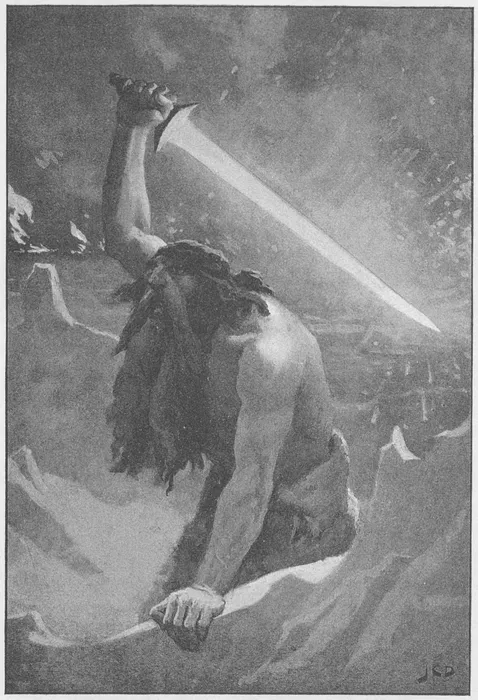
South of this dark chasm, and directly opposite Niflheim, the realm of mist, was another world called Muspells-heim, the home of elemental fire, where all was warmth and brightness, and whose frontiers were continually guarded by Surtr, the flame giant. This giant fiercely brandished his flashing sword, and continually sent forth great showers of sparks, which fell with a hissing sound upon the ice-blocks in the bottom of the abyss, and partly melted them by their heat.
“Great Surtur, with his burning sword,
Southward at Muspel’s gate kept ward,
And flashes of celestial flame,
Life-giving, from the fire-world came.”
Valhalla (J. C. Jones).
The Giant with the Flaming Sword
J. C. Dollman (see page 2)
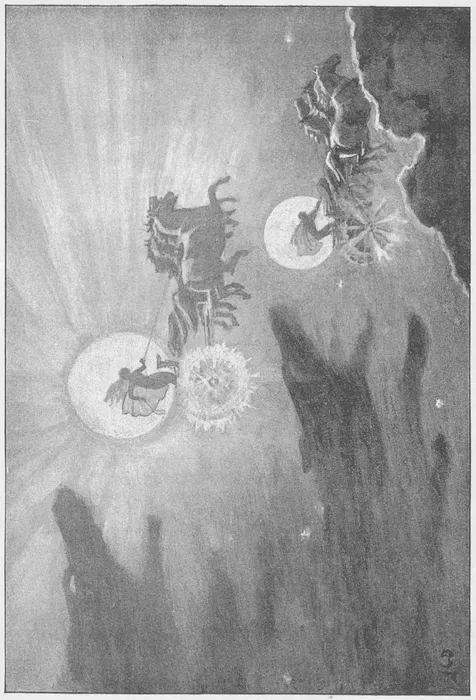
The Wolves pursuing Sol and Mani J. C. Dollman
(see page 8)
Ymir and Audhumla
As the steam rose in clouds it again encountered the prevailing cold, and was changed into rime or hoarfrost, which, layer by layer, filled up the great central space. Thus by the continual action of cold and heat, and also probably by the will of the uncreated and unseen, a gigantic creature called Ymir or Orgelmir (seething clay), the personification of the frozen ocean, came to life amid the ice-blocks in the abyss, and as he was born of rime he was called a Hrim-thurs, or ice-giant.
“ In early times,
When Ymir lived,
Was sand, nor sea,
Nor cooling wave;
No earth was found,
Nor heaven above;
One chaos all,
And nowhere grass.”
Sœmund’s Edda (Henderson’s tr.).
Groping about in the gloom in search of something to eat, Ymir perceived a gigantic cow called Audhumla (the nourisher), which had been created by the same agency as himself, and out of the same materials. Hastening towards her, Ymir noticed with pleasure that from her udder flowed four great streams of milk, which would supply ample nourishment.
All his wants were thus satisfied; but the cow, looking about her for food in her turn, began to lick the salt off a neighbouring ice-block with her rough tongue. This she continued to do until first the hair of a god appeared and then the whole head emerged from its icy envelope, until by-and-by Buri (the producer) stepped forth entirely free.
While the cow had been thus engaged, Ymir, the giant, had fallen asleep, and as he slept a son and daughter were born from the perspiration under his armpit, and his feet produced the six-headed giant Thrudgelmir, who, shortly after his birth, brought forth in his turn the giant Bergelmir, from whom all the evil frost giants are descended.
“ Under the armpit grew,
’Tis said of Hrim-thurs,
A girl and boy together;
Foot with foot begat,
Of that wise Jötun,
A six-headed son.”
Sœmund’s Edda (Thorpe’s tr.).
Odin, Vili, and Ve
When these giants became aware of the existence of the god Buri, and of his son Börr (born), whom he had immediately produced, they began waging war against them, for as the gods and giants represented the opposite forces of good and evil, there was no hope of their living together in peace. The struggle continued evidently for ages, neither party gaining a decided advantage, until Börr married the giantess Bestla, daughter of Bolthorn (the thorn of evil), who bore him three powerful sons, Odin (spirit), Vili (will), and Ve (holy). These three sons immediately joined their father in his struggle against the hostile frost-giants, and finally succeeded in slaying their deadliest foe, the great Ymir. As he sank down lifeless the blood gushed from his wounds in such floods that it produced a great deluge, in which all his race perished, with the exception of Bergelmir, who escaped in a boat and went with his wife to the confines of the world.
“ And all the race of Ymir thou didst drown,
Save one, Bergelmer: he on shipboard fled
Thy deluge, and from him the giants sprang.”
Balder Dead (Matthew Arnold).
Here he took up his abode, calling the place Jötun-heim (the home of the giants), and here he begat a new race of frost-giants, who inherited his dislikes, continued the feud, and were always ready to sally forth from their desolate country and raid the territory of the gods.
The gods, in Northern mythology called Æsir (pillars and supporters of the world), having thus triumphed over their foes, and being no longer engaged in perpetual warfare, now began to look about them, with intent to improve the desolate aspect of things and fashion a habitable world. After due consideration Börr’s sons rolled Ymir’s great corpse into the yawning abyss, and began to create the world out of its various component parts.
The Creation of the Earth
Out of the flesh they fashioned Midgard (middle garden), as the earth was called. This was placed in the exact centre of the vast space, and hedged all round with Ymir’s eyebrows for bulwarks or ramparts. The solid portion of Midgard was surrounded by the giant’s blood or sweat, which formed the ocean, while his bones made the hills, his flat teeth the cliffs, and his curly hair the trees and all vegetation.
Well pleased with the result of their first efforts at creation, the gods now took the giant’s unwieldy skull and poised it skilfully as the vaulted heavens above earth and sea ; then scattering his brains throughout the expanse beneath they fashioned from them the fleecy clouds.
“Of Ymir’s flesh
Was earth created,
Of his blood the sea,
Of his bones the hills,
Of his hair trees and plants,
Of his skull the heavens,
And of his brows
The gentle powers
Formed Midgard for the sons of men ;
But of his brain
The heavy clouds are
All created.”
Norse Mythology (R. B. Anderson).
To support the heavenly vault, the gods stationed the strong dwarfs, Nordri, Sudri, Austri, Westri, at its four corners, bidding them sustain it upon their shoulders, and from them the four points of the compass received their present names of North, South, East, and West. To give light to the world thus created, the gods studded the heavenly vault with sparks secured from Muspells-heim, points of light which shone steadily through the gloom like brilliant stars. The most vivid of these sparks, however, were reserved for the manufacture of the sun and moon, which were placed in beautiful golden chariots.
“And from the flaming world, where Muspel reigns,
Thou sent‘st and fetched’st fire, and madest lights:
Sun, moon, and stars, which thou hast hung in heaven,
Dividing clear the paths of night and day.”
Balder Dead (Matthew Arnold).
When all these preparations had been finished, and the steeds Arvakr (the early waker) and Alsvin (the rapid goer) were harnessed to the sun-chariot, the gods, fearing lest the animals should suffer from their proximity to the ardent sphere, placed under their withers great skins filled with air or with some refrigerant substance. They also fashioned the shield Svalin (the cooler), and placed it in front of the car to shelter them from the sun’s direct rays, which would else have burned them and the earth to a cinder. The moon-car was, similarly, provided with a fleet steed called Alsvider (the all-swift) ; but no shield was required to protect him from the mild rays of the moon.
Mani and Sol
The chariots were ready, the steeds harnessed and impatient to begin what was to be their daily round, but who should guide them along the right road ? The gods looked about them, and their attention was attracted to the two beautiful offspring of the giant Mundilfari. He was very proud of his children, and had named them after the newly created orbs, Mani (the moon) and Sol (the sun). Sol, the Sun-maid, was the spouse of Glaur (glow), who was probably one of Surtr’s sons.
The names proved to be happily bestowed, as the brother and sister were given the direction of the steeds of their bright namesakes. After receiving due counsel from the gods, they were transferred to the sky, and day by day they fulfilled their appointed duties and guided their steeds along the heavenly paths.
“Know that Mundilfær is hight
Father to the moon and sun ;
Age on age shall roll away,
While they mark the months and days.”
Hávamál (W. Taylor’s tr.).
The gods next summoned Nott (night), a daughter of Norvi, one of the giants, and entrusted to her care a dark chariot, drawn by a sable steed, Hrim-faxi (frost mane), from who...