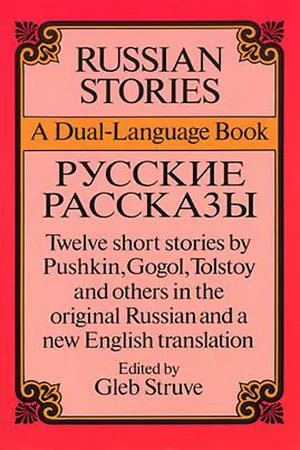
The story, or novella, as a literary genre has a much shorter history in Russia than in some Western countries, but it has nevertheless produced important works by some of the greatest names in Russian literature. This dual-language volume contains 12 such stories — memorable tales by Tolstoy, Dostoevsky, Pushkin, Chekhov, Gogol, Turgenev, Bunin, and other masters. Each selection is presented here in the original Russian with an excellent literal English translation on the facing pages.
Also included are linguistic and cultural notes, a Russian-English vocabulary, study questions and more. In addition, Professor Struve has supplied an enlightening introduction to the Russian short story, as well as concise biographical/critical introductions to each selection. An especially helpful feature for students of Russian is the presence of stress accents in the Russian text, a feature usually found only in primers.
- 416 pages
- English
- ePUB (mobile friendly)
- Available on iOS & Android
eBook - ePub
About this book
Information
Subtopic
LanguesNIKOLAY GOGOL
(1809-1852)
Nikolay Vasilievich Gogol-Yanovsky (he dropped the second half of his family name) was born in the little town of Sorochintsy—it figures in one of his stories on which Mussorgsky based his short comic opera—in the Province of Poltava. His family was Ukrainian (or Little Russian, as Gogol himself would have said) Cossack gentry. His father was a small landowner and an amateur playwright who, unlike his son, wrote in Ukrainian. After studying at the Lyceum of Nezhin, Gogol went to St. Petersburg and entered civil service. Later he taught history at the Young Ladies’ Institute and even at the University of St. Petersburg, though in this latter job he almost immediately proved a failure. He had come to Petersburg with literary ambitions and a long narrative poem in his pocket. Upon its publication, it proved a complete flop: Gogol bought up the copies and destroyed them. Stung by this setback he decided to emigrate to America but went only as far as Lübeck. Befriended and encouraged by Zhukovsky, Pushkin and other writers of their circle, he brought out in 1831 and 1832 the two volumes of Evenings on a Farm Near Dikanka, followed in 1835 by two volumes of Mirgorod and two volumes of Arabesques (which contained his first Petersburg stories). In April 1836 his comedy Revizor (The Government Inspector), which many believe to be the greatest comedy in the Russian language, was produced in Petersburg. It had a mixed reception. Rather in a huff, Gogol left Russia and for the next twelve years lived abroad, in Rome and elsewhere. There he wrote The Overcoat and the first volume of Dead Souls, his greatest work. Gogol’s last years were marked by a profound psychological and religious crisis. Suffice it to mention: the publication of his Selected Passages from a Correspondence with Friends (in 1847), a book of great conceit and yet of undoubted sincerity which incensed even his closest friends and greatest well-wishers; his frantic trip to the Holy Land in quest of spiritual comfort (1848); his subsequent fits of ascetic self-mortification; his burning of his manuscripts, including most of the second volume of Dead Souls (1852). The account of the details of Gogol’s death reads like a grotesque nightmare from one of his own works.
Gogol is one of the most enigmatic and controversial figures in Russian literature, both as a man and as a writer. Belinsky and other social-minded critics extolled him as the father of Russian realism. Thi...
Table of contents
- Cover
- Title Page
- Copyright Page
- Contents
- Foreword
- Alexander Pushkin
- Nikolay Gogol
- Ivan Turgenev
- Fyodor Dostoevsky
- Leo Tolstoy
- Nikolay Leskov
- Anton Chekhov
- Fyodor Sologub
- Ivan Bunin
- Evgeny Zamyatin
- Isaac Babel
- Mikhail Zoshchenko
- Notes
- Questionnaire
- Vocabulary
Trusted by 375,005 students
Access to over 1.5 million titles for a fair monthly price.
Study more efficiently using our study tools.
Frequently asked questions
Yes, you can cancel anytime from the Subscription tab in your account settings on the Perlego website. Your subscription will stay active until the end of your current billing period. Learn how to cancel your subscription
No, books cannot be downloaded as external files, such as PDFs, for use outside of Perlego. However, you can download books within the Perlego app for offline reading on mobile or tablet. Learn how to download books offline
Perlego offers two plans: Essential and Complete
- Essential is ideal for learners and professionals who enjoy exploring a wide range of subjects. Access the Essential Library with 800,000+ trusted titles and best-sellers across business, personal growth, and the humanities. Includes unlimited reading time and Standard Read Aloud voice.
- Complete: Perfect for advanced learners and researchers needing full, unrestricted access. Unlock 1.5M+ books across hundreds of subjects, including academic and specialized titles. The Complete Plan also includes advanced features like Premium Read Aloud and Research Assistant.
We are an online textbook subscription service, where you can get access to an entire online library for less than the price of a single book per month. With over 1.5 million books across 990+ topics, we’ve got you covered! Learn about our mission
Look out for the read-aloud symbol on your next book to see if you can listen to it. The read-aloud tool reads text aloud for you, highlighting the text as it is being read. You can pause it, speed it up and slow it down. Learn more about Read Aloud
Yes! You can use the Perlego app on both iOS and Android devices to read anytime, anywhere — even offline. Perfect for commutes or when you’re on the go.
Please note we cannot support devices running on iOS 13 and Android 7 or earlier. Learn more about using the app
Please note we cannot support devices running on iOS 13 and Android 7 or earlier. Learn more about using the app
Yes, you can access Russian Stories by Gleb Struve in PDF and/or ePUB format, as well as other popular books in Langues et linguistique & Langues. We have over 1.5 million books available in our catalogue for you to explore.