![]()
The Ghost of Sakura
The misfortunes and death of the farmer S
gor
, which, although the preternatural appearances by which they are said to have been followed may raise a smile, are matters of historic notoriety with which every Japanese is familiar, furnish a forcible illustration of the relations which exist between the tenant and the lord of the soil, and of the boundless power for good or for evil exercised by the latter. It is rather remarkable that in a country where the peasant — placed as he is next to the soldier, and before the artisan and merchant, in the four classes into which the people are divided — enjoys no small consideration, and where agriculture is protected by law from the inroads of wild vegetation, even to the lopping of overshadowing branches and the cutting down of hedgerow timber, the lord of the manor should be left practically without control in his dealings with his people.
The land-tax, or rather the yearly rent paid by the tenant, is usually assessed at forty per cent of the produce; but there is no principle clearly defining it, and frequently the landowner and the cultivator divide the proceeds of the harvest in equal shares. Rice land is divided into three classes; and, according to these classes, it is computed that one tan (1,800 square feet) of the best land should yield to the owner a revenue of five bags of rice per annum; each of these bags holds four to (a to is rather less than half an imperial bushel), and is worth at present (1868) three riyos, or about sixteen shillings; land of the middle class should yield a revenue of three or four bags. The rent is paid either in rice or in money, according to the actual price of the grain, which varies considerably. It is due in the eleventh month of the year, when the crops have all been gathered, and their market value fixed.
The rent of land bearing crops other than rice, such as cotton, beans, roots, and so forth, is payable in money during the twelfth month. The choice of the nature of the crops to be grown appears to be left to the tenant.
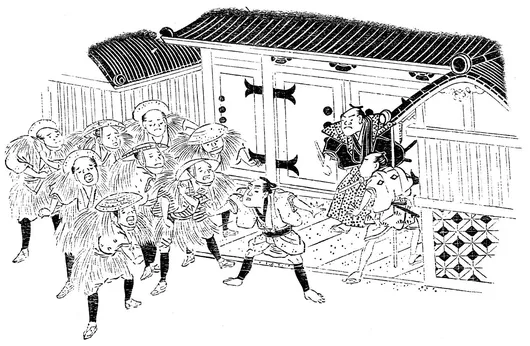
The Japanese landlord, when pressed by poverty, does not confine himself to the raising of his legitimate rents: he can always enforce from his needy tenantry the advancement of a year’s rent, or the loan of so much money as may be required to meet his immediate necessities. Should the lord be just, the peasant is repaid by instalments, with interest, extending over ten or twenty years. But it too often happens that unjust and merciless lords do not repay such loans, but, on the contrary, press for further advances. Then it is that the farmers, dressed in their grass rain-coats, and carrying sickles and bamboo poles in their hands, assemble before the gate of their lord’s palace at the capital, and represent their grievances, imploring the intercession of the retainers, and even of the womankind who may chance to go forth. Sometimes they pay for their temerity by their lives; but, at any rate, they have the satisfaction of bringing shame upon their persecutor, in the eyes of his neighbours and of the populace.
The deputation of peasants at their lord’s gate
The official reports of recent travels in the interior of Japan have fully proved the hard lot with which the peasantry had to put up during the government of the Tycoons, and especially under the Hatamotos, the created nobility of the dynasty. In one province, where the village mayors appear to have seconded the extortions of their lord, they have had to flee before an exasperated population, who, taking advantage of the revolution, laid waste and pillaged their houses, loudly praying for a new and just assessment of the land; while, throughout the country, the farmers have hailed with acclamations the resumption of the sovereign power by the Mikado, and the abolition of the petty nobility who exalted themselves upon the misery of their dependants. Warming themselves in the sunshine of the court at Yedo, the Hatamotos waxed fat and held high revel, and little cared they who groaned or who starved. Money must be found, and it was found.
It is necessary here to add a word respecting the position of the village mayors, who play so important a part in the tale.
The peasants of Japan are ruled by three classes of officials: the Nanushi, or mayor; the Kumigashira, or chiefs of companies; and the Hiyakush
dai, or farmers’ representatives. The village, which is governed by the Nanushi, or mayor, is divided into companies, which, consisting of five families each, are directed by a Kumigashira; these companies, again, are subdivided into groups of five men each, who choose one of their number to represent them in case of their having any petition to present, or any affairs to settle with their superiors. This functionary is the Hiyakush
dai. The mayor, the chief of the company, and the representative keep registers of the families and people under their control, and are responsible for their good and orderly behaviour. They pay taxes like the other farmers, but receive a salary, the amount of which depends upon the size and wealth of the village. Five per cent of the yearly land tax forms the salary of the mayor, and the other officials each receive five per cent of the tax paid by the little bodies over which they re...