This influential 1851 work was written by the French libertarian socialist and journalist whose doctrines later formed the basis for radical and anarchist theory. This is his vision of an ideal society, in which frontiers are abolished, national states eliminated, and authority decentralized among communes or locality associations, with free contracts replacing laws.
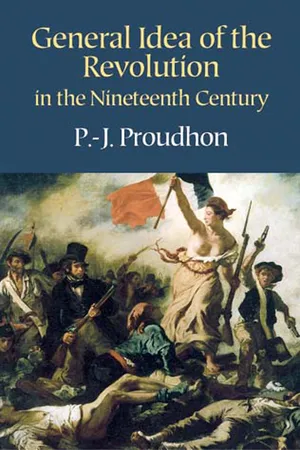
- 304 pages
- English
- ePUB (mobile friendly)
- Available on iOS & Android
eBook - ePub
General Idea of the Revolution in the Nineteenth Century
About this book
Information
GENERAL IDEA OF THE REVOLUTION IN THE NINETEENTH CENTURY.
IN every revolutionary history three things are to be observed:
The preceding state of affairs, which the revolution aims at overthrowing, and which becomes counter-revolution through its desire to maintain its existence.
The various parties which take different views of the revolution, according to their prejudices and interests, yet are compelled to embrace it and to use it for their advantage.
The revolution itself, which constitutes the solution.
The parliamentary, philosophical, and dramatic history of the Revolution of 1848 can already furnish material for volumes. I shall confine myself to discussing disinterestedly certain questions which may illuminate our present knowledge. What I shall say will suffice, I hope, to explain the progress of the Revolution of the Nineteenth Century, and to enable us to conjecture its future.
FIRST STUDY, Reaction causes Revolution.
SECOND STUDY, Is there sufficient reason for a revolution in the Nineteenth Century?
THIRD STUDY, The Principle of Association.
FOURTH STUDY, The Principle of Authority.
FIFTH STUDY, Social Liquidation.
SIXTH STUDY, The Organization of Economic Forces.
SEVENTH STUDY, Dissolution of Government in the Economic Organism.
This is not a statement of facts: it is a speculative plan an intellectual picture of the Revolution.
Fill it in with data of space and time, with dates, names, manifestoes, episodes, harangues, panics, battles, proclamations, manipulations, parliamentary manoeuvres, assassinations, duels, &c. &c., and you will have a flesh and blood Revolution, as described in the pages of Buchez and Michelet.
For the first time the public will be able to judge of the spirit and form of a revolution before it is accomplished: who knows whether our fathers might not have avoided disaster, if they had been able to read in advance their destiny, in a general abstract account of the dangers, the parties and the men.
In this account I shall endeavor as far as possible to adduce facts as proofs. And among facts I shall always choose the simplest and best known: this is the only method by which the Revolution, hitherto a prophetic vision, can become at last a reality.
FIRST STUDY.
Reaction Causes Revolution.
1. The Revolutionary Force.
IT is an opinion generally held nowadays, among men of advanced views as well as among conservatives, that a revolution, boldly attacked at its incipiency, can be stopped, repressed, diverted or perverted; that only two things are needed for this, sagacity and power. One of the most thoughtful writers of today, M. Droz, of the Academie Francaise, has written a special account of the years of the reign of Louis XVI, during which, according to him, the Revolution might have been anticipated and prevented.
And among the revolutionaries of the present, one of the most intelligent, Blanqui, is equally dominated by the idea that, given sufficient strength and skill, Power is able to lead the people whither it chooses, to crush the right, to bring to nought the spirit of revolution. The whole policy of the Tribune of Belle-Isle — I beg his friends to take this characterization of him in good part — as well as that of the Academician, springs from the fear that he has of seeing the Reaction triumph, a fear that I am not afraid to call, in my opinion, ridiculous. Thus the Reaction, the germ of despotism, is in the heart of everybody; it shows itself at the same moment at the two extremes of the political horizon. It is not least among the causes of our troubles.
Stop a revolution! Does not that seem a threat against Providence, a challenge hurled at unbending Destiny, in a word, the greatest absurdity imaginable? Stop matter from falling, flame from burning, the sun from shining!
I shall endeavor to show, by what is passing before our eyes, that just as the instinct for conservatism is inherent in every social institution, the need for revolution is equally irresistible; that every political party may become by turns revolutionary and reactionary; that these two terms, reaction and revolution, correlatives of each other and mutually implying each other, are both essential to Humanity, notwithstanding the conflicts between them: so that, in order to avoid the rocks which menace society on the right and on the left, the only course is for reaction to continually change places with revolution; just the reverse of what the present Legislature boasts of having done. To add to grievances, and, if I may use the comparison, to bottle up revolutionary force by repression, is to condemn oneself to clearing in one bound the distance that prudence counsels us to pass over gradually, and to substitute progress by leaps and jerks for a continuous advance.
Who does not know that the most powerful sovereigns have made themselves illustrious by becoming revolutionaries within the limits of the circumstances wherein they lived? Alexander of Macedon, who reunited Greece, Julius Caesar, who founded the Roman Empire on the ruins of the hypocritical and venal Republic, Clovis, whose conversion was the signal for the definite establishment of Christianity in Gaul, and to a certain extent, the cause of the fusion of the Frankish hordes in the Gallic ocean, Charlemagne, who began the centralization of freeholds, and marked the beginning of feudalism, Louis the Fat, dear to the third estate on account of the favor he extended to the towns, Saint Louis, who organized the corporations of arts and crafts, Louis XI and Richelieu, who completed the defeat of the barons, all performed, in different degrees, acts of revolution. Even the execrable Bartholomew massacre was directed against the lords, rather than against the reformers, in the opinion of the people, agreeing in that respect with Catherine de Medicis. Not until 1614, at the last meeting of the States General, did the French monarchy seem to abjure its function of leadership and betray its tradition; the 21st of January, 17939 was the penalty for its crime.
It would be easy to multiply examples; anybody with the slightest knowledge of history can supply them.
A revolution is a force against which no power, divine or human, can prevail: whose nature it is to be strengthened and to grow by the very resistance which it encounters. A revolution may be directed, moderated, delayed: I have just said that the wisest policy lay in yielding to it, foot by foot, that the perpetual evolution of Humanity may be accomplished insensibly and silently, instead of by mighty strides. A revolution cannot be crushed, cannot be deceived, cannot be perverted, all the more, cannot be conquered. The more you repress it, the more you increase its rebound and render its action irresistible. So much so that it is precisely the same for the triumph of an idea, whether it is persecuted, harassed, beaten down during its beginning, or whether it grows and develops unobstructed. Like the Nemesis of the ancients, whom neither prayers nor threats could move, the revolution advances, with sombre and fatal step, over the flowers cast by its friends, through the blood of its defenders, across the bodies of its enemies.
When the conspiracies came to an end in 182210, some thought that the Restoration had overcome the Revolution. It was at this time, under the Villèle administration, and during his expedition to Spain, that insults were hurled at him. Poor fools! The Revolution had passed away: it was waiting for you in 1830.
When the secret societies were broken up in 1839, after the attacks of Blanqui and Barbès, again the new dynasty was believed to be immortal: it seemed that progress was at its command. The years that followed were the most flourishing of the reign. Nevertheless it was in 1839 that the serious disaffection began, among the business men by the coalition, among the people by the uprising of the 12th of May, which ended in the events of February. Perhaps with more prudence, or with more boldness, the existence of the monarchy, which had become flagrantly reactionary, might have been prolonged a few years: the catastrophe, although delayed, would have been only the more violent.
Following February, we saw the Jacobins, the Girondists, the Bonapartists, the Orleanists, the Legitimists, the Jesuits, all the old parties, I had almost said factions, that had successively opposed the revolution in the past, undertake, by turns, to put down a revolution which they did not even understand. At one time the coalition was complete: I dare not say that the Republican party came out of it well. Let the opposition continue, let it persist: its defeat will be universal. The more the inevitable overthrow is put off, the more must be paid for the delay: that is as elementary in the working-out of revolutions as an axiom in geometry. The Revolution never lets go, for the simple reason that it is never in the wrong.
Every revolution first declares itself as a complaint of the people, an accusation against a vicious state of affairs, which the poorest always feel the first. It is against the nature of the masses to revolt, except against what hurts them, physically or morally. Is this a matter for repression, for vengeance, for persecution? What folly! A government whose policy consists in evading the desires of the masses and in repressing their complaints, condemns itself: it is like a criminal who struggles against his remorse by committing new crimes. With each criminal act the conscience of the culprit upbraids him the more bitterly; until at last his reason gives way, and turns him over to the hangman.
There is but one way, which I have already told, to ward off the perils of a revolution; it is to recognize it. The people are suffering and are discontented with their lot. They are like a sick man groaning, a child crying in the cradle. Go to them, listen to their troubles, study the causes and consequences of them, magnify rather than minimize them; then busy yourself without relaxation in relieving the sufferer. Then the revolution will take place without disturbance, as the natural and easy development of the former order of things. No one will notice it; hardly even suspect it. The grateful people will call you their benefactor, their representative, their leader. Thus, in 1789, the National Assembly and the people saluted Louis XVI as the “Restorer of Pubilc Liberty.” At that glorious moment, Louis XVI, more powerful than his grandfather, Louis XV, might have consolidated his dynasty for centuries: the revolution offered itself to him as an instrument of rule. The idiot could see only an encroachment upon his rights! This inconceivable blindness he carried with him to the scaffold.
Alas, it must be that a peaceful revolution is too ideal for our bellicose nature. Rarely do events follow the natural and least destructive course: pretexts for violence are plentiful. As the revolution has its principle in the violence of needs, the reaction finds its own principle in the authority of custom.
Always the status quo tries to prescribe for poverty; that is why the reaction has the same majority at first that the revolution has at the end. In this march in opposite directions, in which the advantage of the one continually turns into a disadvantage for the other, how much it is to be feared that clashes will occur! ...
Two causes are against the peaceful accomplishment of revolutions: established interests and the pride of government.
By a fatality which will be explained hereafter, these two causes always act together; so that riches and power, together with tradition, being on one side, poverty, disorganization and the unknown on the other, the satisfied party being unwilling to make any concession, the dissatisfied being unable to submit longer, the conflict, little by little, becomes inevitable.
Then it is curious to observe the fluctuations of the struggle, in which all the unfavorable chances at first seem to be for the progressive movement, all the elements of success for the resistance. They who see only the surface of things, incapable of understanding an outcome which no perspicacity, it seems to them, could have anticipated, do not hesitate to accuse as the cause of their disappointment, bad luck, the crime of this one, the clumsiness of that, all the caprices of fortune, all the passions of humanity. Revolutions, which for intelligent contemporaries are monsters, seem to the historians who afterwards recount them the judgments of God. What has not been said about the Revolution of ‘89? We are still in doubt about that revolution, which asserted itself in eight successive constitutions, which remodelled French society from bottom to top, and destroyed even the memory of ancient feudalism. We have not compassed the idea of its historic necessity: we have no comprehension of its marvellous victories. The present reaction was organized in part through hatred of the principles and tendencies of the Revolution. And among those who defend what was accomplished in ’89, many denounce them who would repeat it: having escaped, they fancy, by a miracle from the first revolution, they do not want to run the risk of a second! All are agreed then upon reaction, as sure of victory as they are that they are in the right, and multiplying perils around them by the very measures which they take to escape them.
What explanation, what demonstration can turn them from their error if their experience does not convince them?
I shall prove in the different parts of this work, and I am now about to establish in the most triumphant manner, that for three years past the revolution has been carried on only by the red, tricolor, and white conservatives who welcomed it: and when I say, carried on, I use the expression in the sense of the determination of the idea, as well as the propagation of the deeds. Make no mistake, if the revolution did not exist, the reaction would have invented it. The Idea, vaguely conceived under the spur of necessity, then shaped and formulated by contradiction, is soon asserted as a right. And, as rights are so bound together that one cannot be denied without at the same time sacrificing all the rest, the result is that a reactionary government is drawn on, by the phantom which it pursues, to endless arbitrary acts, and that, in endeavoring to save society from revolution, it interests all the members of society in revolution. In this way the ancient monarchy, dismissing first Necker, then Turgot, opposing every reform, dissatisfying the Third Estate, the parliaments, the clergy, the nobility, created the Revolution, I mean to say, caused it to enter into the world of facts — the Revolution, which since then has not ceased to grow in extent and in perfection, and to extend its conquests.

2. Parallel Progress of the Reaction and of the Revolution since February.
In 1848 the lower class, suddenly taking part in the quarrel between the middle class and the Crown, made its cry of distress heard. What was the cause of its distress? Lack of work, it said. The people demanded work, their protest went no further. They embraced the republican cause with ardor, those who had just proclaimed the Republic in their name having promised to give them work. Lacking better security, the people accepted a draft on the Republic. That was sufficient to make it take them under its protection. Who would have believed that the next day those who had signed the agreement thought only of burning it? Work, and through work, bread, this was the petition of the working classes in 1848; this was the unshakeable basis given by them to the Republic; this is the Revolution.
Another thing was the proclamation of the Republic on the 25th of February, 1848, the action of a more or less intelligent, more or less usurping, minority; and yet another, the revolutionary question of work, which gave to this republic an interest, and alone gave it real value, in the eyes of the masses. No, the Republic of February was not the revolution; it was the pledge of revolution. It is not the duty of those who govern this Republic, from the highest to the lowest, to see that the pledge is not broken: it is for the people, at the next election, to determine on what further conditions they will accept it.
At first this demand for work did not seem exorbitant to the new officials, of whom not one up to this time had cared anything for political economy. On the contrary, it was the subject for mutual congratulations. What a people was that which, on the day of its triumph, asked for neither bread nor amusements, as formerly the Roman mob had demanded, — panem et circenses — but asked only for work! What a guaranty among the laboring classes of morality, of discipline, of docility! What a pledge of security for a government! With the greatest confidence, and, it must be admitted, with the most praiseworthy intentions, the Provisory Government proclaimed the right to labor! Its promises, no doubt, bore witness to its ignorance, but the good intention was there. And what cannot be done with the French people by the manifestation of good intentions? There was not at this time an employer so surly that he was not ready to give work to everybody, if the power were granted to him. The Right to Labor! The Provisional Government will claim from posterity the glory of this fateful promise, which confirmed the fall of the monarchy, sanctioned the Republic, and made the Revolution certain.
But ...
Table of contents
- Title Page
- Copyright Page
- Table of Contents
- TO BUSINESS MEN.
- GENERAL IDEA OF THE REVOLUTION IN THE NINETEENTH CENTURY.
- EPILOGUE.
Trusted by 375,005 students
Access to over 1.5 million titles for a fair monthly price.
Study more efficiently using our study tools.
Frequently asked questions
Yes, you can cancel anytime from the Subscription tab in your account settings on the Perlego website. Your subscription will stay active until the end of your current billing period. Learn how to cancel your subscription
No, books cannot be downloaded as external files, such as PDFs, for use outside of Perlego. However, you can download books within the Perlego app for offline reading on mobile or tablet. Learn how to download books offline
Perlego offers two plans: Essential and Complete
- Essential is ideal for learners and professionals who enjoy exploring a wide range of subjects. Access the Essential Library with 800,000+ trusted titles and best-sellers across business, personal growth, and the humanities. Includes unlimited reading time and Standard Read Aloud voice.
- Complete: Perfect for advanced learners and researchers needing full, unrestricted access. Unlock 1.5M+ books across hundreds of subjects, including academic and specialized titles. The Complete Plan also includes advanced features like Premium Read Aloud and Research Assistant.
We are an online textbook subscription service, where you can get access to an entire online library for less than the price of a single book per month. With over 1.5 million books across 990+ topics, we’ve got you covered! Learn about our mission
Look out for the read-aloud symbol on your next book to see if you can listen to it. The read-aloud tool reads text aloud for you, highlighting the text as it is being read. You can pause it, speed it up and slow it down. Learn more about Read Aloud
Yes! You can use the Perlego app on both iOS and Android devices to read anytime, anywhere — even offline. Perfect for commutes or when you’re on the go.
Please note we cannot support devices running on iOS 13 and Android 7 or earlier. Learn more about using the app
Please note we cannot support devices running on iOS 13 and Android 7 or earlier. Learn more about using the app
Yes, you can access General Idea of the Revolution in the Nineteenth Century by P.-J. Proudhon in PDF and/or ePUB format, as well as other popular books in History & World History. We have over 1.5 million books available in our catalogue for you to explore.