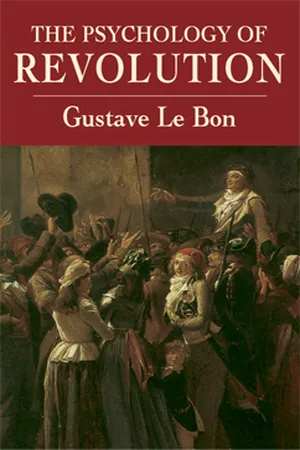
Le Bon examines the psychology of revolutions in general, both religious and political, as well as the mental and emotional qualities of the movements' leaders. Most of his examples are drawn from French history, with a particular emphasis on the French Revolution: its origins and rational, plus its affective, mystic, and collective influences.
- 336 pages
- English
- ePUB (mobile friendly)
- Available on iOS & Android
eBook - ePub
The Psychology of Revolution
About this book
Information
Subtopic
World HistoryIndex
HistoryPART I
THE PSYCHOLOGICAL ELEMENTS OF REVOLUTIONARY MOVEMENTS
BOOK I
GENERAL CHARACTERISTICS OF REVOLUTIONS
CHAPTER I
SCIENTIFIC AND POLITICAL REVOLUTIONS
1. Classification of Revolutions.
WE generally apply the term revolution to sudden political changes, but the expression may be employed to denote all sudden transformations, or transformations apparently sudden, whether of beliefs, ideas, or doctrines.
We have considered elsewhere the part played by the rational, affective, and mystic factors in the genesis of the opinions and beliefs which determine conduct. We need not therefore return to the subject here.
A revolution may finally become a belief, but it often commences under the action of perfectly rational motives: the suppression of crying abuses, of a detested despotic government, or an unpopular sovereign, &c.
Although the origin of a revolution may be perfectly rational, we must not forget that the reasons invoked in preparing for it do not influence the crowd until they have been transformed into sentiments. Rational logic can point to the abuses to be destroyed, but to move the multitude its hopes must be awakened. This can only be effected by the action of the affective and mystic elements which give man the power to act. At the time of the French Revolution, for example, rational logic, in the hands of the philosophers, demonstrated the inconveniences of the ancien régime, and excited the desire to change it. Mystic logic inspired belief in the virtues of a society created in all its members according to certain principles. Affective logic unchained the passions confined by the bonds of ages and led to the worst excesses. Collective logic ruled the clubs and the Assemblies and impelled their members to actions which neither rational nor affective nor mystic logic would ever have caused them to commit.
Whatever its origin, a revolution is not productive of results until it has sunk into the soul of the multitude. Then events acquire special forms resulting from the peculiar psychology of crowds. Popular movements for this reason have characteristics so pronounced that the description of one will enable us to comprehend the others.
The multitude is, therefore, the agent of a revolution ; but not its point of departure. The crowd represents an amorphous being which can do nothing, and will nothing, without a head to lead it. It will quickly exceed the impulse once received, but it never creates it.
The sudden political revolutions which strike the historian most forcibly are often the least important. The great revolutions are those of manners and thought. Changing the name of a government does not transform the mentality of a people. To overthrow the institutions of a people is not to re-shape its soul.
The true revolutions, those which transform the destinies of the peoples, are most frequently accomplished so slowly that the historians can hardly point to their beginnings. The term evolution is, therefore, far more appropriate than revolution.
The various elements we have enumerated as entering into the genesis of the majority of revolutions will not suffice to classify them. Considering only the designed object, we will divide them into scientific revolutions, political revolutions, and religious revolutions.
2. Scientific Revolutions.
Scientific revolutions are by far the most important. Although they attract but little attention, they are often fraught with remote consequences, such as are not engendered by political revolutions. We will therefore put them first, although we cannot study them here.
For instance, if our conceptions of the universe have profoundly changed since the time of the Revolution, it is because astronomical discoveries and the application of experimental methods have revolutionised them, by demonstrating that phenomena, instead of being conditioned by the caprices of the gods, are ruled by invariable laws.
Such revolutions are fittingly spoken of as evolution, on account of their slowness. But there are others which, although of the same order, deserve the name of revolution by reason of their rapidity : we may instance the theories of Darwin, overthrowing the whole science of biology in a few years; the discoveries of Pasteur, which revolutionised medicine during the lifetime of their author ; and the theory of the dissociation of matter, proving that the atom, formerly supposed to be eternal, is not immune from the laws which condemn all the elements of the universe to decline and perish.
These scientific revolutions in the domain of ideas are purely intellectual. Our sentiments and beliefs do not affect them. Men submit to them without discussing them. Their results being controllable by experience, they escape all criticism.
3. Political Revolutions.
Beneath and very remote from these scientific revolutions, which generate the progress of civilisations, are the religious and political revolutions, which have no kinship with them. While scientific revolutions derive solely from rational elements, political and religious beliefs are sustained almost exclusively by affective and mystic factors. Reason plays only a feeble part in their genesis.
I insisted at some length in my book Opinions and Beliefs on the affective and mystic origin of beliefs, showing that a political or religious belief constitutes an act of faith elaborated in unconsciousness, over which, in spite of all appearances, reason has no hold. I also showed that belief often reaches such a degree of intensity that nothing can be opposed to it. The man hypnotised by his faith becomes an Apostle, ready to sacrifice his interests, his happiness, and even his life for the triumph of his faith. The absurdity of his belief matters little ; for him it is a burning reality. Certitudes of mystic origin possess the marvellous power of entire domination over thought, and can only be affected by time.
By the very fact that it is regarded as an absolute truth a belief necessarily becomes intolerant. This explains the violence, hatred, and persecution which were the habitual accompaniments of the great political and religious revolutions, notably of the Reformation and the French Revolution.
Certain periods of French history remain incomprehensible if we forget the affective and mystic origin of beliefs, their necessary intolerance, the impossibility of reconciling them when they come into mutual contact, and, finally, the power conferred by mystic beliefs upon the sentiments which place themselves at their service.
The foregoing conceptions are too novel as yet to have modified the mentality of the historians. They will continue to attempt to explain, by means of rational logic, a host of phenomena which are foreign to it.
Events such as the Reformation, which overwhelmed France for a period of fifty years, were in no wise determined by rational influences. Yet rational influences are always invoked in explanation, even in the most recent works. Thus, in the General History of Messrs. Lavisse and Rambaud, we read the following explanation of the Reformation :—
“It was a spontaneous movement, born here and there amidst the people, from the reading of the Gospels and the free individual reflections which were suggested to simple persons by an extremely pious conscience and a very bold reasoning power.”
Contrary to the assertion of these historians, we may say with certainty, in the first place, that such movements are never spontaneous, and secondly, that reason takes no part in their elaboration.
The force of the political and religious beliefs which have moved the world resides precisely in the fact that, being born of affective and mystic elements, they are neither created nor directed by reason.
Political or religious beliefs have a common origin and obey the same laws. They are formed not with the aid of reason, but more often contrary to all reason. Buddhism, Islamism, the Reformation, Jacobinism, Socialism, &c., seem very different forms of thought. Yet they have identical affective and mystic bases, and obey a logic that has no affinity with rational logic.
Political revolutions may result from beliefs established in the minds of men, but many other causes produce them. The word discontent sums them up. As soon as discontent is generalised a party is formed which often becomes strong enough to struggle against the Government.
Discontent must generally have been accumulating for a long time in order to produce its effects. For this reason a revolution does not always represent a phenomenon in process of termination followed by another which is commencing, but rather a continuous phenomenon, having somewhat accelerated its evolution. All the modern revolutions, however, have been abrupt movements, entailing the instantaneous overthrow of governments. Such, for example, were the Brazilian, Portuguese, Turkish, and Chinese revolutions.
To the contrary of what might be supposed, the very conservative peoples are addicted to the most violent revolutions. Being conservative, they are not able to evolve slowly, or to adapt themselves to variations of environment, so that when the discrepancy becomes too extreme they are bound to adapt themselves suddenly. This sudden evolution constitutes a revolution.
Peoples able to adapt themselves progressively do not always escape revolution. It was only by means of a revolution that the English, in 1688, were able to terminate the struggle which had dragged on for a century between the monarchy, which sought to make itself absolute, and the nation, which claimed the right to govern itself through the medium of its representatives.
The great revolutions have usually commenced from the top, not from the bottom; but once the people is unchained it is to the people that revolution owes its might.
It is obvious that revolutions have never taken place, and will never take place, save with the aid of an important fraction of the army. Royalty did not disappear in France on the day when Louis XVI. was guillotined, but at the precise moment when his mutinous troops refused to defend him.
It is more particularly by mental contagion that armies become disaffected, being indifferent enough at heart to the established order of things. As soon as the coalition of a few officers had succeeded in overthrowing the Turkish Government the Greek officers thought to imitate them and to change their government, although there was no analogy between the two régimes.
A military movement may overthrow a government —and in the Spanish republics the Government is hardly ever destroyed by any other means—but if the revolution is to be productive of great results it must always be based upon general discontent and general hopes.
Unless it is universal and excessive, discontent alone is not sufficient to bring about a revolution. It is easy to lead a handful of men to pillage, destroy, and massacre, but to raise a whole people, or any great portion of that people, calls for the continuous or repeated action of leaders. These exaggerate the discontent; they persuade the discontented that the government is the sole cause of all the trouble, especially of the prevailing dearth, and assure men that the new system proposed by them will engender an age of felicity. These ideas germinate, propagating themselves by suggestion and contagion, and the moment arrives when the revolution is ripe.
In this fashion the Christian Revolution and the French Revolution were prepared. That the latter was effected in a few years, while the first required many, was due to the fact that the French Revolution promptly had an armed force at its disposal, while Christianity was long in winning material power. In the beginning its only adepts were the lowly, the poor, and the slaves, filled with enthusiasm by the prospect of seeing their miserable life transformed into an eternity of delight. By a phenomenon of contagion from below, of which history affords us more than one example, the doctrine finally invaded the upper strata of the nation, but it was a long time before an emperor considered the new faith sufficiently widespread to be adopted as the official religion.
4. The Results of Political Revolutions.
When a political party is triumphant it naturally seeks to organise society in accordance with its interests. The organisation will differ accordingly as the revolution has been effected by the soldiers, the Radicals, or the Conservatives, &c. The new laws and institutions will depend on the interests of the triumphant party and of the classes which have assisted it—the clergy for instance.
If the revolution has triumphed only after a violent struggle, as was the case with the French Revolution, the victors will reject at one sweep the whole arsenal of the old law. The supporters of the fallen régime will be persecuted, exiled, or exterminated.
The maximum of violence in these persecutions is attained when the triumphant party is defending a belief in addition to its material interests. Then the conquered need hope for no pity. Thus may be explained the expulsion of the Moors from Spain, the autodafés of the Inquisition, the executions of the Convention, and the recent laws against the religious congregations in France.
The absolute power which is assumed by the victors leads them sometimes to extreme measures, such as the Convention’s decree that gold was to be replaced by paper, that goods were to be sold at determined prices, &c. Very soon it runs up against a wall of unavoidable necessities, which turn opinion against its tyranny, and finally leave it defenceless before attack, as befell at the end of the French Revolution. The same thing happened recently to a Socialist Australian ministry composed almost exclusively of working-men. It enacted laws so absurd, and accorded such privileges to the trade unions, that public opinion rebelled against it so unanimously that in three months it was overthrown.
But the cases we have considered are exceptional. The majority of revolutions have been accomplished in order to place a new sovereign in power. Now this sovereign knows very well that the first condition of maintaining his power consists in not too exclusively favouring a single class, but in seeking to conciliate all. To do this he will establish a sort of equilibrium between them, so as not to be dominated by any one of these classes. To allow one class to become predominant is to condemn himself presently to accept that class as his master. This law is one of the most certain of political psychology. The kings of France understood it very well when they struggled so energetically against the encroachments first of the nobility and then of the clergy. If they had not done so their fate would have been that of the German Emperors of the Middle Ages, who, excommunicated by the Pope, were reduced, like Henry IV. at Canossa, to make a pilgrimage and humbly to sue for the Pope’s forgiveness.
This same law has continually been verified during the course of history. When at the end of the Roman Empire the military caste became preponderant, the emperors depended entirely upon their soldiers, who appointed and deposed them at will.
It was therefore a great advantage for France that she was so long governed by a monarch almost absolute, supposed to hold his power by divine right, and surrounded therefore by a considerable prestige. Without such an authority he could have controlled neither the feudal nobility, nor the clergy, nor the parliaments. If Poland, towards the end of the sixteenth century, had also possessed an absolute and respected monarchy, she would not have descended the path of decadence which led to her disappearance from the map of Europe.
We have shewn in this chapter that political revolutions may be accompanied by important social transformations. We shall soon see how slight are these transformations compared to those produced by religious revolutions.
CHAPTER II
RELIGIOUS REVOLUTIONS
1. The importance of the study of Religious Revolutions in respect of the comprehension of the great Political Revolutions.
A PORTION of this work will be devoted to the French Revolution. It was full of acts of violence which naturally had their psychological causes.
These exceptional events will always fill us with astonishment, and we even feel them to be inexplicable. They become comprehensible, however, if we consider that the French Revolution, constituting a new religion, was bound to obey the laws which condition the propagation of all beliefs. Its fury and its hecatombs will then become intelligible.
In studying the history of a great religious revolution, that of the Reformation, we shall see that a number of psychological elements which figured therein were equally active during the French Revolution. In both we observe the insignificant bearing of the rational value of a belief upon its...
Table of contents
- Title Page
- Copyright Page
- Table of Contents
- INTRODUCTION - THE REVISION OF HISTORY
- PART I - THE PSYCHOLOGICAL ELEMENTS OF REVOLUTIONARY MOVEMENTS
- PART II - THE FRENCH REVOLUTION
- PART III - THE RECENT EVOLUTION OF THE REVOLUTIONARY PRINCIPLES
- CONCLUSIONS
- INDEX
Trusted by 375,005 students
Access to over 1.5 million titles for a fair monthly price.
Study more efficiently using our study tools.
Frequently asked questions
Yes, you can cancel anytime from the Subscription tab in your account settings on the Perlego website. Your subscription will stay active until the end of your current billing period. Learn how to cancel your subscription
No, books cannot be downloaded as external files, such as PDFs, for use outside of Perlego. However, you can download books within the Perlego app for offline reading on mobile or tablet. Learn how to download books offline
Perlego offers two plans: Essential and Complete
- Essential is ideal for learners and professionals who enjoy exploring a wide range of subjects. Access the Essential Library with 800,000+ trusted titles and best-sellers across business, personal growth, and the humanities. Includes unlimited reading time and Standard Read Aloud voice.
- Complete: Perfect for advanced learners and researchers needing full, unrestricted access. Unlock 1.5M+ books across hundreds of subjects, including academic and specialized titles. The Complete Plan also includes advanced features like Premium Read Aloud and Research Assistant.
We are an online textbook subscription service, where you can get access to an entire online library for less than the price of a single book per month. With over 1.5 million books across 990+ topics, we’ve got you covered! Learn about our mission
Look out for the read-aloud symbol on your next book to see if you can listen to it. The read-aloud tool reads text aloud for you, highlighting the text as it is being read. You can pause it, speed it up and slow it down. Learn more about Read Aloud
Yes! You can use the Perlego app on both iOS and Android devices to read anytime, anywhere — even offline. Perfect for commutes or when you’re on the go.
Please note we cannot support devices running on iOS 13 and Android 7 or earlier. Learn more about using the app
Please note we cannot support devices running on iOS 13 and Android 7 or earlier. Learn more about using the app
Yes, you can access The Psychology of Revolution by Gustave Le Bon, Bernard Miall in PDF and/or ePUB format, as well as other popular books in History & World History. We have over 1.5 million books available in our catalogue for you to explore.