This user-friendly guide from the 1930s offers aspiring cartoonists a wealth of practical advice. Rich in period flavor, it supplies the ageless foundations of comic art. Abundant illustrations and clear, nontechnical prose cover: creating expressions, attaining proportion and applying perspective, depicting anatomy, simple shading, achieving consistency, lettering, and writing a strip.
- 64 pages
- English
- ePUB (mobile friendly)
- Available on iOS & Android
eBook - ePub
Learn to Draw Comics
About this book
Information
Topic
ArtSubtopic
Art TechniquesThe Figure in Action
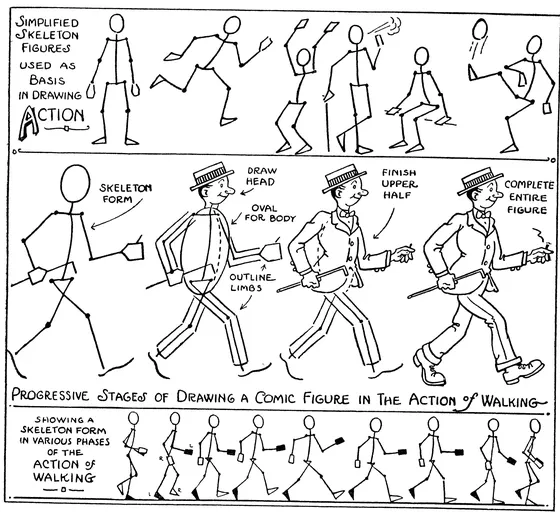
IN AN effective cartoon, action often tells more than half the story. Likewise, it is the element in a comic-picture that is most apt to get a laugh. Action, therefore, will be another of the important items in the course of our study and it will continue to be of importance in your work as a professional cartoonist.
Careful and thorough study of proportions and details of the figure which have been the subject of the previous chapters, will prove its value when the student is ready to draw the figure in action.
A simple and practical way to begin the study of action is known as the “skeleton” method. Having once learned this method thoroughly, the ability to make the figures in your drawings go through all sorts of antics will come very easy.
Note the little skeleton figures in the diagram above. Although very simply done, with only an oval for a head and straight lines for limbs and body, the proportions, pose, and action of the completed figure can be visualized instantly.
In the above illustration, the steps taken in drawing a figure in action by this method are shown. First make sure that the skeleton’s limbs are correct in proportion to each other, as it forms the framework for your finished work. Next, draw the shape of the body by means of an oval with its center line indicated as instructed in the chapter on drawing the comic figure. Finally, add whatever sort of costume you want to put on it, being careful to draw the wrinkles correctly, as well as the bend in the shoes and the position of the hands.
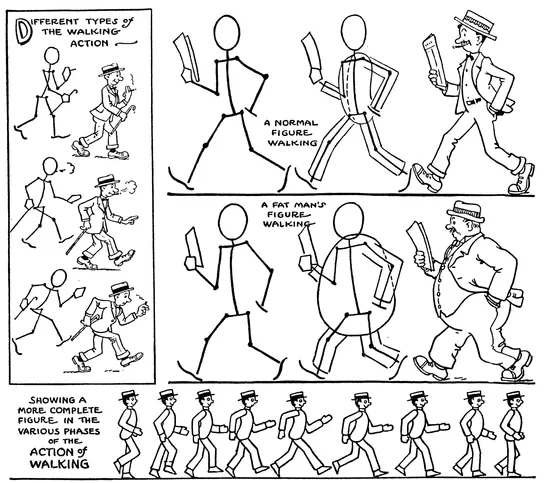
The various phases of movement that a figure goes through in the action of walking are shown in the above procession of skeletons and the more completed figures adjoining. Notice particularly that the arms swing back and forth contrary to the movement of the legs so that when the right foot is forward, the right arm swings back, coming forward again when the left foot is foremost. The best way to study the action of walking is to observe how others do it. Watch people as they go along the street and fix an image of the movements firmly in your mind. First acquaint yourself with just the mechanical action of walking. Notice how the arms swing, how the body sways and the way the feet bend when touching the ground. Then study the formation of the principal wrinkles in the clothing and you will see that they fall into exactly the same position as the movements are repeated. It is observation of this kind that will make your study work easier and of more practical value.
The action of walking can also be pictured in various ways of which a few examples are shown. With the same diagrams, the walk of a man of ordinary build is compared with that of a very fat man.
The diagram picturing the three-quarter view of the walking figure shows the underside of the shoe on the foremost foot. This position is frequently used in comic drawing and the effect of perspective can be shown by placing the rear leg higher than the one in front. An arrogant cock-sure air can also be expressed in this pose as shown in the example of a comic-picture “swagger.”
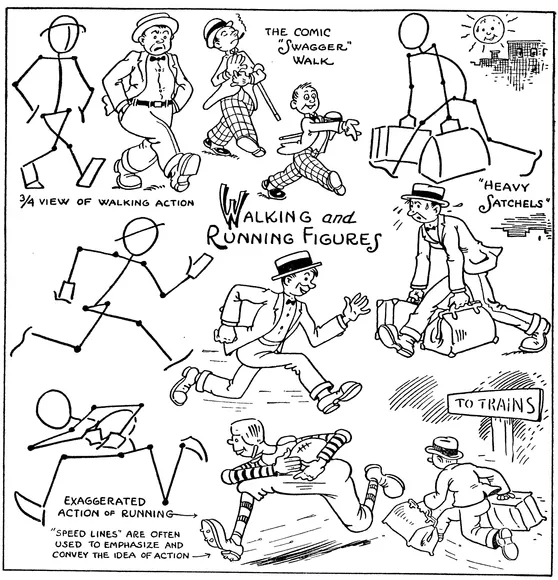
There is a chance to picture effective walking action where a figure carries a heavy weight as in the case of the man laboring along with two large satchels. The backbone is bent to a curve, bringing the arms well forward so that the center of the weight seems balanced with the rest of the figure. Note also how his perspiring facial expression emphasizes the appearance of discomfort.
In the action of running, the arms and legs also take opposite position in relation to each other as in walking. The body is bent more forward and the legs and arms extend at wide angles. More violent and exaggerated action is shown in the football player, and the running man with the satchels presents a rear three-quarter view.
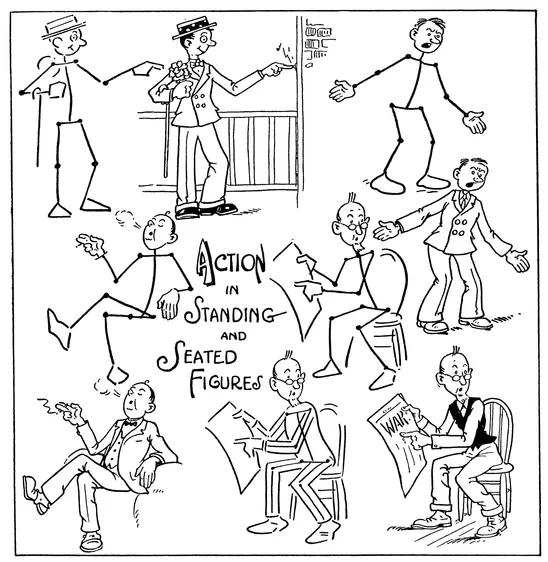
A comic figure can be made to look funnier if the natural action or pose is exaggerated. “Action” in a drawn figure does not necessarily mean walking, running, turning somersaults and so forth. A sitting or standing figure also portrays “action,” but in this case the word is used in a sense that means pose or position passively assumed by the subject of your drawing.
The gay young blade ringing the doorbell, the irate man involved in argument, and the seated figures pictured herewith all suggest a certain amount of “action” which is brought out quite clearly in the skeleton forms. After you have decided upon the position of your subject, you can easily tell by its “skeleton” if it is correct in proportion and true to life in its action.
Study other printed examples of “standing still” poses that portray passive action. Note carefully the way wrinkles in the clothing have been drawn. It will be good practice for the student to draw similar figures, and, where a thin man is shown, draw the same subject as a fat man, or vary the costume or transform the type into some other character.
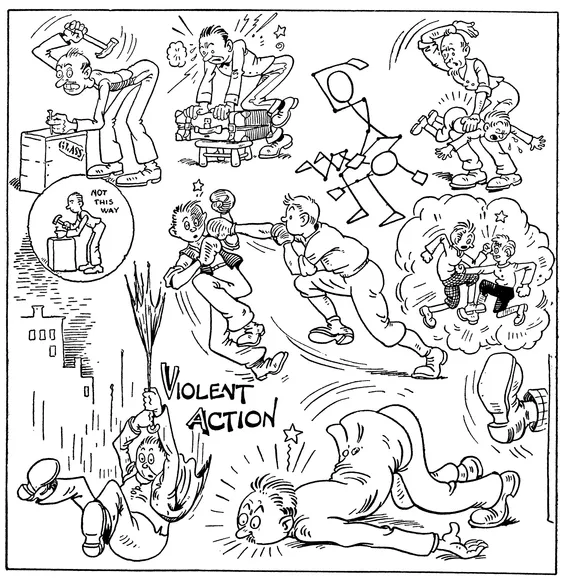
The comic artist often finds it necessary to resort to more extreme kind of action. In this he can take plenty of liberty with his work and, in exaggerating the actions, add greatly to its effectiveness. The examples of “violent” action which are shown herewith will give the student an idea of the manner in portraying it. Thus, if you draw a man using a hammer, put plenty of activity in it, or if he is packing a suit-case, picture the procedure with plenty of pressure and profanity. If your comic-picture kid is due for a licking, be sure that he gets a good one and spare neither rod nor drawing ink in producing action.
A lively scrap requires plenty of “pep” and activity, with dust-clouds and radiating lines to enliven the scene. The party using a 98-cent umbrella for a parachute takes his downward course with coat-tails flying upward and frightened expression. The persistent canvasser can be shown making a forced landing on his way out. Of course, there are numerous other ways of picturing these, and other actions, and the student cartoonist will find it a part of his study that is well worth while.
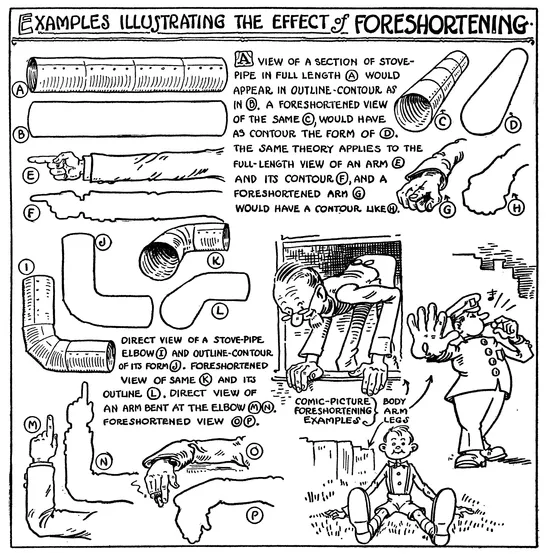
Drawing the figure in more intense and complicated forms of action, often requires the use of foreshortening, one of the artist’s very difficult problems. An object in a position extended toward you, where you see all of it, yet not its entire length, is in a foreshortened view. A clearer idea of this is shown in the pictures herewith of the section of stove-pipe. An outline profile of its entire length (A-B) would still convey an idea of its exact shape. By placing it so that one end is pointing toward you, we have a foreshortened view, (C), yet, an outline of its form, (D) would, in this case, be meaningless. Diagrams E to H show the same problem applied in drawing an arm with a pointing hand.
The stove-pipe with its elbow joint (I to L) presents another problem in foreshortening that has its similarity in the pictures of a bent arm. (M to P). There will be many opportunities to use foreshortening throughout your work, and, by keeping these facts in mind, together with observation and faithful practice, it should not be very hard to do. A few cases where comic-picture style of foreshortening has been used are also shown with the foregoing diagrams.
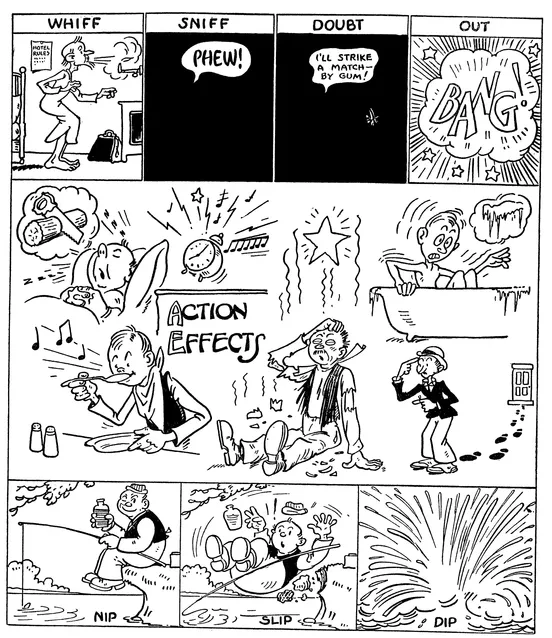
Besides drawing the figure in appropriate pose, there are many little tricks continuously used in cartoons that accentuate and picture actions, emotions, and noises, and serve to tell a story very forcibly. While we cannot exactly call them actions, they are, more properly speaking, action effects.
In the pictures shown above, various little items are introduced to interpret some of these effects. The time-honored comic-picture explosion, the pictured snore, the frigid bath and musical soup often appear in cartoons to emphasize and convey...
Table of contents
- Title Page
- Copyright Page
- Table of Contents
- Foreword
- How to Begin and What to Use
- Drawing the Head
- Facial Expression
- How to Draw Various Kinds of Comic Faces
- Hands and Feet
- Drawing the Comic Figure
- The Figure in Action
- Tones, Shades and Technique
- Shadows
- Women and Children in Comic-Pictures
- Types and Characters
- Comic-Picture Animals
- Perspective and Backgrounds
- Composition and Arrangement
- Lettering
- Comic Strips
- Comic Pictures in Advertising
- Getting Your Work Into Print
Trusted by 375,005 students
Access to over 1.5 million titles for a fair monthly price.
Study more efficiently using our study tools.
Frequently asked questions
Yes, you can cancel anytime from the Subscription tab in your account settings on the Perlego website. Your subscription will stay active until the end of your current billing period. Learn how to cancel your subscription
No, books cannot be downloaded as external files, such as PDFs, for use outside of Perlego. However, you can download books within the Perlego app for offline reading on mobile or tablet. Learn how to download books offline
We are an online textbook subscription service, where you can get access to an entire online library for less than the price of a single book per month. With over 1.5 million books across 990+ topics, we’ve got you covered! Learn about our mission
Look out for the read-aloud symbol on your next book to see if you can listen to it. The read-aloud tool reads text aloud for you, highlighting the text as it is being read. You can pause it, speed it up and slow it down. Learn more about Read Aloud
Yes! You can use the Perlego app on both iOS and Android devices to read anytime, anywhere — even offline. Perfect for commutes or when you’re on the go.
Please note we cannot support devices running on iOS 13 and Android 7 or earlier. Learn more about using the app
Please note we cannot support devices running on iOS 13 and Android 7 or earlier. Learn more about using the app
Yes, you can access Learn to Draw Comics by George Leonard Carlson in PDF and/or ePUB format, as well as other popular books in Art & Art Techniques. We have over 1.5 million books available in our catalogue for you to explore.