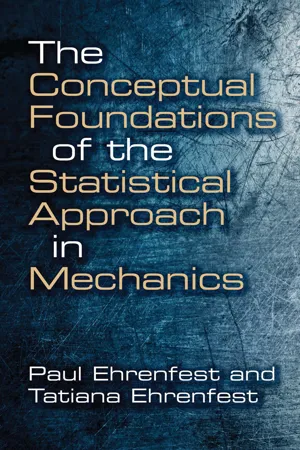
In this concise classic, Paul Ehrenfest ― one of the twentieth century's greatest physicists ― reformulated the foundations of the statistical approach in mechanics. Originally published in 1912, this classic has lost little of its scientific and didactic value, and is suitable for advanced undergraduate and graduate students of physics and historians of science.
Part One describes the older formulation of statistico-mechanical investigations (kineto-statistics of the molecule). Part Two takes up the modern formulation of kineto-statistics of the gas model, and Part Three explores W. B. Gibbs's major work, Elementary Principles in Statistical Mechanics and its coverage of such topics as the problem of axiomatization in kineto-statistics, the introduction of canonical and microcanonical distributions, and the analogy to the observable behavior of thermodynamic systems. The book concludes with the authors' original notes, a series of useful appendixes, and a helpful bibliography.
eBook - ePub
The Conceptual Foundations of the Statistical Approach in Mechanics
- 114 pages
- English
- ePUB (mobile friendly)
- Available on iOS & Android
eBook - ePub
The Conceptual Foundations of the Statistical Approach in Mechanics
About this book
Information
Notes
PREFACE TO THE TRANSLATION
1. I expressed this point of view for the first time in a paper entitled “Zur Axiomatisierung des zweiten Satzes der Thermodynamik” (Zeits. f. Phys., 33 and 34, 1925). A more complete discussion is contained in my book Die Grundlagen der Thermodynamik (Leiden, 1956).
2. Only a few authors take my views into account. The ones I know of are: J. D. van der Waals, Lehrbuch der Thermostatistik, 3d ed., ed. by P. Kohnstamm (Leipzig, 1927); A. Lande, Axiomen tische Begrundung der Thermodynamik (Handbuch der Physik, vol. IX); and lately A. H. Wilson, Thermodynamics and Statistical Mechanics (Cambridge, 1957).
INTRODUCTION, TEXT, AND APPENDIX
1. The number of molecules in 1 cm3 at 0° and atmospheric pressure (i.e., the Loschmidt number) is about 4×10¹⁹. (Its value as known today is 2.68709 ± 0.00009×10¹⁹.—THE TRANSLATOR)
2. Cf. V 8, Sections 1 and 26 (L. Boltzmann and J. Nabl).
3. These “probability assumptions” are therefore statements about the statistical regularities among the billions of molecules which compose one gas quantum. The position and motion of one molecule is considered here the single event; the behavior of the one given gas quantum is a mass phenomenon. Hence occasionally these older works were also referred to as “statistico-mechanical” studies. Complying, however, with present-day terminology, we will reserve the term “statistico-mechanical” in our discussions to a group of investigations in which the behavior of one gas quantum is considered an individual event and where the behavior of a whole set, to be specified later, of infinitely many copies of such a gas quantum is taken to be a mass phenomenon. All these copies are identical and move independently of each other. (Cf. Sections 9-15.)
4. V 8, Sections 15-25.
5. Boltzmann [6].
6. See Section 6 and V 8, Section 11.
7. Loschmidt [1].
8. Zermelo [1].
9. Section 7.
10. Sections 9-15.
11. Zermelo [3] (1900); Poincaré [3] (1908); Brillouin [1] (1902-1905); Lippmann [1] (1900); Liénard [1] (1903); Burbury, Phil. Mag., (6) 16 (1908), 122.
12. Zermelo [1].
13. Cf. note 15.
14. The arrangement of the next eight sections parallels the treatment in V 8.
15. In the following discussion we will discard the term “the probability of an occurrence” and will replace it by the clumsier but explicit statements about frequencies. It is true that in the older work, which we will discuss now, the uncritical use of the term “probability” proved to be heuristically fruitful. Consider, for instance, the following two different physical quantities: (a) the relative time which a molecule A spends in state S, (b) the relative number of those molecules which at a given time are in state S. These two different frequencies were both described by the expression: “The” probability of A being in state S, and no further differentiation was made. In this way the identity of the two frequencies was implicitly assumed, and this identity was then applied in further considerations. The actual proof of the identity would perhaps have encountered great difficulties, if it could have been done at all. It is unfortunate that this procedure has not been completely eliminated even in the more recent critical studies of the foundations of the kinetic theory. Cf. the beginning of Section 14.
16. Cf. V 8, Section 2.
17. Krönig [1].
18. Because of the special form of the sums which appear in the calculation of the pressure, the Krönig model leads in this problem to the same results as the later, more-refined scheme of Clausius. In other problems, however, such as diffusion and heat conduction, this is no longer the case.
19. The following remarks refer primarily to those papers of Clausius [1, 2], which preceded the first publication of Maxwell [1], on the theory of gases.
20. This statement obviously formulates one of the many meanings in which the expression “the equal probability of all directions of the velocity” has been used. The same can be said about the phrase “the probability that an individual molecule is in a certain specified volume element of the container.” Cf. note 15.
21. Cf. the explanation of this assumption applied to a simplified model in the Appendix of Section 5.
22. Our considerations will be limited, for the sake of simplicity, to spherical molecules. Then the “action sphere” of a molecule is a sphere concentric with the surface of the molecule but having a radius double that of the molecule. It marks the limit of the distance which the centers of two molecules can take before a collision takes place. Cf. Boltzmann, Vorlesungen über Gastheorie y I, §3.
23. For the correct formulation of this purely kinematic part of the problem, see Boltzmann, Gastheorie, I, 15, and V 8, Section 8. For the case of molecules of general structure, see Boltzmann, Gastheoriey I, 107; II, 230.
24. Clausius [2, 3].
2...
Table of contents
- Cover
- Title Page
- Copyright Page
- Foreword
- Authors’ Preface
- Contents
- Introduction
- I. The Older Formulation of Statistico-Mechanical Investigations (Kineto-Statistics of the Molecule
- II. The Modern Formulation of Statistico-Mechanical Investigations (Kineto-Statistics of the Gas Model)
- III. W. Gibbs’s Elementary Principles in Statistical Mechanics
- Appendix
- Notes
- Bibliography
Trusted by 375,005 students
Access to over 1.5 million titles for a fair monthly price.
Study more efficiently using our study tools.
Frequently asked questions
Yes, you can cancel anytime from the Subscription tab in your account settings on the Perlego website. Your subscription will stay active until the end of your current billing period. Learn how to cancel your subscription
No, books cannot be downloaded as external files, such as PDFs, for use outside of Perlego. However, you can download books within the Perlego app for offline reading on mobile or tablet. Learn how to download books offline
Perlego offers two plans: Essential and Complete
- Essential is ideal for learners and professionals who enjoy exploring a wide range of subjects. Access the Essential Library with 800,000+ trusted titles and best-sellers across business, personal growth, and the humanities. Includes unlimited reading time and Standard Read Aloud voice.
- Complete: Perfect for advanced learners and researchers needing full, unrestricted access. Unlock 1.5M+ books across hundreds of subjects, including academic and specialized titles. The Complete Plan also includes advanced features like Premium Read Aloud and Research Assistant.
We are an online textbook subscription service, where you can get access to an entire online library for less than the price of a single book per month. With over 1.5 million books across 990+ topics, we’ve got you covered! Learn about our mission
Look out for the read-aloud symbol on your next book to see if you can listen to it. The read-aloud tool reads text aloud for you, highlighting the text as it is being read. You can pause it, speed it up and slow it down. Learn more about Read Aloud
Yes! You can use the Perlego app on both iOS and Android devices to read anytime, anywhere — even offline. Perfect for commutes or when you’re on the go.
Please note we cannot support devices running on iOS 13 and Android 7 or earlier. Learn more about using the app
Please note we cannot support devices running on iOS 13 and Android 7 or earlier. Learn more about using the app
Yes, you can access The Conceptual Foundations of the Statistical Approach in Mechanics by Paul Ehrenfest,Tatiana Ehrenfest, Tatiana Ehrenfest in PDF and/or ePUB format, as well as other popular books in Physical Sciences & Mathematical & Computational Physics. We have over 1.5 million books available in our catalogue for you to explore.