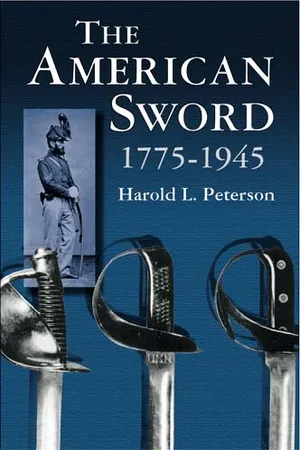
The first book devoted exclusively to the subject, this invaluable volume will aid collectors, curators, historians. Enhanced with more than 400 illustrations from rare documents, the book classifies and describes all major types of swords worn by the U.S. armed forces, cadets, and diplomats since the American Revolution to the end of World War II.
- 352 pages
- English
- ePUB (mobile friendly)
- Available on iOS & Android
eBook - ePub
The American Sword 1775-1945
About this book
Information
Print ISBN
9780486428024
Subtopic
Military & Maritime HistoryOFFICERS’ SWORDS
THE SWORDS CARRIED by officers of the uniformed services of the United States present a far more complicated field of study than those worn by enlisted men. In fact, one of the compelling factors about this subject for the student and the collector is the great variety of different specimens that fall within it. At one end of the scale are officers’ swords possessing the same useful and efficient appearance that is characteristic of enlisted men’s swords and enhanced by fine workmanship and esthetic decoration. At the other end are mere trinkets, designed for ornamental purposes only.
There are two principal reasons for this great variety. First, there were a sizable number of ranks, branches and arms of the service to be indicated by the sword. Second, and perhaps more important, the patterns for officers’ swords for many years were not nearly so rigidly controlled as those for enlisted men. Underlying this lack of control was the fact that officers had to purchase their swords from outside the government. Thus their choice could only be directed through the passing of regulations. Prior to 1840 these regulations for most branches of the service were very general in their wording so that any one of a number of different swords could qualify under them. Also, there was a tendency among many officers to ignore the regulations and carry the sword of their own choice. This was particularly true of state troops even when serving with the regular forces in war time.
Although some of these officers’ swords were manufactured in America by such makers as Nathan Starr, the Roses, and the Ames Manufacturing Company, the great majority of blades and a large number of entire swords were made in Europe. Most often they were produced by the famous German swordsmiths of Solingen, but some came from France, Great Britain, and Belgium. These complete swords and blades were usually imported, mounted if necessary by American smiths, and then sold by various firms which dealt in the military field. By 1830 two great companies began to handle the bulk of all such trade. These were W. H. Horstmann & Son of Philadelphia and Schuyler, Hartley & Graham of New York. Well over half of all officers’ swords made or sold in the United States after 1830 bore either the Ames mark or the name of one or the other of these concerns.
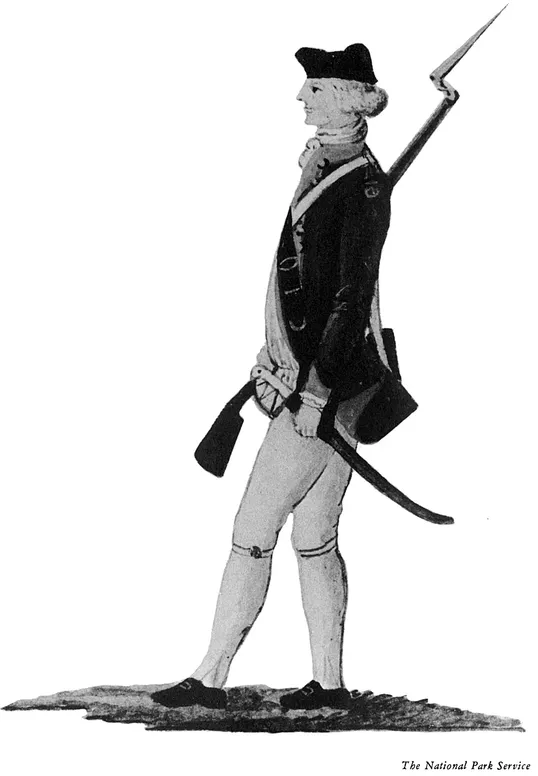
An American officer as seen by a German soldier with Burgoyne. Note the short saber worn in a frog on a shoulder belt.
Infantry Officers’ Swords
The infantry officers of the United States Army have been armed with many different weapons. They have carried spontoons, fusils, revolvers, automatic pistols, and carbines. Through most of American history, however, the constant companion of these weapons was the sword. And sometimes, during the early period, these other arms were laid aside, leaving the sword as the only weapon which the officer carried.
The Civil War was the last major conflict in which officers of infantry consistently used their swords in hand-to-hand combat, and with the close of that war the ascendant period of the infantry officers’ sword ended. Thereafter changes in tactics caused by the increased efficiency of firearms relegated the sword to a position of minor importance. There were still some officers who favored the sword, however, and when an utterly useless model was adopted in 1872, many complained that they were being deprived of their last defense in emergencies. These criticisms continued through the years, and finally in 1902 a sword was adopted that could be used efficiently in combat. It was a futile gesture, however, for the sword soon ceased to be worn in the field.
The Period of the Revolution
The officers who commanded infantry during the American Revolution carried whatever swords they could obtain. Many used the swords they had worn in civilian life before the war. Others used swords from colonial arsenals that dated back to the French wars, and still others purchased new swords from Europe or had them made by American smiths. There were no rigid regulations, and officers of infantry, cavalry, artillery, and the general staff all wore the same general types. Thus it is impossible to divide these swords by categories according to the usual divisions. In this work, most of the types are described here as infantry officers’ swords because this is the first category to be discussed. The only other category into which these swords have been divided is cavalry swords. This class consists of the heavy sabers normally carried by horsemen, but it should be remembered that this line was not rigid either and that there are known instances in which foot officers used the heavy saber.
56. Officers’ Short Saber of the Revolution
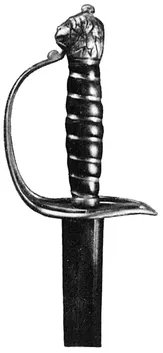
One of the principal types of swords carried by officers of all branches of the service during the Revolution was the short saber. There were many variations of this weapon, some with animal head pommels, some with plain or urn pommels, some with cut out guards similar to the one described here and some with true half-basket guards. The generic type can quickly be recognized, however, by the short light cut and thrust blade and the guard with a true knuckle-bow.
56
The blade of the specimen illustrated is slightly curved, single-edged, and the pronounced false edge is 9 inches long. There are two fullers, one narrow one at the back which runs from the hilt to the beginning of the false edge, and one somewhat wider one which runs for almost the entire length of the blade. The grip is horn, wound with a flat strip of copper. The brass pommel is a lion’s head, and there is a capstan rivet. The guard is cut from a heavy sheet of brass to resemble a knuckle-bow which divides as it turns up toward the blade with a branch on either side and a transverse connecting bar at the midpoint where they cross the blade. The point where the branches join the quillon is decorated with incised lines. The scabbard has not survived, but it was undoubtedly leather with brass mounts.
32 inches overall, blade 25½ inches by 1¼ inches wide at the hilt.
57. Hunting Sword, 1750-1770
The hunting sword was a typical civilian arm of the mid-eighteenth century, and when the American Revolution broke out many such weapons were available for the use of the officers of the new Continental Army and of the militia. Never a military weapon in any sense, these swords would have been of little use in actual combat. They were, however, useful as symbols of rank, and as such they were worn by a large number of American officers including Generals Washington, Dearborn, Montgomery, and Von Steuben. The design of these swords varied considerably. The short, slightly curved blade with a single fuller was almost universal, but the grips were made of such different materials as horn, plain or tinted ivory or bone, wood, stag horn, and metal. The pommels were sometimes plain caps and sometimes decorated with dog, lion or bird heads. The quillons were sometimes straight and sometimes S-curved. One typical specimen is illustrated herewith. Others will be found in the section on American silver hilted swords below.
The slightly curved blade is single-edged with a false edge extending back six and one-half inches from the point. A single relatively narrow fuller at the back of the blade runs from the hilt to the beginning of the false edge. The obverse side of the blade is stamped with the figures “1759” and the running wolf mark of Solingen. The reverse side bears only the figures ”175” plus two stars and the wolf mark. The grips are horn carved in a spiral pattern and wrapped with a strip of silver. The pommel is a flat cap engraved with a mask and a flower and having a capstan rivet for the tang. There is also a loop to hold a chain which originally connected the pommel and the lower quillon. The small S-curved quillons are iron plated with silver and decorated with floral designs. The scabbard is missing, but it was undoubtedly leather with silver plated mounts and could have had either a frog stud or carrying rings.
Collection of Robert F. Wheeler
32 inches overall, blade 26½ inches by 1¼ inches wide at the hilt.
58. Small Sword, 1750-1770
The small sword described here is typical of the weapon carried by many of the officers of the Continental Army who could not afford the more elaborate and expensive weapons which had been the property of the men of wealth in this country. It is a plain, brass hilted weapon with no decoration whatsoever, but well made and a sturdy sword. According to family tradition it was carried by Major Amos King of Peabody (then Salem), Massachusetts.
The straight blade is triangular in section and tapers evenly to a point. The three faces of the blade are highly concave, however, and so almost give the impression of three edges. The grips are wood wrapped with twisted brass wire. The pommel is a modified urn shape, and there is a capstan rivet. The knuckle-bow sweeps below the blade in an almost rectangular form. The pas d’anes are ample for the fingers, and the quillon terminates in a tear drop finial which turns towards the obverse side but does not bend forward towards the blade. The shells of the counter-guard are slightly disparate, with thickened borders, and ...
Table of contents
- Title Page
- Copyright Page
- Dedication
- THE COMPANY OF MILITARY COLLECTORS AND HISTORIANS
- INTRODUCTION
- PREFACE
- PREFACE TO THE SECOND EDITION
- Table of Contents
- THE TERMINOLOGY OF THE SWORD
- ENLISTED MEN’S SWORDS
- OFFICERS’ SWORDS
- CADET SWORDS
- DIPLOMATIC SWORDS
- SPECIAL PRESENTATION SWORDS
- SILVER HILTED SWORDS
- SCABBARDS AND ATTACHMENTS
- A DIRECTORY OF AMERICAN MAKERS
- AN ESSAY ON SOURCES
- INDEX
- NOTES
- Appendix: - American Silver Mounted Swords 1700-1815
Trusted by 375,005 students
Access to over 1.5 million titles for a fair monthly price.
Study more efficiently using our study tools.
Frequently asked questions
Yes, you can cancel anytime from the Subscription tab in your account settings on the Perlego website. Your subscription will stay active until the end of your current billing period. Learn how to cancel your subscription
No, books cannot be downloaded as external files, such as PDFs, for use outside of Perlego. However, you can download books within the Perlego app for offline reading on mobile or tablet. Learn how to download books offline
Perlego offers two plans: Essential and Complete
- Essential is ideal for learners and professionals who enjoy exploring a wide range of subjects. Access the Essential Library with 800,000+ trusted titles and best-sellers across business, personal growth, and the humanities. Includes unlimited reading time and Standard Read Aloud voice.
- Complete: Perfect for advanced learners and researchers needing full, unrestricted access. Unlock 1.5M+ books across hundreds of subjects, including academic and specialized titles. The Complete Plan also includes advanced features like Premium Read Aloud and Research Assistant.
We are an online textbook subscription service, where you can get access to an entire online library for less than the price of a single book per month. With over 1.5 million books across 990+ topics, we’ve got you covered! Learn about our mission
Look out for the read-aloud symbol on your next book to see if you can listen to it. The read-aloud tool reads text aloud for you, highlighting the text as it is being read. You can pause it, speed it up and slow it down. Learn more about Read Aloud
Yes! You can use the Perlego app on both iOS and Android devices to read anytime, anywhere — even offline. Perfect for commutes or when you’re on the go.
Please note we cannot support devices running on iOS 13 and Android 7 or earlier. Learn more about using the app
Please note we cannot support devices running on iOS 13 and Android 7 or earlier. Learn more about using the app
Yes, you can access The American Sword 1775-1945 by Harold L. Peterson in PDF and/or ePUB format. We have over 1.5 million books available in our catalogue for you to explore.