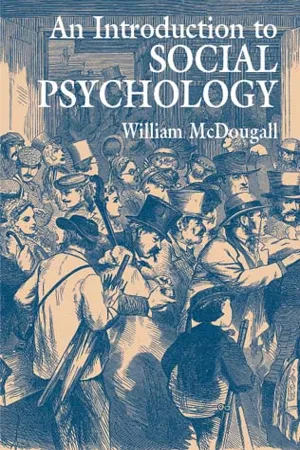
A pioneering work in psychology, this enormously influential book served as a catalyst in the study of the foundations of social behavior. Ironically, its approach marked such a dramatic departure from contemporary trends that it stimulated little follow-up research at the time of its 1908 publication. In recent years, however, the author's ideas have been resurrected in sociobiological reasoning, making the republication of this systematic treatise particularly timely. McDougall's work grounds social behavior in biology, focusing on the individual and attributing most social behavior to instinct. This reasoning makes his work one of the first in modern psychology to take human motivation as its central concern. As one of the initial texts of social psychology, it assisted in laying the foundations of a new discipline, separating the field from its forerunners, sociology and general psychology. McDougall's emphasis on the instinctive basis of social phenomena also helped promote the individualistic approach typical of modern social psychology. Popular, long-lived, and ever-relevant, this landmark work is guaranteed a wide audience among teachers and students of psychology.
- 560 pages
- English
- ePUB (mobile friendly)
- Available on iOS & Android
eBook - ePub
An Introduction to Social Psychology
About this book
Information
SOCIAL PSYCHOLOGY
CHAPTER I
INTRODUCTION
AMONG students of the social sciences there has always been a certain number who have recognised the fact that some knowledge of the human mind and of its modes of operation is an essential part of their equipment, and that the successful development of the social sciences must be dependent upon the fulness and accuracy of such knowledge These propositions are so obviously true that any formal attempt to demonstrate them is superfluous. Those who do not accept them as soon as they are made will not be convinced of their truth by any chain of formal reasoning. It is, then, a remarkable fact that psychology, the science which claims to formulate the body of ascertained truths about the constitution and working of the mind, and which endeavours to refine and to add to this knowledge, has not been generally and practically recognised as the essential common foundation on which all the social sciences—ethics, economics, political science, philosophy of history, sociology, and cultural anthropology, and the more special social sciences, such as the sciences of religion, of law, of education, and of art—must be built up. Of the workers in these sciences, some, like Comte, and, at the present time, M. Durkheim, repudiate the claim of psychology to such recognition. Some do lip service to psychology, but in practice ignore it, and will sit down to write a treatise on morals or economics, or any other of the social sciences, cheerfully confessing that they know nothing of psychology. A certain number, perhaps the majority, of recent writers on social topics recognise the true position of psychology, but in practice are content to take as their psychological foundations the vague and extremely misleading psychology embodied in common speech, with the addition of a few hasty assumptions about the mind made to suit their particular purposes. There are signs, however, that this regrettable state of affairs is about to pass away, that psychology will before long be accorded in universal practice the position at the base of the social sciences which the more clear-sighted have long seen that it ought to occupy.
Since this volume is designed to promote this change of practice, it is fitting that it should open with a brief inquiry into the causes of the anomalous state of affairs at present obtaining and with some indication of the way in which it is hoped that the change may be brought about For there can be no question that the lack of practical recognition of psychology by the workers in the social sciences has been in the main due to its deficiencies, and that the only way of establishing it in its true place is to make good these deficiencies. What, then, are these deficiencies, and why have they so long persisted ? We may attempt very briefly to indicate the answers to these questions without presuming to apportion any blame for the long continuance of these deficiencies between the professed psychologists and the workers in the social sciences.
The department of psychology that is of primary importance for the social sciences is that which deals with the springs of human action, the impulses and motives that sustain mental and bodily activity and regulate conduct ; and this, of all the departments of psychology, is the one that has remained in the most backward state, in which the greatest obscurity, vagueness, and confusion still reign. The answers to such problems as the proper classification of conscious states, the analysis of them into their elements, the nature of these elements and the laws of the compounding of them, have but little bearing upon the social sciences ; the same may be said of the range of problems connected with the relations of soul and body, of psychical and physical process, of consciousness and brain processes ; and also of the discussion of the more purely intellectual processes, of the way we arrive at the perception of relations of time and place or of likeness and difference, of the classification and description of the intellectual processes of ideation, conception, comparison, and abstraction, and of their relations to one another. Not these processes themselves, but only the results or products of these processes—the knowledge or system of ideas and beliefs achieved by them, and the way in which these ideas and beliefs regulate conduct and determine social institutions and the relations of men to one another in society, are of immediate importance for the social sciences. It is the mental forces, the sources of energy, which set the ends and sustain the course of all human activity—of which forces the intellectual processes are but the servants, instruments, or means—that must be clearly defined, and whose history in the race and in the individual must be made clear, before the social sciences can build upon a firm psychological foundation. Now, it is with the questions of the former classes that psychologists have chiefly concerned themselves and in regard to which they have made the most progress towards a consistent and generally acceptable body of doctrine: and they have unduly neglected these more socially important problems.
This has been the result of several conditions, a result which we, looking back upon the history of the sciences, can see to have been inevitable. It was inevitable that, when men began to reflect upon the complex phenomena of social life, they should have concentrated their attention upon the problems immediately presented, and should have sought to explain them deductively from more or less vaguely conceived principles that they entertained they knew not why or how, principles that were the formulations of popular conceptions, slowly grown up in the course of countless generations and rendered more explicit, but hardly less obscure, by the labours of theologians and metaphysicians. And when, in the eighteenth century and the early part of the nineteenth century, the modern principles of scientific method began to be generally accepted and to be applied to all or most objects of human speculation, and the various social sciences began to be marked off from one another along the modern lines, it was inevitable that the workers in each department of social science should have continued in the same way, attempting to explain social phenomena from proximate principles which they falsely conceived to be fundamental, rather than to obtain a deeper knowledge of the fundamental constitution of the human mind. It was not to be expected that generations of workers, whose primary interest it was to lay down general rules for the guidance of human activity in the great fields of legislation, of government, of private and public conduct, should have deliberately put aside the attempt to construct the sciences of these departments of life, leaving them to the efforts of after-coming generations, while they devoted themselves to the preparatory work of investigating the individual mind, in order to secure the basis of psychological truth on which the labours of their successors might rear the social sciences. The problems confronting them were too urgent ; customs, laws, and institutions demanded theoretical justification, and those who called out for social reform sought to strengthen their case with theoretical demonstrations of its justice and of its conformity with the accepted principles of human nature.
And even if these early workers in the social sciences had made this impossible self-denying ordinance, it would not have been possible for them to achieve the psychology that was needed. For a science still more fundamental, one whose connection with the social phenomena they sought to explain or justify was still more remote and obscure, had yet to be created—namely, the science of biology. It is only a comparative and evolutionary psychology that can provide the needed basis ; and this could not be created before the work of Darwin had convinced men of the continuity of human with animal evolution as regards all bodily characters, and had prepared the way for the quickly following recognition of the similar continuity of man’s mental evolution with that of the animal world.
Hence the workers in each of the social sciences, approaching their social problems in the absence of any established body of psychological truth and being compelled to make certain assumptions about the mind, made them ad hoc ; and in this way they provided the indispensable minimum of psychological doctrine required by each of them. Many of these assumptions contained sufficient truth to give them a certain plausibility ; but they were usually of such a sweeping character as to leave no room for, and to disguise the need for, more accurate and detailed psychological analysis. And not only were these assumptions made by those who had not prepared themselves for the task by long years of study of the mind in all its many aspects and by the many possible avenues of approach, but they were not made with the single-hearted aim of discovering the truth ; rather they were commonly made under the bias of an interest in establishing some normative doctrine ; the search for what is was clogged and misled at every step by the desire to establish some preconceived view as to what ought to be. When, then, psychology began very slowly and gradually to assert its status as an independent science, it found all that part of its province which has the most immediate and important bearing on the social sciences already occupied by the fragmentary and misleading psychological assumptions of the workers in these sciences ; and these workers naturally resented all attempts of psychology to encroach upon the territory they had learned to look upon as their own ; for such attempts would have endangered their systems.
The psychologists, endeavouring to define their science and to mark it off from other sciences, were thus led to accept a too narrow view of its scope and methods and applications. They were content for the most part to define it as the science of consciousness, and to regard introspection as its only method ; for the introspective analysis and description of conscious states was a part of the proper work of psychology that had not been undertaken by any other of the sciences. The insistence upon introspection as the one method of the science tended to prolong the predominance of this narrow and paralysing view of the scope of the science ; for the life of emotion and the play of motives is the part of our mental life which offers the least advantageous field for introspective observation and description. The cognitive or intellectual processes, on the other hand, present a rich and varied content of consciousness which lends itself well to introspective discrimination, analysis, and description ; in comparison with it, the emotional and conative consciousness has but little variety of content, and that little is extremely obscure and elusive of introspection
Then, shortly after the Darwinian ideas had revolutionised the biological sciences, and when it might have been hoped that psychologists would have been led to take a wider view of their science and to assert its rights to its whole field, the introduction of the experimental methods of introspection absorbed the energies of a large proportion of the workers in the re-survey, by the new and more accurate methods, of the ground already worked by the method of simple introspection.
Let us note some instances of the unfortunate results of this premature annexation of the most important and obscure region of psychology by the sciences which should, in the logical order of things, have found the fundamental psychological truths ready to their hands as a firm basis for their constructions.
Ethics affords perhaps the most striking example ; for any writer on this subject necessarily encounters psychological problems on every hand, and treatises on ethics are apt to consist very largely of amateur psychologising. Among the earlier moralists the lack of psychological insight led to such doctrines as that of certain Stoics, to the effect that the wise and good man should seek to eradicate the emotions from his bosom ; or that of Kant, to the effect that the wise and good man should be free from desire. Putting aside, however, these quaint notions of the earlier writers, we may note that in modern times three false and hasty assumptions of the kind stigmatised above have played leading roles and have furnished a large part of the matter with which ethical controversy has been busied during the nineteenth century. First in importance perhaps as a topic for controversy was the doctrine known as psychological hedonism, the doctrine that the motives of all human activity are the desire of pleasure and the aversion to pain. Hand in hand with this went the false assumption that happiness and pleasure are synonymous terms. These two false assumptions were adopted as the psychological foundation of utilitarianism; they rendered that doctrine repugnant to many of the best minds and drove them to fall back upon vague and mystical conceptions. Of these the old conception of a special faculty of moral intuition, a conscience, a moral sense or instinct, was the most important ; and this was the third of the trio of false psychological assumptions on which ethical systems were based. Many of those who adopted some form of this last assumption were in the habit of supplementing it by similar assumptions hastily made to afford explanations of any tendencies they noted in human conduct which their master principle was inadequate to meet ; they postulated strange instincts of all kinds as lightly and easily as a conjurer produces eggs from a hat or a phrenologist discovers bumps on a head.
It is instructive to note that as recently as the year 1893 the late Professor H. Sidgwick, one of the leaders of the ethical thought of his time, still inverted the problem ; like his predecessors he assumed that moral or reasonable action is normal and natural to man in virtue of some vaguely conceived principle, and in all seriousness wrote an article a to prove that “unreasonable action” is possible and is actually achieved occasionally, and to explain if possible this strange anomalous fact. He quotes Bentham’s dictum that “on the occasion of every act he exercises every human being is led to pursue that line of conduct which, according to his view of the case, taken by him at the moment, will be in the highest degree contributory to his own greatest happiness.” He points out that, although J. S. Mill admitted certain exceptions to this principle, his general view was that “to desire anything, except in proportion as the idea of it is pleasant, is a physical impossibility.“” So that, according to this school, any action of an individual that does not tend to produce for him the maximum of pleasure can only arise from an error of judgment as to the relative quantities of pleasure that will be secured by different lines of action. And, since, according to this school, all actions ought to be directed to securing a maximum of pleasure, action of any other kind is not only unreasonable action, but also immoral action ; for it is action in a way other than the way in which the individual knows he ought to act. Sidgwick then goes on to show that the doctrine that unreasonable action (or wilful action not in accordance with what the individual knows that he ought to do) is exceptional, paradoxical, or abnormal is not peculiar to the utilitarians, but is common also to their opponents; he takes as an example T. H. Green, who “still lays down as broadly as Bentham that every person in every moral action, virtuous or vicious, presents to himself some possible state or achievement of his own as for the time his greatest good, and acts for the sake of that good, and that this is how he ought to act” So that Green only differs from Bentham and Mill in putting good in the place of pleasure, and for the rest makes the same grotesquely false assumption as they do Sidgwick then, instead of attacking and rejecting as radically false the conception of human motives common to both classes of his predecessors, goes on in all seriousness to offer a psychological explanation of the paradox that men do sometimes act unreasonably and otherwise than they ought to act. That is to say, Sidgwick, like those whom he criticises, accepts the doctrine that men normally and in the vast majority of cases act reasonably and as they ought to act, in virtue of some unexplained principle of their constitution, and defines as a problem for solution the fact that they sometimes act otherwise But the truth is that men are moved by a variety of impulses whose nature has been determined through long ages of the evolutionary process without reference to the life of men in civilised societies ; and the psychological problem we have to solve, and with which this book is mainly concerned, is—How can we account for the fact that men so moved ever come to act as they ought, or morally and reasonably ?
One is driven to suppose that the minds of the moral philosophers who maintain these curious views as to the sources and nature of human conduct are either constitutionally devoid of the powerful impulses that so often move ordinary men to actions which they know to be morally wrong and against their true interests and destructive of their happiness, or so completely moralised by strict self-discipline that these powerful impulses are completely subordinated and hardly make themselves felt. But if either alternative is true, it is unfortunate that their peculiar constitutions should have led these philosophers to base the social sciences on profoundly fallacious psychological doctrines.
Political economy suffered hardly less from the crude nature of the psychological assumptions from which it professed to deduce the explanations of its facts and its prescriptions for economic legislation. It would be a libel, not altogether devoid of truth, to say that the classical political economy was a tissue of false conclusions drawn from false psychological assumptions. And certainly the recent progress in economic doctrine has largely consisted in, or resulted from, the recognition of the need for a less inadequate psychological basis. An example illustrating these two facts will be not out of place The great assumption of the classical political economy was that man is a reasonable being who always intelligently seeks his own good or is guided in all his activities by enlightened self-interest ; and this was usually combined with the psychological hedonism which played so large a part in degrading utilitarian ethics ; that is to say, good was identified with pleasure. From these assumptions, which contained sufficient truth to be plausible, it was deduced, logically enough, that free competition in an open market will secure a supply of goods at the lowest possible rate. But mankind is only a little bit reasonable and to a great extent very unintelligently moved in quite unreasonable ways. The economists had neglected to take account of the suggestibility of men which renders the arts of the advertiser, of the “pushing” of goods generally, so profitable and effective. Only on taking this character of men into account can we understand such facts as that sewing-machines, which might be sold at a fair profit for £5, find a large sale at £12, while equally good ones are sold in the same market at less than half the price. The same deduction as to competition and prices has been signally falsified by those cases in which the establishment by trusts or corporations of virtual monopolies in articles of universal consumption has led to a reduction of the market prices of those commodities ; or again, by the fact that so enormous a proportion of the price paid for goods goes into the pockets of small shopkeepers and other economically pernicious middlemen.
As an example of the happy effect of the recent introduction of less crude psychology into economic discussions, it will suffice to mention Mrs. Bosanquet’s work on The Standard of Life.
In political science no less striking illustrations may be found. What other than an error due to false psychological assumptions was the cosmopolitanism of the Manchester school, with its confident prophecy of the universal brotherhood of man brought about by enlightened self-interest assigning to each region and people the work for which it was best suited ? This prophecy has been notoriously falsified by a great outburst of national spirit which has played the chief part in shaping European history during the last half-century.
Again, in the philosophy of history we have the same method of deduction from hasty, incomplete, and misleading, if not absolutely false, assumptions as to the human mind. We may take as a fair example the assumptions that V. Cousin made the foundation of his philosophy of history. Cousin, after insisting strongly upon the fundamental importance of psychological analysis for the interpretation of history, proceeds as follows : b “The various manifestations and phases of social life are all traced back to tendencies of human nature from which they spring, from five fundamental wants each of which has corresponding to it a general idea. The idea of the useful gives rise to mathematical and physical science, industry, and political economy ; the idea of the just to civil society, the State, and jurisprudence ; the idea of the beautiful to art ; the idea of God to religion and worship ; and the idea of truth in itself, in its highest degree and under its purest form, to philosophy. These ideas are argued to be simple and indecomposable, to coexist in every mind, to constitute the whole foundation of humanity, and to follow in the order mentioned.” No better illustration of the truth of the foregoing remarks could be found. We have here the spectacle of a philosopher, who exerted a great influence on the thought of his own country, and who rightly conceived the relation of psychology to the social sciences, but who, in the absence of any adequate psychology, contents himself with concocting on the spur of the moment the most flimsy substitute for it in the form of these five assumptions
As for the philosophies of history that make no pretence of a psychological foundation, they are sufficiently characterised by M. Fouillée who, when writing of the development of sociology, says : “Elle est née en effet d’une étude en grande partie mythique ou poetique : je veux parler de la philosophie de l’histoire telle que les metaphysiciens ou les théologiens l’ont d’abord conçue, et qui est à la sociologie positive ce que l’alchimie fut à la chimie, l’astrologie â l’astronomie.” c
From the science of jurisprudence we may take, as a last illustration, the retributive doctrine of punishment, which is still held by a considerable number of writers. This barbarous conception of the grounds on which punishment is justified arises naturally fr...
Table of contents
- Title Page
- Copyright Page
- PREFACE TO THE FOURTEENTH EDITION
- PREFACE TO THE TWENTIETH EDITION
- PREFACE TO THE TWENTY-SECOND EDITION
- PREFACE TO THE TWENTY-THIRD EDITION
- Table of Contents
- SOCIAL PSYCHOLOGY - CHAPTER I
- SECTION I - THE MENTAL CHARACTERS OF MAN OF PRIMARY IMPORTANCE FOR HIS LIFE IN SOCIETY
- SECTION II - THE OPERATION OF THE PRIMARY TENDENCIES OF THE HUMAN MIND IN THE LIFE OF SOCIETIES
- CHAPTER XIII - THE INSTINCTS THROUGH WHICH RELIGIOUS CONCEPTIONS AFFECT SOCIAL LIFE
- INDEX
- STRUCTURE OF THE CHARACTER - OF JOHN DOE
Trusted by 375,005 students
Access to over 1.5 million titles for a fair monthly price.
Study more efficiently using our study tools.
Frequently asked questions
Yes, you can cancel anytime from the Subscription tab in your account settings on the Perlego website. Your subscription will stay active until the end of your current billing period. Learn how to cancel your subscription
No, books cannot be downloaded as external files, such as PDFs, for use outside of Perlego. However, you can download books within the Perlego app for offline reading on mobile or tablet. Learn how to download books offline
Perlego offers two plans: Essential and Complete
- Essential is ideal for learners and professionals who enjoy exploring a wide range of subjects. Access the Essential Library with 800,000+ trusted titles and best-sellers across business, personal growth, and the humanities. Includes unlimited reading time and Standard Read Aloud voice.
- Complete: Perfect for advanced learners and researchers needing full, unrestricted access. Unlock 1.5M+ books across hundreds of subjects, including academic and specialized titles. The Complete Plan also includes advanced features like Premium Read Aloud and Research Assistant.
We are an online textbook subscription service, where you can get access to an entire online library for less than the price of a single book per month. With over 1.5 million books across 990+ topics, we’ve got you covered! Learn about our mission
Look out for the read-aloud symbol on your next book to see if you can listen to it. The read-aloud tool reads text aloud for you, highlighting the text as it is being read. You can pause it, speed it up and slow it down. Learn more about Read Aloud
Yes! You can use the Perlego app on both iOS and Android devices to read anytime, anywhere — even offline. Perfect for commutes or when you’re on the go.
Please note we cannot support devices running on iOS 13 and Android 7 or earlier. Learn more about using the app
Please note we cannot support devices running on iOS 13 and Android 7 or earlier. Learn more about using the app
Yes, you can access An Introduction to Social Psychology by William McDougall in PDF and/or ePUB format, as well as other popular books in Psychology & History & Theory in Psychology. We have over 1.5 million books available in our catalogue for you to explore.