The Nobel Prize-winning scientist offers a precise, full, and accessible exposition of his landmark work in experimental psychology. Pavlov details the technical means by which he established experiments and controls, the experiments, observations on formation of conditioned reflexes, external and internal reflex inhibitions, the function of cerebral hemispheres and cortex, and more. 18 figures.
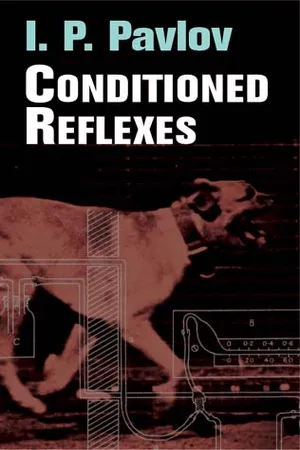
- 448 pages
- English
- ePUB (mobile friendly)
- Available on iOS & Android
eBook - ePub
Conditioned Reflexes
About this book
Information
LECTURE XXI
Pathological disturbances of the cortex, resutt of surgical interference (continued): attempt to correlate the general post-operative behaviour of the animals with the disturbances in the activity of individual analysers.
IT may be considered as firmly established that removal of the entire cerebral cortex converts the dog into a comparatively simple reflex machine. The animal retains the relatively limited number of unconditioned reflexes, but is completely deprived of the more complex and delicate co-ordination of its activities with the external world, since these adjustments are solely based upon innumerable conditioned reflexes established through the intermediation of the cerebral cortex. We possess also some knowledge as to the significance of different areas of the cortex—the cortical analysers, the united function of which determines the complete adjustment of the organism with its surroundings, or, in other words, determines the behaviour of the animal. A great deal can be learned of the physiological activity of the cortex as a whole by careful observation of the general state of the animal after extirpation of definite cortical areas, whether such extirpations are free from post-operative complications or are complicated by a further disintegration of the cortex through the growth of scar tissue or by other secondary effects of the operation. The present lecture will be devoted to the description of changes in the general behaviour of the animal, and an attempt will be made to correlate these changes with the different structural lesions of the cortex. We shall start our description with simpler, going on to more complicated, cases.
In one dog the upper part of the hemispheres was extirpated above the level of the gyrus sylviaticus [experiments by Dr. Orbeli]. The extirpation was made by means of a single incision on each side, the operation being performed in two stages with a long interval of time between. A fortnight after the operation upon the second hemisphere the general state of the animal became definitely constant, remaining unchanged to the end of the experiments (4 months). As before, the animal was extremely lively, and when called reacted quickly, whipping round in the direction of the call. At a first glance its condition could not be distinguished from that of a normal dog. On closer observation, however, it was possible to observe a certain ataxy of the extremities, which on running were thrown up higher and brought down more vigorously than usual. Walking upon a smooth or wet floor the animal would very often slip; moreover, on starting off it always performed some peculiar movements with its head. When walking in a definite direction the animal seldom ran into any obstacle, but as soon as it did encounter an obstacle a surprising abnormality in its behaviour appeared. It became entirely helpless if it ran even against the narrow leg of a table; for a long time it would go on pressing forward, until slipping accidentally it would get by; and this was the only way in which the animal could continue its progression. When placed with the front part of its body on a chair and then called, the dog started disorderly scrambling movements and fell off the chair sideways, or sometimes, moving forwards, it contrived to get its whole body on to the chair, where it remained, helplessly kicking its hind legs in the air. The foregoing is a brief sketch of the general abnormality of the dog.
Coming now to the study of its conditioned reflexes, it was found that all those which were present before the second operation became, with the exception of tactile and thermal reflexes, quickly restored, while new conditioned reflexes to olfactory and visual stimuli were easily established. Unconditioned reflexes to various tactile and thermal cutaneous stimuli were present—various “shaking,” flexion and extension reflexes, responses by whining, howling and turning the head towards the point of application of the stimulus. I shall endeavour to correlate these deviations of the animal from normal with the disturbances of the functions of the different analysers. The activity of the olfactory and acoustic analysers was entirely unimpaired, and the activity of the visual analyser was only slightly disturbed. Remembering the peculiar movements of the head in locomotion, and taking into account that the a...
Table of contents
- Title Page
- Copyright Page
- Dedication
- EDITOR’S PREFACE
- AUTHOR’S PREFACE
- PREFACE TO - THE RUSSIAN EDITION
- Table of Contents
- LECTURE I
- LECTURE II
- LECTURE III
- LECTURE IV
- LECTURE V
- LECTURE VI
- LECTURE VII
- LECTURE VIII
- LECTURE IX
- LECTURE X
- LECTURE XI
- LECTURE XII
- LECTURE XIII
- LECTURE XIV
- LECTURE XV
- LECTURE XVI
- LECTURE XVII
- LECTURE XVIII
- LECTURE XIX
- LECTURE XX
- LECTURE XXI
- LECTURE XXII
- LECTURE XXIII
- BIBLIOGRAPHY
- INDEX
Trusted by 375,005 students
Access to over 1.5 million titles for a fair monthly price.
Study more efficiently using our study tools.
Frequently asked questions
Yes, you can cancel anytime from the Subscription tab in your account settings on the Perlego website. Your subscription will stay active until the end of your current billing period. Learn how to cancel your subscription
No, books cannot be downloaded as external files, such as PDFs, for use outside of Perlego. However, you can download books within the Perlego app for offline reading on mobile or tablet. Learn how to download books offline
Perlego offers two plans: Essential and Complete
- Essential is ideal for learners and professionals who enjoy exploring a wide range of subjects. Access the Essential Library with 800,000+ trusted titles and best-sellers across business, personal growth, and the humanities. Includes unlimited reading time and Standard Read Aloud voice.
- Complete: Perfect for advanced learners and researchers needing full, unrestricted access. Unlock 1.5M+ books across hundreds of subjects, including academic and specialized titles. The Complete Plan also includes advanced features like Premium Read Aloud and Research Assistant.
We are an online textbook subscription service, where you can get access to an entire online library for less than the price of a single book per month. With over 1.5 million books across 990+ topics, we’ve got you covered! Learn about our mission
Look out for the read-aloud symbol on your next book to see if you can listen to it. The read-aloud tool reads text aloud for you, highlighting the text as it is being read. You can pause it, speed it up and slow it down. Learn more about Read Aloud
Yes! You can use the Perlego app on both iOS and Android devices to read anytime, anywhere — even offline. Perfect for commutes or when you’re on the go.
Please note we cannot support devices running on iOS 13 and Android 7 or earlier. Learn more about using the app
Please note we cannot support devices running on iOS 13 and Android 7 or earlier. Learn more about using the app
Yes, you can access Conditioned Reflexes by I. P. Pavlov, G. V. Anrep in PDF and/or ePUB format, as well as other popular books in Psychology & History & Theory in Psychology. We have over 1.5 million books available in our catalogue for you to explore.