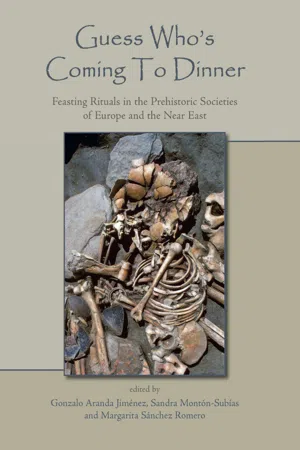
Guess Who's Coming to Dinner examines how specific types of food were prepared and eaten during feasting rituals in prehistoric Europe and the Near East. Such rituals allowed people to build and maintain their power and prestige and to maintain or contest the status quo. At the same time, they also contributed to the inner cohesion and sense of community of a group. When eating and drinking together, people share thoughts and beliefs and perceive the world and human relationships in a certain way. The twelve contributions to this book reflect the main theoretical and methodological issues related to the study of food and feasting in prehistoric Europe and the Near East.
The book is introduced by Ferrán Adrià, considered to be the world's greatest chef. Famed for his "molecular gastronomy", he invented the technique of reducing foods to their essence and then changing how they are presented, for example in the form of foam. In 2010,he was named Best Chef of the Decade by the prestigious Restaurant magazine.
eBook - ePub
Guess Who's Coming To Dinner
Feasting Rituals in the Prehistoric Societies of Europe and the Near East
- 192 pages
- English
- ePUB (mobile friendly)
- Available on iOS & Android
eBook - ePub
Guess Who's Coming To Dinner
Feasting Rituals in the Prehistoric Societies of Europe and the Near East
About this book
Information
Subtopic
Ancient HistoryIndex
History1
APPETITE COMES WITH EATING: AN OVERVIEW OF THE SOCIAL MEANING OF RITUAL FOOD AND DRINK CONSUMPTION
Gonzalo Aranda Jiménez, Sandra Montón-Subías,
Margarita Sánchez Romero and Eva Alarcón García
Margarita Sánchez Romero and Eva Alarcón García
In Stanley Kramer’s famous 1967 film about the romance between a young white American woman and her African-American fiancé, a family dinner serves as the backdrop for the disclosure of the couple’s inter-ethnic relationship in the context of late 1960s racial tensions in the US. The film dramatically (and at times, also comically) highlights the social and communicative dimensions of food practices, and that is precisely the focus of Guess Who’s Coming to Dinner: Feasting Rituals in the Prehistoric Societies of Europe and the Near East.
The purpose of this book is to make available for a broader international audience the 11 presentations given at the workshop of the same title held in Granada (Spain) in 2009. Research on the social contexts of food and drink consumption has gained tremendous importance in the field of archaeology in recent years. Studying where, when, why, by whom and under what circumstances specific foods were prepared and consumed is increasingly recognised as fundamental to understanding the dynamics of past societies. It throws light on issues such as the construction and transformation of power and status relationships, the formation of various types of individual and collective identities, or the connection between human beings and the environment – it shows us how different ways of understanding the world were expressed.
Feeding practices are some of the most fundamental activities in society – they help establish and sustain social life. Having food is not simply about feeding ourselves, nor is feeding a purely biological fact. Although food consumption is universal, the practices whereby it is materialised in each specific historical and spatial context are widely diverse. Social groups select foodstuffs and prepare and organize meals in accordance with cultural norms that define what can be eaten and how. The process involves historically determined social patterns, such as taboos, ritual prescriptions, and religious prohibitions. Eating is basically a social activity.
Through food consumption networks of personal relationships are created and maintained, and social bonds are constructed and expressed. The politics of food consumption plays a key role in the definition and creation of identity and difference, both at the individual and the collective scale. In this sense, the way foodstuffs are produced, prepared, distributed and consumed both generates and expresses ethnic and nationalistic feelings, as well as differences based on gender, class, age, etc. Preference for a certain type of food – or indeed, aversion to it – along with rules regarding how it should be prepared, served and consumed, afford a sense of communal identity and belonging, helping to establish the contrast between those inside the social group and the outsiders. Food consumption is closely linked to one’s self-image and how it is outwardly projected, and is also one of the fundamental cohesive mechanisms within any given community. Food universally expresses sociability and hospitality; sharing food creates and sustains a group’s sense of communion.
The creation of a communal identity generates a feeling of cohesion and belonging, of collective principles and views, of a shared understanding of the general and the particular, the human and the divine. Quite often this is connected with events linked to intense personal and collective experiences: on special occasions such as births, weddings, deaths, rites of passage, religious festivities, sowing and harvesting, seasonal changes, etc., food consumption becomes emotionally charged; its patterns help define and structure the passing of time, and indeed life itself on both the personal and the social level. Food consumption is a privileged locus for the expression and reproduction of worldviews and belief systems and the symbolic structuration of reality. Dividing foodstuffs into categories such as healthy/unhealthy, ordinary/festive, good/bad, male/ female, sacred/profane, pure/impure, for children/for adults, for masters/for slaves, etc. helps establish the norms defining our relationship with ourselves, with others, and with our social and natural environment.
Both collectively and individually, food consumption is, moreover, a vehicle for the transmission of memory, i.e. historically established knowledge. Communal and personal attitudes toward food are usually learnt within a social network – the family, the ethnic group, the social class, or the local or regional community. Culinary rules are part of the knowledge and skills acquired during a human being’s socialization process. Food embodies the values and relations of the society where one lives, which are both reproduced and modified by collective and individual behaviour. What we eat – and how we prepare and consume it – is connected to our memory of the past, our definition of the present, and our construction of the future.
In the study of communal food consumption, its role in the representation and transformation of social relationships deserves special attention. Different food practices may afford opportunities for social mobility and transformation, as individuals and groups may seek to assert their status in front of others, competing for power, challenging order and authority, and in general pursuing their political and economical goals. In this context, food and drink consumption helps establish bonds of reciprocity which generate social credit, influence, prestige, debts and obligations, etc. The efforts and resources invested in commensality practices thus become extremely valuable – though intangible – assets: what has been defined as symbolic capital. The polysemic complexity of commensality practices results in transversal networks of cohesion that establish boundaries, with the concomitant feelings of inclusion and exclusion. Food-related behaviour signals social similarities as well as differences; it hierarchically classifies individuals and groups, embodying worldviews and evoking such highly charged symbolic meaning that, as the saying goes, we are what we eat.
Research on the social context of food consumption has advanced enormously in the field of anthropology in recent decades – in stark contrast with archaeology, which remains focused on other cultural issues. The fact is that the prevailing historicist, paleoeconomical or processual paradigms tend to privilege the archaeological study of resource acquisition at the expense of other areas of inquiry such as the analysis of food consumption. This is all the more surprising given that archaeological evidence usually comprises a great deal of material elements and contexts connected with the processing, preparation, and consumption of food and drink.
The situation has changed in recent years, however, as growing interest in food practices is leading to a substantial increase of research on the subject. As mentioned above, Guess Who’s Coming to Dinner gathers 11 contributions to the study of the commensal consumption of food, spanning millennia of Prehistory from the last hunter-gatherer communities to the earliest proto-urban societies. Throughout this vast period, the ritual consumption of food and drink has taken widely different forms and meanings, which the essays in this book discuss through different case examples, in connection with the main theoretical and methodological issues in the field.
In the second chapter of the book, Margarita Sánchez-Romero deals with socioideological issues from a theoretical approach, reflecting on the interplay between food consumption, authority and power structures. She provides, in addition, an in-depth review of the methods for the detection of food consumption in archaeological material, especially in human bodies, and recapitulates how certain crucial areas of archaeological investigation – such as diet in human evolution, processes of breast feeding and weaning, mobility patterns, or cannibalism – belong to the sphere of food consumption.
There follow next ten case studies devoted to different areas of Europe and the Near East, in periods ranging from the Epipaleolithic to the Iron Age. Combining archaeological and ethnographic evidence, these studies examine multiple hypotheses on the purposes of commensal practices and discuss issues of great relevance, such as the indicators that may throw light on feasting, or the methodological procedures to access commensality. Despite their focus on specific time-frames, taken all together these studies offer a useful overview of the state of the art in our discipline.
Adopting political ecology as a theoretical framework, in chapter three Bryan Hayden puts forward a hypothesis that integrates feasting in the social course of the Fertile Crescent’s Epipaleolithic communities. He advocates a multi-site, regional approach to understanding feasting, whose importance as a precondition for animal and plant domestication he deems paramount. Given the connection between feasts and the process of domestication, and in light of the data from multiple excavations at Natufian and closely related sites in the Near East, a synthetic analysis of Natufian feasting behaviour gains special theoretical and methodological significance. Hayden reviews the available information on Natufian feasting based on artefacts, fauna, flora, environmental factors, prestige items and burials, presenting inferences about the nature and size of feasts together with their implications for Natufian social structure.
Focusing on the period when feasting first emerged in the Near East, Hayden considers this phenomenon at different levels, examining its context, its role in a community’s social dynamic, and the social groups that sponsored feasting events. In a setting characterized by trans-egalitarian communities strongly organized around corporate descent groups – Hayden suggests-, feasting served (along with other strategies) as a self-aggrandising mechanism promoting the interests of high-ranking individuals – which contributed to the shift from egalitarian into trans-egalitarian societies.
Remaining in the same geographical area but moving ahead in time, in chapter four Nigel Goring-Morris and Anna Belfer-Cohen analyse funeral feasting – and specially cattle consumption – in the context of increasing behavioural complexity during the Neolithic. They also review the symbolic dimensions that different researchers have attributed to bulls in Neolithic societies of the Northern Levant and Anatolia, critically reevaluating the archaeological evidence that supports such interpretations. They then turn to the Southern Levant, and hypothesize that mortuary feasting rituals are the most likely explanation for the increase in the presence of wild cattle in that area.
Still in the Neolithic period, but shifting the focus to such an emblematic site as Stonehenge, in chapter five Mike Parker Pearson, Joshua Pollard, Colin Richards, Julian Thomas, Kate Welham, Umberto Albarella, Ben Chan, Peter Marshall and Sarah Viner discuss the remains recovered from the related site of Durrington Walls as evidence of feasting: pottery, flint tools, cattle and pig bones, and carbonised plant remains. Large quantities of food remains – it turns out – were deposited within domestic and public spaces during seasonal gatherings at Durrington Walls over a short period of less than 50 years. The brief time span of the site’s occupation, taken together with the large amount of pig and cattle remains, and the evidence for seasonality of consumption, suggest that during the Late Neolithic period people gathered there to engage in communal feasting. The site’s chronological and structural relationship with Stonehenge suggests, furthermore, that the feasting at Durrington Walls may have been connected with the building of the famous stone circle.
In chapter six, Paul Halstead and Valasia Issakidou move to Greece for a cross-comparison of ceremonial commensality in the societies of the Neolithic period and the Aegean Bronze Age, evaluating architectural, ceramic and faunal evidence, with specific attention to scale, material elaboration, (a)symmetry between participants, and ritualisation. The ‘palatial’ societies of Southern Greece’s second millennium BC are well known for diacritical feasting: elite dining was characterised by the use of high-value ingredients (including exotic spices), varied methods of cooking (some probably involving specialised staff), and a recognisable etiquette; participants were differentiated by the use of reception spaces and utensils of contrasting status. This inegalitarian society was legitimised by sacrifice.
Halstead and Issakidou compare this picture of diacritical feasting with the more enigmatic archaeological records from the Neolithic (seventh-fourth millennium BC) and Early Bronze Age (third millennium BC) in the Aegean, discussing two basic issues: (1) whether food and commensality merely expressed the changes in social relations, or also played a part in promoting them; (2) and whether second millennium diacritical feasting may be seen as part of a wider shift in the value regimes that underpinned palatial strategies of mobilisation. Halstead and Issakidou argue that commensality played a central role in shaping social relations and material culture in the earlier periods, and that asymmetry between hosts and guests, though also signalled to some degree in the Early Bronze Age, was deliberately played down during the Neolithic. Halstead and Issakidou show us how changes in commensal events parallel social change in the area; commensal practices – they claim – reflect the increase in social asymmetry from the Early Bronze Age, and a triumph of household bonds over collective solidarity from the later Neolithic onwards.
Bell-beaker pottery from Central Iberia is the focus of chapter seven, where the symbolic and socio-political context of commensality rituals involving its use is analysed by Rafael Garrido-Pena, Manuel A. Rojo-Guerra, Iñigo García-Martínez de Lagrán and Cristina Tejedor-Rodríguez. The small number of available Bell-beaker vessels – as compared with other kinds of pottery – along with their fine finish and their nonfunctional features probably rendered them unfit for everyday use, but particularly apt for special occasions such as feasting rituals, both in settlements and in tombs. The authors discuss the symbolic meaning of these vessels in funerary contexts, and the tense politics of the Beaker period, characterised by power struggles and unstable leadership. In such a context – they argue – feasts hosted by emerging leaders involved the donation of large amounts of food and alcohol, and helped mobilize the workforce and recruit supporters.
Still in the Iberian Peninsula, but farther to the Southwest, in chapter eight Gonzalo Aranda Jiménez and Sandra Montón-Subías analyse Bronze Age funeral feasting in Argaric Societies, focusing specifically on faunal remains from multiple tombs – almost exclusively bovine and ovicaprines. Consumption of these types of meat was an integral part of the funerary ritual, and certain cuts – always from the animal’s limbs – were deposited as offerings among the grave goods buried with the dead. Interestingly enough, the type of meat that was consumed depended on the social status of the deceased. Cattle would be slaughtered in ceremonies involving people of the highest social order, while sheep and goat were used for people of a lower standing. The aim of Argaric commensality practices – according to Aranda Jiménez and Montón-Subías – was twofold: to strengthen social cohesion and solidarity while simultaneously displaying and naturalizing asymmetry within the community.
In chapter nine Xosé-Lois Armada takes us north to the Peninsula’s Atlantic coast for a study of Late Bronze Age banqueting practices and their connection with power and social inequality. Although feasts are considered a key element in the period’s political strategies, their material record has not always received sufficient scholarly attention, and Armada offers us an updated review of the available archaeological evidence with special emphasis on metal implements such as cauldrons, flesh-hooks, rotary spits, bowls and stands. He then attempts to modelize these objects’ social function, geographical dispersal and technological complexity from a biographical perspective, taking into account the dynamics of Spain’s Atlantic area during the Late Bronze Age and its interaction with the Mediterranean region.
Food and nutrition-related material culture from various Occidental Phoenician settlements, resulting from ritual practices connected with the life cycle in domestic and funereal contexts, is analysed in chapter ten by Ana Delgado and Meritxell Ferrer, who carefully explore the social and ideological dimension of food – everyday food in particular – in the processes of construction and representation of Phoenician communities. Both within the diasporic communities of the Occidental Phoenicians and in the larger Mediterranean context, a series of changes in material culture can be observed between the 8th and the 5th century BC, coinciding with pivotal mutations in economic activity and socio-political relationships. These transformations challenge traditional notions of material culture as a conservative, eminently passive and static sphere, disconnected from the dynamics of social change.
The last two chapters deal with the culture that gave its name to the Iberian Peninsula, focusing on Spain’s North-eastern area. Iberian culture emerged in the 6th century BC and developed until the 1st century BC, slowly fading as a result of the country’s Romanization.
In chapter eleven, Ramon Buxó and Jordi Principal discuss the contrast between exceptional and everyday forms of commensality, focusing on domestic units and the social dimension of commensality in the domestic domain. Domestic commensality is bound to reflect the codification of consumption relationships as established within the household as a unit, i.e.: who controls and manages food, how the process of terminal consumption is organised, and which cultural criteria regulate how the nutritional needs of the various household members are perceived. From this perspective, everyday commensality can be seen as just another manifestation of power relations within household units, which are in turn linked as such with power relations within human society at large. Buxó’s and Principal’s approach to the study of everyday commensa...
Table of contents
- Cover Page
- Title Page
- Copyright
- Contents
- CONTRIBUTORS
- PROLOGUE
- 1: APPETITE COMES WITH EATING : AN OVERVIEW OF THE SOCIAL MEANING OF RITUAL FOOD AND DRINK CONSUMPTION
- 2: COMMENSALITY RITUALS: FEEDING IDENTITIES IN PREHISTORY
- 3: FEASTING AND SOCIAL DYNAMICS IN THE EPIPALEOLITHIC OF THE FERTILE CRESCENT: AN INTERPRETIVE EXERCISE
- 4: EVOLVING HUMAN/ANIMAL INTERACTIONS IN THE NEAR EASTERN NEOLITHIC: FEASTING AS A CASE STUDY
- 5: FEEDING STONEHENGE: FEASTING IN LATE NEOLITHIC BRITAIN
- 6: POLITICAL CUISINE: RITUALS OF COMMENSALITY IN THE NEOLITHIC AND BRONZE AGE AEGEAN
- 7: DRINKING AND EATING TOGETHER: THE SOCIAL AND SYMBOLIC CONTEXT OF COMMENSALITY RITUALS IN THE BELL BEAKERS OF THE INTERIOR OF IBERIA (2500–2000 CAL BC)
- 8: FEASTING DEATH: FUNERARY RITUALS IN THE BRONZE AGE SOCIETIES OF SOUTH-EASTERN IBERIA
- 9: FEASTING METALS AND THE IDEOLOGY OF POWER IN THE LATE BRONZE AGE OF ATLANTIC IBERIA
- 10: REPRESENTING COMMUNITIES IN HETEROGENEOUS WORLDS: STAPLE FOODS AND RITUAL PRACTICES IN THE PHOENICIAN DIASPORA
- 11: CONSUMPTION RELATIONS IN NORTHERN IBERIAN HOUSEHOLDS
- 12: THE ARCHAEOLOGICAL IDENTIFICATION OF FEASTS AND BANQUETS: THEORETICAL NOTES AND THE CASE OF MAS CASTELLAR
Trusted by 375,005 students
Access to over 1.5 million titles for a fair monthly price.
Study more efficiently using our study tools.
Frequently asked questions
Yes, you can cancel anytime from the Subscription tab in your account settings on the Perlego website. Your subscription will stay active until the end of your current billing period. Learn how to cancel your subscription
No, books cannot be downloaded as external files, such as PDFs, for use outside of Perlego. However, you can download books within the Perlego app for offline reading on mobile or tablet. Learn how to download books offline
Perlego offers two plans: Essential and Complete
- Essential is ideal for learners and professionals who enjoy exploring a wide range of subjects. Access the Essential Library with 800,000+ trusted titles and best-sellers across business, personal growth, and the humanities. Includes unlimited reading time and Standard Read Aloud voice.
- Complete: Perfect for advanced learners and researchers needing full, unrestricted access. Unlock 1.5M+ books across hundreds of subjects, including academic and specialized titles. The Complete Plan also includes advanced features like Premium Read Aloud and Research Assistant.
We are an online textbook subscription service, where you can get access to an entire online library for less than the price of a single book per month. With over 1.5 million books across 990+ topics, we’ve got you covered! Learn about our mission
Look out for the read-aloud symbol on your next book to see if you can listen to it. The read-aloud tool reads text aloud for you, highlighting the text as it is being read. You can pause it, speed it up and slow it down. Learn more about Read Aloud
Yes! You can use the Perlego app on both iOS and Android devices to read anytime, anywhere — even offline. Perfect for commutes or when you’re on the go.
Please note we cannot support devices running on iOS 13 and Android 7 or earlier. Learn more about using the app
Please note we cannot support devices running on iOS 13 and Android 7 or earlier. Learn more about using the app
Yes, you can access Guess Who's Coming To Dinner by Gonzalo Aranda Jiménez, Sandra Montón-Subias, Margarita Sánchez Romero, Gonzalo Aranda Jiménez,Sandra Montón-Subias,Margarita Sánchez Romero, Margarita Sánchez Romero in PDF and/or ePUB format, as well as other popular books in History & Ancient History. We have over 1.5 million books available in our catalogue for you to explore.