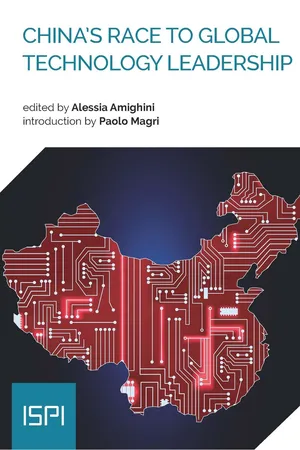
The current trade war between the US and China looks like a small piece in a much larger puzzle over world leadership in which China plays the part of the ascending challenger seeking to upset the existing balance of power. Technology and innovation seem to be Beijing's weapons of choice in its frontal assault on Washington in sectors traditionally led by the US.China is not only acquiring technology. Its ambitions include the regulation of international trade and global governance. Just what a China-led global order would look like is still unclear, but the inherent side-effects of technology need to be meticulously assessed, as they have the potential to alter the core values of modern societies. To what extent will technology facilitate China's rise?
- 122 pages
- English
- ePUB (mobile friendly)
- Available on iOS & Android
eBook - ePub
China's Race to Global Technology Leadership
About this book
Trusted by 375,005 students
Access to over 1.5 million titles for a fair monthly price.
Study more efficiently using our study tools.
Information
5. Case Study: China’s “Giant Leap” Towards Fintech
Paolo Giudici
China’s race to global technology leadership includes the development of a strong financial technology (fintech) sector among its priorities.
Financial technology platforms lead to cost reduction, and to an improved user experience. However, these improvements may come at the price of inaccurate risk measurements, which can hamper a platform’s users and endanger the stability of a financial system. In this chapter, we propose how to improve the credit risk accuracy of peer-to-peer platforms, to make them sustainable regardless of the country in which they are based. To achieve this goal, we propose augmenting traditional credit-scoring methods with centrality measures derived from network models of borrowers, estimated from their financial activity. We apply our proposal to fintech platforms in China and Italy characterised, respectively, by a large and a small incidence of fintech activities. Our empirical findings show that, in both cases, the inclusion of network centralities improves credit risk models and, therefore, makes fintech innovations sustainable.
In recent years, the emergence of financial technologies (fintechs) has redefined the roles of traditional intermediaries and has introduced many opportunities for consumers and investors. Here we focus on peer-to-peer (P2P) online lending platforms, which allow private individuals to directly make small and unsecured loans to private borrowers, such as individuals and small/medium enterprises.
The recent growth of peer-to-peer lending is due to several “push” factors. First, when compared to classic banks, P2P platforms have much lower intermediation costs. Second, the evolution of big data analytics and Artificial Intelligence enables P2P platforms to provide banking services that can improve personalisation and, therefore, user experience. A third push factor is the presence of favorable, or absent, regulation. An example of favorable regulation is the European Payment Service Directive (PSD2), which discloses bank clients’ account information to fintechs through application payment interfaces (API) that take consumer’s consent and ethics into account.
P2P lending business models vary in scope and structure: a comprehensive review is provided by Claessens et al. (2018). Here we specifically refer to the platforms that lend themselves to small and medium enterprises (SME), as in the paper by Giudici, Hadji-Misheva and Spelta (2019). A key point of interest to assess the sustainability of P2P lenders is to evaluate the accuracy of the credit risk measurements they assign to the borrowers.
While both classic banks and P2P platforms rely on credit-scoring models for the purpose of estimating the credit risk of their loans, the incentive for model accuracy may differ significantly. In a bank, the assessment of the credit risk of the loans is conducted by the financial institution itself, which, being the actual entity that assumes the risk, is interested in having the most accurate model possible. In a P2P lending platform, the credit risk of the loans is determined by the platform but the risk is fully borne by the lender (Serrano-Cinca et al., 2016). In other words, P2P lenders allow for direct matching between borrowers and lenders, without the loans being held on the intermediary’s balance sheet (Milne and Parboteeah, 2016).
From a different perspective, while in classic banking the financial institution chooses its optimal trade-off between risks and returns, subject to regulatory constraints, in P2P lending the platform maximises its returns, without taking care of the risks that are borne by the lenders.
Another factor that penalises the accuracy of P2P credit-scoring models is that they often do not have access to the borrowers’ data usually employed by banks, such as account transaction data, financial data and credit bureau data. For these reasons, the accuracy of credit risk estimates provided by P2P lenders may be poor. However, P2...
Table of contents
- Cover
- China’s Race to Global Technology Leadership
- Colophon
- Table of Contents
- Introduction
- Beijing: Ready for Global Technology Leadership?
- China’s Technological Prowess
- Competing Over Leadership: China vs the US
- A Green China
- Case Study: China’s “Giant Leap” Towards Fintech
- Footnotes
- The Authors
Frequently asked questions
Yes, you can cancel anytime from the Subscription tab in your account settings on the Perlego website. Your subscription will stay active until the end of your current billing period. Learn how to cancel your subscription
No, books cannot be downloaded as external files, such as PDFs, for use outside of Perlego. However, you can download books within the Perlego app for offline reading on mobile or tablet. Learn how to download books offline
Perlego offers two plans: Essential and Complete
- Essential is ideal for learners and professionals who enjoy exploring a wide range of subjects. Access the Essential Library with 800,000+ trusted titles and best-sellers across business, personal growth, and the humanities. Includes unlimited reading time and Standard Read Aloud voice.
- Complete: Perfect for advanced learners and researchers needing full, unrestricted access. Unlock 1.5M+ books across hundreds of subjects, including academic and specialized titles. The Complete Plan also includes advanced features like Premium Read Aloud and Research Assistant.
We are an online textbook subscription service, where you can get access to an entire online library for less than the price of a single book per month. With over 1.5 million books across 990+ topics, we’ve got you covered! Learn about our mission
Look out for the read-aloud symbol on your next book to see if you can listen to it. The read-aloud tool reads text aloud for you, highlighting the text as it is being read. You can pause it, speed it up and slow it down. Learn more about Read Aloud
Yes! You can use the Perlego app on both iOS and Android devices to read anytime, anywhere — even offline. Perfect for commutes or when you’re on the go.
Please note we cannot support devices running on iOS 13 and Android 7 or earlier. Learn more about using the app
Please note we cannot support devices running on iOS 13 and Android 7 or earlier. Learn more about using the app
Yes, you can access China's Race to Global Technology Leadership by Alessia Amighini in PDF and/or ePUB format, as well as other popular books in Politics & International Relations & Science & Technology Public Policy. We have over 1.5 million books available in our catalogue for you to explore.