Chinese folklorists are well acquainted with the work of their English-language colleagues, but until recently the same could not be said about American scholars' knowledge of Chinese folkloristics. Chinese Folklore Studies Today aims to address this knowledge gap by illustrating the dynamics of contemporary folklore studies in China as seen through the eyes of the up-and-coming generation of scholars. Contributors to this volume focuses on topics that have long been the dominant areas of folklore studies in China, including myth, folk song, and cultural heritage, as well as topics that are new to the field, such as urban folklore and women's folklore. The ethnographic case studies presented here represent a broad range of geographic areas within mainland China and also introduce English-language readers to relevant Chinese literature on each topic, creating the foundation for further cross-cultural collaborations between English-language and Chinese folkloristics.
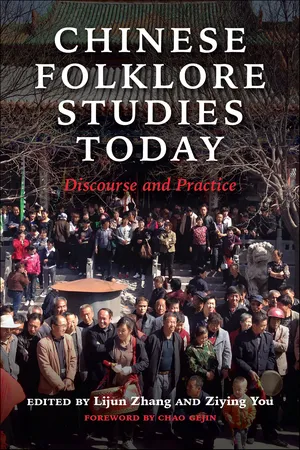
- 182 pages
- English
- ePUB (mobile friendly)
- Available on iOS & Android
eBook - ePub
About this book
Information
Topic
Scienze socialiSubtopic
Storia cinese1
DISCIPLINARY TRADITION, EVERYDAY LIFE, AND CHILDBIRTH NEGOTIATION
The Past and Present of Chinese Urban Folklore Studies
Yongyi Yue Translated by Wenyuan Shao and Yuanhao Zhao
CONTEMPORARY CHINA IS IN THE MIDST OF A transformation from a rural society to an urbanized one. Due to the universal presence of science and technology in cities and villages, people’s work and lives are undergoing continuous revolution. Not only have the rural elements of cities been reduced, but everyday life in villages is now influenced to a certain degree by the urban. This trend requires folklore studies, as a contemporary discipline, to transform itself from the nostalgic, rural folklore studies that looked to the past into an urban folklore studies that looks at contemporary life. While studying urban legends, anecdotes, and other forms of oral literature, in addition to documentation, Chinese folklorists have started to conduct chronological research on the everyday lives of street artists, rickshaw drivers, and others. However, long before the outbreak of the Pacific War, Yang Kun and his students had already been studying urban life by carrying out a comprehensive survey on childbirth customs in Beijing. In line with this disciplinary tradition, this chapter depicts the dynamics of childbirth customs in contemporary Beijing in the context of social transformation and life revolution relating to modernity, including the coexistence of and negotiation among the wide acceptance of gynecology and other specialized knowledge, state surveillance on childbirth activities, and traditional conceptions of fertility rooted in beliefs in supernatural powers. These progressive revolutions are happening on a daily basis and are challenging the narratives, expressions, and interpretations that make up contemporary Chinese folklore studies.
Transformations in the Discipline of Chinese Folkloristics
After China’s Reform and Opening Up led to faster economic development, rural people witnessed rapid and profound changes in their everyday lives in transformative or even revolutionary ways. Chinese folklorists attempted to accommodate these social changes with new voices. Zhong Jingwen (1903–2002), known as the “Father of Chinese Folklore Studies,” played a major role at this time. During the summer of 1978, with the relaxation of political discourse, Zhong, together with Gu Jiegang (1893–1980), Yang Kun (1901–98), Yang Chengzhi (1901–91), and two other professors, proposed to resume folklore research and reestablish related institutions (Zhong 2002, 679–83). Under his proposal and leadership, the Chinese Folklore Society was established in May of 1983 (Zhong 2002, 613–16). During the “Cultural Enlightenment” movement in the 1980s, Zhong Jingwen actively engaged in the Cultural Fever discussion and advocated for the “study of folk culture” (Zhong 1996). In this way, he drew public attention to folklore studies as a discipline and folk culture as part of everyday life (Liu 2002).
Since the 1990s, with the recovery of sociology, anthropology, and other disciplines and more frequent exchanges among different disciplines, in addition to the translation and introduction of many foreign theories, Chinese folklore studies has experienced holistic transformation from focusing on folk literature to the inclusion of religious beliefs, festivals, ceremonies, rites of passages, and other social and behavioral aspects. Even when studying orally transmitted folk literature, scholars went beyond the topics of themes, plot, genre, function, and other text-based studies. Instead, they examined these texts closely in specific contexts, paying attention to factors such as narrator, audience, place, time, motivation, and style, all of which influence each other and form the “at present” storytelling event (Nishimura 2011; Zhu 2013). Furthermore, oral literature obtained from fieldwork becomes supporting data for the study of other forms of folklife, and thus becomes a part of the folklore studies that focuses on behavior and process. In other words, there was a major turn from textual analysis to fieldwork-based contextual study in the field of Chinese folklore studies (Liu 2009).
In addition to folklorists’ active response to and reflection upon social changes, the introduction of foreign folklore studies, anthropology, sociology, and other related fields also played a significant role in the shift of focus in Chinese folklore studies. Research and theories introduced included “fakelore,” public folklore, and performance theory from the United States; village folklore studies proposed by Japanese folklorists, especially the joint investigation of Sino-Japanese village folklore led by Fukuta Ajio, which lasted almost twenty years; folklorism from Germany; Clifford Geertz’s interpretative anthropology with the core concepts of “thick description” and “local knowledge”; James Scott’s political sociology on everyday resistance of the weak; phenomenology; and so forth.
Meanwhile, Gao Bingzhong’s (1994) analysis of the semantic history of minsu 民俗 (folklore) inherited what our forerunners had left us and also moved forward with new trends that have been very influential in the study of folklore. Liu Tieliang’s understanding of the epistemology and methodology of folklore studies as well as his practice of what he advocates have always been of exemplary significance. In 1996, Liu strongly advocated that Chinese folklorists should treat villages as the time-space units for observing folklore transmission (Liu 1996). He emphasized that folkloric ethnography (minsu zhi 民俗志) is not just the documentation of folklore, but itself a way of doing research “driven by research questions” (Liu 1998). After many years of village ethnographic studies, he proposed the idea of writing folkloric ethnography with a “representative culture-oriented” style and enlarged his time-space units of field research from villages to counties and districts (Liu 2005).
Against the background of disciplinary transformation and the acceleration of rural-urban integration since the Reform and Opening Up, urban folklore, with equal emphasis on documentation and research, entered the spotlight. In 1992, the Shanghai Folk Literature and Art Association published an edited series entitled Chinese Folk Culture (Zhongguo minjian wenhua 中国民间文化) in which the eighth volume was devoted to “An Introduction to Urban Folklore Studies.” More or less influenced by the newly emerged Japanese urban folklore studies, this volume mainly followed the tradition of ancient books such as Dongjing menghua lu 东京梦华录 (The Eastern Capital: A Dream of Splendor) and Meng Liang lu 梦梁录 (A Dream of Lin’an) by focusing on perished urban folklore. More than ten years later, Chinese folklorists tried to establish urban folklore studies as a subfield of folklore studies covering topics such as systematic research, the protection of urban folklore resources, the shifting of folklore centers, agents and space mobility, the adjustment between tradition and modernity, and so on (Tao 2004). Compared to the booming field of rural folklore at that time, studies on urban folklore were still relatively narrow and marginal. Most were related to urban legends and specific groups. Moreover, in studying specific groups in cities, scholars mainly concentrate on groups who carry on historical traditions in Beijing and other metropolitan areas, such as street artists who perform on overpasses at the Miscellaneous Place in old Beijing (Yue 2007, 2011), the old rickshaw pullers who made a living by hard labor (Yue 2015b, 93–109) and contemporary rickshaw drivers in the Shichahai area who appear as part of the cityscape and showcase old Beijing culture (Zhang 2016), and grassroots and elite pilgrim associations organizing travel to offer incense on the “golden top” of Mount Miaofeng in west Beijing (Wu 2006; Zhang 2013), as well as others. In the field of folk literature, in addition to general reflections on the current transmission of folk literature in cities (Yue 2015b, 110–22), research on contemporary urban legends is apparently influenced by American scholar Jan Harold Brunvand’s The Vanishing Hitchhiker (translated into Chinese in 2006). In the last ten years, many studies have been published on old and new urban legends in Beijing, Shanghai, and other cities, including ghost stories either similar to the vanishing hitchhiker or about freshmen on university campuses (Wang 2005; Zhang 2005, 2006; Wei 2012, 2013; Huang 2014). Now, the field of urban literature studies extends to the general study of rumor and gossip (Zhou 2010; Shi 2012) and reflections on the paradigm set up by Brunvand (Chen 2011).
Objectively speaking, since the urban lifestyle pervades rural areas, folkloric studies that limit the research subject and space to urban cities is not comprehensive enough, and such scholars also neglect the general trend in China where most cities have become cities of migration. It is undeniable that significant numbers of “migrant workers” (mingong 民工) who have entered the city from the countryside in pursuit of a better livelihood have brought their own perspectives and customs and thereby enriched the city with rural culture. At the same time, migrant workers become the soil and medium where legends are formed and transmitted. In other words, a geographically defined Chinese village has urban traits. Similarly, a geographically defined Chinese city has noticeable characteristics of rural culture and life. This is why, while using the term urban folklore to designate his recent studies, Yongyi Yue is not trying to construct a subfield of Chinese folklore studies, but rather to propose a transformation in the epistemology of folklore studies. For him, urban folklore studies, contrary to its literal meaning, does not emphasize something distinct from the rural and the traditional. Nor is it only about collecting, recording, and sorting out folkloric data. It is “an epistemological paradigm which is valuable as a frame of reference, and a way of knowing the world and its tendency from the everyday life of the people” (Yue 2015b, 315). For this purpose, Yue points out, “If rural folklore studies center on the agricultural civilization and related lifestyle in the process of modernization—based on rural China as a starting point and as the center, then urban folklore studies center and emphasize on the contemporary urban lifestyle that is dominated by industrial civilization and scientific and technological civilization—based on contemporary China as the center and expanding the studies from this starting point” (Yue 2015b, 317).
At the same time, he also notes that the basic gestures of “looking downward” and “looking backward” adopted by rural folklore studies, based on the theory of linear evolution, should be abandoned. In terms of space, Yue tries to break down the mechanical separation between cities and villages, emphasizing the rural character of contemporary urban folklore and the urban character of rural folklore—that is, the interaction and intertwinement of folklore in different spaces (Yue 2015b, 320–38). Furthermore, Yue proposes that in China, where people have enjoyed a long history of rituals and customs as a form of interaction, and where the current situation is characterized by the coexistence of challenges and opportunities as well as diversity and unity, the value of human beings and the meaning of life should be the permanent core of defining urban folklore. In order to reach this basic humanistic concern, folklorists must start with people’s daily lives wherever they live (Bai 2015). Therefore, Yue moves against the tide and proposes the “ruralization of cities and towns” instead of the “urbanization of villages” that is propagandized and practiced on a grand scale in mainstream ideology (Yue 2015a). He advocates the study of shared folklore that conveys the national soul and mentality, rather than focusing only on forms of folklore that are used as “a social butterfly” and instrument by certain groups. He takes a clear stand against “elites from official media” in terms of their patronizing and egoistic attitude of “feeding back” and cultivating ordinary people (Yue 2015b, 243–55, 320–39).
Therefore, Yongyi Yue’s study of urban folklore is actually “modern folklore” that deals with everyday life in contemporary society and modernity, not just folklore in urban cities. In the field of folk literature and art, Liu Zongdi (2016) also takes a clear stand against research and application based on individualism and instrumental rationality. He sharply criticizes the biases and deficiencies of positivism in the study of folk literature and suggests “transcending the context” and “returning to the text” in the hope of refocusing research on the national mentality and commonalities, instead of merely indulging the segmented and the trivial. In his reflection on Chinese folklore studies in the past thirty years, Zhou Xing (2017) designates the dramatic change in the everyday life of the masses created by the transforming Chinese society, economy, and culture as “life revolution.” Starting from there, Zhou strongly criticizes opportunism that treats folklore as an instrument—the over-glorification of tradition, indulgence in nostalgia, and idealization of nostalgia into aesthetic subjects among Chinese intellectuals. He hopes that folklorists can face everyday life in modern Chinese society and the process of its change and document and study how common people construct their own daily lives in order to comprehend the “meaning of life.” Similarly, Lü Wei (2016) proposes in his reflection on the history of Chinese folklore studies that Chinese folklorists should forsake the existing “acquaintance principle” and move forward to the “stranger principle” while Gao Bingzhong (2017) makes a call for a “future folklore on everyday life.”
In this regard, urban folklore is a way of knowing and an epistemological paradigm. In other words, modern or new Chinese folklore studies is a criticism on the conservative attitude held by previous scholarship that cherishes the outmoded and preserves the outworn. It is also a criticism on the instrumental attitude shared by contemporary scholarship that blindly follows political trends and fashions. It reminds people that the position and pursuit of folklore studies is about human beings, transmission, and everyday life. Under this principle, this chapter examines contemporary China through the lens of childbirth, a rite of passage, of people living in Beijing—the New Beijingers.
The Neglected Disciplinary Tradition
The long-time state capital, the fluid old Beijing city is actually rural in nature.1 Or we can say it is a big, densely populated village. In this capital city, with interlaying city walls and stratifying gates, urbanites and those from the countryside from all walks of life share the same cosmology of worshipping heaven and earth and the same sense of morality whereby virtuous deeds and accomplishments should be rewarded and rulers and ancestors should be respected. Meanwhile, the Forbidden City and temples, alleys, and courtyard houses in the city share isomorphic spatial aesthetics (Yue 2016, 3–11). This rurality and isomorphism also exist in the weddings, funerals, births, and other rites of passages of most people in Beijing. The only difference is the degree of complication in the procedures. Therefore, from the late Qing to the early Republican period, the “stand-in (tishen 替身)” (Xia 1986, 41) in rich and powerful families turned into a “burnable effigy (shaotishen 烧替身)”—that is to say, “returning a child (huantonger 还童儿)” to the gods by burning a paper substitute (Wang 1940, 89; Chang 1990, 248).
In the process of modernizing old Beijing by imitating the West, with the introduction of professional midwives from church hospitals and the establishment of the police, the rites of life and death gradually got rid of old customs and embraced Western practices. This resulted in the vanishi...
Table of contents
- Cover
- Title Page
- Copyright
- Dedication
- Contents
- Foreword
- Acknowledgments
- Introduction: History and Trends of Chinese Folklore Studies
- 1. Disciplinary Tradition, Everyday Life, and Childbirth Negotiation: The Past and Present of Chinese Urban Folklore Studies
- 2. From “Women” to “Female Folklore Practitioners”: The History and Current Trend of Women’s Folklore Studies in China
- 3. A Semiotics of Song: Fusing Lyrical and Social Narratives in Contemporary China
- 4. Contested Myth, History, and Beliefs: Remaking Yao and Shun’s Stories in Hongtong, Shanxi
- 5. Institutional Practice of Heritage-Making: The Transformation of Tulou from Residences to UNESCO World Heritage Site
- Index
Trusted by 375,005 students
Access to over 1.5 million titles for a fair monthly price.
Study more efficiently using our study tools.
Frequently asked questions
Yes, you can cancel anytime from the Subscription tab in your account settings on the Perlego website. Your subscription will stay active until the end of your current billing period. Learn how to cancel your subscription
No, books cannot be downloaded as external files, such as PDFs, for use outside of Perlego. However, you can download books within the Perlego app for offline reading on mobile or tablet. Learn how to download books offline
Perlego offers two plans: Essential and Complete
- Essential is ideal for learners and professionals who enjoy exploring a wide range of subjects. Access the Essential Library with 800,000+ trusted titles and best-sellers across business, personal growth, and the humanities. Includes unlimited reading time and Standard Read Aloud voice.
- Complete: Perfect for advanced learners and researchers needing full, unrestricted access. Unlock 1.5M+ books across hundreds of subjects, including academic and specialized titles. The Complete Plan also includes advanced features like Premium Read Aloud and Research Assistant.
We are an online textbook subscription service, where you can get access to an entire online library for less than the price of a single book per month. With over 1.5 million books across 990+ topics, we’ve got you covered! Learn about our mission
Look out for the read-aloud symbol on your next book to see if you can listen to it. The read-aloud tool reads text aloud for you, highlighting the text as it is being read. You can pause it, speed it up and slow it down. Learn more about Read Aloud
Yes! You can use the Perlego app on both iOS and Android devices to read anytime, anywhere — even offline. Perfect for commutes or when you’re on the go.
Please note we cannot support devices running on iOS 13 and Android 7 or earlier. Learn more about using the app
Please note we cannot support devices running on iOS 13 and Android 7 or earlier. Learn more about using the app
Yes, you can access Chinese Folklore Studies Today by Lijun Zhang,Ziying You in PDF and/or ePUB format, as well as other popular books in Scienze sociali & Storia cinese. We have over 1.5 million books available in our catalogue for you to explore.