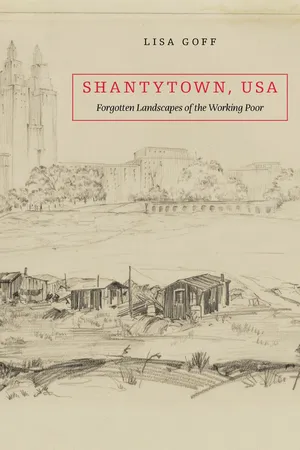
The word "shantytown" conjures images of crowded slums in developing nations. Though their history is largely forgotten, shantytowns were a prominent feature of one developing nation in particular: the United States. Lisa Goff restores shantytowns to the central place they once occupied in America's urban landscape, showing how the basic but resourcefully constructed dwellings of America's working poor were not merely the byproducts of economic hardship but potent assertions of self-reliance.
In the nineteenth century, poor workers built shantytowns across America's frontiers and its booming industrial cities. Settlements covered large swaths of urban property, including a twenty-block stretch of Manhattan, much of Brooklyn's waterfront, and present-day Dupont Circle in Washington, D.C. Names like Tinkersville and Hayti evoked the occupations and ethnicities of shantytown residents, who were most often European immigrants and African Americans. These inhabitants defended their civil rights and went to court to protect their property and resist eviction, claiming the benefits of middle-class citizenship without its bourgeois trappings.
Over time, middle-class contempt for shantytowns increased. When veterans erected an encampment near the U.S. Capitol in the 1930s President Hoover ordered the army to destroy it, thus inspiring the Depression-era slang "Hoovervilles." Twentieth-century reforms in urban zoning and public housing, introduced as progressive efforts to provide better dwellings, curtailed the growth of shantytowns. Yet their legacy is still felt in sites of political activism, from shanties on college campuses protesting South African apartheid to the tent cities of Occupy Wall Street demonstrations.
- 320 pages
- English
- PDF
- Available on iOS & Android
eBook - PDF
About this book
Information
Table of contents
- Cover
- Title
- Copyright
- Dedication
- Contents
- Preface
- Chapter 1. Walden, a Shanty or a House?
- Chapter 2. Shanties on the Western Frontier
- Chapter 3. Shantytowns on the Urban Frontier
- Chapter 4. A Working-Poor Ideology of Dwelling
- Chapter 5. Squatter Sovereignty: Shantytown’s Broadway Debut
- Chapter 6. Transformed by Art and Journalism
- Chapter 7. African-American Shantytowns, 1860–1940
- Chapter 8. Depression-Era Shantytowns
- Epilogue
- Notes
- Acknowledgments
- Credits
- Index
Trusted by 375,005 students
Access to over 1.5 million titles for a fair monthly price.
Study more efficiently using our study tools.
Frequently asked questions
Yes, you can cancel anytime from the Subscription tab in your account settings on the Perlego website. Your subscription will stay active until the end of your current billing period. Learn how to cancel your subscription
No, books cannot be downloaded as external files, such as PDFs, for use outside of Perlego. However, you can download books within the Perlego app for offline reading on mobile or tablet. Learn how to download books offline
Perlego offers two plans: Essential and Complete
- Essential is ideal for learners and professionals who enjoy exploring a wide range of subjects. Access the Essential Library with 800,000+ trusted titles and best-sellers across business, personal growth, and the humanities. Includes unlimited reading time and Standard Read Aloud voice.
- Complete: Perfect for advanced learners and researchers needing full, unrestricted access. Unlock 1.5M+ books across hundreds of subjects, including academic and specialized titles. The Complete Plan also includes advanced features like Premium Read Aloud and Research Assistant.
We are an online textbook subscription service, where you can get access to an entire online library for less than the price of a single book per month. With over 1.5 million books across 990+ topics, we’ve got you covered! Learn about our mission
Look out for the read-aloud symbol on your next book to see if you can listen to it. The read-aloud tool reads text aloud for you, highlighting the text as it is being read. You can pause it, speed it up and slow it down. Learn more about Read Aloud
Yes! You can use the Perlego app on both iOS and Android devices to read anytime, anywhere — even offline. Perfect for commutes or when you’re on the go.
Please note we cannot support devices running on iOS 13 and Android 7 or earlier. Learn more about using the app
Please note we cannot support devices running on iOS 13 and Android 7 or earlier. Learn more about using the app
Yes, you can access Shantytown, USA by Lisa Goff in PDF and/or ePUB format, as well as other popular books in History & History of Architecture. We have over 1.5 million books available in our catalogue for you to explore.