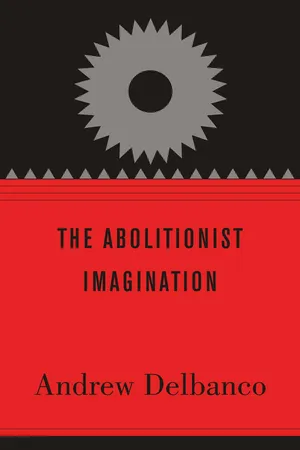
The abolitionists of the mid-nineteenth century have long been painted in extremes--vilified as reckless zealots who provoked the catastrophic bloodletting of the Civil War, or praised as daring and courageous reformers who hastened the end of slavery. But Andrew Delbanco sees abolitionists in a different light, as the embodiment of a driving force in American history: the recurrent impulse of an adamant minority to rid the world of outrageous evil.
Delbanco imparts to the reader a sense of what it meant to be a thoughtful citizen in nineteenth-century America, appalled by slavery yet aware of the fragility of the republic and the high cost of radical action. In this light, we can better understand why the fiery vision of the "abolitionist imagination" alarmed such contemporary witnesses as Herman Melville and Nathaniel Hawthorne even as they sympathized with the cause. The story of the abolitionists thus becomes both a stirring tale of moral fervor and a cautionary tale of ideological certitude. And it raises the question of when the demand for purifying action is cogent and honorable, and when it is fanatic and irresponsible.
Delbanco's work is placed in conversation with responses from literary scholars and historians. These provocative essays bring the past into urgent dialogue with the present, dissecting the power and legacies of a determined movement to bring America's reality into conformity with American ideals.
eBook - ePub
The Abolitionist Imagination
- English
- ePUB (mobile friendly)
- Available on iOS & Android
eBook - ePub
The Abolitionist Imagination
About this book
Trusted by 375,005 students
Access to over 1.5 million titles for a fair monthly price.
Study more efficiently using our study tools.
Information
1
THE ABOLITIONIST IMAGINATION
Andrew Delbanco
Who were the abolitionists? In revisiting that well-worn question, my aim is not to join the long line of commentators who have drawn and redrawn the boundary between abolition proper and the broader anti-slavery sentiment of which it was a part. I want, instead, to consider the abolition movement as an instance of a recurrent American phenomenon: a determined minority sets out, in the face of long odds, to rid the world of what it regards as a patent and entrenched evil. If we construe abolition in this wider sense—in its particular manifestation in the struggle against slavery but also as a persistent impulse in American life—what might it tell us about our country?
1
One way to begin is with a quick tour of the movement from within. First of all, it is not easy to say how large it was. On the one hand, by the late 1830s, the American Anti-Slavery Society reported a membership of about a quarter-million persons in a nation of roughly seventeen million, of whom two and a half million were African American slaves. Some anti-slavery groups claimed even larger numbers of signatories on the petitions with which they lobbied Congress. On the other hand, by the outbreak of the Civil War, the subscription list of William Lloyd Garrison’s newspaper The Liberator had dwindled to about 1,200.1
So this is a case where measuring by the numbers will not tell us much. What we do know is that defenders of slavery thought that abolitionists—no matter how numerous or sparse—were noxious and dangerous. In the 1830s, when an organized mail campaign flooded the slave states with pamphlets denouncing slavery, reaction “bordered on apoplexy,” and as Horace Greeley later put the matter, “rulers of opinion at the South” took the view that “whoever evinced repugnance to Slavery anywhere, under any circumstances, was an Abolitionist, and an enemy of their section—a wanton aggressor upon their rights.”2
As for the North, the distribution of antebellum attitudes looked something like this: “The population was divided into the relatively few bitter abolitionists, the large number of defenders of slavery, and the much larger number of independents not yet committed to either side of the great controversy but more and more aware of its importance.”3 So in its geographical reach, abolitionism was a national movement, at least as a goad and challenge to the standing order. It radiated out from New England through what might be called the New England diaspora—from the “burned over” districts of New York that were evangelized during the Second Great Awakening, to the Western Reserve, and, to some extent, into border states such as Missouri and Kentucky. By means of publication and rumor, it reached into the South itself, where indigenous abolitionist sentiment also existed but took the form mainly of private qualms and gestures. An elderly slave might be permitted to buy his freedom after years of saving a fraction of his wages from having been hired out; a young slave of light complexion might be freed if his master acknowledged, at least privately, that he was the slave’s father.4
Some masters who freed their slaves may have hoped thereby to set an example that would encourage others to do the same. Almost from the first settlements, there was a good deal of hand-wringing about slavery among members of the slaveowning classes. As early as the 1730s, the patriarch of the Byrd family lamented that slaves “blow up the pride and ruin the industry of our white people, who, seeing a rank of poor creatures below them, detest work for fear it should make them look like slaves.”5 Both James Madison and Thomas Jefferson (that “ambidexter philosopher” as one abolitionist called him in the 1820s) used the word “evil” to describe slavery, although their plans for doing anything to combat the evil were invariably deferred till some indefinite future.6 Midway between the signing of the Declaration of Independence and the adoption of the Constitution, Jefferson wrote that “the spirit of the master is abating, that of the slave rising from the dust,” but he offered no timetable for when the latter would overcome the former.
In the South, hopes for an end to slavery were sometimes borne of genuine moral scruples but more often tended to reflect alarm about a growing black population—a problem for which prohibition of the African slave trade and the “diffusion” of slaves into western territories proved to be ineffective solutions.7 Some Southern critics of slavery went further. When the North Carolinian Hinton Rowan Helper declared in 1858 that “no man can be a true patriot without first becoming an abolitionist,” he, like Byrd and Jefferson before him, evinced less concern for black people than for whites. If slavery persisted, he said, the South would become a region of “niggervilles” under the rule of potentates who gave not a damn about the menial whites caught between the slaves below and the grandees above.8 Slavery should be abolished because it was an impediment to white progress.
In short, as one historian has said with apt alliteration, the abolitionist movement was “diverse, decentralized, and divided”—so much so that it can seem a distortion to call it a movement at all.9 Some abolitionists were concerned with the cruelties of whites toward blacks; others with the effects of slavery on whites. Some were immediatists; others were gradualists. Some regarded the Constitution as hostile to slavery; others thought the Constitution a shameful compact that must be repudiated along with the slave system, which it at least tacitly endorsed.
Some abolitionists, notably Garrison and, for a time, Frederick Douglass, considered the Union itself an obstacle to freedom and believed that all connection between free and slave states ought to be severed—an opinion widely shared before and after the secession crisis of 1860–1861, when many Northerners (not just abolitionists) were happy to see “South Carolina go, and any other states that wish to share her ‘outer darkness.’ ”10 Others likened the South to a rabid dog that, if cut loose, would roam “through the world poisoning nations, ruining men, women, and children yet unborn”—and therefore must be kept on a short leash till it could be brought to heel.11
If differences ran deep over how to analyze the problem of slavery, they ran deeper over how to attack it. Agreement on principles did not mean agreement on strategy. When John Brown confided to Douglass his intention to seize the arsenal at Harpers Ferry and to distribute its weapons to slaves, Douglass, at least by his own account, tried to persuade Brown not only that the plan would fail but that it would “rivet the fetters more firmly than ever on the limbs of the enslaved.”12 For Massachusetts senator Charles Sumner, who argued as early as 1849 for racially integrated public schools in Boston, putting an end to slavery was a step toward achieving genuine civic equality for black people.13 Others thought the best means to end slavery was to send all blacks (including free blacks) back to their “native” Africa—a program that today we would call ethnic cleansing. Still others regarded Central America as a better place to send them and, carefully avoiding the word “abolitionist,” proposed to “emancipationists of the South” that proceeds from the sale of public lands should be used to compensate them for the human property they would lose under any colonization plan.14
To the extent that these disputes had the character of a family quarrel, it is tempting to regard them as what Freud called “the narcissism of minor differences.”15 Especially after the Kansas-Nebraska Act of 1854 and the Dred Scott decision of 1857, when the South was regarded by many Northerners as a hostile expansionist power (“the slave power must go on in its career of exactions,” said Douglass, “give, give will be its cry”), there was reason for cooperation among anti-slavery factions, whatever their differences.
So far I have been talking about abolitionists as if they were pieces on a chessboard, some more potent than others, but all predictable insofar as they could act only within the limits of their designated functions. This is, of course, a defective description. They were not instruments in the hands of some game master. Like all people, they were inconsistent and sometimes inconstant to their own professed views. They wavered, contradicted themselves as well as each other, and repudiated ideas in which they had once believed. Douglass, for instance, who once accepted Garrison’s premise that no true abolitionist should participate in electoral politics, moved to the view, in which he was encouraged by Gerrit Smith, that to “abstain from voting was to refuse to exercise a legitimate and powerful means for abolishing slavery.” Sooner or later, he came to believe, government would have to be enlisted in the abolitionist cause since, as W. E. B. Du Bois was to write fifty years later, “only national force could dislodge national slavery.”16
2
We should be wary, then, of generalizations—including, no doubt, those I have just made. This is especially true if we hope to get beyond policy positions to inner motives. For some young people, abolitionism may have been a rite of passage into adulthood; for those of blue-blood lineage, it may have been a means to mitigate their fear, in David Donald’s phrase, of becoming an “elite without function.”17 For women, abolitionism may have offered a sense of efficacy in the public sphere from which they were otherwise excluded. For fugitive-slaves-turned-abolitionists, it may have assuaged what today we would call “survivor’s guilt”—the feeling, that is, of having abandoned one’s fellow sufferers to a fate one has escaped. Some abolitionists were merciless toward slaveowners; others saw themselves as Good Samaritans rescuing not only slaves from masters but masters from themselves—since, again in Du Bois’s words, “the degradation of men costs something both to the degraded and those who degrade.”18
Never a unified party, abolitionism was in some respects radical, in others conservative. While participation in the cause may have furnished a variety of psychological rewards—both conscious and unconscious—there is no reason to question the passion and sincerity of those who enlisted in it. It was a movement that looked forward to a world reconstructed on a new principle of universal liberty, but it also looked backward to Jefferson’s neoclassical ideal of “temperate liberty,” the sine qua non of republican citizenship—which, it said, the slavery regime undermined for slave and slavemaster alike. “The slave is a subject, subjected by others,” as Douglass put it, but the “slaveholder is a subject” as well—“the author of his own subjection.” This was Douglass the transcendentalist (“every new-born white babe comes armed from the Eternal presence, to make war on slavery”), who sees each person as a moral being in potentia— distorted and deranged by a system that imprisons the soul and consigns both slave and slaveowner to a “little nation of [his] own,” where “appetite, not food, is the great desideratum.”19 Abolitionists belonged self-consciously to the tradition of imprecatory prophets; they were the thundering Isaiahs and Jeremiahs of their time, calling to account this fallen world and exploiting the fear of apocalypse if they should fail.
Accordingly, Douglass included in his autobiography scenes of violence that seem to say, Look at me, gentle reader: if you hope to save yourselves, you must first save me. Men like me—angry black men, cut off from the softening influences of family and friends, confined to the sordid “present and the past”—are longing for “a future—a future with hope in it.” If you deny us this hope, we will become monsters.20 Slavery is the factory of the South, and what it is producing—indeed, mass-producing—is black rage.
The shadings I have just sketched were generally absent from the picture of abolitionism as seen through the eyes of unsympathetic contemporaries, which is to say, most contemporaries. To their enemies, abolitionists seemed to be fanatics pure and simple. They wanted the world purged of slavery, and, by and large, they wanted the purging to start now. “I do not wish to think, or speak, or write, with moderation,” as Garrison announced in the inaugural issue of The Liberator. “No! no! Tell a man whose house is on fire to give a moderate alarm; tell him to moderately rescue his wife from the hands of the ravisher; tell the mother to gradually extricate her babe from the fire … but urge me not to use moderation in a cause like the present. I am in earnest—I will not equivocate—I will not excuse—I will not retreat a single inch—and I WILL BE HEARD.”21
This kind of talk was received in the South as the rant of an “unHoly crusade” threatening the very foundations of society. If not checked, it would force even the kindest slavemasters to draw the sword “against our own property,” whose putatively childlike minds were being excited by fantasies of freedom. Slaveowners who dismissed abolitionists as dreamers and fools nevertheless took seriously the abolitionist portrayal of slaves as restive and potentially rebellious, even as they remained convinced—or at least tried to persuade themselves—that any discontent among their slaves was incited rather than intrinsic to their condition. “Strange that they should be alarmed,” as Harriet Jacobs wrote in her remarkable memoir, Incidents in the Life of a Slave Girl (1861), “when their slaves were so ‘contented and happy’! But so it was.”22
On both sides of the regional divide, to call someone an abolitionist was to denounce or deride him. What abolitionists took up as an honorable name was in fact a name assigned to them as a term of opprobrium. The very word “abolitionism” (in this respect, it was like the word for an earlier reform movement, Puritanism, to which not a few leading abolitionists could trace their ancestry) was usually uttered as a slander meant to convey what many Americans considered its essential qualities: unreason, impatience, implacability. When Stephen Douglas, the last major politician to give up the idea of a bisectional political party, wished to mock his opponent in the Illinois senatorial campaign of 1858, Douglas likened him to “the little abolitionist orators in the church and school basements.”23 It was Douglas’s way of trying to make his tall opponent seem small. Two years later, when that opponent, Abraham Lincoln, went to New York to audition before the kingmakers of the Republican Party, he had to make sure the abolitionist...
Table of contents
- Cover
- Series Page
- Title Page
- Contents
- Foreword
- Copyright
- 1. The Abolitionist Imagination
- 2. Fighting the Devil with His Own Fire
- 3. Did the Abolitionists Cause the Civil War?
- 4. The Invisibility of Black Abolitionists
- 5. Abolition as Master Concept
- 6. The Presence of the Past
- Notes
- About the Authors
- Index
Frequently asked questions
Yes, you can cancel anytime from the Subscription tab in your account settings on the Perlego website. Your subscription will stay active until the end of your current billing period. Learn how to cancel your subscription
No, books cannot be downloaded as external files, such as PDFs, for use outside of Perlego. However, you can download books within the Perlego app for offline reading on mobile or tablet. Learn how to download books offline
Perlego offers two plans: Essential and Complete
- Essential is ideal for learners and professionals who enjoy exploring a wide range of subjects. Access the Essential Library with 800,000+ trusted titles and best-sellers across business, personal growth, and the humanities. Includes unlimited reading time and Standard Read Aloud voice.
- Complete: Perfect for advanced learners and researchers needing full, unrestricted access. Unlock 1.5M+ books across hundreds of subjects, including academic and specialized titles. The Complete Plan also includes advanced features like Premium Read Aloud and Research Assistant.
We are an online textbook subscription service, where you can get access to an entire online library for less than the price of a single book per month. With over 1.5 million books across 990+ topics, we’ve got you covered! Learn about our mission
Look out for the read-aloud symbol on your next book to see if you can listen to it. The read-aloud tool reads text aloud for you, highlighting the text as it is being read. You can pause it, speed it up and slow it down. Learn more about Read Aloud
Yes! You can use the Perlego app on both iOS and Android devices to read anytime, anywhere — even offline. Perfect for commutes or when you’re on the go.
Please note we cannot support devices running on iOS 13 and Android 7 or earlier. Learn more about using the app
Please note we cannot support devices running on iOS 13 and Android 7 or earlier. Learn more about using the app
Yes, you can access The Abolitionist Imagination by Andrew Delbanco,John Stauffer,Manisha Sinha,Darryl Pinckney,Wilfred M McClay in PDF and/or ePUB format, as well as other popular books in History & American Civil War History. We have over 1.5 million books available in our catalogue for you to explore.