The British Empire at its height governed more than half the world's Muslims. It was a political imperative for the Empire to present itself to Muslims as a friend and protector, to take seriously what one scholar called its role as "the greatest Mohamedan power in the world." Few tasks were more important than engagement with the pilgrimage to Mecca.
Every year, tens of thousands of Muslims set out for Mecca from imperial territories throughout Africa, the Middle East, and Asia, from the Atlantic Ocean to the South China Sea. Men and women representing all economic classes and scores of ethnic and linguistic groups made extraordinary journeys across waterways, deserts, and savannahs, creating huge challenges for officials charged with the administration of these pilgrims. They had to balance the religious obligation to travel against the desire to control the pilgrims' movements, and they became responsible for the care of those who ran out of money. John Slight traces the Empire's complex interactions with the Hajj from the 1860s, when an outbreak of cholera led Britain to engage reluctantly in medical regulation of pilgrims, to the Suez Crisis of 1956. The story draws on a varied cast of characters—Richard Burton, Thomas Cook, the Begums of Bhopal, Lawrence of Arabia, and frontline imperial officials, many of them Muslim—and gives voice throughout to the pilgrims themselves.
The British Empire and the Hajj is a crucial resource for understanding how this episode in imperial history was experienced by rulers and ruled alike.
- 446 pages
- English
- ePUB (mobile friendly)
- Available on iOS & Android
eBook - ePub
About this book
Information
Topic
Theology & ReligionSubtopic
British History1
Contexts
Introduction
THE TRAVELS OF Muslims from across the world to the Holy City of Mecca in the Hijaz to perform the Hajj has been a constant feature in world history since the Prophet Muhammad’s Farewell Pilgrimage in AH 11/632 CE. It is the single largest annual gathering of people on the planet for a religious purpose.1 The Hajj is “unique among religious pilgrimages for its doctrinal centrality, geographic focus, and historical continuity.”2 As one of the five pillars of Islam, the Hajj is obligatory for all Muslims who are financially and physically able to undertake it.3 Once pilgrims reach Mecca, they can fulfill one of their core religious obligations and participate in a series of deeply profound rituals, the anticipation and subsequent experience of which remain in their memories forever. If the spiritual experience of the Hajj can be summarized, the end of Ikbal Ali Shah’s 1928 pilgrimage account seems apt: “From life I need nothing more. I have been to Mecca, the cradle of my faith.”4
Mecca—and Medina, the location of the Prophet Muhammad’s tomb—are powerful religious symbols. In their daily prayers as individuals and as part of the umma, the worldwide community of believers, Muslims worship in the direction of the Kaʿba, the large black cubic structure in the center of the Holy Mosque in Mecca and the spiritual center of Islam. But as well as being a profoundly spiritual experience, the Hajj, like other religious pilgrimages, is also a historical and material phenomenon that encompasses a variety of features, such as taxation, commerce, the logistics of travel, official bureaucracy, and the politics surrounding the pilgrimage.5
Although the pilgrimage has pre-Islamic roots, the Muslim Hajj is nearly 1,400 years old. Europe’s imperial moment in the Muslim world and its impact on the pilgrimage were a significant interlude in the ritual’s history. This chapter provides a broad context to the Hajj in order to appropriately situate Britain’s involvement in the pilgrimage from 1865 to 1956. It describes the rituals that make up the Hajj and the parts of the Qur’an that discuss the pilgrimage. A survey of Islamic and European empires’ engagement with the pilgrimage brings out several themes that contextualize Britain’s later involvement in the Hajj, such as how these polities positioned themselves as Islamic empires, how they became patrons or protectors of Islam in relation to the Hajj in order to gain legitimacy for imperial rule, and how multiple imperial regulations regarding the Hajj were evaded or subverted by pilgrims. Finally, this chapter shows how the Hajj, while unique in many respects, was part of a wider religious geography of pilgrimage, and it examines Britain’s interactions with these pilgrimages, which highlights how technological change and policies of accommodation were important in shaping the contours of this wide-ranging imperial engagement.
The Hajj as Ritual
The Hajj is notable for the unchanging nature of the rituals that pilgrims must perform.6 These rites were ordained by the Prophet Muhammad shortly before his death in 632 CE and are a series of ritual reenactments of faith-testing events from the lives of the Prophet Abraham; his wife, Hajar; and his son Ismail. Before commencing the Hajj during dhu al-hijja, the twelfth month in the Islamic lunar calendar, male pilgrims don the ihram, two white sheets that cover the body. Women are directed only to wear modest clothing. The ihram shows the equality and humility of all pilgrims before God, regardless of individual differences in race, nationality, age, gender, or wealth. Once they have donned the ihram, pilgrims repeatedly call the talbiyya, the pilgrims’ invocation, “Here I am, Lord, responding to Your call [to perform the Hajj]. Praise belongs to You, all good things come from You, and sovereignty is Yours alone.” The first ritual is the tawaf, where pilgrims circle seven times around the Ka’ba in the center of the Holy Mosque in Mecca, also called the Bayt Allah (House of God), supposedly the equivalent of God’s throne in heaven. The Kaʿba is doubly significant because Muslims face in its direction during their salat, daily prayers. During this circling, many pilgrims try to approach and touch the Black Stone that is set in the corner of the Kaʿba. The origins and powers of the stone are disputed, but pilgrims who cannot touch the stone salute it from a distance to signal their renewed commitment to God, and others believe that physical contact with it absorbs sin. After the tawaf comes the sa‘y, when pilgrims run back and forth seven times between the two small hills of Safa and Marwa near the Kaʿba in emulation of Hajar’s search for water for Ismail.7 After this, pilgrims drink from the Zamzam well, which miraculously appeared and rescued Hajar and Ismail from death. On the ninth day of dhu al-hijja, pilgrims travel a few miles to Mount Arafat to spend time in prayer and conversation, a ritual called wuquf, meaning “standing.” Some stay and listen to a sermon delivered from Mount Arafat, which commemorates the Prophet Muhammad’s sermon delivered during his Farewell Pilgrimage at the same site. After sunset, pilgrims move to the nearby Muzdalifa pass and spend the night there. The next morning, pilgrims travel a short distance to the Valley of Mina; at Jabal Rahma, Mount Mercy, they perform the jamarat, which involves throwing pebbles at pillars that signify places where Abraham rejected Satan’s temptation to disobey God’s order to sacrifice Ismail. Once this “Stoning of the Devil” is complete, pilgrims offer an animal sacrifice at Mina to commemorate the sheep God accepted from Abraham in lieu of Ismail. Simultaneously, Muslims who are not on Hajj celebrate the holiday of the ‘Id (also spelled ‘Eid) with their own animal sacrifices. Pilgrims are then required to perform six more stonings and one more tawaf and sa‘y. A pilgrimage is valid only if the whole journey is undertaken with the intention of coming closer to God, so every ritual does not have to be performed precisely.8 There are huge spiritual rewards associated with a successfully completed Hajj—pilgrims are absolved from all previous sins.9 A further bonus of completing the pilgrimage is the ability to prefix one’s name with “Hajji” for men or “Hajja” for women, a distinction that enhances pilgrims’ status in their local community. The Hajj’s importance in Islam is heightened by the fact that, every day, Muslims pray in the direction of Mecca.
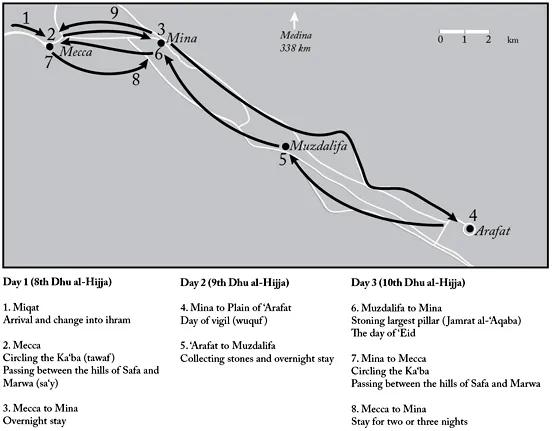
Hajj rituals
Credit: Adapted by John O’Connor and John Slight from Venetia Porter (ed.), Hajj: Journey to the Heart of Islam (London: British Museum Press, 2012). Reproduced with the permission of the British Museum Press.
The Qur’an contains various chapters (singular, sura; plural, suwar) that command Muslims to perform the Hajj.10 It is important to describe these because they are cited innumerable times in British documents in the archives as justification, or otherwise, for a variety of British and Muslim proposals and responses to the issue of destitute pilgrims that are detailed throughout this book. The first reference to Hajj in the Qur’an states simply, “Perform the pilgrimage and the visit [to Mecca] for Allah.” It goes on to stipulate that those who cannot, whether from ill health or other reasons, should send “such gifts as can be obtained with ease.” While Muslims are on Hajj, there should be “no lewdness nor abuse nor angry conversation.” A verse of critical importance, “And whatsoever good ye do Allah knoweth it,” describes how the performance of good deeds while on Hajj will be known by God and came to be interpreted as requiring the disbursement of zakat, or alms-giving, to poor pilgrims and others in the Hijaz.11 Later in the Qur’an, “Pilgrimage to the House [of Abraham, referring to the Kaʿba] is a duty unto Allah for mankind, for him who can find a way thither,” underscores the mandatory nature of Hajj for Muslims except in certain circumstances, such as illness or penury.12 Another command to pilgrims is “So make provision for yourselves” before going on Hajj. These last two passages from the Qur’an repeatedly appear in British official memorandums and reports as evidence to support restrictions on poor pilgrims who traveled to the Hijaz.13 The final reference to pilgrimage is the Hajj sura, where God ordered Abraham to “proclaim unto mankind the Pilgrimage. They will come unto thee on foot and on every lean camel; they will come from every deep ravine”14—and, many centuries later, by steamship and airplane.
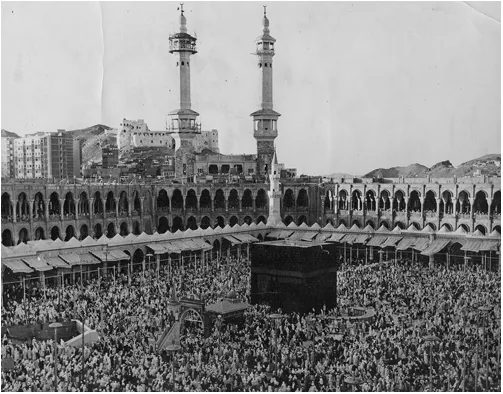
Pilgrims surrounding the Kaʿba, Mecca, c. 1900
Credit: Royal Geographical Society, London
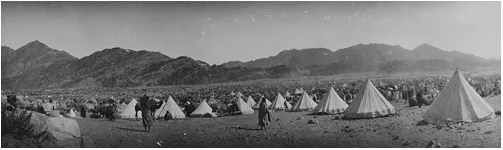
Pilgrim camp at Arafat, 1909, Abbas Hilmi Album
Credit: Mohamed Ali Foundation
Muslim Empires and the Hajj before 1800
Before considering the cases of the Mughal and Ottoman empires that are the principal examples in this section, several antecedents to European interactions with the Hajj before the nineteenth century should be mentioned briefly. The Frankish crusader states controlled the land routes between Syria and Egypt from 1116 to 1187. This forced Egypt to replace Aqaba with Aydhab as the main port for the Red Sea’s pilgrimage traffic in this period.15 In the early modern period, Portuguese expansion into the Indian Ocean disrupted the Hajj in 1541. Spurred by the legacy of the Reconquista, the Portuguese mounted a naval expedition in the Red Sea that blocked pilgrim and merchant ships sailing to the Hijaz.16 This built on previous attempts by Portuguese commander Alfonso de Alberquerque, who mounted an unsuccessful expedition to secure the Red Sea for Portugal in 1513. One of Alberquerque’s aims during the 1513 expedition was to steal the Prophet Muhammad’s body from Medina and then demand that Muslims leave the Christian Holy Land as a condition for his returning the body. Compared with the crusader states’ limited impact on the Hajj, the Ottoman and Mughal empires’ inability to respond adequately to this Portuguese challenge hampered pilgrims’ voyages to and from Arabia. Portuguese control over Daman and Diu on South Asia’s western seaboard tightened their grip over the region’s seaborne traffic, and a Mughal attempt to capture these ports failed in 1582. Mughal court historian Abu’l Fazl referred to the Portuguese resentfully as a “stumbling block” to South Asian pilgrims’ travels.17 This obstructionist activity was not confined to European powers; Shiʿi Safavid Iran closed its border to South Asian pilgrims several times during the sixteenth to eighteenth centuries.18 Conversely, in 1595, the Mughal emperor Akbar (1556–1605) forced European trading companies to assist pilgrims by providing armed naval escorts for pilgrim ships after an upsurge in piracy in the Indian Ocean; England was responsible for India’s south coast, France for the Persian Gulf, and the Netherlands for the Red Sea, although these protective measures proved ineffective.19
Several Mughal and Ottoman policies on the pilgrimage were echoed in later British actions. This points to the need to transcend what Dane Kennedy has termed the “binary distinction between Islamic and Western empires.”20 The remainder of this section will provide an overview of these policies. Michael Pearson asserts that “the early modern Islamic empires saw it as their duty to ensure that as many of their subjects as possible could go on pilgrimage.”21 This principally took the form of state-sponsored caravans by land and sea, which in practice meant a procession of people who traveled together. Pilgrim numbers from South Asia rose because of state patronage. In the early modern era, there were approximately 15,000 pilgrims every year out of a total South Asian Muslim population of 22.5 million, and an Indian Muslim community emerged in the Hijaz.22 According to a Mughal official, these pilgrims went on Hajj “at great public expense, with gold and goods and rich presents.”23 Mughal emperors sponsored the pilgrimage to “stand out as defenders of Islam.”24 In Chapter 4, we will see similar rhetoric used by Britain in the context of the Hajj during the First World War.
This sponsorship began after Akbar conquered Gujarat in 1573, which meant that Surat, the South Asian gateway to Mecca, fell under Mughal rule.25 Akbar’s continued search for sources of ideological authority as a means to consolidate his rule made subsidizing the Hajj for his subjects, and the resultant increase in a Mughal presence in Mecca, increasingly attractive.26 An imperial edict proclaimed that “the travelling expenses of anybody, who might intend to perform the pilgrimage to the Sacred Places, should be paid.” The Mughal Hajj caravan left Agra in 1576 with its party of sponsored pilgrims and an enormous donation of 600,000 rupees (R) for the Holy Places. Members of the Mughal royal household, who made up part of the caravan, were delayed in Surat until October 1576 while a cartez was secured from the Portuguese so they could cross the Arabian Sea unhindered. The lack of a Mughal navy left pilgrims vulnerable to Portuguese maritime depredations. In 1577, another caravan left for the Hijaz with R 500,000 and R 100,000 for the sharif of Mecca, the ruler of the Hijaz, who had a distinguished lineage as a descendant of the Prophet Muhammad’s grandson Hasan ibn ‘Ali.27
These gargantuan amounts of money caused many poor people from across the Muslim world to flock to the Hijaz in 1577–1578 to share in the alms bonus. This trend caused considerable consternation among the Ottoman authorities in the Hijaz. ...
Table of contents
- Cover
- Title Page
- Copyright
- Contents
- Map
- Introduction
- 1. Contexts
- 2. Pilgrimage in the Mid-Victorian Era, c. 1865–1900
- 3. Pilgrimage in the Edwardian Era, 1901–1914
- 4. The First World War and the Hashemite Interregnum, 1914–1924
- 5. Britain and the Hajj under Saudi Control, 1924–1939
- 6. Hajj from the Far Ends of Britain’s Muslim Empire, 1924–1939
- Epilogue: Hajj in the Time of War and Decolonization, 1939–1956
- Conclusion
- Abbreviations
- Notes
- Glossary
- Archival Sources
- Acknowledgments
- Index
Trusted by 375,005 students
Access to over 1.5 million titles for a fair monthly price.
Study more efficiently using our study tools.
Frequently asked questions
Yes, you can cancel anytime from the Subscription tab in your account settings on the Perlego website. Your subscription will stay active until the end of your current billing period. Learn how to cancel your subscription
No, books cannot be downloaded as external files, such as PDFs, for use outside of Perlego. However, you can download books within the Perlego app for offline reading on mobile or tablet. Learn how to download books offline
Perlego offers two plans: Essential and Complete
- Essential is ideal for learners and professionals who enjoy exploring a wide range of subjects. Access the Essential Library with 800,000+ trusted titles and best-sellers across business, personal growth, and the humanities. Includes unlimited reading time and Standard Read Aloud voice.
- Complete: Perfect for advanced learners and researchers needing full, unrestricted access. Unlock 1.5M+ books across hundreds of subjects, including academic and specialized titles. The Complete Plan also includes advanced features like Premium Read Aloud and Research Assistant.
We are an online textbook subscription service, where you can get access to an entire online library for less than the price of a single book per month. With over 1.5 million books across 990+ topics, we’ve got you covered! Learn about our mission
Look out for the read-aloud symbol on your next book to see if you can listen to it. The read-aloud tool reads text aloud for you, highlighting the text as it is being read. You can pause it, speed it up and slow it down. Learn more about Read Aloud
Yes! You can use the Perlego app on both iOS and Android devices to read anytime, anywhere — even offline. Perfect for commutes or when you’re on the go.
Please note we cannot support devices running on iOS 13 and Android 7 or earlier. Learn more about using the app
Please note we cannot support devices running on iOS 13 and Android 7 or earlier. Learn more about using the app
Yes, you can access The British Empire and the Hajj by John Slight in PDF and/or ePUB format, as well as other popular books in Theology & Religion & British History. We have over 1.5 million books available in our catalogue for you to explore.