"Original and revelatory."
—David Blight, author of Frederick Douglass
Avery O. Craven Award Finalist
A Civil War Memory/Civil War Monitor Best Book of the Year
In April 1865, Robert E. Lee wrote to Ulysses S. Grant asking for peace. Peace was beyond his authority to negotiate, Grant replied, but surrender terms he would discuss. The distinction proved prophetic.
After Appomattox reveals that the Civil War did not end with Confederate capitulation in 1865. Instead, a second phase of the war began which lasted until 1871—not the project euphemistically called Reconstruction, but a state of genuine belligerence whose mission was to shape the peace. Using its war powers, the U.S. Army oversaw an ambitious occupation, stationing tens of thousands of troops in outposts across the defeated South. This groundbreaking history shows that the purpose of the occupation was to crush slavery in the face of fierce and violent resistance, but there were limits to its effectiveness: the occupying army never really managed to remake the South.
"The United States Army has been far too neglected as a player—a force—in the history of Reconstruction… Downs wants his work to speak to the present, and indeed it should."
—David W. Blight, The Atlantic
"Striking… Downs chronicles…a military occupation that was indispensable to the uprooting of slavery."
—Boston Globe
"Downs makes the case that the final end to slavery, and the establishment of basic civil and voting rights for all Americans, was 'born in the face of bayonets.' …A remarkable, necessary book."
—Slate
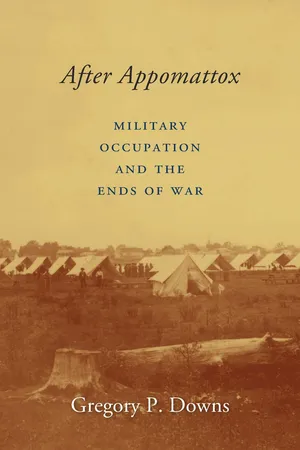
- 342 pages
- English
- ePUB (mobile friendly)
- Available on iOS & Android
eBook - ePub
About this book
Information
Publisher
Harvard University PressYear
2015Print ISBN
9780674241626
9780674743984
eBook ISBN
9780674426160
1
AFTER SURRENDER
BEFORE GRANT REACHED Washington, D.C., the question of what followed surrender surfaced 170 miles north of Appomattox in the town of Winchester, Virginia. Occupied numerous times by both U.S. and Confederate forces, the people of Winchester knew what wartime meant: soldiers walking the streets, military officers overruling courts, civilians sitting in jails under army orders. What they did not know was whether wartime conditions continued now that the battles in Virginia were over. On April 11, two days after the surrender agreement at Appomattox, U.S. Major General Winfield Scott Hancock decided that peace had now arrived in Winchester. A conservative who consistently fought against postsurrender occupations, Hancock asked permission to withdraw his men from the town limits to avoid clashes with paroled Confederate soldiers and to give the white people “every freedom consistent with the situation.” If surrender marked the break in time between war and peace, Hancock’s suggestion made sense. In peacetime, the United States must restore civil rule and normal social life. But surrender did not end the war, army chief of staff Major General Henry W. Halleck responded. An architect of the military justice system, Halleck peremptorily denied Hancock’s request without even bothering “to trouble” Grant with the question. In exasperation, Hancock argued that it was best to “occupy as little ground as possible,” but Halleck remained unmoved.1
The end of battles did not end the occupation of the rebel states. Surrender marked a turning point, not an end point, for the state of war. While battlefield fighting would close over April and May 1865, wartime did not. The questions that surfaced first in Winchester materialized within weeks in small towns and rural districts across the former Confederacy. As other armies surrendered in the Carolinas and then in the Southwest, commanders faced the same issue that Hancock confronted: Did the conclusion of combat conclude the war? The answer remained the same: the army did not intend to give up its war powers simply because the fighting had stopped. Rather than breaking sharply at the end of surrender, military policy toward the conquered states in many ways stayed intact. Although the national policy would not be clear until the end of April, when President Johnson and the cabinet firmly rejected the opportunity for an armistice with Confederate forces, its roots were laid in the orders, like Halleck’s, that immediately followed Appomattox.
The crucial question that the U.S. government faced was who controlled those defeated rebel states. In time, the issue of civil rights—and the way to make them meaningful—would take center stage in the postsurrender era. That would be the crucible for war powers, the brake against a return to peace, and the prelude to a deep constitutional crisis. But in the first days after Lee’s surrender, the problem was even simpler and more concrete. Did the local officials in the rebel states have normal, peacetime power over their regions? If the United States answered yes, if it retained local officials in office and acknowledged their ultimate power, then the army would be hamstrung. It could not constitutionally use its force against governments in peacetime and would be powerless to put down outlaws, squelch trials of U.S. soldiers, and provide basic protection to freedpeople unless it received a request from a local or federal official. Absent another declaration of insurrection that established a new state of war, the national government would be simply a bystander. Freedpeople’s civil rights may not have shaped the initial decision to continue the state of war, but they depended upon it. It was the necessary prelude for everything that would follow.
What first shaped the decision to extend wartime was the military’s wariness about the quiescence of rebel soldiers and the possibility of ongoing fighting in the rebel states. As the Confederate armies surrendered, the U.S. government grappled with an enormous set of challenges in the rebel states. It was reacquiring control over a vast, largely unconquered territory filled with newly freed slaves and newly returning soldiers. While some regions—especially the eastern coast, the Mississippi valley, and western and central Tennessee—had been ruled by a mixture of military and loyal civilian governments for years, large sections of the ex-Confederate states had been nearly untouched by the armies. They were, essentially, terra incognita, regions where the army knew very little about the quiescence of the white people or the actions of the ex-slaves.
In that context the army had reason to fear additional uprisings or ongoing guerrilla wars. Confederate president Jefferson Davis remained at large; by rumor, he was heading to Mexico or as-yet-unconquered Texas to rebuild the Confederate nation. Into the vast, unknown space of the South would soon march hundreds of thousands of rebel soldiers heading home. Young, isolated, unpaid, angry, and well armed, these white men could easily join uprisings or launch guerrilla wars. Northern generals and politicians well knew that civil wars often sparked spiraling conflicts, echo wars that sounded for years or for generations as ex-soldiers continued to strike back against the victors.
Beyond the problems that confront every society at the end of a civil war, the United States faced the particular challenge of managing a quick transition from a society shaped by slavery to one structured around freedom. For the more than 3.5 million slaves in the Confederate states, the war’s end meant a revolution in their status, an opening to a new form of freedom they claimed whenever and however they could. For white planters, the war’s end meant the recognition that slavery—the basis of their economy, political system, theological beliefs, and self-image—seemed to be on the verge of disappearing. Although Northern planners hoped for a smooth transition from slave to free labor, they had every reason to fear violence from one side or from both. Finally, there was the crucial issue of the political world that would follow peace. Unless the U.S. government planned to overhaul the constitutional system, the end of wartime meant the return of law and civil governments that would regulate their localities and, when Congress returned in December, send representatives to vote on national policy. On the ground, this would mean magistrates charging soldiers with kidnapping their slaves by setting them free, judges ruling on contracts, and sheriffs delivering public whippings of freedpeople. In Washington, this might mean the end of the advances of the war; peacetime even threatened the passage of the Thirteenth Amendment, which had not received the approval of a sufficient number of states.
Fearful that rebel soldiers would launch a guerrilla campaign, that planters would reestablish slavery, and that Southern courts would indict soldiers, the War Department continued to operate on a war footing. U.S. officers generally claimed the common political and police authority of mid-nineteenth-century militaries over the places they occupied during a period of wartime, though, in keeping with military practices, fairly little control over property titles. The army could replace, vacate, or overrule existing civil officials; it could retain, dismiss, or topple local courts; it could arrest civilians, interpret contracts, temporarily seize property, close newspapers, restrict commerce, overturn laws, regulate movement, levy fines, and in many other ways either directly assume the powers of local government or supervise civilians in those positions. Most controversially, it could try civilians in front of military commissions. The army could be police, judge, jury, council, and mayor, or it could permit locals to fill those offices while retaining the power to oversee them. Although the army tried to avoid direct violence, its forceful claims of authority and its recourse to military justice raised the specter of what one contemporary scholar of occupation calls “latent violence,” a threat meant to quiet the subject population. Even at the beginning, the United States never punished many people, but it relied upon its ultimate power to frighten people into acquiescence.2
As the military’s focus shifted from winning battles to governing territory, it began reassigning its soldiers to reach into the expansive Southern territory and assert the nation’s power. When the U.S. Army extended its lines across the entire Confederacy, it found itself responsible for more than 800 county governments spread over 750,000 square miles, containing about 9 million people. Slowly but surely, the military spread out toward regions far from the war’s front lines. From about 120 towns in March 1865, the army extended to 218 reported posts by the end of May and 334 by the end of August.3 From a narrow range of posts along coasts and rivers, and a series of posts in southern Louisiana, middle Tennessee, central Arkansas, northern Alabama, and northern Virginia, the army moved deep into the Confederate countryside over the spring and summer. There they tried to create a new social order on the ground. Peace would follow, not create, the birth of the new world.

The Civil War endured because everyone from the president down to the army staff dismissed efforts to declare it finished. There was no proclamation that the war continued; there did not need to be one. The old proclamations were still in effect. The army’s code of war stated that martial law did not end with a surrender or armistice but continued until the commander in chief proclaimed it over. Therefore, the decision not to announce a policy was a decision to continue the powers of occupation.4
At Appomattox, there were simple, practical reasons to understand that the war continued. In the field, the Confederacy’s other large army still held North Carolina, having fled northward through Georgia and South Carolina as U.S. Major General William T. Sherman’s men pursued it. Other scattered armies of Confederate regulars and irregulars operated throughout the South, and General Edmund Kirby Smith commanded the forces west of the Mississippi in Texas. Confederate president Jefferson Davis fled southward, driven by the hope of sustaining the rebellion. Still, it seemed possible that surrender in Texas or the capture of Jefferson Davis would signal the end of wartime.
Instead, the war powers endured, in large part because of the government’s response to the second major surrender in the field. In North Carolina, the famously tough-minded Sherman pursued the last large rebel army under Confederate general Joseph Johnston into central North Carolina. As word of Lee’s surrender reached the outnumbered Johnston, Sherman moved boldly—and it turned out foolishly—toward peace by offering not surrender but an armistice and political restoration to the Confederacy. Sherman’s terms raised fundamental questions about the endurance of the government’s war powers over the rebel states. This proposed armistice tested the new government of President Andrew Johnson and forced him to declare unambiguously that the state of war continued and that the South would be ruled by the army.5
Sherman’s offer of peace unfolded from the clear, commonsensical way he distinguished wartime from peace. “I will fight as long as the enemy shows fight, but when he gives up and asks quarter I cannot go further,” he wrote in late April 1865. When Lee surrendered, Sherman’s men rejoiced at what seemed like the dawn of peace. Sherman regarded “the war as over, for I well knew that General Johnston had no army with which to oppose mine.” Turning from war to peace, Sherman pondered “the only questions that remained.” Would Johnston surrender, or “would he allow his army to disperse into guerrilla-bands, to ‘die in the last ditch,’ and entail on his country an indefinite and prolonged military occupation?”6
To hasten peace and prevent a guerrilla uprising, Sherman began to overstep his authority and act on political matters. Even before he met with General Johnston, Sherman urged North Carolina governor Zebulon Vance to remain in his office, since “the war was substantially over.” Vance wisely disregarded Sherman’s advice and fled. On the Confederate side, Johnston convinced President Jefferson Davis to seek peace terms rather than continuing the fight. When Sherman and Johnston finally met, an additional factor complicated the situation. As he left for the meeting, Sherman learned that President Abraham Lincoln had been assassinated; the news was not yet known in most of the South. Recognizing the danger of a Northern reaction, Sherman passed Johnston a confidential note with the news. Alarmed, Johnston asked if they “might arrange terms that would embrace all the Confederate armies.” The terms Johnston sought were political. Would the rebels be “denied representation to Congress” and made “slaves to the people of the North?” Sherman replied, “No.”7
With that settled, the two generals resolved to end the war. Grandiosely, Sherman proclaimed that their agreement would lead to peace from “the Potomac to the Rio Grande.” Their agreement ordered Confederate soldiers to return to their state capitals to deposit weapons in the state arsenals. In exchange the federal government would recognize the existing state governments as legitimate once the officers took an oath of allegiance. The white men of the states, including soldiers, would be guaranteed the right to vote, and new president Andrew Johnson would pledge “not to disturb any of the people by reason of the late war.” Although General Johnston admitted that slavery was dead, Sherman did not include any promises of abolition in the agreement. Summing up, Sherman wrote, “In general terms—the war to cease; a general amnesty” and the “resumption of peaceful pursuits.” This agreement would sustain rebels in control of county courts and state capitals. Within months, returning Confederate soldiers would cast votes for new officers. State adjutants would manage large stores of arms to be used against guerrillas or rebellious freedpeople. Even if the Thirteenth Amendment successfully ended slavery, the rebel states would be free to regulate black people through explicitly unequal legal systems and to deny them the right to testify in court. The U.S. Army would presumably retreat to a few state capitals, port cities, and major depots as a guard against any future uprising. Against ex-Confederates, the federal government would have no more power than it did anywhere else. That was the fruit of peacetime. Sherman began to ponder which corps he could muster out first.8
More than perhaps any document of the war, Sherman’s agreement suggested how clearly an immediate end to war would maintain the power of white Southerners over their governments, their lands, and their slaves and ex-slaves. While evaluations of Reconstruction contrast its disappointments to better potential outcomes, Sherman’s offer illustrates an alternative in 1865 that would have eliminated Reconstruction and constrained emancipation in ways that far exceeded the effects of Jim Crow. If Sherman’s offer had stood, if the United States had only pursued peace and reunion, then there would be no Civil Rights Act, no Fourteenth Amendment, no black enfranchisement, and no constitutional and legal legacy of civil rights to draw upon in the twentieth century. There might not even be a Thirteenth Amendment. Sherman’s agreement therefore revealed the dilemmas of peace. A premature peace would not mean harmony; it would mean acquiescence.
Sherman understood the hard hand of war, but he did not think it applied any longer. During battlefield conflict, he had hanged guerrillas, obliterated an entire town in Tennessee for harboring outlaws, led the notorious March to the Sea to demoralize white Georgians, and distributed South Carolina planters’ lands to ex-slaves. Eight months earlier, he had ordered all civilians to evacuate Atlanta and warned the mayor that “war is cruelty, and you cannot refine it.” But Sherman sharply distinguished between war and peace. “During War the Conqueror of a Country may use the local government & authorities already in existence, or create new ones subordinate to his Use,” he wrote to Chief Justice Salmon P. Chase. “That is not the question now, for War has Ceased.”9
The U.S. general sought a quick restoration of peace because he did not believe the United States could govern the rebel states by military force. He was not sure that any country could. To understand what was possible, Sherman and other Americans looked to what they believed was a Roman imperial model of very light occupation, holding provinc...
Table of contents
- Cover
- Title Page
- Copyright
- Dedication
- Contents
- Note on Sources
- Introduction: The War That Could Not End
- 1. After Surrender
- 2. Emancipation at Gunpoint
- 3. The Challenge of Civil Government
- 4. Authority without Arms
- 5. The War in Washington
- 6. A False Peace
- 7. Enfranchisement by Martial Law
- 8. Between Bullets and Ballots
- 9. The Perils of Peace
- Conclusion: A Government without Force
- Appendixes
- Abbreviations
- Notes
- Acknowledgments
- Index
Trusted by 375,005 students
Access to over 1.5 million titles for a fair monthly price.
Study more efficiently using our study tools.
Frequently asked questions
Yes, you can cancel anytime from the Subscription tab in your account settings on the Perlego website. Your subscription will stay active until the end of your current billing period. Learn how to cancel your subscription
No, books cannot be downloaded as external files, such as PDFs, for use outside of Perlego. However, you can download books within the Perlego app for offline reading on mobile or tablet. Learn how to download books offline
Perlego offers two plans: Essential and Complete
- Essential is ideal for learners and professionals who enjoy exploring a wide range of subjects. Access the Essential Library with 800,000+ trusted titles and best-sellers across business, personal growth, and the humanities. Includes unlimited reading time and Standard Read Aloud voice.
- Complete: Perfect for advanced learners and researchers needing full, unrestricted access. Unlock 1.5M+ books across hundreds of subjects, including academic and specialized titles. The Complete Plan also includes advanced features like Premium Read Aloud and Research Assistant.
We are an online textbook subscription service, where you can get access to an entire online library for less than the price of a single book per month. With over 1.5 million books across 990+ topics, we’ve got you covered! Learn about our mission
Look out for the read-aloud symbol on your next book to see if you can listen to it. The read-aloud tool reads text aloud for you, highlighting the text as it is being read. You can pause it, speed it up and slow it down. Learn more about Read Aloud
Yes! You can use the Perlego app on both iOS and Android devices to read anytime, anywhere — even offline. Perfect for commutes or when you’re on the go.
Please note we cannot support devices running on iOS 13 and Android 7 or earlier. Learn more about using the app
Please note we cannot support devices running on iOS 13 and Android 7 or earlier. Learn more about using the app
Yes, you can access After Appomattox by Gregory P. Downs in PDF and/or ePUB format, as well as other popular books in History & American Civil War History. We have over 1.5 million books available in our catalogue for you to explore.