Iran's nuclear program has generated intense controversy ever since the International Atomic Energy Agency reported in 2003 that Iran was secretly pursuing enrichment activities. Although Iranian officials insist the program is peaceful, many in the international community are skeptical of Iran's stated aims—and some allege there is no greater nuclear-weapons proliferation danger in the world today.
Nuclear Iran guides readers through the intricate maze of science and secrecy that lies at the heart of Iran's nuclear ambitions. Writing for the general reader, Jeremy Bernstein brings his knowledge as a physicist to bear on the issues, offering elucidations of the scientific principles and technical hurdles involved in creating nuclear reactors and bombs. His explanations range from the physics of fission to methods of isotope separation to the technologies required for weaponizing fissile uranium and plutonium. Iran's construction of centrifuges capable of producing weapons-grade uranium has received much media attention, and Bernstein explains how these complex devices work. He intersperses many elements of the human story into his discussions of technology, such as the fact that centrifuges were first invented by German war prisoners working in the Soviet Union.
Nuclear Iran turns a spotlight on the controversial underground uranium-enrichment facility in Natanz and heavy water reactor in Arak, and profiles key figures in the ongoing international trade in weapons technology, including the Pakistani physicist A. Q. Khan. This succinct book is timely reading for anyone who wishes to understand the science behind the international crisis surrounding Iran's nuclear program.

- 216 pages
- English
- ePUB (mobile friendly)
- Available on iOS & Android
eBook - ePub
Nuclear Iran
About this book
Information
Topic
Physical SciencesSubtopic
Middle Eastern HistoryPART I
Uranium
1
Round and Round
IN 1913 IN THE COURSE of a conversation with her cousin, the British radiochemist Frederick Soddy, the Scottish doctor Margaret Todd coined the term “isotope.” Soddy had found persuasive evidence that chemical elements could come in varieties that had the same chemical properties but had different masses. Therefore all these varieties would occupy the same position in the periodic table. Soddy did not know what name to give to this phenomenon. His cousin suggested from the Greek -isos—the same—and topos—place or position. In 1921 Soddy was awarded the Nobel Prize in Chemistry for his work. Miss Todd had died in 1918 shortly after her biography of her lifelong partner Sophia Jex-Blake was published.
Soddy’s methods for discovering isotopes were largely chemical. But just after the First World War the British physicist and chemist Francis William Aston produced a new method that was basically physical and revealed isotopes directly. It was well known that charged particles in evacuated tubes could have their orbits diverted by electric and magnetic fields. Indeed, by combining the two fields one could make these “ions” follow parabolic orbits. If one had only a magnetic field, these parabolas degenerated into circular arcs. The lighter ions get deflected more than the heavier ones if the two ions have the same electric charge. This is the basic idea of the so-called mass spectrometer, which was Aston’s invention although the British physicist J. J. Thomson had come up earlier with a simpler version of it. The Canadian American physicist Arthur J. Dempster independently invented a similar device. In 1935 he separated two of the isotopes of uranium—uranium 235 and uranium 238. Using his device Aston separated the isotopes of dozens and dozens of elements. For a given element the different isotopes show up as distinct lines on a photographic plate. From the intensity of these lines one can even tell which isotopes are more common than others. To take a case in point, Aston found that for neon two lines showed up, which revealed two of the three stable isotopes.
Aston, who was awarded the Nobel Prize in Chemistry, died on November 20, 1945. This meant that he lived long enough to learn about atomic bombs. One wonders whether he knew that descendants of his mass spectrograph had been used at Oak Ridge, Tennessee, to help separate the isotopes of uranium so as to produce the explosive material for the bomb that flattened Hiroshima. Dempster lived until 1950 and indeed during the war worked on the Manhattan Project.
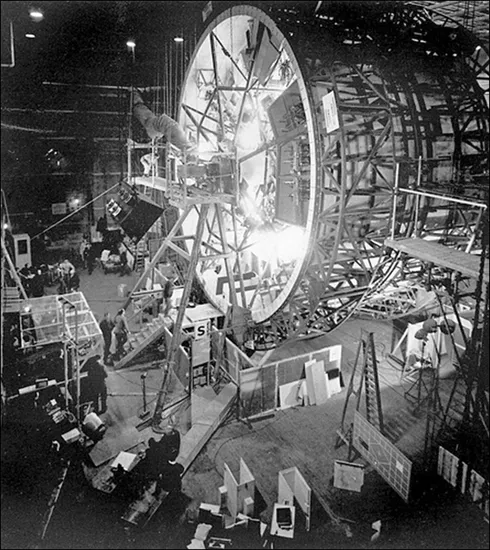
FIGURE 1.1. The centrifuge used in Stanley Kubrick’s film 2001—A Space Odyssey.
(Licensed by Warner Bros. Entertainment, Inc. All Rights Reserved.)
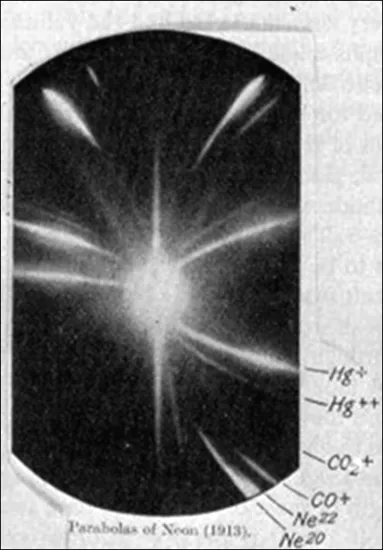
FIGURE 1.2. Mass spectrograph photo showing at the bottom right the two lines from the isotopes of neon.
(Wikimedia Commons)
During the First World War Aston had gotten to know another physicist, Frederick Lindemann. Both men were working on the physics of airplane design. Lindemann developed a theory of aircraft spin recovery and learned to fly so he could test it, which he did successfully. At the time Lindemann did not believe in isotopes. Ironically, he and Aston published a joint paper in 1919 in which, for the first time, the idea of using a centrifuge to separate the isotopes of gasses was suggested.1 This paper was the inspiration for all the later work.
Before I turn to the contents of their paper, I want to say a bit more about Lindemann. He was born in 1886 in Germany of an American mother and a father who had already emigrated to England. Lindemann was a very good tennis player and was actually playing in a tournament in Germany when the First World War broke out. He later competed at Wimbledon. He was also a teetotaler and a vegetarian. He took an appointment at Oxford at about the same time that Aston took one at Cambridge. In the Second World War he became Churchill’s principal science advisor. In 1941 he became Baron Cherwell, which inspired one of the great British academic doggerel verses:
Lord Cherwell, when the war began,Was plain professor Lindemann.But now, midst ministerial cheers,He takes his place among the peers.The House of Christ with one accordNow greets its newly risen Lord.
It helps to know that Christ Church was the name of the Oxford college to which Lindemann belonged and Cherwell is the name of a nearby stream.
Aston and Lindemann begin their paper by discussing a problem that on its face has nothing to do with centrifuges. They ask if the gravitational attraction of the Earth can separate the isotopes of the gasses in its atmosphere. The answer is yes, and here is how it works. Let us for the sake of argument suppose that the atmosphere consists of a single gas. I will take this to be neon, since what Aston and Lindemann studied was whether gravity would separate the isotopes of neon in the stratosphere. Let me begin by supposing that neon has no isotopes. We will add the isotopes later.
Let us imagine a very small boxlike volume way up in the stratosphere and ask what forces act on the neon gas located within it. The first thing that comes to mind is gravity, which attracts all the neon molecules down toward the surface of Earth. Why don’t they all simply fall down and collect on Earth’s surface? This is because there is a second force that pushes them up. This is the collective force exerted by all the molecules pressing on the bottom of the box and exerting a pressure. (One could ask the same question about clouds. What keeps them up?) When the two forces are equal, we have a state of equilibrium. Now suppose neon has an isotope that is heavier than the one we have been considering. We can make the same argument, but since the individual molecules are heavier, it requires fewer of them to achieve equilibrium. The pressure pushing them up is the same for the two isotopes, but the force of gravity is greater for the heavier one, hence it takes fewer of them to balance the pressure. Therefore, the heavier isotopic gas is less dense. If the two isotopes are in the box together, then, all things being equal, there will be a very small difference in the densities of the two components, and that is what we will try to measure.
If we compute the ratio of the two densities under reasonable assumptions, it has an exponential behavior. What counts is the exponent that determines how the exponential grows. Let us call the two densities m1 and m2—the densities are simply these masses per unit volume. Then the exponential that determines the mass ratio is proportional to the mass difference Δm multiplied by the height h above the earth times the gravitational acceleration g that any molecule experiences as a consequence of the Earth’s gravity. Thus, the argument of the exponential that determines the ratio is proportional to the product Δmgh. Whether the density ratio is greater or less than 1 depends on the sign of Δm. Let me point out that once equilibrium has been established, the density ratio is fixed and will remain unchanged so long as the equilibrium is maintained. We do not increase the degree of separation as time passes. We shall keep this in mind when we turn to centrifuges. Aston and Lindemann proposed to take a balloon that could collect samples of the ambient atmosphere and let it rise to about 100,000 feet. They thought that there would be a small but measurable effect on the isotopic densities. As far as I know, this experiment was never performed and hasn’t been even to this day.
Those of you who remember Stanley Kubrick’s film 2001 will recall one of the astronauts jogging around a centrifuge that was located on a spaceship in outer space. As I can testify, having visited the set several times, this was a real centrifuge built at the cost of about $300,000 by the Vickers Engineering Group. It had a 38-foot diameter and a maximum peripheral speed—the speed a stationary object located on the periphery of the centrifuge would have as observed by an observer located at rest in the center of the centrifuge—of about three miles an hour. Kubrick told me that he was thinking of selling rides to help recover the cost. He asked me not to put that in the profile I was writing of him. It is amusing to note that to reproduce the gravitational acceleration of 32 feet per second per second at the periphery of this centrifuge, a peripheral speed of about seventeen miles an hour would be required. As it was, it produced about one foot per second per second.
Aston and Lindemann did not live long enough to see Kubrick’s film, but in 1919 they grasped the analogy between the centrifugal force in the centrifuge and the action of gravitation when it came to separating isotopes. The acceleration g is replaced by the acceleration that is directed toward the perimeter of the centrifuge. If v is the speed of an object located at a distance r from the center, then this acceleration is v2/r. Kubrick’s centrifuge produced an acceleration of his astronauts of about a half a foot per second per second, whereas the gravitational acceleration at the surface of the Earth in the same units is about 32 feet per second per second. A good modern centrifuge can produce accelerations at the periphery a thousand times greater than this. It is customary to rewrite the peripheral velocity in terms of frequencies of rotation. Suppose an object located at a distance r from the center makes a complete rotation f times a second. Because the distance it goes around each time is just the circumference of a circle of radius r—that is, 2πr—then v is given by 2πfr. It is customary to define the angular frequency ω as ω = 2πf. Thus, in terms of ω, the centrifugal acceleration is given by ω2r. Now let us consider a gas centrifuge.
In the relevant examples, these consist of long thin cylinders into which the gas is inserted. These cylinders can be made of various metals or, in the recent versions, carbon fiber. We shall discuss the details in another chapter. The cylinders are mounted vertically on some sort of bearing. They are rotated at high speeds around the central axis. After they are set rotating, the gas is inserted. The first thing that comes to mind is the thought that the cylinders would spin while leaving the gas in place. This would be true if the materials of the cylinders were perfectly smooth. But they have tiny rugosities off which the gas molecules can bounce and in which they can stick before bouncing. The molecules then partake of the rotation, and when they return to the body of the gas, they convey the sense of rotation to other molecules with which they collide. Soon the entire body of gas is rotating. Once this happens the centrifugal force impels the gas molecules toward the periphery of the cylinder. But this force is opposed by a counterforce due to the pressure of some of the gas molecules. When these forces are equal, we have an equilibrium situation that is analogous to the one we have already discussed where gravity played the role of the centrifugal force. It is important to note that, like the atmospheric case, once equilibrium has been established between the centrifugal and pressure forces the degree of separation of the isotopes remains the same. It does not matter how long we allow the gas to spin—the degree of separation does not change. This has profound consequences for the practical separation of isotopes.
There is a difference between the centrifugal force case and gravitation. In the centrifugal force case the acceleration depends on where we are in the cylinder. The farther away from the center, the stronger the acceleration. If we want to know what is the best separation the centrifuge can produce, we will take this distance as big as we can, which is the radius of the cylinder. The speed of a spot at this radius is called the “peripheral speed,” vp. Once again we can do the same mathematics that led to the answer in the gravitational case. We find as before that the ratio of the densities of two isotopes separated by the centrifugal force is given by an exponential whose exponent in this case is proportional to Δm ω2r2 = Δmvp2. In a good centrifuge, vp is of the order of 355 meters per second or greater. This is somewhat larger than the speed of sound in air. (Kubrick’s centrifuge did about 1.5 meters per second.) If we put in all the numbers, then in a typical case the exponential is something like .06, which is pretty small, indicating that a single centrifuge has limited separation capacity.2 This is the kind of number we have to deal with if we try to use the centrifuge to separate the isotopes of uranium—a case that will be our principal concern. In considering the use of centrifuges, Lindemann and Aston concluded, “Separation by this method therefore seems possible though difficult and costly.”3 So it turned out to be. In fact it was not done until 1934, when Jesse Beams of the University of Virginia managed to separate two isotopes of chlorine gas—chlorine 35 and chlorine 37—using a centrifuge. None of this work was done with any military applications in mind. And then came the discovery of fission.
In December 1938 the German radiochemists Otto Hahn and Fritz Strassmann discovered nuclear fission. This statement must be qualified. They in fact observed something of which they had no understanding that turned out to be the result of nuclear fission. To understand this we must back up a little. In 1932 the British physicist James Chadwick discovered the neutron. It was accepted at the time that the atomic nucleus consisted of charged particles (protons) and electrically neutral particles (neutrons). The assumption was that the neutron was an electron and a proton bound together. Indeed, that is what Chadwick thought and he said so in his paper. But it soon became apparent that the neutron was a particle in its own right. It also became apparent that the neutron, because of its lack of electric charge, was the perfect candidate to penetrate atomic nuclei. Several groups began bombarding a variety of materials with neutrons. One of the most successful was a group led by Enrico Fermi in Rome. These people bombarded every element they could lay their hands on, finally coming to uranium, which was the heaviest element then known. Fermi’s expectation was that the neutrons would transform uranium into even heavier elements—“transuranics.” In fact that is what he thought had happened, and he even published the result. It turned out that he was wrong, and if some extra shielding had not been added to his equipment he would have discovered fission.
There was a German group that was working in Berlin. One of its members was the aforementioned Otto Hahn. He had had a longtime, on-and-off collaboration with an Austrian-born physicist, Lise Meitner. After the neutron was discovered they joined forces again. They were soon joined by Strassmann. He was an outspoken and very courageous anti-Nazi, which meant that he was virtually unemployable in Germany. But Hahn and Meitner found some money to pay him as an assistant. The three of them went in search of the transuranics. Meitner had been born Jewish but had converted so as to blend in better with the German cultural scene. She thought that her Austrian citizenship would protect her, in any event. It did until 1938 when the Germans annexed Austria and Meitner found herself to be a German ci...
Table of contents
- Cover
- Title Page
- Copyright
- Contents
- Prologue
- Part I: Uranium
- Part II: Plutonium
- Part III: Dual Use
- Epilogue
- Postscript
- Notes
- Acknowledgments
- Index
Trusted by 375,005 students
Access to over 1.5 million titles for a fair monthly price.
Study more efficiently using our study tools.
Frequently asked questions
Yes, you can cancel anytime from the Subscription tab in your account settings on the Perlego website. Your subscription will stay active until the end of your current billing period. Learn how to cancel your subscription
No, books cannot be downloaded as external files, such as PDFs, for use outside of Perlego. However, you can download books within the Perlego app for offline reading on mobile or tablet. Learn how to download books offline
Perlego offers two plans: Essential and Complete
- Essential is ideal for learners and professionals who enjoy exploring a wide range of subjects. Access the Essential Library with 800,000+ trusted titles and best-sellers across business, personal growth, and the humanities. Includes unlimited reading time and Standard Read Aloud voice.
- Complete: Perfect for advanced learners and researchers needing full, unrestricted access. Unlock 1.5M+ books across hundreds of subjects, including academic and specialized titles. The Complete Plan also includes advanced features like Premium Read Aloud and Research Assistant.
We are an online textbook subscription service, where you can get access to an entire online library for less than the price of a single book per month. With over 1.5 million books across 990+ topics, we’ve got you covered! Learn about our mission
Look out for the read-aloud symbol on your next book to see if you can listen to it. The read-aloud tool reads text aloud for you, highlighting the text as it is being read. You can pause it, speed it up and slow it down. Learn more about Read Aloud
Yes! You can use the Perlego app on both iOS and Android devices to read anytime, anywhere — even offline. Perfect for commutes or when you’re on the go.
Please note we cannot support devices running on iOS 13 and Android 7 or earlier. Learn more about using the app
Please note we cannot support devices running on iOS 13 and Android 7 or earlier. Learn more about using the app
Yes, you can access Nuclear Iran by Jeremy Bernstein,Jeremy Bernstein in PDF and/or ePUB format, as well as other popular books in Physical Sciences & Middle Eastern History. We have over 1.5 million books available in our catalogue for you to explore.